
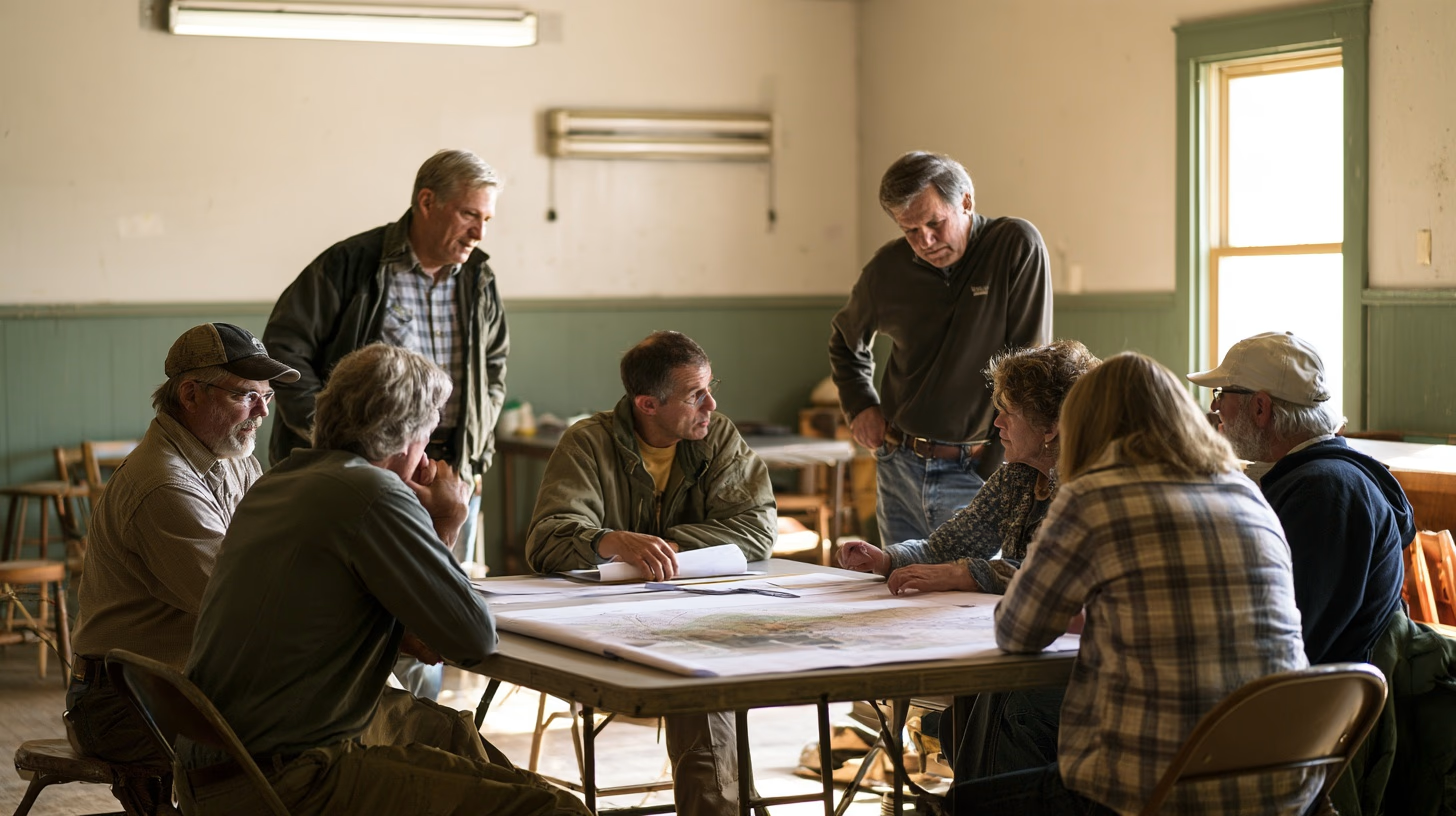
A Plan Is Something You Do
Every planner knows the scene. The comprehensive plan is finished after eighteen months of meetings, surveys, open houses, and drafts. The council adopts it with a round of applause and a photo for the local paper. The consultant goes home. And then the plan goes on a shelf, where it waits, mostly undisturbed, until someone notices that it is fifteen years old and should probably be updated.
Nobody intends for that to happen. Small towns and rural counties don’t adopt plans because they want a binder. They adopt plans because they want something to change: a downtown that holds on, housing young families can afford, roads the county can keep up, a farm economy that has a future. The plan is supposed to be the bridge between that hope and the decisions that make it real. Too often, the bridge stops halfway across.
There is an old word for what is missing: praxis. The Greeks used it for action, for the practical doing of things, as distinct from theory. Later thinkers gave it a sharper meaning: reflection and action held together, each correcting the other, over and over. Not plan first and implementation someday, but thinking and doing as a single, continuing practice. A year ago, in our first November series, From Ideas to Action, we described rural praxis as listening to residents as place experts, experimenting and adapting, treating trust as infrastructure, and collaborating across town lines. This year’s work has tested those ideas against the nuts and bolts of the comprehensive plan.
That is the argument this site has been building all year. Month by month, whether we were talking about parks, utilities, soils, hazards, land use, or roads, the same lesson kept coming back in different clothes. In Part I of this November’s series on implementation and your comprehensive plan, we asked you to use the holiday season as fieldwork, watching how your downtown, your events, and your permit counter actually perform. Today, in Part II, we turn to the questions that fieldwork raises. It is not whether small communities should plan. It is why so many plans change so little, and what it takes to make the next one different.
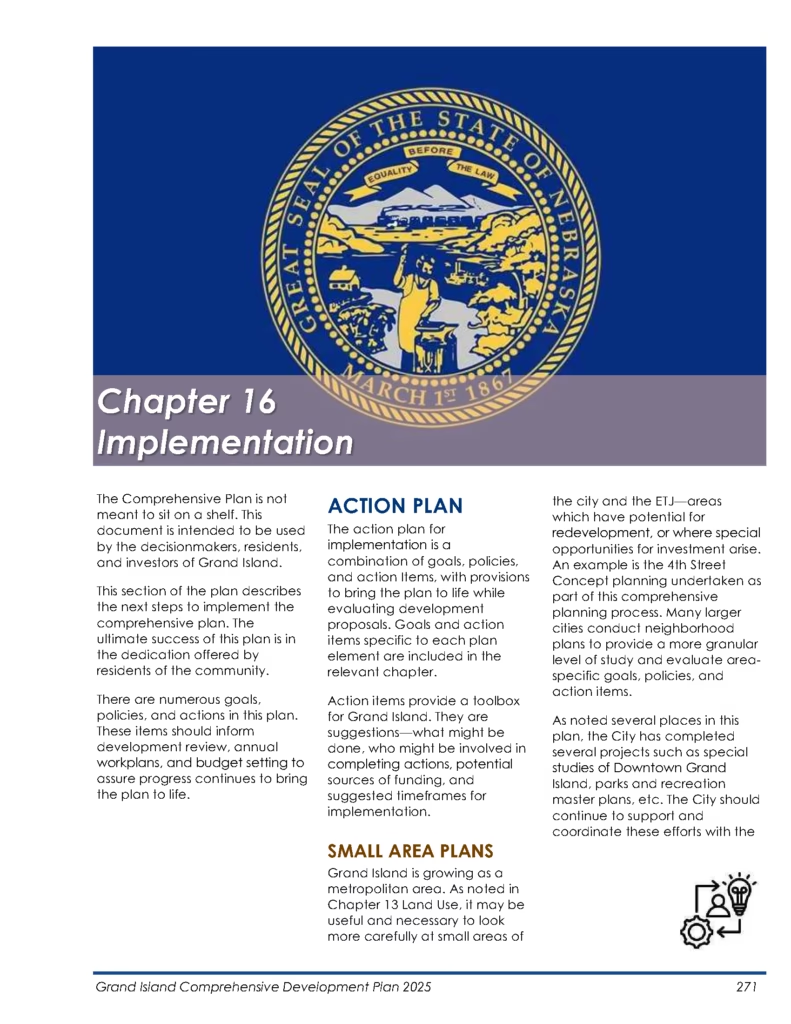
The answer comes down to four questions any community can ask of its own plan, and four commitments that answer them. Can the plan be used when a decision gets hard? Do the community’s operating systems carry the plan out, or quietly work against it? Is the plan sized to the people and money actually available? And who is responsible, every year, for asking whether any of it is getting done? Each question is simple. Answering them honestly is the work of implementation.
The examples that follow come from the field. Over the past several years I have helped prepare comprehensive plans for towns, cities, and counties in Colorado, New Mexico, and Nebraska, from Pagosa Springs, Bernalillo, Aztec, and Raton, to Kimball, Burwell, and Grand Island. Those plans got some things right, and like every plan, they left some questions for the people who would carry them out. Read together, they show what the four questions look like when they meet a real town hall, a real county board, and a real budget.
A plan is not something a community has. It is something a community does.

Four Questions
1. Design for Use, Not Just Adoption
The question: Can a commissioner use this plan on a Tuesday night?
Most comprehensive plans are written for the night they are adopted. They are built to win approval: comprehensive enough that nobody feels left out, polished enough to look professional, general enough to avoid a fight. Those are understandable goals. They are also the wrong test. The real audience for a plan is not the council on adoption night. It is the planning commission on a Tuesday evening two years later, with a rezoning request on the table and a room full of neighbors.
Ask a simple question of any plan: can a commissioner pick it up in that moment and find something that helps them decide? If the answer is a forty-page vision chapter, a dozen goals that all sound the same, and a land use map nobody has looked at since it was printed, the plan was designed for adoption. If the answer is a clear policy, a map that matches it, and a short explanation of why it matters, the plan was designed for use.
The difference shows up in the language. A typical plan says something like, “Encourage compatible development that preserves community character.” Nobody disagrees with that sentence, and nobody can apply it. A usable policy says something closer to, “Direct new residential subdivisions to areas within the city’s sewer service area shown on the future land use map; outside that area, support rezoning only where the applicant demonstrates soils suitable for on-site systems and access to a maintained road.” A commissioner can hold an application up against that policy and reach a conclusion that the applicant, the neighbors, and a reviewing court can all follow. We’ll devote Part III next week to writing goals and objectives, but the principle starts here: a policy is useful in proportion to how clearly it tells someone what to weigh.
Designing for use also means building the plan around the decisions the community will actually make. In most small towns and rural counties, that list is short and predictable: rezonings, subdivision plats, conditional use permits, annexation requests, utility extension requests, and variances. A plan built for use anticipates those decisions. One practical tool is a one-page decision index at the front or back of the plan, listing each common decision type and pointing to the specific policies and maps that apply. It costs almost nothing to prepare, and it changes how a volunteer commission experiences the document. Instead of searching two hundred pages for something relevant, they start with the three pages that matter.
Some plans go a step further and write the decision criteria directly into the plan. Annexation is a good example, because it is one of the most consequential and least frequent decisions a small city makes, and the people making it may never have done one before. Our plan for the City of Raton, New Mexico, plan calls for an annexation evaluation process with four criteria: existing infrastructure capacity; the feasibility, cost, and timeliness of extending infrastructure, transportation, and public safety services; the economic benefit and revenue to the city; and the support of the property owners. Our plan for Aztec, New Mexico, takes a similar approach; the Bernalillo, New Mexico, plan adds a cost-benefit analysis, and our plan for Ruidoso Downs, New Mexico asks the city to weigh the “capacity, cost, and benefit” of serving the areas shown for future annexation on its land use map. None of these criteria is complicated. What matters is that they exist before the request arrives, so the commission is applying a standard instead of inventing one under pressure.
The Nebraska plans I’ve worked on build a similar expectation into the review of every development proposal. Each application, the plans say, “should address how the specific proposal meets the policies of the comprehensive plan.” Where a proposal runs counter to the plan, the developer is encouraged to bring it into conformance. Then comes the sentence that matters most: approval of a proposal that does not conform “would point to the need to review and update the plan.” That is a small piece of language with a large effect. It treats a nonconforming approval not as a quiet exception, but as information. If the council keeps approving things the plan says it shouldn’t, either the decisions are wrong or the plan is, and someone should find out which.
The map deserves its own attention. In September, we offered a future land use reality check for planners and local officials, and the most common failure it reveals is simple: the future land use map and the zoning map disagree, and nobody has reconciled them. That is not only a design problem. Most states expect zoning to follow the plan. In Nebraska, for example, state law provides that municipal zoning regulations shall be in accordance with a comprehensive development plan, and the courts have long held that zoning must be made in accordance with the plan. When the two maps point in different directions, every contested rezoning becomes harder to defend, and the plan’s credibility erodes one hearing at a time.
The map works best when the plan says plainly who is supposed to use it and when. I was fortunate to be on a team developing a land use master plan for a Northern New Mexico pueblo during COVID. The completed document makes this idea explicit in one of its first actions: tribal leadership will use the future land use map when deciding where new development should occur. Before adoption, the tribal council reviewed the plan chapter by chapter, including how each part would fit with the ongoing work of each tribal division. That is design for use in its plainest form. The map was not prepared as an exhibit. It was prepared as a working tool for the people who make the decisions, and they said so in writing.
We saw the same pattern most clearly in July, in our series on natural resources. Soils, water, wetlands, floodplains: in most rural counties, the information already exists. The USDA soil survey is online. The flood maps are there. The well data and the wetland inventory are there. The data already exist; the question is whether local governments are using them when they make decisions. A plan that summarizes that information in a background chapter and never connects it to a development decision has done half its job. The missing half is usually a single sentence in the right place: a policy stating that floodplain, soils, and well data will be reviewed for every subdivision and rezoning in a defined area, and that the staff report will say what that review found. In our July discussion of water resources, we suggested formalizing a regular review process with natural resources district staff, water providers, road departments, and emergency management. A plan designed for use writes that review into the decision process rather than leaving it to good intentions.
Designing for use changes how a plan is written. It means fewer goals and clearer ones. It means policies written in language a volunteer commissioner can apply without calling the consultant. It means maps that answer the questions people actually bring to the counter. And it means building the plan around the decisions the community will make most often, not the ones that look best on a poster.
The test of a plan is not whether it was adopted. It is whether anyone reached for it the next time a decision got hard.
2. Close the Gap Between Policy and Operating Systems
The question: Do the systems that run the community carry the plan out, or quietly work against it?
A comprehensive plan is a policy document. But a community doesn’t run on policy. It runs on operating systems: the zoning code, the subdivision regulations, the building and fire codes, the capital budget, the road maintenance schedule, the permit process, the way the utility decides where to extend a line. These are the systems that turn decisions into results. When they point one way and the plan points another, the operating systems win every time.
In September, we looked at what happens when the zoning code works against the plan. The plan celebrates the historic Main Street pattern of shops downstairs and apartments upstairs. The code, written decades earlier, makes that same pattern a conditional use requiring a hearing. Or the use is technically permitted, but parking requirements, setbacks, and building-code triggers for an old structure make it unbuildable in practice. Permitted is not the same as buildable. The plan said yes; the system said no.
It is worth walking that example all the way to a fix, because the fix is rarely a single amendment. To make upper-floor housing on Main Street real, a town typically needs to change several systems at once. The zoning code should list residential units above ground-floor commercial space as a permitted use in the downtown district, not a conditional one. Off-street parking requirements for downtown buildings should be reduced or eliminated, because the lot lines on a historic block leave no room for them and on-street and public parking already serve the district. Setback and lot coverage rules should match the existing zero-lot-line pattern so that existing buildings are not automatically nonconforming.
Real plans name these changes in specific terms. Bernalillo’s plan calls for amending the zoning ordinance to allow context-sensitive development standards along Camino del Pueblo, its historic main street, defining the minimum requirements for parking, setbacks, building height and massing, and the building’s relationship to the street. Aztec’s plan calls for a review of permitted and conditional uses and minimum parking standards in every district, along with contextual standards for downtown, with a particular focus on Main Avenue. Raton’s plan expands its downtown commercial zone into areas currently zoned for other uses and reviews which uses should be allowed by right in the business district. Each is a code amendment with a date and a responsible party attached, which is exactly what the plan’s housing and downtown policies need in order to mean anything.
The building code side needs attention, too. Where the state or community has adopted the International Existing Building Code, or a similar framework for existing structures, local officials can evaluate an older building’s conversion on its own terms rather than holding it to every requirement for new construction. That is a conversation between the planner, the building official, and the fire marshal, and it is far more productive before an owner has paid an architect than after. Aztec’s plan builds that conversation into an institution: a historic landmark commission responsible for reviewing development in the historic overlay districts and for recommending building code revisions to accommodate historic buildings, with the city working alongside the state’s construction and historic preservation agencies on any changes that require state action.
None of these steps is dramatic. Together, they are the difference between a plan that celebrates downtown housing and a town that actually gets some.
Sometimes the gap is not a mismatched code. It is the absence of any code at all. Nemaha County, on the Missouri River in the southeast corner of Nebraska, offers a clear example in the draft comprehensive plan we posted earlier this year. The county has never adopted zoning. Several of its towns have, and some of them extend their regulations into their one-mile extraterritorial jurisdiction (ETJ). While the plan was being prepared, an energy developer proposed a solar farm of 1,200 to 1,700 acres on leased farmland around the village of Brock, designed to generate about 100 megawatts. The part of the project inside Brock’s one-mile jurisdiction went through public hearings for zoning review. As the draft plan notes, any part outside that line was “not subject to public review, since Nemaha County has not previously implemented the Comprehensive Plan through zoning regulations.” Residents raised concerns about the project’s proximity to homes, property values, environmental risks, and fire safety, and also about the lack of county zoning itself.
The county’s previous plan had already set out land use policy for its rural areas. What it did not have was an operating system to carry that policy into a decision.
The Nemaha example is not about whether solar energy belongs in rural Nebraska. Reasonable people in that county disagree, and the draft plan records that disagreement honestly. It is about what a plan can do when the moment arrives. A policy with no code behind it can describe a preference. It cannot give neighbors a hearing, give a developer a clear set of standards, or give elected officials a defensible basis for a decision. The plan’s first recommended action, as drafted, is to prepare and review potential county zoning regulations, and that is the right place to start.
In October, our transportation series found the same gap in a different place. A transportation plan may be full of new projects, while the real problem is that the county can’t maintain the roads and bridges it already has. The plan talks about growth. The budget is consumed by deferred maintenance. Until the two documents are reconciled, the plan is describing a community that doesn’t exist. Reconciling them can start with a single policy in the transportation chapter: maintain and rehabilitate the existing network before adding new lane miles, and require that any new road or street proposed in the plan identify who will maintain it and how. That policy then has to show up where money is actually allocated, which in Nebraska means the one- and six-year road plans as well as the capital improvements program. As we noted in our October discussion of streets, roads, and the edge of town, deciding what each corridor is for comes before deciding what to build.
The plans I’ve worked on approach that connection from different directions, but they arrive at the same place. Bernalillo, Aztec, and Raton each call for a preventative street maintenance plan that sets priorities for pavement, reconstruction, and routine work such as crack sealing and patching, along with asset management plans for water and wastewater tied to the community’s Infrastructure Capital Improvement Plan, the five-year list New Mexico local governments use to request state capital funding. Raton’s implementation chapter puts it plainly: one of “the more deliberate ways to ensure the strategies are implemented is to link the Comprehensive Plan to the City’s Infrastructure Capital Improvement Plan.”
Our Nebraska plans make the same link through the capital improvements program, which they describe as an annual plan assessing capital needs and setting priorities in the budget, coordinated with the one- and six-year road plan. The Northern New Mexico pueblo plan does something similar through its federal transportation program: road priorities are approved by the tribal council and submitted every year in a five-year Tribal Transportation Improvement Plan, which includes maintenance intended to delay the need for reconstruction. Three different funding systems, one principle. The plan’s priorities have to appear in the document that actually spends the money.
Small operating-system changes can matter as much as large ones. Bernalillo, Aztec, and Raton each call for a “Dig Once” policy requiring public and private excavators to coordinate with the community so that fiber conduit goes in whenever the right-of-way is already open. Earlier, in Archuleta County, Colorado, we made the same commitment in our community plan. It is one sentence in a utilities chapter. It also changes how every future street project, water line replacement, and private excavation in the community should be done, which is precisely the kind of change our June series on communications and utilities argued for.
The most useful tool for closing these gaps is a plain one: a plan-to-code crosswalk. It is a table, usually prepared right after adoption, that lists each major policy in the plan and traces it to the operating system that carries it out. For each policy, the crosswalk asks what system is involved, what has to change, who is responsible, and when the change is expected. A short excerpt might look like this:
| Plan policy | Operating system | Change needed | Lead | Target |
| Support upper-floor housing on Main Street | Zoning code; parking standards; building code review | Permit upper-floor residential by right downtown; remove off-street parking minimum in the downtown district; establish a pre-application meeting with the building official | Planning commission; city council; building official | Code amendment adopted by June 2027 |
| Maintain existing roads before expanding the network | Capital improvements program; one- and six-year road plan | Add a maintenance-first ranking criterion to project selection | Public works; city council | Applied in the FY2028 budget cycle |
| Protect floodplain and wellhead areas from incompatible development | Subdivision regulations; staff report template | Require floodplain, soils, and well data review for plats in mapped areas | Zoning administrator | Template revised by March 2027 |
A crosswalk does two things. It turns the plan into a work list with names and dates attached, and it exposes the policies that nobody has assigned to any system at all. Those orphaned policies are where plans quietly die.
The implementation matrices in the New Mexico plans completed by Consensus Planning are a version of the same idea. Every strategy in the plan is repeated in a single table, organized by chapter, with a time frame and a responsible party. Bernalillo’s matrix goes a step further, naming a lead entity for each strategy and listing supporting entities alongside it, so that a strategy led by Public Works might show Capital Projects and Economic and Community Development in support. That simple convention answers the question every implementation effort eventually asks: when this stalls, whose desk is it on?
A French Connection
It is worth looking at how other countries handle this. In France, a town’s plan local d’urbanisme, or PLU, combines the vision and the rules in one document. The PLU contains the community’s planning and sustainable development strategy, the general vision of what the town wants to become, alongside the zoning map and the regulations that apply to each zone. A building permit is checked directly against that document. The vision and the code are adopted together and revised together, so a gap between them is much harder to create and much easier to see.
That is not a model American communities can simply copy. Our legal traditions are different, and a French PLU revision has its own share of delays and frustrations. But it is a useful mirror. It shows what happens when the plan and the operating system are treated as a single thing rather than two documents written years apart by different people.
The practical step for an American small town is more modest. Every time the comprehensive plan is adopted or amended, ask what has to change in the code, the budget, and the permit process to make it real, and put those changes on the crosswalk with dates attached. Then bring the crosswalk back every year, as we’ll describe in the fourth question, and mark what moved.
A plan amendment without a code amendment is a promise without a delivery date.
3. Match Ambition to Practical Capacity
The question: Is the plan sized to the people, time, and money the community actually has?
The Nebraska plans I’ve worked on open their implementation chapters with the same line: successful community plans have the same key ingredients, “2% inspiration and 98% perspiration.” Next plan I work on I will have to mix that up. That said, each plan itself is intended to hold the inspiration of the officials and residents who took part. The perspiration belongs to everyone who comes after. That line is a good place to start thinking about capacity, because it is honest about where the work really is.
Small communities are often told to dream big, and there is nothing wrong with ambition. But a plan written as if the town had a full planning department, a grant writer, a public works director with time on their hands, and a council with no other priorities is not ambitious. It is fiction. Most rural communities run on a part-time clerk, a contract engineer, a volunteer planning commission, and a public works crew of two or three people who are also plowing snow and fixing water leaks.
Capacity is not only staff. It is volunteer hours, which are finite and tend to fall on the same dozen people. It is borrowing capacity and the willingness to use it. And it is the ability to maintain what you build. In August, in our series on public safety and hazard mitigation, we argued that risk is planned: every decision either reduces or quietly increases the risks a community will carry in the future. The same is true of cost. A new building, a new road, a new park, a new fire truck each comes with decades of operating and maintenance obligations. A plan that adds assets without asking who will maintain them is planning a future budget crisis.
The plans themselves can be a capacity problem. Raton’s comprehensive plan, adopted in 2021, contains roughly 160 implementation strategies, and about two-thirds of them were scheduled for the first three years. Many were assigned to the same few positions, led by the city manager. Every one of those strategies came out of real public engagement and a real community need. Taken together, though, they described a workload no small city staff could complete in three years while also running the city. Bernalillo and Aztec spread their schedules more evenly across short, medium, long-term, and ongoing time frames. All three plans say plainly that the schedule is “not binding” and depends on available funding, staff resources, and the community’s ability to build partnerships. That is an honest disclaimer. It is also a reminder that sequencing has to happen somewhere, and if the plan doesn’t do it, the annual review will have to.
In Archuleta County’s community plan, the Planning Commission may have been more modest, but they also wanted to challenge the elected decisionmakers. Some of our action items, the plan notes, “can be accomplished by local volunteers, elected officials and staff working together; others will require investments in outside expertise or additional staff to have meaningful effect.” That one sentence does more capacity planning than many full chapters, because it tells the reader that not every action is the same kind of work.
Several plans treat capacity itself as an implementation strategy. Bernalillo calls for evaluating its code enforcement staffing. Aztec and Raton call for adequate code enforcement staff. Ruidoso Downs commits to adequate staffing for code enforcement, nuisance property remediation, and GIS mapping services. None of these is glamorous, and none will make the cover of the plan. But a zoning code amendment is only as good as the capacity to administer it, and a plan that says so is more honest than one that assumes the work will simply get done.
Nemaha County’s draft plan takes that idea to its starting point. If the county board decides to adopt zoning, the draft lists the immediate next steps: appoint a zoning administrator as a county staff position, “providing an office and meeting space for the Planning Commission”; appoint a board of adjustment, as state law requires; and route all new zoning applications through the zoning administrator for staff review before referral to the commission, the board of adjustment, or the county board. The draft also calls for education for staff and training for volunteers. For a county that has never administered zoning, implementation does not begin with a code amendment. It begins with a desk, a meeting room, and a person other than the volunteer chair of the Planning Commission to answer the phone.
Before deciding what the plan can take on, it helps to take an honest inventory. A small town or county can do this in an afternoon, and the answers usually fit on one page:
- Staff time. How many hours a week does anyone actually have for planning, code updates, grant writing, and implementation, as opposed to permits, utility billing, and the daily work that keeps the doors open?
- Volunteer bench. Who serves on the planning commission, the board of adjustment, the park board, and the economic development group, and how many of those seats are held by the same people? How many open positions went unfilled last year?
- Financial capacity. What is the community’s remaining debt capacity, what is the tax levy room, and, just as important, what is the council’s appetite for using either?
- Maintenance load. What does it cost each year to maintain the streets, buildings, parks, and utilities the community already owns, and is that number fully funded in the current budget?
- Partners. Which outside organizations already do work the community needs, and has anyone asked them to do more of it?
That inventory is not meant to discourage anyone. It is meant to make the plan honest, so that the work it calls for is work someone can actually do. Matching ambition to capacity does not mean lowering expectations. It means sequencing them. A simple way to organize a plan’s actions is in three groups. The first is work that is within reach now, using existing staff, existing budgets, and existing authority: a code amendment, a policy change, a small pilot project. The second is work that needs a partner, whether a county, a school district, a regional development district, or a private organization. The third is work that needs new money, through a bond issue, a grant, or a dedicated revenue source. Do the things within reach first, do them well, and use the credibility and experience they build to take on the next thing. A town that adopts one well-crafted code amendment in its first year has earned the standing to ask voters for a bond in its third.
Matching Ambition to Capacity
Matching ambition to capacity also means looking honestly for capacity beyond city hall. Here, too, the European Union and France in particular offers a useful example. Many French villages have a few hundred residents and no planning staff of their own. Over the past decade, more and more of them have stopped writing their own local plans and instead prepared a shared plan with their neighbors at the level of the communauté de communes, a federation of rural municipalities. This intercommunal plan, the PLUi, pools the technical work, the data, and the cost, while each village keeps its own character and its own voice in the process. Under the 2014 ALUR law, responsibility for local planning transfers automatically to the intercommunal level unless at least a quarter of member communes, representing at least 20 percent of the population, vote to block it. The default, in other words, is cooperation, and staying separate requires a deliberate choice.
The American translation is not a new layer of government. It is the county and its towns planning together instead of in parallel. And in rural Nebraska, it already exists. In Clay County, a single joint planning commission includes representatives of the unincorporated county, the cities of Fairfield and Harvard, and the villages of Deweese, Glenvil, Saronville, and Trumbull. The county’s zoning administrator, who also serves as floodplain administrator, issues zoning permits for the participating towns and provides staff support to the planning commissions in Clay Center and Edgar. County zoning is mapped to meet the towns’ extraterritorial jurisdictions with no gaps between them. In neighboring Thayer County, the county zoning administrator handles zoning review for every village in the county as well as the unincorporated area. In 2022, that office processed 54 zoning permits, roughly 40 percent in the unincorporated county and 60 percent in the villages, with Bruning the busiest at eleven. No village in either county could justify a full-time zoning administrator on its own. Together, they have one.
The Hall County Regional Planning Commission shows how long that kind of arrangement can last. It was established by an interlocal cooperation agreement in 1967 to maintain a cooperative and comprehensive approach to land use planning among its member communities. Its twelve volunteer members are appointed by the City of Grand Island, Hall County, the City of Wood River, and the villages of Alda, Cairo, and Doniphan, and its staff function as a unified regional planning department for all of them. The plans for those communities say the arrangement has avoided duplication of staff and services and proven efficient and cost-effective. A village of a few hundred people gets professional planning support, a seat at the table, and its own comprehensive plan, without hiring a planner of its own.
Other partnerships work at a different scale. Many rural places already have a regional partner and underuse it. In southeast Nebraska, for example, the Southeast Nebraska Development District is a voluntary association of counties and municipalities formed under the Nebraska Interlocal Cooperation Act, offering member communities grant writing and administration, housing rehabilitation program management, special studies, business financing, and GIS and mapping services. In south-central Nebraska, the South Central Economic Development District offers its members housing programs, project planning, housing studies, nuisance abatement assistance, and grant writing. Aztec’s plan names the Northwest New Mexico Council of Governments as the lead for securing gap funding for a major economic development project and as a partner in a revolving loan fund. Ruidoso Downs relies on a regional joint use board, shared with the Village of Ruidoso, to operate the wastewater treatment plant serving both communities, and turned to the Rural Community Assistance Partnership for technical help on septic systems. Aztec’s plan even considers a joint extraterritorial zoning commission with San Juan County for the area just outside the city.
Similar organizations, whether called development districts, councils of governments, or regional planning commissions, operate in most states. For a town with a part-time clerk, the most consequential capacity decision in the plan may be a single action item: meet with the regional development district and agree on what it will help carry out this year.
The most ambitious thing a small town can do is often to stop pretending it has to do everything alone.
4. Make Implementation a Recurring Public Responsibility
The question: Who is responsible, every year, for asking whether the plan is getting done?
The most common way a plan dies is not rejection. It is neglect. The council that adopted it turns over. The planner who wrote it moves on (that would be me). The commission that championed it gets busy with permits. Within a few years, nobody in the room remembers what the plan said, and nobody is responsible for asking.
Implementation cannot be a project with an end date. It has to be a recurring public responsibility, built into the calendar the way the budget and the annual audit are. Nobody asks whether the town will adopt a budget this year. It simply happens, every year, in public, with a deadline. The plan deserves the same treatment.
Some plans make that responsibility a goal in its own right. Burwell’s plan, like several other Nebraska plans I’ve worked on, lists among its implementation goals a single plain sentence: “The Planning Commission reviews this plan regularly.” It is not a statement about land use or housing or roads. It is a statement about the plan itself, and it gives the planning commission a standing assignment that does not depend on anyone remembering to ask.
In practice, that can be remarkably simple:
- An annual implementation report. Once a year, staff or the planning commission reports to the council on what the plan called for, what got done, what didn’t, and why. Two or three pages is enough.
- A joint meeting. Once a year, the council and the planning commission sit down together to review the plan and agree on priorities for the coming year, before the budget is drafted rather than after.
- A connection to the budget. The capital improvements program and the operating budget should point back to the plan. If a project isn’t in the plan, someone should be able to explain why it’s being funded anyway.
- A public report card. Residents who gave their time to the planning process deserve to know what happened to their ideas. A short summary in the newsletter, on the website, or at the county fair booth builds trust for the next round.
These four practices work best as a cycle rather than a checklist, timed to the community’s budget calendar. For a town whose fiscal year begins in the fall, the year might look like this.
- In November and December, the community does the kind of fieldwork we described last week in Part I, observing how downtown, public spaces, events, and the permit process actually perform during the busiest weeks of the year.
- In January, staff pulls those observations together with the crosswalk and drafts the annual implementation report.
- In February or March, the report goes to the council, and the council and planning commission hold their joint meeting to set the year’s priorities.
- Through spring and early summer, those priorities shape the capital improvements program, the road plan, and the draft operating budget. When the budget is adopted, each funded project points back to a plan policy.
- Over the summer, the public report card goes out through the newsletter, the website, and the fair booth, so residents see the results before the next round of fieldwork begins.
The cycle is small enough for a part-time staff and steady enough to survive a change in leadership.
That January timing is not hypothetical. The Nebraska plans I’ve worked on, from Kimball and Burwell to Grand Island, Jefferson County or the Nemaha County draft, call for the annual review to be “performed each January to begin the calendar year,” resulting in a report from the planning commission and staff to the governing body “and the citizens.” The purpose, as those plans describe it, is to maintain public and private confidence, evaluate the effectiveness of planning activities, and make mid-plan corrections in the use of community resources. The Northern New Mexico pueblo’s plan assigns the same work to tribal staff, who lead the annual review and advise the tribal council on when the plan needs a full update. It also commits the pueblo to linking its capital improvement plan to the plan’s strategies and to basing future grant applications and funding requests on the plan’s priorities. Every one of those provisions is easy to write. The value comes from doing them every year.
The annual report itself does not need to be elaborate. A useful format has four short parts. The first lists actions completed during the year, with a sentence on what each accomplished. The second lists actions underway, with an honest estimate of when they will be finished. The third lists actions that stalled, and says why: no funding, no staff time, a change in conditions, or a decision that the action no longer makes sense. That third section is the most valuable part of the report, because it is where the community learns. The fourth lists recommended priorities for the coming year, which become the agenda for the joint meeting. A commission that produces that report every year will know its plan better than most consultants who wrote one.
A community that wants to go further can add a short page of measures. Grand Island’s plan offers a useful structure, dividing its sustainability measures into two groups. Content indicators are point-in-time measures of what the community has: acres of parks and open space, miles of trails, the number of “missing middle” housing units, landfill capacity. Performance indicators are yearly measures of how the community is doing: new housing units permitted, median rent as a share of household income, unemployment, the cost of producing and delivering water, the number of permits for construction in the regulated floodplain. The plan describes these as “iterative diagnostic tools” to be evaluated and adjusted as the plan is implemented. A small town doesn’t need a dashboard. It might need five numbers, tracked the same way every year, that tell the council whether the plan’s biggest promises are moving.
The report card depends on something deeper than a newsletter column. Grand Island’s implementation chapter makes the point directly: if adequate public support is to be developed, “a permanent program educating residents is necessary.” Residents who understand what the plan is trying to do, and why, are the ones who show up at the hearing, serve on the commission, and support the bond issue. The annual report and the public report card are the simplest form of that program, and they cost almost nothing.
The annual cycle also changes what happens at the five-year mark. Most comprehensive plans are meant to be reviewed periodically, and many communities treat that review as a choice between doing nothing and starting over. The Nebraska plans call for a full update at least every ten years, with plan amendments allowed between updates when “major new, innovative development and/or redevelopment opportunities arise” that affect several elements of the plan. A community that has kept up its annual reports has a third option at the midpoint: a targeted amendment that updates the chapters and maps that have fallen out of date, retires actions that have been completed or abandoned, and carries forward the policies that are still working. That is faster, cheaper, and far less disruptive than a full rewrite, and it preserves the institutional memory that a full rewrite tends to lose.
Archuleta County, Colorado, shows what that looks like over two decades. Its 2001 community plan was formally amended in 2006 and 2011 and kept evolving into the plan the county uses today. The plan describes itself as a community “to-do checklist,” with 41 policies and 116 action items to check off, and recommends annual review with updates every three to five years. In 2007, the county’s planning commission adopted a process for minor plan amendments that can be requested by staff or an applicant during development review. An amendment may be approved only if it meets six criteria, including compatibility with the surrounding area, no undue burden on infrastructure, and consistency with the plan’s existing policies and desired future conditions. Amendments tied to a subdivision are heard at the sketch plan stage, and where a rezoning conflicts with the plan, the amendment must be heard before the rezoning can be approved. The plan’s own code-revision agenda follows the same logic, recommending changes to the land use regulations “in line with recent Board of Adjustment / Board of County Commissioners approvals.” This year they started doing a comprehensive update to the community plan, as a lot has changed on Colorado’s West Slope over the last few years.
The decisions inform the plan, and the plan informs the next round of decisions. That is praxis in a county planning office.
In May, we made the case that parks are infrastructure and belong in the comprehensive plan alongside roads and water lines. In June, our series on communications, utilities, and energy showed how many of the systems a community depends on are owned or run by someone other than city hall. Both lessons point to the same conclusion: if implementation depends on one champion, it will fail when that person leaves. If it is part of how the community does business every year, it outlasts any single council, planner, or consultant.
What gets reviewed every year gets done. What gets reviewed once a decade gets rewritten.
From the Field: Two Kinds of Implementation Chapter
The plans I’ve worked on in New Mexico and Nebraska take two different approaches to the implementation chapter, and setting them side by side shows what each does well and what each leaves to the community.
The New Mexico plans for Bernalillo, Aztec, and Raton use an implementation matrix. Every strategy from every chapter of the plan is repeated in a single set of tables, organized by plan element, with a projected time frame and the party responsible. The time frames are grouped as short, medium, long-term, or ongoing, and the responsible parties range from the city manager and public works director to the regional council of governments, the school district, and the state department of transportation. These chapters are strong on who and when. They are, in effect, a crosswalk prepared before adoption. Their weakness is volume. A matrix with well over a hundred strategies can be hard to manage without a routine for reviewing it.
The Nebraska plans for Kimball, Burwell, Grand Island, and the counties around them use a maintenance chapter. The goals and action items stay in each element chapter, and the implementation chapter itself is short. Its strength is process: every development application must address how it meets the plan, a nonconforming approval signals that the plan needs another look, the capital improvements program is coordinated with the one- and six-year road plan, the planning commission and staff report to the governing body and the public each January, amendments can be made for unanticipated opportunities, and the plan is updated at least every ten years. These chapters are strong on how and how often. Their weakness is that the work list is scattered across a dozen chapters, and nobody may own it unless someone builds a crosswalk.
| Feature | New Mexico implementation matrix | Nebraska maintenance chapter |
| What it lists | Every strategy, by plan element | Key regulatory and capital actions; other actions stay in element chapters |
| Who and when | Time frame and responsible party for each strategy | General; assigned through annual workplans and budgets |
| Link to the budget | Infrastructure Capital Improvement Plan | Capital improvements program and one- and six-year road plan |
| Review routine | Not specified; “not binding” | January annual review reported to the governing body and citizens |
| Development review | Through element policies | Each application addresses how it meets the plan |
| Best at | Naming the work | Keeping someone looking at it |
The lesson for any community is that a plan needs both. A matrix without a review routine becomes a list nobody reads. A review routine without a matrix becomes a meeting without an agenda. The good news is that each is easy to add to the other. A community with a New Mexico-style matrix can adopt a January review and a development-review requirement by resolution. A community with a Nebraska-style chapter can build the crosswalk in its first annual review and carry it forward from there.
Who Carries the Work: Vision, Institutions, Individuals
The four questions are about the plan as a tool: how it is written, how it connects to the systems that carry it out, how it is sized, and how it is reviewed. But a tool does nothing on its own. Someone has to pick it up. In a small town, the work of implementation is carried at three levels at once: by the community as a whole through its shared vision, by the institutions that hold the authority and the money, and by individuals who act on their own initiative. These are not three more commitments to add to the list. They are the people and organizations who answer the four questions, and a community that works at only one level will stall no matter how good its plan is.
Community vision is where the plan starts: a shared picture of what kind of place people want to live in. As we discussed in January, in From Vision to Impact, the vision is what gives the plan legitimacy. Without it, every implementation step looks like somebody’s pet project. With it, a hard decision about a rezoning or a bond issue can be explained in terms people already agreed to. The vision also has to be maintained. A vision built by listening to residents during the plan’s preparation stays alive only if residents keep hearing back about what happened to their ideas, which is exactly what the annual report and the public report card are for.
Institutional alignment is where most plans quietly fail. A small town rarely controls everything that shapes its future. The county runs the roads outside city limits. The school district decides where to build. The rural electric cooperative and the broadband provider decide where to invest. The state department of transportation owns Main Street, which is also a highway. A comprehensive plan is, by definition, comprehensive, but the city can only command part of it. The rest has to be negotiated, coordinated, and persuaded. Implementation means getting those institutions to read from the same page, or at least knowing in advance where they don’t.
The New Mexico plans are full of examples.
- In Aztec, Main Avenue is a state highway. The plan’s answer is a sequence: complete the East Aztec Arterial, then work with the New Mexico Department of Transportation to transfer ownership of Main Avenue to the city, and then adopt regulations that move hazardous-materials trucks off Main Avenue and onto the new arterial. That is three strategies, two agencies, and several years of coordination, all aimed at giving the community control of its own main street.
- Bernalillo depends on special districts it does not control, including the Middle Rio Grande Conservancy District and the arroyo flood control authorities in Sandoval County, for irrigation, drainage, and flood protection.
- Ruidoso Downs works with Lincoln County, the Mescalero Apache Tribe, and the Village of Ruidoso on stormwater in the shared Rio Ruidoso watershed.
- All three of the plans for Bernalillo, Aztec, and Raton call for joint-use agreements with the school district for parks and school facilities, and Raton’s goes further, pursuing a memorandum of understanding with Raton Public Schools for the donation of the former Kearny Elementary School for housing or mixed-use redevelopment.
- In Nebraska, our county plans ask the zoning administrator to keep watching annexations and to make sure the planning commission is involved whenever municipal boundaries, extraterritorial jurisdictions, or zoning maps change.
That alignment can be organized rather than left to chance. A practical starting point is an implementation partners list, prepared with the plan, that names each outside institution whose decisions affect the plan, identifies the policies and actions that depend on that institution, and names a contact. The list might include the county board and road department, the school district, the natural resources district, the electric cooperative or public power district, the broadband provider, the state department of transportation district office, the regional development district, and the economic development corporation. From there, the community can hold an annual partners meeting, scheduled shortly before the joint council and commission meeting, where each partner hears the year’s priorities and shares its own plans for the coming budget cycle. Where a relationship needs more structure, an interlocal agreement or memorandum of understanding can formalize who does what, whether that means shared GIS services, coordinated extraterritorial review, or a joint approach to the state about a highway project through downtown. The point is not to control partners. It is to make sure that their decisions and the community’s plan are made with knowledge of each other.
Individual initiative is the level that is easiest to overlook and hardest to replace. A great deal of what makes a small town work is done by people who never sat on a committee: the couple who reopen the hardware store, the farmer who starts a market stand, the retired teacher who organizes the trail cleanup, the young family that renovates the empty house on Third Street. A plan can’t order any of that to happen. What it can do is make it easier: clear rules, quick answers at the permit counter, and a public sector that sees itself as a partner rather than a gatekeeper. In practice, that means a permit counter where the first answer to a reasonable idea is “here’s how” rather than “you can’t,” a pre-application conversation that costs the applicant nothing, small matching grants for facade work or pop-up uses, and code provisions that let people test an idea temporarily before committing to it permanently. It also means remembering that rural communities are full of place experts whose knowledge never appears in a background chapter.
The plans offer a range of small tools for exactly that purpose. Bernalillo and Raton both call for facade improvement programs for commercial buildings. Aztec and Ruidoso Downs propose “House of the Month” programs that recognize property owners who improve their homes, and Raton proposes a Strong Neighborhoods Initiative that encourages residents to work together on beautifying and identifying their own neighborhoods. All three of the plans for Bernalillo, Aztec, and Raton propose allowing small-scale manufacturing downtown as a conditional use, which opens the door for a woodworker, a brewer, or a small fabricator to set up shop on Main Street. In Fairbury, the Jefferson County seat, the city’s community development office administers the local LB840 economic development program and has used a business design challenge to encourage property owners to upgrade their buildings and an Elevate grant program to encourage entrepreneurship. None of these programs is expensive. Each tells residents that the community wants their initiative and has a way to help.
The levels and the questions fit together. Each of the four questions plays out differently depending on who is answering it:
| Question | Community vision | Institutions | Individuals |
| Design for use | Policies reflect what residents said they wanted, in language they recognize | Commissioners and staff can apply the plan to real decisions | Applicants can read the plan and know what the community will support |
| Policy and operating systems | The community understands why codes and budgets are changing | Codes, budgets, and partner investments point the same direction as the plan | Rules make good private projects buildable, not just permitted |
| Ambition and capacity | The community agrees on what comes first | The county, towns, and regional partners share the work | Volunteers and businesses take on what government cannot |
| Recurring responsibility | Residents hear back every year on what happened to their ideas | Council, commission, and partners review progress on a set calendar | Local initiative is recognized and folded into the next year’s priorities |
The communities that implement well connect all three levels. The vision gives direction. The institutions provide the systems and the money. The individuals provide the energy. When one of them is missing, the plan stalls: a vision without institutions becomes a wish list, institutions without a vision become a bureaucracy, and individual energy without either eventually burns out. When all three move together, even a very small town can accomplish remarkable things. That is also where this year’s work connects back to last year’s: listening, experimentation, trust, and collaboration are not soft skills that sit beside implementation. They are how the three levels stay connected.
From Argument to Practice
This is what we mean by praxis. Not a better binder, but a continuing practice built on four questions: Can the plan be used when a decision gets hard? Do the community’s operating systems carry it out? Is it sized to the capacity the community actually has? And who reviews the work, in public, every year? Those questions are answered at three levels at once, by a community vision that gives the plan its legitimacy, by institutions aligned to carry it out, and by individuals whose initiative a good plan makes easier. None of it requires a large staff or an expensive consultant. It requires a decision to treat the plan as a working tool rather than a finished product.
The plans described here, from the Rio Grande valley and the Animas River to the Raton Pass and the farm counties of Nebraska, show that the tools already exist. There are annexation criteria that tell a commission what to weigh, matrices that name the work, January reviews that keep someone looking, joint commissions and regional planning departments that share the load, and amendment processes that let a plan learn from its own decisions. What remains, in every community, is the 98 percent: the steady, unglamorous work of picking up the plan every year and asking what moved.
The rest of this month puts that argument to work. If a plan is going to be used, what should its goals and objectives actually look like? How do you write a goal a part-time staff and a volunteer commission can work toward, measure, and report on, without inventing a precision nobody can deliver?
That is where we’ll pick up next week in Part III, From Vision to Doable: Setting Goals and Objectives in Your Community Plan. Part IV, Planning for Capital Improvements: A Practical CIP for Small Towns, will take up the connection between plan priorities and the budget. And Part V, Put the Idea-Friendly Method to Work, will return to the third level, individual initiative, with a method designed precisely for turning local ideas into visible action.

Read More
- Implementation: How Great Expectations in Washington Are Dashed in Oakland, Jeffrey L. Pressman and Aaron Wildavsky (University of California Press, 1973; later expanded editions)
- Planning in the Public Domain: From Knowledge to Action, John Friedmann (Princeton University Press, 1987). I still have my copy from grad school.
- Strong Towns: A Bottom-Up Revolution to Rebuild American Prosperity, by Charles L. Marohn Jr. (Wiley, 2019)
- From Possibilities to Reality: Save Your Small Town with these Uniquely Do-able Ideas, Projects, and Success Stories by Deb Brown (2024)
- The Idea Friendly Guide: Practical, Immediate Steps to Break Free from Old-Way Thinking and Transform Your Community’s Future by Becky McCray (2025)
Our November 2026 featured book of the month; read our book review on the blog here.
As an Amazon Associate, I earn from qualifying purchases. Links to books on this site may earn a small commission at no extra cost to you.
Here on JCShepard.com:
- Put Your Plan to Work: Use This Holiday Season as Fieldwork for 2027
(Part I of this series) - Demography is Destiny… Except When It Isn’t (February)
- Make Your Small Town a Winter City (February)
- What is Economic Development in Modern America? A Field Guide for Small Towns and Rural Places (March)
- Community Facilities: Why We Need to Rebuild Our Foundations (April)
- How Better Parks and Planning Build Healthier, More Livable Rural Communities (May)
- Rural Infrastructure 2026: Communications, Utilities & Energy Explained (June)
- Natural Resources in Your Comprehensive Plan (July)
- Public Safety and the Comprehensive Plan (August)
- Land Use: The Hidden Blueprint for Your Town’s Future (September)
- When the Zoning Code Works Against the Plan (September)
- Fuel Prices Move Fast—Transportation Systems Do Not (October)
Resources
RURAL-READY ENGAGEMENT: PRACTICAL TOOLS FOR SMALL TOWN PLANNERS
 Watch the full replay: youtube.com/@Engaging-Communities (February 2026). Community engagement can look very different in small towns and rural communities. This webcast was co-sponsored by the APA Community Engagement Interest Group and the Small Town & Rural Planning Division.
THE RURAL IMPACT PODCAST (EPISODE #86)
“Pathways to Powering Rural America” My guest spot on Michelle Rathman’s podcast. Episode page here, listen on Apple Podcasts or Spotify, or watch (!) on youtube. We talked about energy, data centers, and good governance, plus so much more.
POPULAR POSTS ON JCSHEPARD.COM
- The Planning Process—From Vision to Action in Small Towns and Rural America (January 2026)
- Historic Preservation and Rural Economic Development: A Rural Growth Strategy (April 2026)
- Small Towns Can Build a Strong Outdoor Economy Without Selling Out (June 2026)
- The Rise of Rural Entrepreneurship: Building Economies from the Ground Up (January 2026 on Medium.com)
- When the Zoning Code Works Against the Plan (September 2026)
- What is Economic Development in Modern America? A Field Guide for Small Towns and Rural Places (March 2026)
- Rethinking the Rural Economy: New Paths, New Possibilities for Growth (August 2025) / Rural Entrepreneurship: Building Economies from the Ground Up (August 2026 on Medium.com)
- Reviving Rural America: Why Heritage Tourism Is a Game-Changer Now (September 2025)
- Is Rural Really the Same as Non-Metro? (February 2026)
- Rural Housing Supply Crisis: Why Small Towns Are Running Out of Homes (February 2026)
- Main Street America and the Revival of Downtown (June 2026)
.