Most of us know a small town or rural area when we see it. Certain thing stand out, like cows, crops, or more trees than people. Yet it is unlikely any two of us could agree, exactly, on a specific definition of how small a town must be to be considered “small”, or how rural a place must be to be considered “rural”.
This is one reason my friends in the American Planning Association’s Small Town & Rural Planning (STaR) Division say, if you consider yourself planning in a small town or rural area, join the club! The more the merrier, if you are in a “city” of 800 or a small village in a county of 800,000 or more.
What is the definition of “rural”?
In the United States, we have a multitude of official and unofficial uses of the terms “small town” and “rural”. The US Census Bureau changed their definition of “urban” for the 2020 Census from a place of 2,500 residents to an area comprising “a densely settle core [with] at least 2,000 housing units or have a population of at least 5,000.” Then as they say, “Rural encompasses all population, housing, and territory not included within an urban area.”
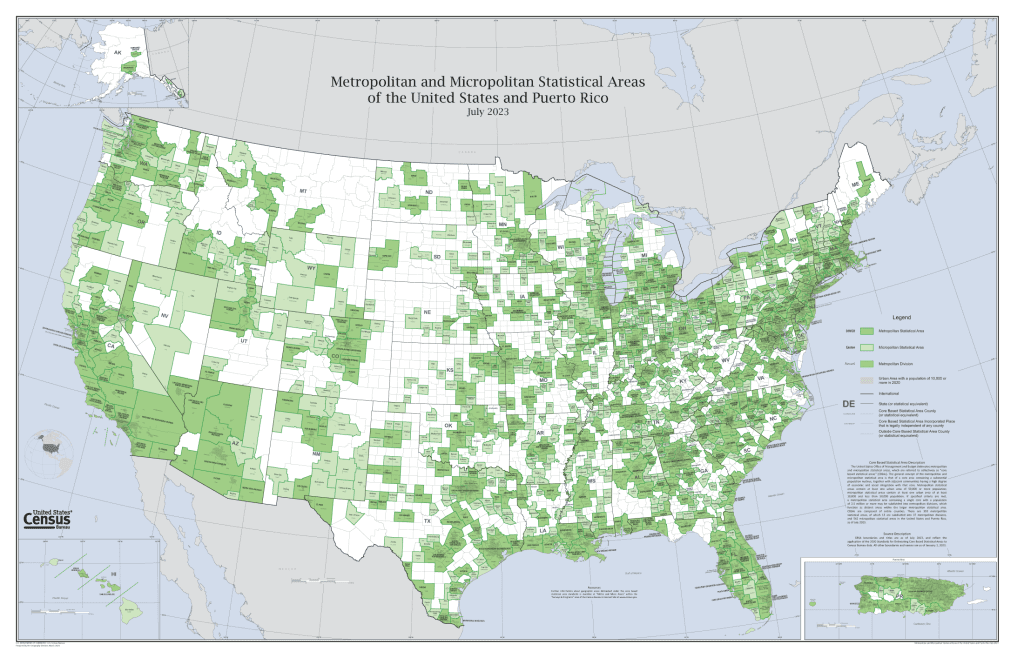
Though the Census Bureau also has a category called Urbanized area, which contain 50,000 people or more, which is the basis for defining Metropolitan Statistical Areas (MSAs).
The US Office of Management and Budget (OMB) delineates MSAs, and since 2003, Micropolitan Statistical Areas (μSA). OMB Bulletin No. 23-1 states:
Metropolitan Statistical Areas have at least one urban area of 50,000 or more population, plus adjacent territory that has a high degree of social and economic integration with the core as measured by commuting ties. Micropolitan Statistical Areas have at least one urban area of at least 10,000 but less than 50,000 population, plus adjacent territory that has a high degree of social and economic integration with the core as measured by commuting ties. Metropolitan and Micropolitan Statistical Areas are delineated in terms of whole counties or county equivalents.
Other federal agencies and programs even use some other classification systems to define rural and urban areas. It gets confusing.
Most people aren’t going to be too concerned about official definitions. However, when we’re considering policy and planning, it’s a good idea to be clear about what we’re talking about.
The Census definition, even at 5,000 residents, provides a finer geographic grain–you’re either in-town or out-of-town. That said, there’s a big difference between a municipality of 5,000 compared to 50,000 or 500,000.
We also have to consider how connected people are between places and the countryside around them. In many places, about as many people commute into town as commute out of town every day. That “social and economic integration” mentioned in the OMB definitions.
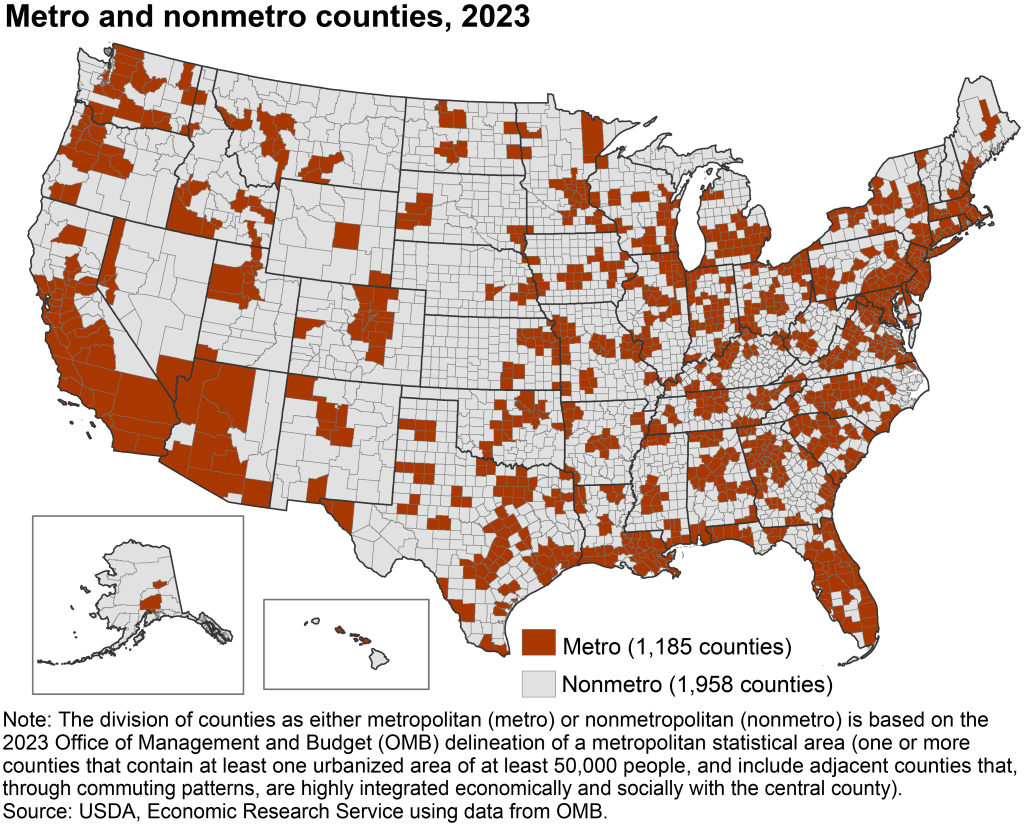
So many people rely on OMB’s MSAs to distinguish urban (MSAs) and rural (Non-Metropolitan counties). Counties have fairly stable boundaries with long trend-lines of data available from a variety of sources, the Census and American Community Survey (ACS) included.
Many counties classified as MSAs can include large areas that look and act rural, especially in large western states. I worked in Larimer County, a metro county on the front range of Colorado, for example, which reached very remote areas across the continental divide. So STaR has many Small Town & Rural planners who live and work in un-urbanized areas of Metro counties.
When forced to choose these two definitions, we believe that the nonmetro definition best describes places that share common characteristics, better represents the diversity of rural America, and reflects the critical social and economic dynamics of smaller economies that link open land areas and small towns.
–CORI, “Defining rural America: The consequences of how we count”
So is “rural” really the same as “non-metro”? Well, no, not really. But it’s the best data we have, especially from the US Census reports, as long as we have that available.
Who Is Rural? McKinsey & Company Have an Idea
McKinsey & Company did some really cool maps of Rural America. I wrote about their report here on the blog last year.
.