Visioning is where planning feels less like a technical exercise and more like a shared act of imagination. It is the point where a community pauses long enough to ask, together: “What kind of place do we want to become—and what would it feel like to live here if we got it right?”
Visioning is the structured process of turning that conversation into a clear picture of a desired future and a touchstone that can guide day‑to‑day decisions.
Visioning in planning and public policy is a participatory process where community members articulate a shared picture of the desired future and use it to guide decisions, plans, and investments. It is both a democratic engagement tool and a strategic framing device for policies, programs, and physical development.
That picture is not fortune‑telling; it is orientation. A vision gives people a common “north star” that helps align implementation actions—zoning changes, capital projects, grant applications, and everyday choices that otherwise risk pulling in different directions. Done well, visioning is both creative and practical: it invites residents, businesses, and local leaders to dream in public—and then distills those dreams into a statement concrete enough to impact policies over the long haul.
What Visioning Is
Visioning is the process of imagining and clearly expressing a desired future for a community or organization.
Visioning in planning and public policy is a structured, collective exercise where a community or set of stakeholders describes the future it wants and turns that description into guiding principles for plans, policies, and capital investments. It is less about predicting the future and more about setting a shared reference point—a “north star” or “lighthouse”—for coordinated action among many actors who no single entity fully controls.
Core idea of visioning
The visioning process is intended to be used to articulate a clear, often inspirational picture of a desired future state for their community, organization, or system. It can be a formal phase of a project, an informal part of an overall planning or policy process, or a stand-alone strategic effort of its own.
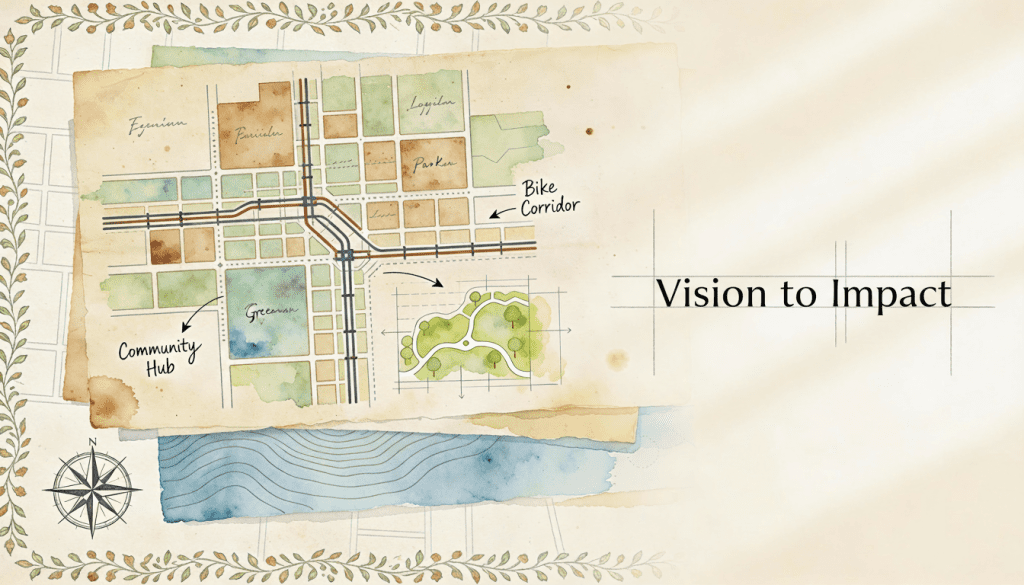
The output is usually a vision statement: a concise affirmation (and sometimes images or maps) that expresses highest aspirations, core values, and the qualities of life the community wants to achieve over the long term. Strong vision statements are future-oriented (“will be…”), value-rich (i.e. safe, sustainable, prosperous, open), and specific enough to guide choices—that last one is a challenge for me!
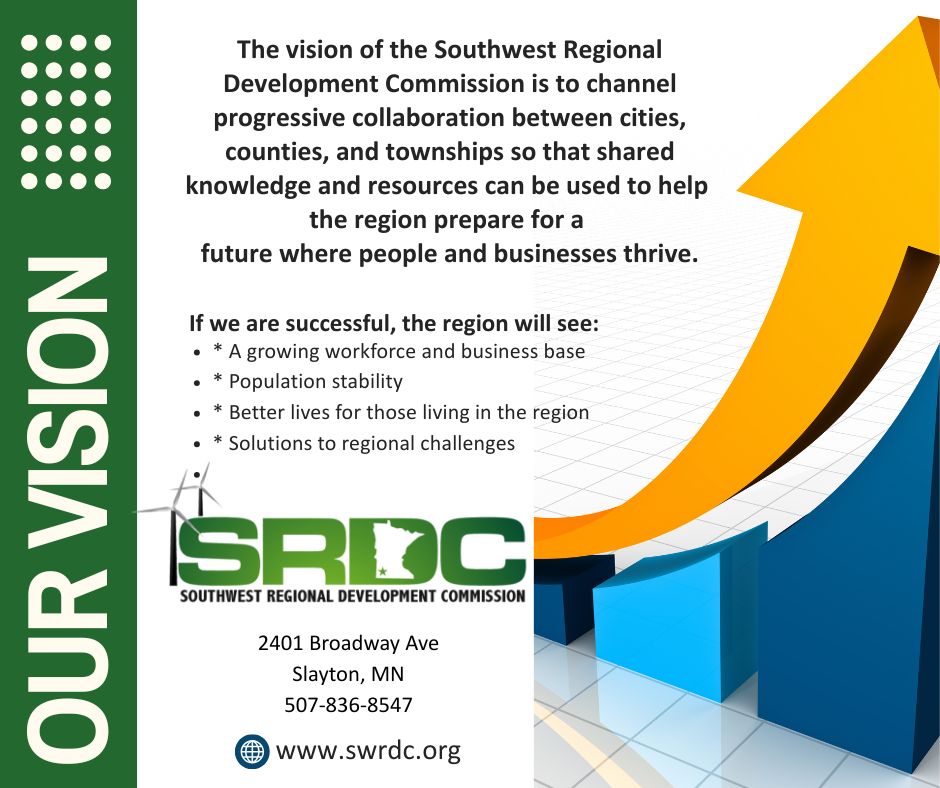
My old friends at Southwest Regional Development Commission (SRDC) in Minnesota have a vision statement that serves as a good example from a local unit of government (regional development organization) which also serves as a regional vision:
The vision of the Southwest Regional Development Commission is to channel progressive collaboration between cities, counties, and townships so that shared knowledge and resources can be used to help the region prepare for a future where people and businesses thrive. If we are successful, the region will see:
- A growing workforce and business base
- Population stability
- Better lives for those in the region
- Solutions to regional challenges
How it fits into planning
In planning and public policy, visioning typically occurs early in a comprehensive or strategic planning process and frames later steps like data analysis, goal setting, and policy design. Vision statements in plans and policy documents are usually short, vivid descriptions of a desired future community or system, anchoring later goals and strategies.
Vision is part of larger planning processes, but visioning is a unique process and product.
- Vision is big picture; a plan is a playbook
- Vision is descriptive; a plan is analytical
- Vision is about possibilities; a plan is policy
- Vision is based on imagination; a plan is based on reason
- Vision is poetry; a plan is a story of who you are and who you want to be
An adopted vision statement serves as a framework for coordinating decisions across domains—such as land use, transportation, economic development, public health, and environmental protection—so that individual actions cumulatively move toward the same desired future.
Charles Marohn of Strong Towns expounds on the importance of vision in the foreword to Ryan Short’s new book The Civic Brand (MODassic Group, 2025):
“what’s missing from so many communities [is] a shared sense of identity. A story we tell ourselves and each other about who we are, what we value, and what kind of future we’re building together… a vision that connects policy, design, investment, and culture.”
Participation and consensus-building
Visioning is intentionally participatory: residents, businesses, interest groups, officials, and other stakeholders are invited to describe what they want their community to “look or be like” in the future. We were fortunate with the Raton planning process to hold our largest event in the community engagement process just before the COVID shutdown in 2020. The vision was based on real-world input from a large cross-section of community members, expressed at the town hall and in a community survey, along with interviews and steering committee discussions.
Because it emphasizes shared values and aspirations rather than immediate conflicts, visioning is often used as a consensus-building technique in communities with divisive histories or fragmented perspectives. Multi-jurisdictional initiatives, for example, can use visioning to find core values and shared long-term goals.
When I was with Consensus Planning, our planning lead Jackie Fishman, AICP, worked with the local team to compose a Vision Statement for the City of Raton, New Mexico, population 6,000. The statement opens the new comprehensive plan adopted in 2021. It starts off:
Raton is a charming and captivating community at the northeast gateway to New Mexico. Our community has become a destination for people seeking a small town that’s rich with history, arts and culture offerings, and outdoor recreation experiences….
The Raton vision statement goes on to reference the historic downtown and Santa Fe depot (Amtrak still stops there), their neighborhoods, and economic innovation tied to both Interstate-25 commerce and the outdoor economy.
Typical elements of a visioning process
Common elements of a visioning process include the methods and techniques we’ve discussed for community engagement overall: facilitated workshops, small-group discussions, surveys, and sometimes mapping or visualization techniques that help people picture alternative futures and refine a preferred direction. You can see how it’s important to match these elements to the community you’re in, not just pull generic text off the internet.
Many processes pair visioning with scenario planning, using alternative growth or policy scenarios to test how well different futures align with community goals, then using the preferred scenario to sharpen the vision statement and associated principles. We touched on scenario planning in our last post. It can be a useful method to make fuzzy visions much more tangible.
Jim Holway, now retired from the Babbitt Centr for Land and Water Policy, wrote about scenario planning techniques for the Lincoln Institute of Land Policy. For example, Gallatin County, Montana, worked with the Sonoran Institute and Montana State University to integrate scenario planning with housing projections as a return-on-investment “reality check” on proposed visions for land use and building types. When I was at Gallatin County, we ended up with a standing-room crowd at the Museum of the Rockies to demonstrate 3D modeling of growth scenarios back before that tech really took off. You know, back before the Internet was a thing!
Why visioning matters for public policy
A well-crafted vision gives legitimacy and direction to public policies, budgets, zoning, and capital investments by tying them to a publicly articulated future rather than ad hoc decisions or short-term politics. At the same time, visioning only has real impact when it is inclusive, linked to concrete implementation actions and performance measures, and revisited over time as conditions change.
In planning, a vision becomes a concise statement (or set of statements) describing core values, long‑term aspirations, and the qualities of the future community policymakers and residents want to create.
Role in planning processes
Visioning is often an early stage in comprehensive, transportation, or strategic planning, setting a framework for data collection, goal-setting, and policy options. Other times, the vision emerges after issues are identified and solutions begin to present themselves. Often we find tension between what we want our vision to be (aspirational) compared to what vision the community actually has for itself.
Visioning typically functions as the early, integrative step in a planning process that sets direction, aligns stakeholders, and provides a framework for later technical work, policy choices, and implementation. It can also become a more iterative function, with sufficient time and budget built into a project.
Where visioning sits in the process
Many comprehensive planning models place visioning after initial data collection and issue identification but before goal-setting and strategy formulation (e.g., Problem → Data → Issues → Visioning → Strategies → Plan → Implementation → Monitoring). Developing a Vision early in the process can help narrow down the large universe of planning problems and focus on demonstrated needs of the community.
Visioning can also run parallel to data collection and analysis, allowing evolving information and public aspirations to inform each other. A more iterative process can offer the benefit of early vision with early and repeated actions to test the vision and implementation actions as we go. Set a vision, try something, evaluate, check the vision against reality.
Functions of visioning in planning
Visioning provides a framework or organizing narrative that makes subsequent data, goals, and objectives coherent; without it, technical work risks becoming a disconnected list of facts and actions. The Montana Department of Transportation notes on its resources for growing communities page, “The vision provides a framework within which planners and decision-makers can set priorities and coordinate decisions across all elements of civic life…”
As we noted earlier, visioning can serve as a consensus-building technique, articulating shared purposes and values, which then guide choices about land use, transportation, environment, economic development, and other sectors. Remember, though, consensus is a technique to reach the vision, not necessarily the goal in and of itself. Ryan Short includes an insightful chapter in his book, The Civic Brand, titled The Illusion of Consensus:
“As we engage our communities in order to build a civic brand and shared community vision, there is a natural tendency to want to work toward a feeling of consensus… When we focus only on consensus, we ignore the nuances and voices that aren’t in that majority. Shifting our focus to consent rather than consensus can be a simple but impactful way to ensure that people are heard, that concerns are addressed as best as possible, and that even those that may not fully agree – or may be on the losing side of a vote – can still see their voice considered in the ultimate decisions.”
Participation and “human glue”
Visioning sessions are designed to be broadly inclusive, giving residents, officials, and other stakeholders equal voice and encouraging representation from all parts of the community. Community engagement is essential for a successful visioning process. After all, the vision—like any good plan or public policy project—represents the wants and needs of people in the community, not just the author’s good will.
Because it emphasizes community assets and future possibilities rather than conflicts and deficits, visioning can act as a catalyst that motivates people to stay engaged through the more technical and contentious later stages. Anna Haines with University of Wisconsin Extension pointed out visioning can operate as both “human glue” for participation and a structural “hook” on which goals, strategies, and regulations are later hung.
Linking vision to policies and tools
In a typical comprehensive planning process, the vision is translated into goals, objectives, and strategies, which then shape regulatory tools such as zoning, subdivision ordinances, parking standards, or urban service boundaries. As Maine’s Community Visioning Handbook noted, a plan can use the community vision statement as a type of yardstick to evaluate which goals and policies best move the community in the direction it wants to go.
A strong vision statement should also be a point of reference when evaluating tangible development proposals, including zone map amendments, conditional use permits, or planned unit development. On the upside, local jurisdictions should also make it easier for projects to move forward when they clearly implement the community’s vision. Carrots and more carrots make for a clear vision.
Transportation planning also often uses a similar process, with an adopted community vision as an input so that projects, scenarios, and investments support agreed values and desired futures across multiple policy areas. The US DOT’s Federal Highway Administration notes on its PlanWorks webpage (still there as of January 2026), “A successful outcome from visioning can improve both the quality and timeliness of transportation decision making. A vision provides the physical, economic and social context of a community’s future, built on collaboration between decision makers and interested groups or individuals.”
Role across scales and over time
Visioning can occur at regional, county, city, or neighborhood scales, with higher-level visions defining the broader context while local processes adapt those aspirations to specific places and implementation tools. For a vision to remain meaningful, the vision should be linked to monitoring and reassessment steps so that plans, codes, and investments can be updated as conditions and community preferences evolve.
Some visions are detailed, some are concise The City of Montrose developed two-sentence statement as part of their Envision 2040 Montrose Comprehensive Plan, adopted in 2021:
“Vision Statement: “Montrose will strive to be a healthy, safe, and thriving community that embraces diversity and the environment. We will come together to grow responsibly to create opportunities for all.”
Montana State University extension suggests a “strategic visioning” process, focused on past and present community issues, determining positive qualities and assets, identifying future goals, designing a practical plan, carrying out actions, then evaluating the outcomes. It’s basically a middle ground between traditional strategic planning and full-scale comprehensive planning.
Whatever the approach, results of visioning helps planners and officials prioritize investments, coordinate across sectors (land use, transport, environment, housing), and evaluate whether proposed actions move the community toward its stated future.
Community Engagement in the Visioning Process
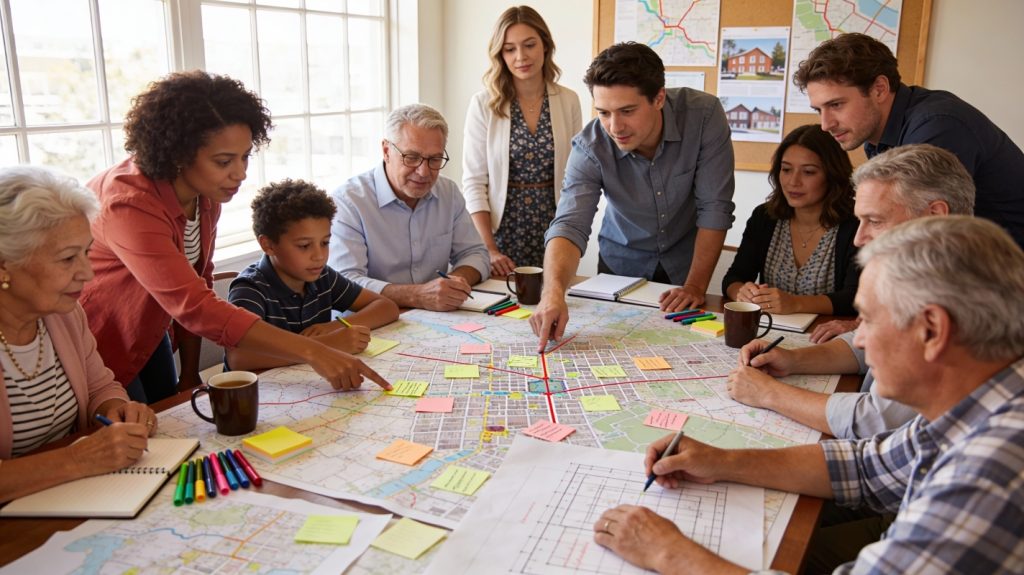
Visioning is intentionally participatory, engaging residents, businesses, officials, and community groups to build consensus on values and priorities.
Community engagement and public participation in Visioning in particular is deliberately broad, creative, and value‑focused, and it often feels different from participation in the more technical stages of a planning process. In visioning, engagement is about imagining and negotiating a shared future, while in later stages it shifts toward reacting to draft plans, regulations, or projects.
What public participation in visioning looks like
Visioning processes aim to maximize group participation and draw on the full range of interests and expertise in a community to craft a shared future. Community engagement and public participation, as one would expect, is central to this process. It is also intentionally broad, hands‑on, and future‑oriented, more suitable to a community workshop or studio than a formal public meeting.
Participation in visioning typically includes residents, community groups, businesses, government staff and officials, and other stakeholders, with emphasis on getting beyond the “usual suspects.” Processes often seek people who are not usually at city hall: youth, renters, small businesses, neighborhood groups, faith communities, and historically marginalized residents, sometimes with targeted outreach and partnerships to reach hard‑to‑reach populations.
Goals of engagement at the visioning stage
The central goal of visioning is to build a common narrative representing community values and a desired future, so plans and policies can articulate what the community should “look or be like” in the future. Typically, we’re looking out 10–20 years, but there’s no reason you couldn’t challenge the community on their vision for generations to come.
Visioning also aims to create a sense of ownership and motivation. Residents who help craft the vision are more likely to support and monitor actions to achieve it over time.
How visioning engagement differs from overall planning engagement
Visioning engagement is designed to feel different from the rest of the planning process: it is earlier, more open‑ended, more relational, and less tightly bound to specific proposals or regulations. Visioning engagement is typically front‑loaded and aspirational: it focuses on values and possibilities, and invites open‑ended input; more general planning engagement tends to be more constrained, seeking feedback on specific options, draft plans, or ordinances. When visioning is done early, before options become fixed, it can set values and direction for a truly comprehensive planning process.
Visioning favors formats that maximize participation and creativity: small‑table workshops, mapping, photo and visioning exercises, dot‑voting, scenario discussions, and interactive activities that let many voices surface at once. Overall planning engagement still uses workshops and surveys, but it leans more on formal public meetings, open houses around draft plans, and online comment periods keyed to specific documents or maps.
In visioning, everyone is treated as a valid “expert” on community values and lived experience; processes intentionally flatten hierarchies so residents, officials, and staff sit together in mixed groups, often without long technical presentations. In later stages, professionals and officials often frame the discussion—through presentations, draft documents, and legal constraints—and the public is more often in a responder role, reacting to proposals within tighter boundaries.
Intensity in the Planning Process
Output from visioning is synthetic and value‑rich: themes, phrases, images, and preferred future “stories” that are distilled into a vision statement and guiding principles. Because visioning is an intensive form of public participation, it often involves more time, facilitation, and outreach than routine public meetings or formal comment periods. It takes time for people to have their say.
It’s worth the effort. By moving beyond “the usual suspects” and using workshops, surveys, and visual techniques, well-designed visioning processes can broaden voice, strengthen legitimacy, and embody democratic ideals in planning and public policy.
Methods and Techniques
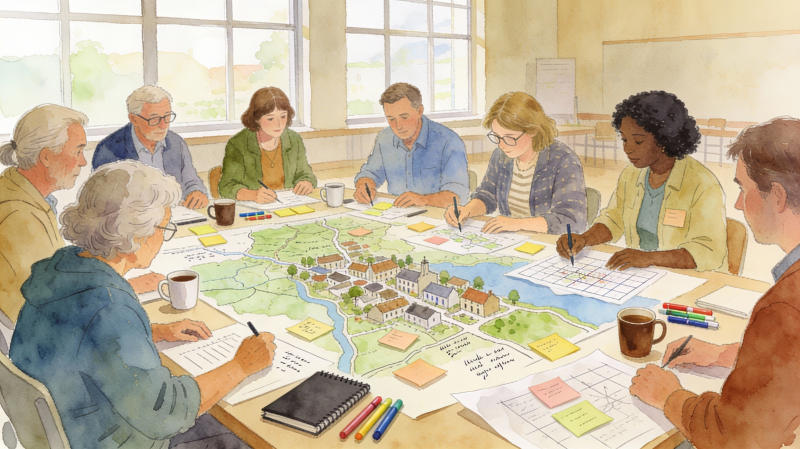
Visioning in planning and public policy uses a mix of facilitation methods, visualization processes, and analytical techniques to help people imagine futures, compare options, and distill a shared long‑term direction. Common methods, as we have discussed over the last couple posts, include facilitated workshops, small‑group dialogues, community surveys, mapping exercises, and visualizations (e.g., 3D renderings, scenario images) that show alternative futures. These methods range from low‑tech workshops and photo exercises to scenario modeling platforms that link maps, numbers, and narratives.
Typical methods used in visioning
Common techniques for visioning reflect methods we’ve discussed all month: large public workshops, small‑group discussions, facilitated “imagine the future” exercises, visual preference surveys, participatory mapping, and scenario comparisons. The difference is in emphasis—are we drawing out “big picture” visions? Or are we asking people to evaluate more tangible options or costs and benefits?
Visualization seems like an obvious method to help visioning, but we don’t want to drive people in a certain direction just because we like pretty pictures. That said, visual preference exercises make it easier for people to say they like Option A over some hypothetical Option B.
A more intensive process like a community design charette may start with vision to drive illustrative scenarios. Many communities supplement in‑person sessions with virtual participation (we learned a lot during COVID), online surveys, interactive maps, and social media campaigns to broaden reach and make participation more accessible.
Core workshop‑style techniques
Facilitated community workshops and small‑group sessions structure conversations around questions like “Where are we now?” and “Where do we want to be?” often using prompts, flip charts, and report‑back discussions. The process is intended to ask broad concepts, not details. Facilitation helps bridge the gap between open-ended brainstorming and overly-formal structure, although care must be taken so the loudest voices in the room do not dominate those who may not be as comfortable with public speaking.
In Coffey County, Kansas, for example my firm Marvin Planning Consultants (MPC) held a series of evening town hall workshops in each of their municipalities, in conjunction with several focus groups organized around different topics, such as utilities, public health, and economic development. Input and comments informed a vision statement, clarified by the advisory committee, and under review now as part of their draft plan.
Focus groups, study circles, and open forums provide more targeted spaces for particular constituencies or topics which can feed into a shared vision statement.
Visual and spatial tools
Visual and spatial tools help people literally see and co‑create possible futures, which makes community visioning more concrete, accessible, and engaging for non‑experts. They turn abstract ideas about “what we want” into images, maps, and spatial choices that can guide later plans and regulations.
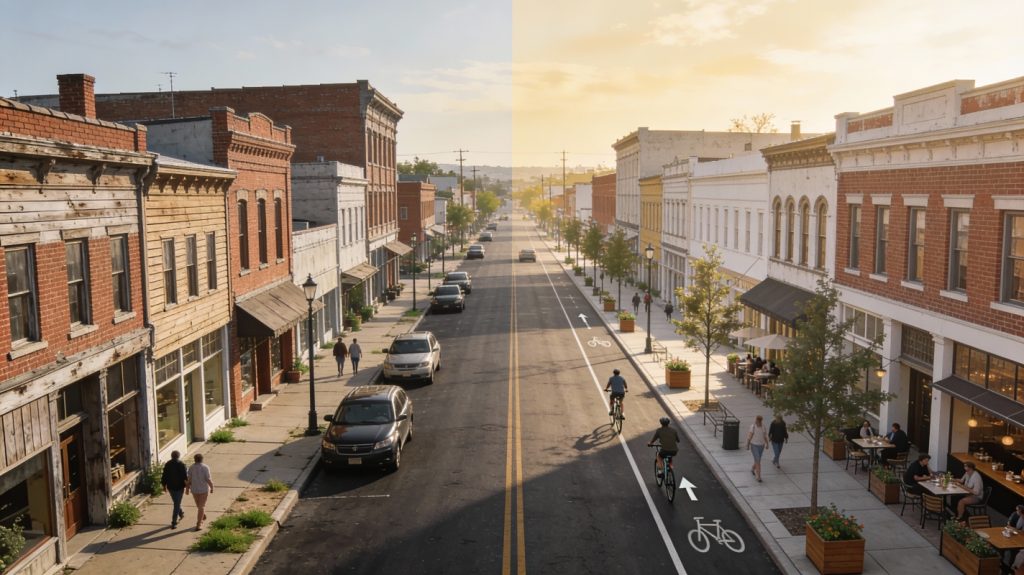
I mentioned visual preference surveys earlier. Along with “photo visioning”, these techniques ask participants to react to images of streets, buildings, landscapes, and public spaces to clarify what kinds of environments they want in the future. Rendered streetscapes, 3D models, and before‑and‑after images show how changes in building height, tree cover, bike lanes, or plazas might look, helping participants react to concrete possibilities instead of purely verbal descriptions. Newer tools, including web‑based visualizations and augmented reality apps, allow people to view proposed projects or future scenarios in situ (e.g., through a smartphone), which can prompt more specific and actionable community feedback for visioning.
Participatory mapping and community tours invite people to identify valued places, areas of concern, and desired changes directly on maps or in the field, grounding the vision in specific locations. Participatory mapping asks community members to draw or mark up maps with places they value, areas of concern, desired changes, and ideas for future land use, often in workshops or online platforms. This can be done of paper maps or online with new apps which let participants drop pins, trace routes, or comment on specific locations—MPC uses online comment maps in most all of our projects.
Communication and outreach techniques
Communication and outreach tools for visioning are about meeting people where they are, in formats they already use, and keeping a two‑way conversation going over time. Communication also complements workshops and charrettes by reaching quieter voices and people who cannot or will not attend formal meetings.
Surveys (online and paper), newsletters, interactive websites, and social media campaigns broaden participation and gather input from residents when and where they are able to participate. Don’t forget your local newspaper, where you are so lucky to still have a local newspaper! Budget to buy ads to promote events, in the front of the paper, not buried back in the legal notices. Talk to local radio as well, where you are so lucky to still have local radio…
In many communities, the local librarians will help get the word out, and assist patrons with online comments, surveys, and participatory mapping… or at least provide an accessible drop-off point to return paper copies. High‑visibility outreach efforts, such as pop‑up events, community festivals, and creative installations, all of which we’ve discussed previously, help bring visioning conversations to everyday public spaces rather than only formal meetings.
Social media has been with us for awhile now, love it or hate it. We’ve used platforms such as Facebook with varying degrees of success. Haven’t found their paid promotions to work very well outside major metro areas. Twitter was a thing before it became X, while Threads and BlueSky have their fans (me among them).
Youtube is a very flexible video platform which can be used on your regular web pages as well as featured on other social media. I don’t do TikTok and many of our public sector clients are still prohibited from that platform, but Instagram and, yes, Facebook, offer plenty of opportunities for static and video engagement. It’s probably best to ask the high school kids! You won’t know what works until you try.

Strengths and Challenges of Visioning
Visioning can create shared ownership, align disparate actors, and provide a “lighthouse” that keeps plans and policies oriented over time, even as details change.
Visioning’s main strength in planning and public policy is its ability to articulate a shared long‑term direction that people feel they own, but it also faces real challenges around power, representation, and follow‑through. It can act as both a community “road map” and a political symbol, which is powerful when backed by action and problematic when it remains largely rhetorical.
Key strengths
- Visioning builds shared purpose and direction by helping community members discover common values, develop a shared sense of the future, and translate that into an overarching vision that orients plans and policies.
- A statement of vision can provide focus, purpose, and direction for a planning or public policy project.
- The process can strengthen social capital: participants gain trust, skills, and relationships; communities often report improved communication, teamwork, and a stronger sense of identity and pride.
Benefits for planning and policy
- A clear, collectively developed vision gives planners and policymakers a framework for goals, strategies, and regulations, making later decisions more coherent and easier to justify publicly.
- A broad vision of a community can better support positive and “doable” goals, policies, and actions
- Because residents help set the “north star,” subsequent policies, budgets, and projects can enjoy greater legitimacy and buy‑in, reducing resistance and helping sustain efforts over time.
Participation and empowerment advantages
- A broad and open visioning process encourages and engages community members who may not participate in typical planning and policy projects.
- When done well, visioning treats community members as agents of change, giving them a structured platform to articulate aspirations and influence strategic direction rather than react to pre‑formed proposals.
Core challenges and limitations
- In any narrative process, the “usual suspects” tend to dominate the conversation—either individuals/groups who are plugged in or special interests chasing the bright shiny objection of the day.
- Representation is a persistent challenge: many processes struggle to include marginalized groups, and critics note that engagement can sometimes construct an idealized “community voice” that masks internal differences.
- Some community members will never agree with any vision or plan, and it can be difficult to balance majority and minority viewpoints.
- There will also always be a share of any group who prefer the familiar tried-and-true to taking any risk, even when no action may be the riskiest action of all.
Risks in implementation and practice
- Without strong links to implementation tools (regulations, budgets, timelines, metrics), vision statements can become vague, aspirational documents with little practical effect—what some practitioners view as “feel‑good” or symbolic exercises.
- Visions can overreach or stay too general, making it difficult to translate them into clear, achievable goals; when that happens, plans drift, priorities shift, and trust in the process can erode. (I resemble this, in general.)
Strategic tensions for planners
- The future is uncertain and dynamic, so any fixed vision risks becoming outdated if it is not periodically revisited and adapted, especially in fast‑changing policy environments. This of course is a critique of any plan or action.
- Balancing open‑ended imagination with realism is difficult: if visioning is too constrained by current constraints it may not inspire change, but if it ignores constraints entirely it can set up unrealistic expectations and disappointment.
Critiques point out that visioning can fail if it is symbolic only, lacks inclusive participation, or is not tied to implementation tools like zoning, budgets, and performance measures. Many modern, more strategic approaches have been development, though, emphasizing the importance of quicker, more iterative planning processes. It may look like more work, but it’s more about managing the process to improve results.
How do you eat the Visioning elephant? Well, first, don’t eat elephants. Then start working on your Vision one bite at a time.
Conclusion: Vision of a Future We Want
Visioning sits in an awkward but ultimately productive tension between poetry and practice. It asks people to slow down long enough to name what they value, imagine a future that is bigger than any one project, and then commit to using that future as a reference point for the everyday work of planning, budgeting, and regulation.
When communities take that seriously—when they keep coming back to the vision to ask “Does this decision move us closer or farther?”—visioning becomes less a one‑off exercise and more a durable habit of civic life.
At the same time, visioning is not a magic wand. It adds cost and complexity, it depends on skilled facilitation, and it can raise expectations that local governments and partners struggle to meet if implementation tools and resources aren’t lined up. The challenge is to right‑size the process, broaden participation beyond the “usual suspects,” and build clear bridges from vision statements to concrete actions, metrics, and periodic check‑ins.
Do that, and “vision into practice” stops being a slogan and starts becoming the way a community learns, over time, to steer itself toward the future it actually wants.
Coming Up Next
During February, we’ll be looking at population and housing trends in small towns and rural areas, mostly focused on the US but we’ll see what I can dig up in other parts of the world. We’ll talk about how population and housing fit into comprehensive planning and some policy tools for more livable rural communities.

Read More
Books
Community Visioning Programs: Processes and Outcomes (Community Development – Current Issues Series) by Walzer & Hamm ed. (Routledge, 2015)
Reviews the development of community visioning in small and medium‑sized North American communities, focusing on process design and what visioning actually achieves over time. Useful if you’re interested in evaluation and outcomes, not just how‑to.
Visioning and Visualization: People, Pixels, and Plans by Michael Kwartler and Gianni Longo (Lincoln Institute of Land Policy, 2008)
Explores how to integrate digital visualization tools into participatory planning and visioning, with principles, techniques, and case studies. Good for planners wanting to connect public involvement, visualization, and democratic decision‑making
Engaging the future: Forecasts, scenarios, plans, and projects by Lewis D. Hopkins and Marisa A. Zapata (Lincoln Institute of Land Policy, 2007)—Lew Hopkins was my undergraduate advisor at UIUC.
Handbooks
Community Visioning and Strategic Planning Handbook (PDF)– National Civic League
Focuses on bringing diverse stakeholders together to create a shared community vision and then move into action planning and performance measures. Good for step‑by‑step process design and facilitation structure.
Building Our Future: A Guide to Community Visioning (PDF) – Green, Haines, Halebsky (Univ. of Wisconsin Extension)
A manual which lays out a full community visioning process, emphasizing public involvement, core values, and linking the vision to community development strategies. Strong on rural/small‑city contexts and civic capacity building.
Community Visioning Handbook: How to Imagine – and Create – a Better Future (PDF) – Maine State Planning Office
Explains what visioning is, how it fits within comprehensive planning, and offers a toolkit built around three prep meetings and a one‑day visioning session, plus a sample vision statement. Particularly good for small municipalities starting their first visioning effort.
More from JCShepard.com
2026: Bring Your Plans to Life – Monthly Themes Preview
- The New Rural Playbook: Planning Trends That Matter
- Planning with Purpose: Emerging Trends in Rural and Small Town Planning
- Thriving Together: Proven Strategies for Sustainable Rural Economies in 2025
- Wired for Change: Rural America and the Energy Economy of Tomorrow
Check out The 12 Planning & Sustainability Books You Need in 2026 and browse through the Small Town & Rural Community guides on our Resources page.
(As an Amazon Associate, we may earn commissions from qualifying purchases. Check your local library or bookshop, too.)
.