
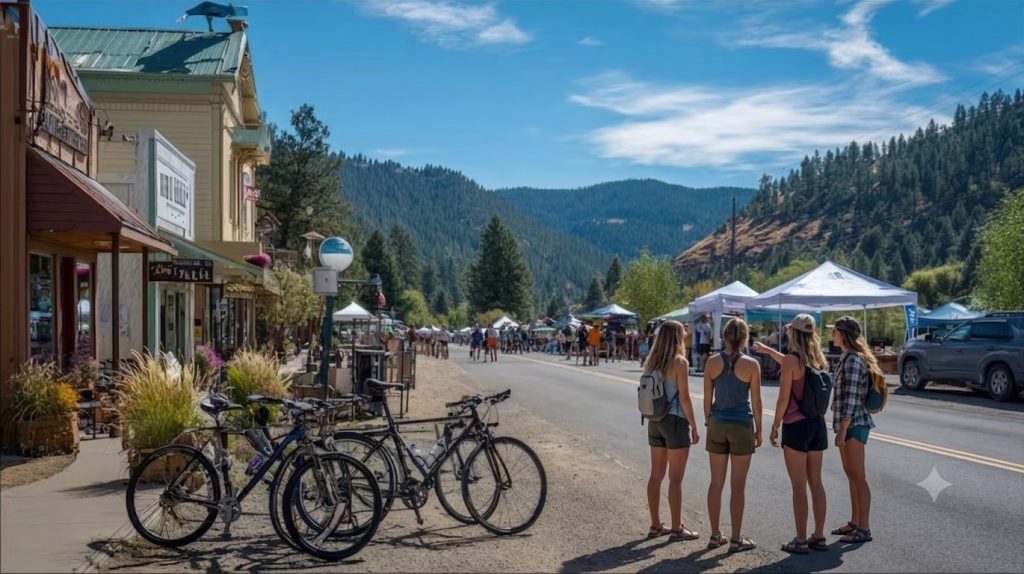
Small towns do not have to choose between becoming a theme park or watching their Main Street wither away. The real opportunity is to treat the Great Outdoors—your parks, trails, fairgrounds, school fields, working lands, and open space—as core infrastructure for health and prosperity, then use planning tools to grow an outdoor economy without losing what makes your place home. This bonus article builds on last summer’s Conservation and the Great Outdoors series and last month’s focus on Public Health, Parks & Recreation, and the Great Outdoors.
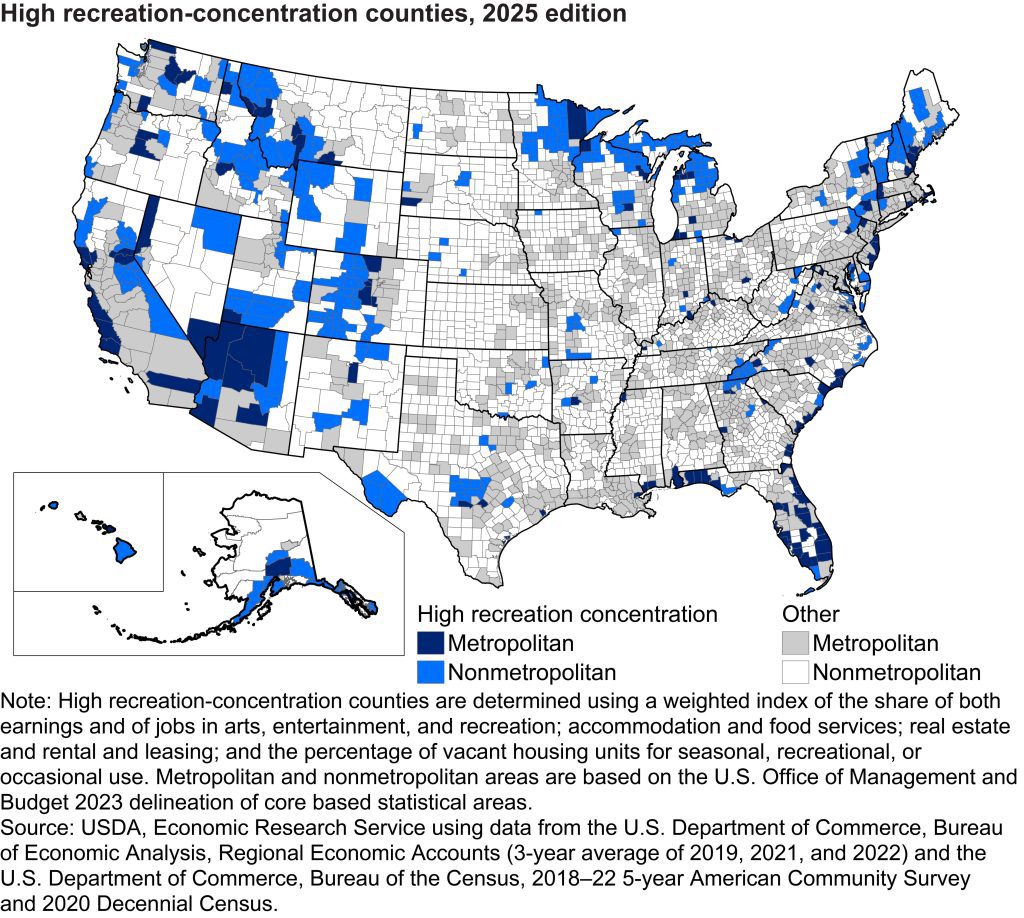
From Great Outdoors Month to Everyday Policy
The Great Outdoors is essential community infrastructure, not just scenery, fueling the outdoor economy. Last month, we discussed how public health, trails, fairgrounds, school fields, and local food systems are the everyday structures through which residents actually experience health and livability. Taken together, we’re making a simple but powerful claim: in rural communities, the outdoor economy, public health, and land use planning are one system, and policy needs to be written as if that were true.
For local leaders and staff, this means “Great Outdoors Month” should be more than seasonal inspiration. It can become a recurring checkpoint to ask whether your small-town decisions on zoning, capital improvements, and economic development are reinforcing or eroding the long-term value of outdoor assets. The question is not whether to pursue an outdoor recreation strategy, but how to do it in ways that build local capacity, strengthen health outcomes, and avoid the extractive, boom–bust cycles that have plagued other resource-based economies.
Principles for a “No‑Sell‑Out” Outdoor Economy
The key to building your outdoor economy is to be honest about the central tension: our small towns want the jobs, visitors, and tax base that come with outdoor recreation, but not the speculative real estate pressures, cultural displacement, and environmental degradation that can follow. I am of the opinion there is a set of principles that can be translated directly into planning practice:
- Lead with existing assets, not megaprojects: Build from the fairgrounds, river access, state recreation areas, and farm roads you already have rather than chasing a single “transformative” development.
- Plan for residents first, visitors second: Design trails, parks, and programs to serve local daily life—walking, informal sports, socializing—so tourism is an additive benefit, not the only justification.
- Align land use with carrying capacity: Use comprehensive planning, zoning, and conservation tools to keep growth patterns in line with water, habitat, and infrastructure limits.
- Diversify the economic base around recreation: Support outdoor‑oriented entrepreneurs, but also invest in remote work, local food, and small manufacturing so the town is not solely dependent on seasonal visitation.
Professional planners and city/county officials can operationalize these principles through our standard toolkits—plans, codes, capital budgets, and intergovernmental agreements. The key shift is to treat “not selling out” as a measurable performance goal rather than a vague aspiration: protecting housing affordability, maintaining working lands, and tracking environmental indicators alongside visitor counts and sales tax receipts.
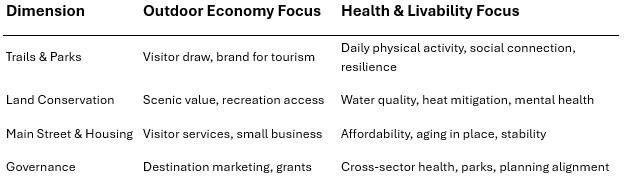
Outdoor economy and health/livability: key linkages
Parks, Recreation, and Health as Economic Strategy
In every community, parks and recreation are not extras; they are the basic platform on which both health and the local economy sit. A trail with exercise stations, a school field open after hours, or a fairground that hosts markets and festivals all serve triple duty: they support physical activity, create social ties, and provide venues for small businesses and cultural events. When planners classify these as “infrastructure,” they unlock eligibility for different funding streams and raise their status in capital improvement plans.
For local leaders, this suggests several strategies:
- Integrate health and recreation metrics into economic development plans, so that projects must demonstrate both job creation and improvements in access to active living.
- Use tools like County Health Rankings and livability indices not just for assessment, but as shared language between planners, health departments, and elected officials when prioritizing outdoor investments.
- Treat programmatic investments—youth outdoor programs, volunteer trail crews, walking groups—as part of the outdoor economy, because they build the human capital that keeps facilities used and maintained.
This dovetails directly with the “no‑sell‑out” framework: communities that improve resident health and everyday quality of life become more attractive to visitors and new residents, but remain oriented around local needs rather than outside expectations.

Planning Tools to Avoid “Selling Out”
The most effective small towns use traditional planning tools in nontraditional ways to steer outdoor growth. Last month, we talked about comprehensive planning as the place where health, land use, and recreation are reconnected after decades of fragmented decision‑making. Bringing those threads together, a professional roadmap might include:
- Comprehensive plans that explicitly designate outdoor assets as critical community infrastructure and set target outcomes for health, economic diversification, and conservation.
- Zoning and subdivision standards that focus new development in and around existing town centers while conserving key viewsheds, agricultural land, and access corridors to public land and water.
- Fiscal policies—impact fees, lodging taxes, dedicated sales tax increments—that capture some of the value created by the outdoor economy and reinvest it in parks, trails, housing, and conservation easements.
- Governance structures that institutionalize collaboration across planning, public health, parks departments, and economic development, rather than relying on ad‑hoc partnerships.
Here is were we use narrative as a tool: telling a consistent story about who the community is, what kind of visitors and residents it wants to attract, and what is off‑limits. We can also extend that story by framing the outdoors in our plans and projects not only as an economic asset, but as the setting where a more livable, equitable rural future is built one small decision at a time.
A Practical Playbook
Here’s what I’m working on with these posts: a practical Great Outdoors playbook for rural planners, volunteers, and elected officials:
- Start from assets: inventory parks, trails, fairgrounds, school fields, and natural features as the backbone of both health and economic strategy.
- Align plans and codes: use the comprehensive plan and zoning to prioritize resident-serving outdoor infrastructure that can also support visitors.
- Measure outcomes broadly: track not just visitor spending, but also health indicators, housing stability, and environmental quality as the outdoor economy grows.
- Guard community character: preserve working lands, cultural landscapes, and historic structures as part of the “great outdoors,” recognizing that heritage is itself an economic and health asset.
In the end, a “no‑sell‑out” outdoor economy is less a special initiative than a discipline: start from the assets you already steward, line up your plans and codes behind resident‑first infrastructure, measure what matters for both health and prosperity, and defend the character of the place you love.
If rural planners, volunteers, and elected officials keep telling that story consistently—in policy, in budgets, and in everyday decisions—the Great Outdoors can remain both your economic engine and your shared commons, a setting where a more livable, equitable rural future is built one small choice at a time.
.Dig Deeper: Resources for Outdoor Economy Planning
These organizations offer research, funding tools, and policy guidance for rural communities building an outdoor economy on their own terms — without sacrificing the character that makes them worth visiting in the first place.
Data-driven rankings that help local leaders compare health outcomes across counties — useful for making the case that outdoor infrastructure is a health investment.
Funding programs for rural infrastructure, business development, and community facilities — including outdoor recreation and economic diversification initiatives.
Research and advocacy on parks as community infrastructure — including economic impact data and health outcome studies that support resident-first planning arguments.
Policy guides, PAS reports, and practitioner tools on outdoor recreation, zoning, and community character — directly applicable to the no-sell-out planning framework.
Click through for our article from June 2025 highlighting real-world success stories from gateway communities like Moab, Utah, and Bozeman, Montana (my favorite place anywhere); Durango, Colorado, and Taos, New Mexico; dynamic small towns like Burwell, Nebraska, resort centers like Telluride, Colorado, and larger regional centers like Asheville, North Carolina, serving extended rural communities.
Our June 22, 2025 post, Part Three in our series on Conservation and the Great Outdoors:: How Small Towns Can Build a Strong Outdoor Economy Without Selling Out.