

In last week’s article, we looked at the growing challenge rural communities face in maintaining essential community facilities. But what if some of those same buildings—often seen as liabilities—are actually among the most valuable assets for rural economic development that a community already has?
Historic Sites and Places as Community Facilities
In many rural communities, the most valuable economic development assets are already standing—often in plain sight, and often underused.
A vacant storefront on Main Street. A shuttered school at the edge of town. A historic courthouse that still functions, but no longer anchors the local economy the way it once did. A century-old church whose congregation has dwindled to a handful of regulars. These buildings are frequently seen as liabilities: expensive to maintain, difficult to repurpose, and tied to a past that no longer feels economically relevant.
But that perception is increasingly out of step with small town reality.
Across rural America, communities are rediscovering that historic preservation is not just about protecting the past. These buildings are core community facilities. Reuse, rehabilitation, and revitalization become some of the most practical, accessible, and underutilized economic development strategies available—particularly in places where new construction is financially out of reach.
The shift begins with a simple but powerful reframing: these buildings are not burdens. They are assets waiting to be activated.

From Liability to Asset
In many rural communities, the biggest barrier to historic preservation is not technical—it is psychological.
Where historic buildings lie vacant, they are often seen as problems to be solved: they leak, they require upgrades, and they rarely fit modern expectations without investment. In communities with limited budgets, the instinct is often to defer, demolish, or ignore. We talk ourselves into believing that “someday” we will be able to afford something better, even as the assets we already have continue to deteriorate in plain sight.
That framing misses a critical point. In many cases, these buildings—entire historic districts—represent some of the most structurally sound, centrally located, and architecturally distinctive spaces a community has. They were built for heavy use, at the heart of town, with good bones and durable materials. Replacing them with new construction is not only expensive—it is often unrealistic in places where private capital is scarce and public budgets are stretched thin. The choice is rarely between “old building” and “new building.” More often, it is between “old building, reimagined” and “empty lot that stays empty.”
The preservation of rural identity, traditions, and places contributes to stronger, more resilient communities. Local culture and history is what makes a place unique from any other place around the world. Heritage—both visible in buildings and landscapes, and lived through stories and practices—gives people a sense of continuity and belonging that helps them navigate change. When we invest in that heritage, we are not just saving the past; we are reinforcing the social fabric and local pride that make collective action possible in the present.
That is why realizing historic buildings are community facilities is so important. A retired school is not just a liability on the district’s balance sheet; it is a potential hub for housing, childcare, or workforce training. A church with a shrinking congregation is not just a cost center; it may be the best-located gathering space in town. A half-empty Main Street is not just a reminder of better days; it is the physical spine of a future small business ecosystem. When we look at these places through a facilities lens—asking what functions they could serve, not just what they used to be—we start to see options instead of obstacles.
The first step in bringing our historic community facilities back into their own is not redevelopment, but inventory. What does the community actually have? Which buildings are structurally viable? Which are located in walkable areas or near schools and services? Which already have access to utilities and infrastructure? And critically: which buildings and sites are being overlooked entirely because they feel “too sensitive” to talk about—churches, older schools, fraternal halls, and other emotionally loaded places?
Done well, that inventory is not just a list of parcels and square footage. It is a map of identity and opportunity: where people gather, where they used to gather, which corners still feel like the center of town, and which buildings residents would fight to keep if push came to shove. It combines GIS layers and tax records with oral histories and community memory. It asks not only “what is technically feasible?” but also “what feels like us?”
If preservation is going to function as a rural development strategy, communities need to do three things in sequence: understand what they already have, decide how they can use it, and be honest about what makes projects succeed or fail over time. The rest of this essay follows that arc. We start with the asset side of the ledger, then turn to strategies for putting those assets to work, and finally look at the hard but necessary questions of process, capacity, and governance that determine whether good ideas actually stick.
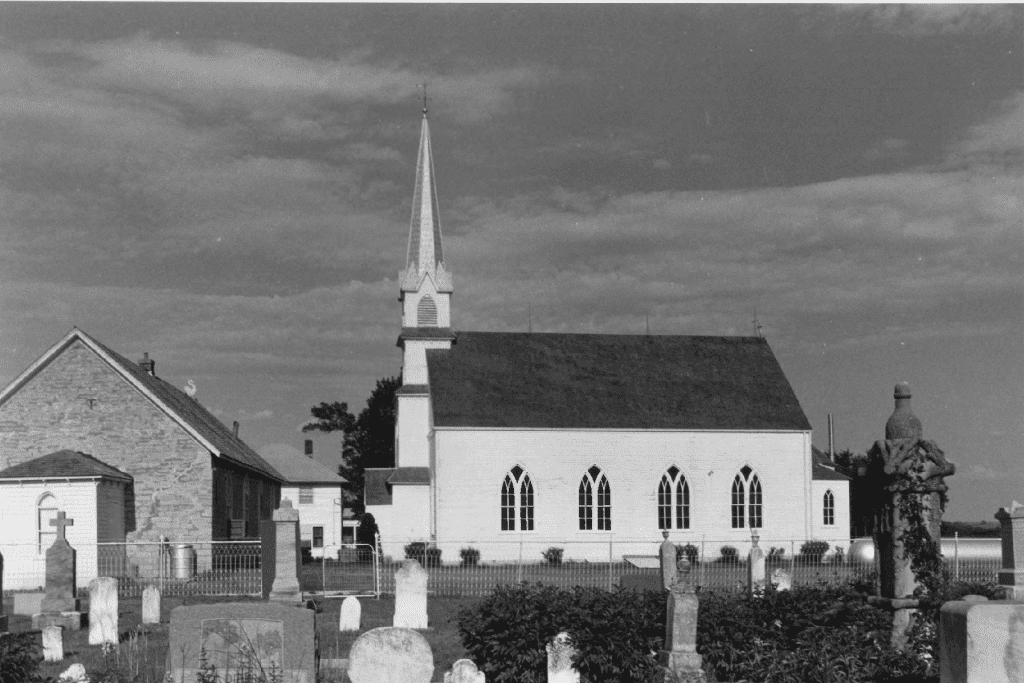
The wooden church and residence have since been lost, while the Old Stone Church and cemetery remain.
What Rural Communities Already Have: Rural Assets and Historic Resource Inventories
Cultural and Historic Sites and Places as Community Facilities.
As we wrote last fall, “Cultural preservation in rural communities goes far beyond saving old buildings—it encompasses the full spectrum of physical places and lived traditions that together create a community’s identity. Understanding the scope of what can and should be preserved is essential for developing strategies that resonate locally and support long-term sustainability.”
Before any grant application or big capital project, rural communities benefit from a simple but powerful step: creating a rural community asset inventory of their historic resources, cultural assets, and community facilities. A structured inventory makes it much easier to see how existing buildings, sites, and organizations can support long-term rural economic development, instead of assuming that new construction is the only option.
In our comprehensive plans, we routinely inventory historic places and sites along with profiles of significant organizations active in the arts and culture. Nemaha County, Nebraska, for example, has a unique resource in the arts community of Brownville—one of the oldest river towns in the state. The Brownville Fine Arts Association, a nonprofit member organization, operates, maintains, sponsors, and supports artist exhibitions and speaker series, workshops and events, as well as:
- An art gallery and nature center in an historic one-room schoolhouse.
- An historic house museum (home of one of Nebraska’s pioneering governors)
- An arboretum and nature center
- An urban garden
The Brownville Historical Society maintains a half dozen other historic sites, including more than one historic house museums, an antique vehicle museum, an original log cabin, the old train depot, and a local history museum. Plus the town has an historic dredge, listed as a National Historic Landmark, docked on the Missouri River.
And that’s not all. There is a pioneer museum on the courthouse square in Auburn, and an art gallery at Peru State College. Plus historic districts in Auburn and Brownville, and a dozen other buildings and sites listed on the National Register of Historic Places. None of these exist in isolation; together, they form a network of community facilities—formal and informal—that already anchor local life.
The National Register of Historic Places
The National Register of Historic Places is the United States’ official list of historic properties that are considered worthy of preservation.
The National Register includes buildings, sites, structures, districts, and objects that matter enough to be worth preserving. It grew out of the 1966 National Historic Preservation Act and is administered by the National Park Service, with most of the day-to-day work carried out in partnership with State Historic Preservation Offices. To make the cut, a place has to be significant—tied to important events, people, architecture, or information—and it has to retain enough integrity in its location, design, materials, and setting that you can still read that story in the landscape.
For all the weight its bronze plaques carry, National Register listing is more about recognition and process than it is about control. It does not, by itself, stop a private owner from altering or even demolishing a building; real regulatory teeth, when they exist, usually come from local historic district ordinances and design review rather than from Washington. What the Register does do is trigger review when federal money or permits are involved, open doors to tools like the Federal Historic Rehabilitation Tax Credit and some state incentives (more on that below), and give communities a structured way to survey and name the places that tell their story.
Seen that way, the National Register is part inventory, part signal. It helps a town say “these are the places that define us,” and it gives planners and local leaders a shared list to work from when they’re aligning preservation with economic development, heritage tourism, or comprehensive planning. In rural communities especially, where every dollar and every building has to work hard, that kind of clarity can be the difference between treating old structures as expendable and treating them as irreplaceable pieces of community infrastructure

Overlooked Community Assets: Churches, Schools, and Civic Buildings in Small Towns
In almost every small town we work with, some of the most important rural community assets are the ones least often named in plans: churches, older school buildings, grange halls, and fire stations. These places are central to local identity, but they rarely show up in economic development strategies. Treating them as part of the historic resource inventory changes the conversation about what’s possible.
Such a place may be a decommissioned historic courthouse transformed into a community center with events, programs, and services housed in a landmark building on the town square in a small town in Wisconsin. Or an historic neighborhood fire station in Southwest Michigan rehabilitated as a community center for after-school programs, summer activities, meetings, and events, still recognized as a historic resource.
“ ”
Mary Means, who helped bring the Main Street revitalization movement to life, pointed us to one category that planners consistently miss: houses of worship. Most mainline churches are experiencing decades of declining membership and can no longer afford upkeep—yet their buildings often sit in the heart of town, structurally sound and rich with community history. “These buildings can be repurposed for a range of mission-related uses that will keep serving the community,” Means notes. “However, few congregational leaders are facing this fact and exploring with the community ways in which they can assure a public-serving role for their property.”
It is worth pausing on that observation. The challenge with churches—and with many civic buildings—is not purely financial. The feelings involved are at least as heavy as the finances. A congregation that has gathered in the same building for generations does not easily discuss its future use. The same is true for a school, a grange hall, a fire station. These are not just real estate transactions. They are inherited identities.
A good inventory, then, is not just a spreadsheet of addresses and conditions. It is a structured way of asking: Which places carry memory? Which buildings sit at the center of town, or at the edge of a neighborhood that used to feel more alive than it does today? Which properties—like churches—are quietly becoming unsustainable in their current use, even as they remain structurally sound?
Once a full inventory is complete—of buildings, sites, and the stories attached to them—the conversation begins to shift. What was once seen as a cost becomes a question of opportunity.

How Rural Communities Can Use These Assets
Heritage Tourism Done Right in Rural Communities
Heritage tourism has become a go-to strategy for many rural communities looking to stabilize their economies without losing their character. Done well, rural heritage tourism connects visitors to local stories, landscapes, and businesses in ways that generate real spending and support small-town main streets. Done poorly, it produces a thin layer of nostalgia that doesn’t pay the bills for local residents.
Historic preservation is often linked to tourism—but not always in productive ways. Too many communities lean into a version of heritage tourism that is built on nostalgia alone: curated, sanitized, and disconnected from the realities of everyday life. The result can feel static—pleasant to look at, but not compelling enough to sustain economic activity.
Visitors are not just looking for something “quaint.” They are looking for experiences.
When a visitor books a room in a historic inn, attends a festival on Main Street, or books a guided tour of working farms, they are participating in heritage tourism that supports local lodging, restaurants, and small businesses—not just taking a photo and driving through.
This is where rural communities have a distinct advantage. In a landscape where many places feel interchangeable, authenticity becomes a competitive edge. A working downtown, a locally owned café in a historic building, a seasonal event tied to local culture—these are the experiences that attract visitors and, more importantly, encourage them to stay and spend.
The most successful communities understand this distinction. They do not preserve buildings as artifacts. They integrate them into the local economy.
This can take many forms.
- Agritourism connects working landscapes with visitor experiences.
- Culinary tourism builds on local food systems and traditions.
- Heritage trails link multiple sites into a cohesive regional story.
Each approach moves beyond passive observation and toward active engagement. The balance, however, is critical.
Growth that is driven entirely by external demand can quickly erode the very qualities that made a place attractive in the first place. The goal is not to become a destination at any cost, but to strengthen the local economy in a way that remains grounded in community identity.

The Adaptive Reuse Playbook
If historic preservation is the strategy, adaptive reuse is the mechanism. Across rural communities, a pattern is emerging—not of one-off projects, but of repeatable models that translate existing buildings into new economic uses.
Adaptive reuse has become one of the most practical ways for rural communities to turn vacant or underused historic buildings into productive assets. Instead of letting schools, warehouses, and courthouses sit empty, small towns are converting them into housing, business space, and community facilities that directly support rural economic development.
Studies find adaptive reuse and historic rehabilitation are financially competitive with, or better than, new construction. That said, “typical” cost-benefit ratios vary widely by building, market, and how you count environmental and cultural benefits. The project itself needs to pencil-out, but the community also benefits from jobs created, local tax base, tourism, neighborhood property values, and embodied‑carbon savings. Analysis has found net present value (NPV) cost reductions of around 15% or more when reusing historic buildings versus building new, once energy and lifecycle costs are included.
Former schools are being converted into workforce housing or mixed-income apartments, addressing both vacancy and housing shortages. Warehouses and grain elevators, once central to local industry, are finding new life as small business incubators and maker spaces. Old banks and post offices are becoming civic hubs or co-working spaces, particularly in communities trying to support remote workers or entrepreneurs.
That last category carries more historical resonance than it might seem. Erik Monsen, a professor at the University of Vermont, has drawn a useful parallel: nineteenth-century Grange Halls served as community infrastructure for the farmers of their era—spaces for gathering, organizing, and sharing resources. Today, many of those same buildings, along with former fraternal lodges and civic halls, have potential for exactly that kind of reuse: flexible, community-serving, built around the economic realities of a new generation. The specifics change; the underlying function does not.
Even larger civic structures—courthouses, armories, historic municipal buildings—are being repurposed as event venues, arts centers, or multi-use community facilities. As Chris Norton from Ohio highlighted for us, “Give a community tangible reasons to visit these places, instead of just admiring them from afar.” I love museums, but there are so many ways we can adapt historic structures for modern use. In doing so, they remain active contributors to local life rather than static relics.

Policy Tools That Actually Work: Historic Tax Credits and Main Street Programs
While vision and creativity are essential, policy tools often determine whether a project moves forward or not.
Even the strongest adaptive reuse concept will stall if the financing does not work. That’s where policy tools—especially historic rehabilitation tax credits and Main Street programs—make a difference. These tools are designed to make it easier to invest in historic downtowns and income-producing historic buildings in small towns.
Among the most significant is the Federal Historic Tax Credit, which provides a 20% credit for the rehabilitation of income-producing historic buildings. For projects that qualify, this can be the difference between financial feasibility and stagnation.
State-level historic tax credits can further enhance this impact, though availability and structure vary widely. In some states, they are a primary driver of redevelopment; in others, they are limited or nonexistent. Understanding what exists—and how to access it—is a critical step for any community considering preservation-based development.
Local designation also plays a role. Establishing a historic district can provide both protection and leverage, signaling to investors that a community is committed to maintaining its character. At the same time, design standards must be calibrated carefully. Too rigid and they can discourage investment. Too loose and they fail to protect what makes a place distinctive. I advise communities to be careful about only adopting regulations they have staff capacity to enforce.
Programs like Main Street America offer an accessible entry point for smaller communities, combining technical assistance, economic development strategies, and preservation principles into a framework that has been tested across hundreds of towns.
None of these tools operate in isolation. The most successful communities are those that layer them—aligning policy, funding, and local initiative into a coherent strategy.

Preserving Value: Three Case Studies
The following examples illustrate how historic preservation can move beyond nostalgia and function as a practical tool for rural economic development.
Each demonstrates a different pathway—and together, they also illustrate the range of conditions, timelines, and trade-offs involved.
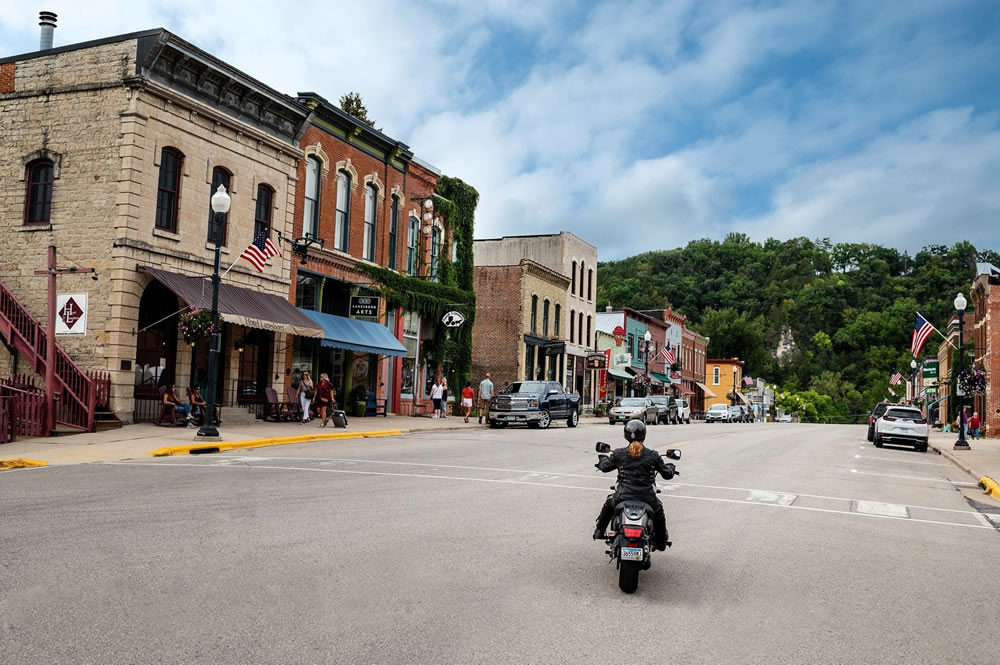
Case Study 1: A School Reimagined — Lanesboro, Minnesota
The Challenge
After a population rebound in the 1970s, Lanesboro, Minnesota, continued its long slow contraction typical of many small towns in the rural Midwest. This small town faced a familiar rural trajectory: declining population, underutilized buildings, and a downtown that was slowly losing its economic relevance. Historic structures remained, but many no longer had a clear purpose in the local economy.
The Solution
Rather than pursuing large-scale industrial recruitment, Lanesboro leaned into what it already had—its historic building stock and regional identity. Vacant and underused buildings were gradually repurposed into arts spaces, theaters, and locally owned businesses. The Lanesboro Arts Council brought the St. Mane Theatre to life, becoming a regional cultural anchor.
Over time, the town of less than 1,000 residents positioned itself as an arts and cultural destination, supported by heritage tourism and outdoor recreation. Preservation was not treated as a standalone effort, but as the foundation for a broader economic strategy.
The Trade-offs
Lanesboro’s success is real—but it did not happen quickly, and it required a sustained commitment that not every community can sustain. The town is small enough that a concentrated effort could shift its character meaningfully. In larger or more fragmented communities, replicating that coherence is harder. And like many arts-driven tourism destinations, Lanesboro faces the ongoing challenge of ensuring that its economy serves residents, not just visitors.
Why It Matters for Planners
Lanesboro demonstrates the power of alignment. Preservation, tourism, and local entrepreneurship were not pursued separately, but as part of a coherent vision. The result is a small town that attracts visitors without losing its identity—and where historic buildings are central to the local economy, not peripheral to it.
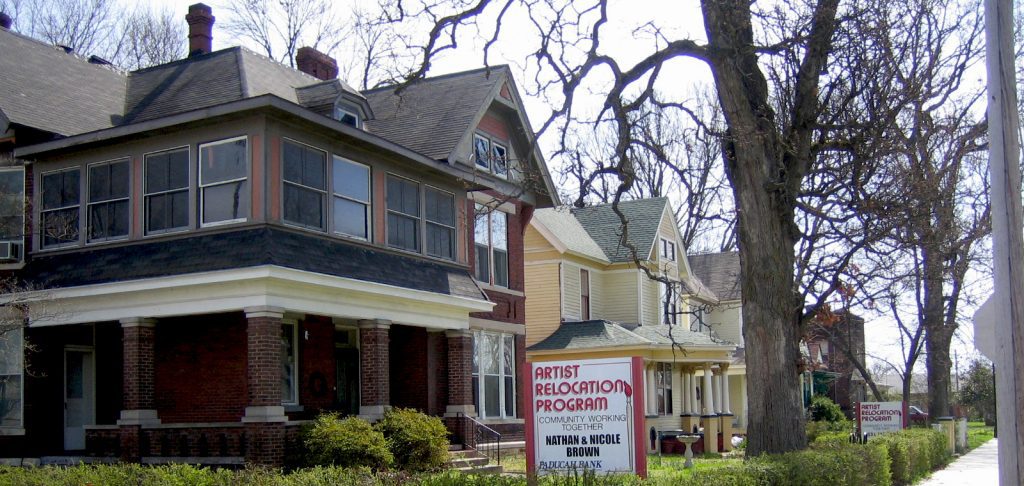
Case Study 2: Industrial Heritage as Economic Engine — Paducah, Kentucky
The Challenge
In the 1990s, Paducah, Kentucky, was dealing with long-term population contraction, and vacancy and disinvestment in its historic Lower Town neighborhood. Many buildings were structurally sound but economically dormant, and traditional redevelopment interest was limited.
The Solution
The city launched the Artist Relocation Program in March 2000, offering financial incentives and affordable property to artists willing to rehabilitate historic buildings. This approach leveraged preservation as both a housing strategy and an economic development tool.
Artists restored historic homes and storefronts, creating studios, galleries, and small businesses. Over time, the neighborhood transformed into a nationally recognized arts district, attracting visitors and investment while maintaining its historic character.
The Trade-offs
The Paducah model has been widely admired—and widely attempted, with mixed results. The success of the original program depended on timing, on relatively low property values, and on a city willing to take early financial risk. Communities that have tried to replicate it in different market conditions have sometimes found that artist relocation, without complementary housing policy, can accelerate gentrification rather than prevent it. The tool is powerful; it requires care.
Why It Matters for Planners
Paducah shows how targeted incentives can unlock private investment in historic structures. Rather than waiting for large developers, the city empowered small-scale actors to drive change. The model has won awards—including an APA National Planning Award and Kentucky APA recognition. The model is also replicable—but its replication requires honest assessment of local conditions, not just admiration of the outcome.
For what its worth, Paducah turned around their population trend and grew by 8.4% from 2010 to 2020, and estimates show accelerated growth today.
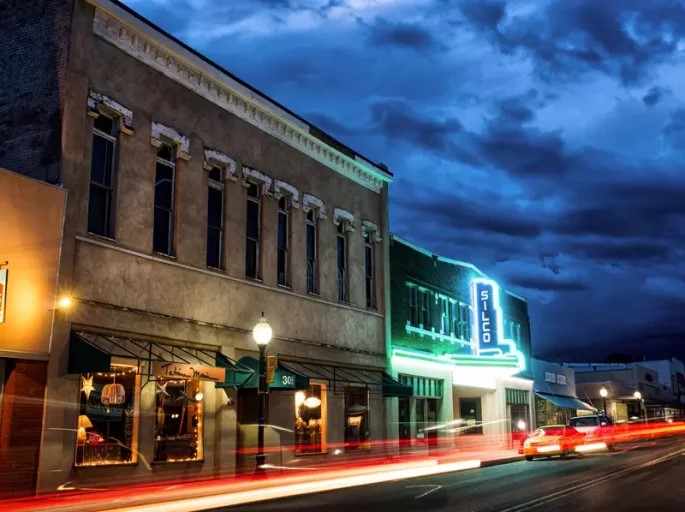
Case Study 3: Main Street as Strategy — Silver City, New Mexico
The Challenge
Silver City is a small town high up in the mountains of southwest New Mexico. After a rebound through about 1990, the community has experienced the decline common to many former mining towns. Its historic downtown remained intact, but vacancy and underinvestment limited its economic potential.
The Solution
Through participation in the Main Street America program, Silver City Mainstreet Project and Arts and Cultural District has adopted a structured approach to downtown revitalization rooted in preservation. Efforts focused on façade improvements, small business development, and consistent reinvestment in historic properties.
Rather than relying on a single transformative project, the strategy emphasized incremental change—supporting local businesses, improving the public realm, and reinforcing the value of existing buildings.
The Trade-offs
The incremental approach is resilient precisely because it does not depend on any single project succeeding. But it is also slow, and it requires sustained organizational capacity over many years. Communities without an active Main Street organization, or without civic leaders willing to play a long game, can find the pace frustrating. Incremental does not mean easy—it means patient.
Why It Matters for Planners
Silver City highlights the effectiveness of incrementalism. Preservation does not always require large capital projects; it can succeed through sustained, small-scale investment. For rural communities with limited resources, this approach is often the most realistic—and the most resilient.
I’m not just saying this because the folks I worked with at Consensus Planning helped write the Town of Silver City Comprehensive Plan and have helped out Silver City Mainstreet Program. Though they do a lot of really cool work across New Mexico.

What Makes Rural Preservation Projects Succeed or Fail
When Reuse Goes Wrong: A Cautionary Note
Not every adaptive reuse project succeeds—and the failures are worth understanding. A common pattern: a community identifies a prominent historic building, generates early enthusiasm, secures some initial funding, and then stalls. The building sits in limbo—too committed to demolish, too underfunded to complete. Years pass. The structure deteriorates. What began as an asset becomes an ongoing liability, and a source of community frustration rather than pride.
Many small towns have at least one stalled adaptive reuse or historic preservation project—a big building, a big idea, and not enough follow-through. Understanding why these efforts stall, and what makes others succeed, is essential if you want preservation to function as a real rural development strategy, not just a one-off grant project.
The causes are usually not architectural. They are organizational. Projects that fail tend to share a few characteristics: governance that was not sorted out early, a use that was identified without genuine market analysis, financing that depended on a single grant rather than a layered strategy, and a community process that generated consensus on paper but not real ownership in practice.
The lesson is not that ambitious projects should be avoided. It is that ambition needs to be matched with honest planning. A smaller project fully realized is almost always more valuable—economically and symbolically—than a larger project that drags on unfinished. Communities that have learned this tend to start with what is achievable: a single storefront, a modest renovation, a temporary use that builds momentum before committing to something permanent.
Process Ingredients for Success
What distinguishes successful projects from those that stall is rarely the building itself. More often, it comes down to process. Projects that succeed tend to have:
- Early and genuine community buy-in
- A clear understanding of market demand
- A phased approach to financing and development
- A willingness to start small and scale over time
In practical terms, that means getting governance right early, grounding reuse concepts in real market analysis, and building a layered, phased funding plan instead of betting everything on a single grant.
Adaptive reuse works best when it is incremental, strategic, and grounded in local conditions. It is less about the perfect master plan and more about a steady series of plausible next steps.
Organizational Alignment, Not Silver Bullets
One consistent challenge in doing all of this is institutional silos. Libraries have their own boards. School districts operate independently. Historic commissions work on their own timeline. Nobody is in a position to tell any of these bodies what to do—and they shouldn’t be. But they are all part of the same community infrastructure.
The communities that make preservation work tend to be the ones that find ways to bring these actors into the same conversation, even informally. A church committee talking with the local economic development office. A school board member sitting in on Main Street meetings. A county commissioner who understands how the local historical society fits into a broader strategy. The building is never really the hard part.
How These Cases Connect
Taken together, these examples reinforce a central idea: historic preservation is not a niche strategy. It is a flexible, scalable approach to economic development that can be adapted to local conditions.
In each case, the starting point was the same—existing buildings that had lost their original function. The outcome, however, depended on how communities chose to respond. And in each case, the path was neither straight nor fast. Communities first recognized what they had, then experimented with how to use it, and learned—sometimes the hard way—what made projects sustainable.

Takeaway: Preservation = Identity + Economy
Historic preservation is often framed as a cultural exercise, separate from economic development. In reality, the two are deeply connected.
For rural communities, this connection is particularly powerful. Limited access to capital makes large-scale new development difficult. But existing buildings—already located, already built, already part of the community fabric—offer a different path forward. The return on preservation is not just financial, though that matters. It is also social and cultural. It reinforces identity, supports local businesses, and creates spaces where community life can continue to unfold.
For planners and local leaders, the implication is clear. The question is not whether to invest in preservation, but where to begin.
In many cases, the answer is already there—standing on Main Street, sitting at the edge of town, anchoring the corner of a neighborhood that used to feel more alive than it does today. The task is not to build something new. It is to see what is already there, more clearly than before.
The Next Challenge
Buildings alone do not create economic resilience. The next challenge for rural communities is ensuring that the people who live and work in these places can fully participate in that growth—something that depends heavily on how education systems and facilities are structured and aligned with local economies. As we will see in our next article, the school building itself is often the most loaded question of all.

Read More: Historic Preservation and Rural Economic Development
For planners and community leaders interested in the intersection of historic preservation and economic growth, the following resources offer practical guidance, proven models, and real-world case studies.
Books
- The Economics of Uniqueness: Investing in Historic City Cores and Cultural Heritage Assets for Sustainable Development (PDF) by Licciardi & Amirtahmasebi, ed. (The World Bank, 2012). A foundational work on how historic preservation drives economic value, particularly through place identity and heritage tourism.
- The Economics of Historic Preservation: A Community Leader’s Guide by Donovan D. Rypkema (National Trust for Historic Preservation, 1994 and 2005)
- Rural by Design: Maintaining Small Town Character by Randall Arendt – First Edition (APA 1994) and Second Edition (Routledge, 2019). Explores how rural communities can grow while preserving their character, with practical insights into land use and built form. Check your library!
- The Smart Growth Manual by Andres Duany, Jeff Speck, and Mike Lydon (McGraw Hill, 2009). A practical reference for planning strategies that support walkable, economically resilient communities—including the reuse of existing buildings.
Case Studies & Applied Practice
- Main Street America — https://www.mainstreet.org One of the most effective national models for downtown revitalization through preservation, small business support, and incremental development.
- National Trust for Historic Preservation — https://savingplaces.org Extensive case studies, toolkits, and research on adaptive reuse, historic districts, and community-led preservation.
- USDA Rural Development – Community Facilities — https://www.rd.usda.gov/programs-services/community-facilities Funding programs and examples of rural communities leveraging existing buildings for civic and economic purposes.
- Measuring Economic Impacts of Historic Preservation. A report to the Advisory Council on Historic Preservation by PlaceEconomics — https://www.achp.gov/sites/default/files/guidance/2018-06/Economic%20Impacts%20v5-FINAL.pdf
Tools, Policy, and Funding
PlaceEconomics — https://www.placeeconomics.com Research and data on the economic impacts of preservation, including ROI comparisons and redevelopment outcomes.
Federal Historic Tax Credit Program (National Park Service) — https://www.nps.gov/subjects/taxincentives/index.htm Overview of the 20% federal tax credit for rehabilitating income-producing historic buildings.
Advisory Council on Historic Preservation — https://www.achp.gov Guidance on preservation policy, federal partnerships, and project review processes.
FAQ: Historic Preservation and Rural Economic Development
- How are historic buildings and sites part of a community’s essential facilities?
Historic and cultural sites house services, events, and gathering spaces—supporting daily life much like schools, libraries, or parks, while also preserving local identity. - Is historic preservation really an economic development strategy for small towns?
Yes. When rural communities reuse historic buildings for housing, small businesses, and tourism, they create new revenue and jobs while protecting their identity. - How can a rural community start an adaptive reuse project?
Start with a community asset inventory, a basic market analysis, and a small, achievable project that proves the concept before tackling the biggest building in town. - What funding sources are available for rural historic preservation?
Common tools include the Federal Historic Rehabilitation Tax Credit, state historic tax credits, and Main Street-style downtown revitalization programs, alongside local fundraising and philanthropy.
More from JCShepard(dot)com
In April, we are looking at Community Facilities, including historic sties and educational infrastructure, as part of the Comprehensive Plan process. I will also be participating in the American Planning Association’s annual National Planning Conference. This year #NPC26 is in Detroit, Michigan.
Our March series on Economic Development:
- What is Economic Development in Modern America? A Field Guide for Small Towns and Rural Places https://jcshepard.com/2026/03/what-is-economic-development-in-modern-america/
- Understanding Your Rural Economy—Jobs and Income and Why Headlines Never Tell the Whole Story https://jcshepard.com/2026/03/understanding-your-rural-economy/
- From Retention to Renewal: How BRE and Entrepreneurship Power Real Economic Development https://jcshepard.com/2026/03/from-retention-to-renewal-bre-entrepreneurship-economic-development/
- Front Porches and Paychecks: Housing, Quality of Life, and Economic Development https://jcshepard.com/2026/03/housing-quality-of-life-and-economic-development/
- How Global Trade Can Make or Break Rural Economies https://jcshepard.com/2026/03/global-trade-make-break-rural-economies/
Our August 2025 series on Rural Development:
- Rethinking the Rural Economy: New Paths, New Possibilities for Growth
- Business Retention in Small Towns: The Quiet Powerhouse of Rural Job Growth
- From Main Street to the World: Rural Entrepreneurship in Action
- The Rural Comeback: How Small Town Innovation Sparks Growth
- The Canadian Perspective on Rural Resilience
2026: Bring Your Plans to Life – Monthly Themes Preview
RuralStrong Podcast (Season 1 Episode 36)
Now playing on Youtube (audio), Spotify, and Apple Podcasts (February 2026). Transcription on the blog here.
Rural-Ready Engagement: Practical Tools for Small Town Planners
 Watch the full replay: youtube.com/@Engaging-Communities (February 2026)
Community engagement can look very different in small towns and rural communities. This webcast was co-sponsored by the APA Community Engagement Interest Group and the Small Town & Rural Planning Division.
Popular posts on JCShepard.com
- The Planning Process—From Vision to Action in Small Towns and Rural America (January 2026)
- Reviving Rural America: Why Heritage Tourism Is a Game-Changer Now (September 2025)
- What is Economic Development in Modern America? A Field Guide for Small Towns and Rural Places (March 2026)
- Rural Housing Supply Crisis: Why Small Towns Are Running Out of Homes (February 2026)
- How Small Towns Succeed: A Proven Playbook for Rural Action (November 2025)
- The Rural Comeback: How Small Town Innovation Sparks Growth (August 2025)
- How Small Towns Can Build a Strong Outdoor Economy Without Selling Out (June 2025)
Check out The 12 Planning & Sustainability Books You Need in 2026 and browse through the Small Town & Rural Community guides on our Resources page.
(As an Amazon Associate, we may earn commissions from qualifying purchases. Check your local library or bookshop, too.)
.

1 Comment
Heritage as Civic Infrastructure
Financing historic cities for housing, livelihoods, and resilience
By Bonnie Burnham – May 27, 2026
Historic city centers should be treated as civic infrastructure—platforms for housing, livelihoods, climate resilience, and community wealth—rather than as fragile museum pieces or tourist backdrops.
https://impactentrepreneur.com/heritage-as-civic-infrastructure/