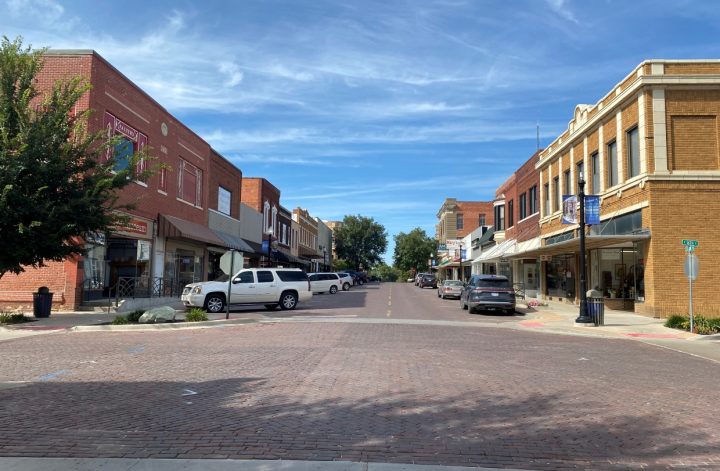
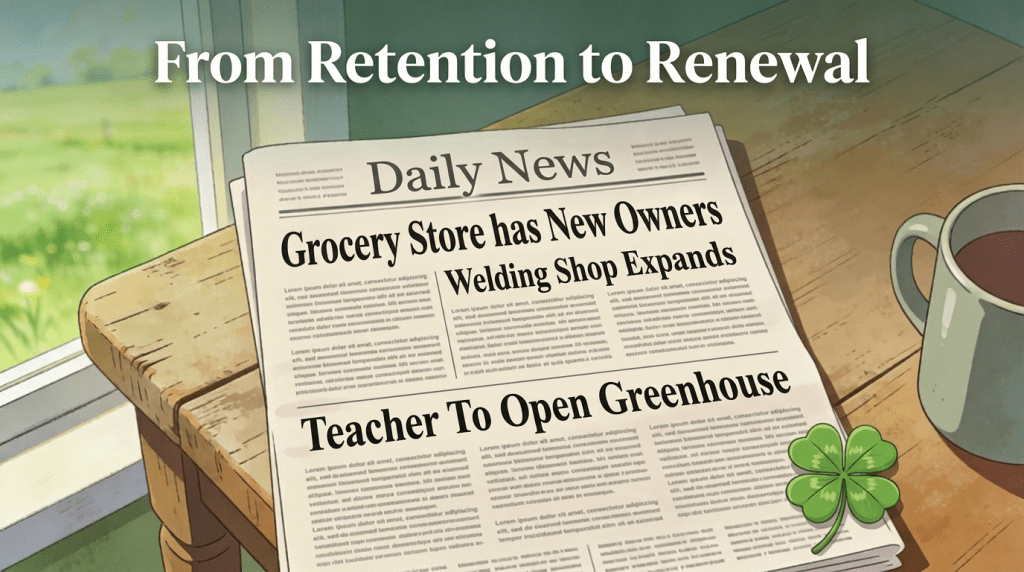
If you spend any time in the trenches of local government or economic development, you learn pretty quickly that the story on the front page and the story on the ground are not the same thing. The press release might celebrate a new plant or a ribbon cutting, but the real test of a local economy is quieter: Will the grocery still be open in five years? Can the welding shop find workers and space to grow? Does the teacher with a side hustle ever get a shot at a storefront?
On paper, “economic development” is about jobs, tax base, and investment. In practice, it’s about whether the businesses that are already betting on your community believe they have a future there—and whether the next generation of local owners sees a way in. That’s where two workhorse strategies come together:
- Business Retention & Expansion (BR&E).
- Entrepreneurship‑led development
In most communities, the bulk of net new jobs come from firms that are already on the tax roll, not from the next “big catch.” In rural areas, that’s even more true. BR&E and entrepreneurship aren’t side projects tacked onto a recruitment strategy; they are the core of a modern local economic development playbook.

What Economic Development Really Looks Like on the Ground
If you work in a public position long enough, you notice a pattern. The “big wins” on the front page matter, but the day‑to‑day health of the local economy comes down to quieter stories, the ones you hear in coffee shops, on shop floors, and at school open houses. The local stories:
- The family grocery store that manages a smooth ownership transition instead of closing when the owner retires.
- The welding shop that adds three employees and starts exporting to a new region.
- The teacher who turns a side hustle into a Main Street storefront or backroad greenhouse.
Those are not the kinds of announcements that get a governor to town or make the national business pages. But in a rural county or a small city, they’re the difference between a community that slowly thins out and one that finds ways to keep people, services, and opportunity in place. Lose the grocery, lose the hardware store, lose the one shop that still hires welders, and you feel it in school enrollment, in housing demand, in whether anyone wants to buy the house at the end of the block.
From manufacturing and mining to tourism and public service, rural economies and economic development across the United States are powered by a wide array of industries that shape local resilience, identity, and opportunity.
On paper, economic development is about jobs, tax base, and investment. On the ground, it’s about whether your existing employers feel like they have a future in your town, and whether new ideas can find enough support to take root. It’s about whether the banker will take a meeting on that expansion plan, whether the zoning code quietly chokes off home‑based businesses, whether the local development group returns calls when someone wants to buy a building on Main Street.
As noted by the Organization for Economic Co-operation and Development (OECD), “Empowering SMEs and entrepreneurs is crucial to sustainable and inclusive growth.” Small and medium‑sized enterprises and local entrepreneurs are the lifeblood of local economies and communities, and they are central to job creation, resilience, and long‑term competitiveness. In other words, if you ignore the small and mid‑sized firms you already have—and the people who want to start the next one—you’re ignoring the main engines of your own economy
That’s where two core strategies come in for asset-based community development:
- Business Retention & Expansion (BR&E): the work of listening to your existing businesses, solving problems, and helping them grow.
- Entrepreneurship‑led development: the work of making it easier for people to start and grow new businesses that fit your place.
The research backs up what many local practitioners have seen for years. New and young firms are responsible for most net new jobs in the U.S., while older firms hold most of the employment but add relatively few jobs on net. At the same time, a large majority of those jobs stay rooted in the communities where firms start and expand, not in the small share of jobs that move because of recruitment or relocation deals. As I’ve noted before, in most communities, 60–80 percent of net new jobs come from existing firms, not recruitment—and in rural areas, that share can be even higher.
That’s why BR&E and entrepreneurship aren’t side projects; they’re the core of the modern economic development system. They are how you tend the employers who are already here, and how you make room for the next wave of local owners who will keep the lights on downtown when today’s owners are ready to hand over the keys.

BR&E: The Quiet Powerhouse of Local Job Growth
As we discussed last summer (“Business Retention in Small Towns: The Quiet Powerhouse of Rural Job Growth”), job creation isn’t necessarily about attracting new employers—it’s about making sure the businesses you already have can thrive. This isn’t new. We just seem to be realizing how important it is.
What BR&E Really Is
Business retention and expansion (BR&E) is simple to describe and surprisingly hard to do well. BR&E works best when you treat local firms as core customers of your economic development organization and build a systematic, ongoing support system around them. It’s really about building relationships between job creators and your community.
At its core, BR&E is a structured way to:
- Regularly talk with local business owners and managers.
- Understand their needs and plans.
- Fix the things you can fix—or connect them to people who can.
- Track what you’re hearing so it changes how you invest and plan.
To build a successful BR&E effort, it helps to make existing businesses a top priority: they are already invested taxpayers and employers, and supporting their growth is usually more cost‑effective and less speculative than recruitment. BR&E should be an ongoing process of relationship building, not a one-off survey or annual visit. And it may seem obvious, but focus n both “retention” (solving problems, addressing risks) and “expansion” (unlocking growth opportunities, new markets, new products).
Adapting to Rural Realities
In urban and metro areas there are usually paid staff who do BR&E every day, all year long. In small towns and rural counties, is usually means all-hand-on-deck type of work bringing together professionals and volunteers. It’s showing up at odd hours to match shift schedules. It’s reassuring owners that you aren’t there to write them up; you’re there to help. It’s following up when you say you will.
Formal surveys and software matter less than three easy hacks (I’ve wondered how to bring that dred SEO term into an article):
- Consistency: you keep showing up.
- Confidentiality: owners trust you with the real story.
- Follow‑through: you actually do something with what you hear.
The need for confidentiality lends itself to BR&E work landing with non-profit economic development organizations or chambers of commerce, rather than governmental agencies. Yet it’s all about delivering results—that matters more than job titles.
Three Core BR&E Moves
Over the years, three pieces of BR&E work have proven especially important in rural places.
Early warning and problem‑solving
You listen for signs of trouble: a key contract lost, a landlord ready to sell, a chronic hiring problem, a utility issue. When you catch these early, local leaders can sometimes:
- Restructure a deal.
- Help find new space.
- Connect employers to workforce programs.
- Prioritize infrastructure where it’s actually needed.
Locally rooted finance
Many smaller firms don’t need venture capital; they need the last 20 percent on a building rehab, a piece of equipment, or a new production line. Communities use BR&E findings to justify tools like:
- Revolving loan funds managed locally or regionally.
- Partnerships with local banks and credit unions.
- Gap financing tied to job retention or modernization.
Succession and ownership transitions
The biggest threat to your business base isn’t always competition—it’s retirement (especialy in small towns). BR&E visits are often the first place you hear, “I’d like to retire in a few years, but I don’t know who would take this over.”
When you treat that as a core BR&E issue, not a private problem, you can:
- Match retiring owners with local buyers or employees.
- Explore ESOPs or worker ownership.
- Bring in technical assistance on valuation and transition.
A successful transition can “retain” 10 or 20 jobs in a single stroke and protect a critical service—like a grocery, pharmacy, or repair shop—that anchors the town. It’s not easy, but it’s worth it.
A Composite Upper Midwest Scenario
Picture a rural county on the Red River’s North Dakota–Minnesota state line, up near Canada. Manufacturing, ag services, and health care anchor the economy. A small regional development group, working with Extension and local lenders, launches a simple BR&E effort:
- They compile a list of 75 key employers.
- Over a year, they visit 30 of them with a short, standard set of questions.
- In the process, they discover:
- One 40‑employee manufacturer is outgrowing its space but doesn’t know where to go.
- A long‑time grocery store owner is five years from retirement with no obvious buyer.
- Several shops are struggling with housing for new workers.
Those conversations trigger action:
- The County and City leaders work together on a site and financing package so the manufacturer can build an expansion—without leaving town.
- The BR&E team connects the grocer with a younger couple already running a deli; a rotation of advisers helps structure a sale.
- The housing concern shows up repeatedly, so the county moves workforce housing projects up the priority list.
None of these stories make national news. But they’re the backbone of the local economy.

Entrepreneurship: From Main Street to the World
Where BR&E tends the existing forest, entrepreneurship plants new trees. Entrepreneurship works best as an economic development strategy when you treat it as ecosystem-building, not just startup promotion, and when you design it as a long-term, data-driven, inclusive, and locally grounded effort. In the face of shifting rural markets, homegrown may be your community’s best bet for new growth and development.
Start with Strategy and Build the Ecosystem
Small businesses have a big impact, and every large business was once but an idea. That said, the cumulative impact of small businesses can be transformative. That goes for growing employment, but also stimulating demand for local suppliers, generating tax revenue, and revitalizing main streets.
An intentional entrepreneurship-led economic development strategy is anchored in your region’s assets, industry strengths, and demographics. Start with your planning process—access conditions, define a vision, set goals, and plan for regular updates and course correction. Just remember to treat this as a complement (not afterthougt) to the rest of your economic development playbook.
One way to build an entrepreneurial ecosystem starts with a focus on systems—finance, talkent, knowledge, culture, networks, and supportive regulations; a bottleneck in any of these can stall the whole process. Support intermediaries such as incubators, accelerators, co‑working spaces, and SBDCs that connect entrepreneurs to mentoring, capital, and customers. Then you will be ready to invest in networks, peer groups, founder meetups, and sector clusters (e.g., food, digital, makers) so entrepreneurs can share know‑how and opportunities.
Here is where the extroverts in the audience shine: Center some Attention on your Startups. Identify successful local growth firms and founders and build strategy around them—engage them as advisors, champions, and co‑designers of programs. Experts like the Kaufmann Foundation suggest we prioritize reducing everyday friction for small and growing firms: permitting, licensing, procurement, and navigation of city services. Other observers also point out how important it is to make independent and locally owned businesses a core pillar, not just high-tech startups, because they create jobs, boost place vitality, and drive local recirculation of dollars (or pounds, or euros).
And here is where the introverts (at least the data-driven ones) shine: Use Your Data. Regularly map and assess your entrepreneurial ecosystem to identify bottlenecks, track changes over time, and target interventions. Collect and analyze data on local growth firms: jobs created, wages, export growth, capital raised, and program usage, then share results with stakeholders. Last week we discussed primary data sources like the US Census, Bureau of Economic Analysis (BEA), and Bureau of Labor Statistics (BLS), as well as easy dashboards from providers like CORI and Headwaters Economics. Aggregators and service providers are starting to emerge, especially around AI value-added analysts like aLocal.ai specifically focused on economic development and local policy.
As they say, what gets measured gets managed. Build in monitorign and evaluation for every initiative, with clear key performance indicators (you know, KPIs in management-speak), baseline indicators, and review cycles). Scale what works and adjust what doesn’t.
How Rural Entrepreneurship Actually Looks
Last summer, I wrote about entrepreneurship. Rural entrepreneurship in particular is deeply rooted in relationships and local assets, with business owners responding directly to community needs and relying heavily on trust and word‑of‑mouth.
- Rural entrepreneurs often build on natural landscapes, agriculture, heritage crafts, and cultural traditions, giving their businesses a distinctive, place‑based authenticity.
- Lower real estate and labor costs are offset by thinner supply chains, smaller labor pools, and tougher access to capital, which pushes owners toward higher ingenuity and multi‑role models like farms that also host weddings or cafés that double as local markets.
- Challenges—broadband gaps, small customer bases, limited professional networks, and local cultures that may or may not reward risk—require targeted community support and regional collaboration if rural entrepreneurs are going to thrive rather than just hang on.
In metro areas, we often picture entrepreneurship as tech startups in glass towers. In rural America, it looks different:
- A ranch family in Montana adding agritourism and direct‑to‑consumer beef sales.
- A Minnesota machinist leaving a big employer to launch a 10‑person shop serving specialized regional clients.
- A Nebraska teacher turning a side baking business into a downtown bakery and coffee shop.
- A Colorado outdoor guide running both in‑person trips and an online gear shop.
Rural entrepreneurs build on what’s already there—landscapes, heritage, trade skills, relationships, and lower costs of living. They also increasingly sell beyond the local market: online, regionally, even globally.
Last year, I also highlighted case studies such as Sarah Calhoun & Red Ants Pants in White Sulphur Springs, Montana; and Farfield, Iowa’s entrepreneurial hub. In Appalachia, for example, EntreWorks Consulting has studied initiatives like ACEnet in Athens, Ohio, and Opportunity SWVA in southwest Virginia, whose leaders built regional entrepreneurial ecosystems by networking service providers, offering shared facilities (like food processing or co‑working), and coordinating capital and technical assistance.
How do we go about serving this market as economic development professionals, especially in rural areas? Anchor yourself in rural assets and social infrastructure, adapting universal systems for the needs of smaller places.
Start by mapping local assets: existing firms (farms, trades, tourism, services), civic groups, schools, hospitals, broadband, and key natural or historic amenities. Build an “entrepreneurial social infrastructure”: trusted local leadership teams, cross‑sector partnerships, and regular spaces where entrepreneurs and civic leaders interact. And treat quality of life (schools, childcare, health care, housing, parks, third places) as a core entrepreneurship strategy, because it directly affects your ability to retain and attract founders.
The Ecosystem Entrepreneurs Need
Entrepreneurship is not just about individuals with grit; it’s about systems that make their life easier. Rural entrepreneurship-led economic development works best when you build social infrastructure and regional capacity around local businesses, not just isolated programs or incentives. It may help to design a purpose-led rural-right implementations tructure, with small steering groups and simple ecosystem assessments. Hey, why not go for broke and work regionally with neighboring towns or counties to share staff, marketing and specialized services? It’s been done and you can do it just as well.
In a typical small town, the entrepreneurial infrastructure might include tailored support and and tools to address gaps in capital:
- Skills and advice: SBDCs, Extension, CDFIs, community colleges, and experienced local owners who can coach on finance, marketing, and operations. Remember confidentiality. Don’t forget succession planning.
- Shared spaces: co‑working rooms in the library, a commercial kitchen in a church basement, maker or light‑industrial space in a previously vacant building. If you are brave, talk to your high school about integrating entrepreneurship into their programs and opening up school facilities to the community.
- Flexible capital: microloans, local funds, and patient bank credit to bridge the gap between a good idea and a bankable track record. Leverage federal and state programs that are designed for rural micro and small businesses (e.g., USDA’s Rural Microentrepreneur Assistance Program and related loan/TA programs)
- Supportive rules: rework you zoning to allow live‑work space, home‑based businesses, pop‑ups, and incremental downtown rehab. Incentivize the good stuff.
Culture matters too. Communities that normalize side hustles, test‑and‑learn experiments, and collaboration between businesses see more people step forward. Results may vary.
A Composite Mountain States Case
Imagine a small town in western Montana or Colorado, near national forest land. Historically, the economy has relied on logging or energy. As those industries shift, the town leans into outdoor recreation and entrepreneurship:
- BR&E work identifies a cluster of existing guides, outfitters, and small hospitality businesses that are all fighting the same issues: housing, marketing, seasonality.
- The town creates a small downtown co‑working space and shared gear‑storage facility in a vacant building.
- A state‑supported program brings in cohort‑based training for outdoor‑sector entrepreneurs.
- Local lenders and a regional fund collaborate on microloans for building rehabs and equipment.
Over time, the town supports:
- More stable guide businesses with year‑round lines of income.
- A few product companies (maps, art, gear) selling globally.
- New Main Street activity tied to coffee, food, and gear shops.
Again, none of this is “one big win.” It’s many small, connected wins.
CORI Rural Entrepreneurship Index
The Center on Rural Innovation (CORI) has developed the Rural Entrepreneurship Index, an online tool—they have a bunch of cool online analytics—which gives local leaders a practical, data‑driven snapshot of where their community sits on the path toward a stronger entrepreneurial ecosystem and what they can learn from peers around the country. By pulling together 11 real‑world indicators—things like new business formation, self‑employment, investment, and job growth—it offers a usable dashboard for seeing how homegrown entrepreneurship can shore up resilience, build local wealth, and support long‑term prosperity.
Butler County, Nebraska (my current home town), is in the 12th percentile of the National Entrepreneurship Index and 18th percentile of the Rural Entrepreneurship Index. A higher value is more robust and dynamic. Our business creation rate is about 7-8%, a point below the rural (non-metro) average, while our business exit rate is only 5% compared to the 9% rural average. The job creation rate is 11-15%, right around the rural average of 13%. We could do better; we could do worse.
In general, counties in the Rocky Mountains and other amenity areas tend to score higher on the Entrepreneurship Index. Archuleta County (Pagosa Springs), Colorado, scores in the 93rd percentile. Laramie County (Cheyenne), Wyoming, surprisingly scores in the 97th. Unsurprisingly, Gallatin County (Bozeman), Montana, scores in the 98th. Yet there are outliers, like Jackson County, Minnesota in the 94th percentile—I give all the credit there to my old friends at the Southwest Regional Development Commission.

How BR&E and Entrepreneurship Fit Together
BR&E and entrepreneurship are sometimes presented as separate strategies. In practice, they feed each other.
BR&E as the Platform
When you do BR&E well, existing businesses feel heard and supported. You have better intelligence about your real economic base, and you uncover new ideas and transitions early.
Those same visits that surface problems also surface opportunities. Perhaps, you connect with a manufacturer whose niche product could be spun off into a new firm. A retiring owner may be open to an employee buy‑out, with the right technical assistance and assurance of confidentiality. Or you might learn about a property owner with vacant building that could host multiple micro‑shops inside one shell.
BR&E gives you a front‑row seat to the next generation of entrepreneurs—and the assets they’ll need.
Entrepreneurship as the renewal engine
Entrepreneurship then steps into the gaps that BR&E reveals—new owners for existing firms, new uses for underused buildings, new products to serve changing markets. Support for start-ups helps diversify the business base so the next downturn doesn’t hit as hard. And it comes full circle when you attract or retain residents who want a chance to build something of their own.
You can picture a simple flywheel:
- Listen – BR&E conversations uncover needs, risks, and ideas.
- Fix – You address systemic problems (permits, utilities, rules, small capital).
- Renew – Entrepreneurs and new owners take advantage of the improved environment.
- Reinforce – “Shop local,” heritage tourism, and cultural efforts keep money and people in the system.
Turn that flywheel long enough, and “economic development” starts to look less like chasing anything that moves and more like tending a living system.
A Word About Economic Gardening
Economic gardening is an entrepreneurial, “grow from within” approach to economic development that focuses on helping existing local businesses—especially second‑stage firms—accelerate growth, create jobs, and build community wealth over time.
Economic gardening emerged in Littleton, Colorado in the late 1980s, when local leaders chose to support homegrown entrepreneurs instead of recruiting outside firms after a major employer downsized. Chris Gibbons and colleagues developed the concept as an alternative to “economic hunting,” as coined by my old boss Phil Burgess, then at Center for the New West in Denver. Chris argued that communities should stay home, “water, fertilize and weed” their existing business base. Over roughly two decades, Littleton’s job base doubled and sales tax revenues rose substantially, helping establish economic gardening as a tested model. Chris is one of the good guys.
Economic gardening programs typically concentrate on second‑stage companies (roughly 10–100 employees and around 1–50 million dollars in revenue) that have proven products and capacity to scale but lack sophisticated market intelligence and strategy tools. Teams provide high‑end services—GIS and market analytics, customer and competitor intelligence, web and SEO analysis, and strategic coaching—once only accessible to large corporations. Rather than subsidies, the emphasis is on solving growth bottlenecks, identifying promising markets, and aligning internal strategy frameworks so firms can add jobs and investment locally.
The big thinkers describe economic gardening as an economic development model that assumes entrepreneurs are the primary drivers of job and income growth. The National Center for Economic Gardening frames it as the “gold standard” entrepreneurial approach, focused on stage‑2 companies and rooted in five core strategic frameworks to uncover and address root causes of slow growth. The Edward Lowe Foundation and others characterize it as a long‑term, community‑centric “grow from within” strategy, not a quick fix or incentive deal.
Economic gardening centers local entrepreneurs, encourages reinvestment of locally generated wealth, and aims to build a resilient base of firms that are embedded in the community. Advocates argue that making entrepreneurial support a standard part of the economic development portfolio diversifies strategies and reduces dependence on a few footloose employers.
While I have urged rural development practitioners to get to know economic gardening, the level of resources required for a full-on program is substantial. As small town & rural planners, there is a lot to learn in Chris’ project, which has fully taken on a life of its own. That said the program also scales to states and regions. It just takes time, effort, and some open minds helps as well.

Lessons for Rural America
Although every place is different, the regions I’ve lived and worked in show consistent patterns in how BR&E and entrepreneurship play out. I know there are good case studies from outside the United States, but we’re going with my lived experience for the most part, this week. I did read up some last summer and wrote about our friends north of the Border in The Canadian Perspective on Rural Resilience.
Go ahead and relate your experiences with rural economic development in the comments—share your joy.
Upper Midwest
Minnesota Extension’s rural BR&E efforts (as shared by U Wisconsin Extension) show that systematic surveys, community action teams, and follow‑through can strengthen local business conditions and inform infrastructure, workforce, and housing decisions over many years. The University of Minnesota’s Connecting Businesses and Community Program (CBC, formerly known as the BR&E Strategies Program) has operated continuously since 1990.
North Dakota State University Extension’s Leadership and Civic Engagement program has consistently promoted BR&E and entrepreneurship as primary, cost‑effective development strategies for North Dakota communities. The University of North Dakota’s Center for Innovation in Grand Forks has long supported entrepreneurship with sector‑based rural development and incubator programs. Both were great help when I was starting out at Traill County EDC years ago.
South Dakota State University Extension’s Community and Economic Development program promotes the Integrated Youth Engagement Process of “Energizing Young Entrepreneurs,” arguing that rural communities can stabilize population and keep schools open by equipping and supporting young people to start businesses locally. They emphasize integrating entrepreneurship concepts into K–12 and postsecondary courses, building support systems for new ventures, and treating entrepreneurs as the backbone of rural economies rather than a niche group.
Consistent outreach plus local and state technical assistance can move a surprising amount of the needle without massive budgets.
- County‑level or regional BR&E efforts identify manufacturing and ag‑related firms that are ready to modernize or expand—but need help with space, workforce, or finance.
- Extension and SBDC partners bring structured BR&E surveys and follow‑up coaching.
- Small‑town manufacturers and service firms quietly add jobs, while younger entrepreneurs step into ownership of long‑standing businesses.
Rocky Mountains
Montana is really two states—the fast-growing, amenity-rich mountains attracting tourists and California refugees, and the rest of the Big Sky state of long roads and more cattle than people. In between the native nations remain. Accelerate Montana’s Rural Innovation Initiative (AMRII), based at the University of Montana, has provided entrepreneurial coaching and support specifically for rural and Indigenous communities across the state. Backed by an EDA University Center grant, AMRII offers workshops on startup fundamentals, pitch events, networking, and one‑on‑one coaching from idea through scaling, across industries from agriculture to tech. They’ve tailored programming over several years to “meet people where they are,” focusing on closing gaps in networks, know‑how, and access to support that rural and tribal entrepreneurs often face.
In the central Rockies, Startup Colorado has quietly built one of the more interesting rural entrepreneurship networks in the country. What started as a university‑linked initiative has grown into a Rural Entrepreneur Network that connects founders, mentors, and funders across the Western Slope, the San Luis Valley, the Eastern Plains, and mountain towns in between. Through an online platform, regional storytelling, cohort programs, and support for local pitch competitions, Startup Colorado gives rural entrepreneurs a way to see each other, learn from each other, and tap into capital and expertise that used to be locked inside the Front Range—making entrepreneurship feel less like a solo act and more like a shared project across small‑town Colorado.
Regionaly, RCAC’s Building Rural Economies program works with small Western communities to use BR&E interviews and workshops to identify local assets. The team then spins them up into projects like farmers and artisans markets tied to local products (for example, Hatch, New Mexico chile‑ and tourism‑based businesses—love me some Hatch green chile). The Building Rural Economies program also supported Lewistown, Montana, using a WealthWorks framework, with “ROC” workshops that helped residents identify local gaps and opportunities, then develop businesses to fill them. Community members focused on what they had—local trails, youth, and civic energy—rather than what they lacked, and raised around $850,000 locally for a trail‑linked project that won a Montana Economic Developers Association Innovation Award.
When planners, economic developers, and entrepreneurs pull together, place‑based assets turn into diverse local enterprises.
- Outdoor recreation towns leverage BR&E to understand their existing businesses’ pain points: housing, seasonality, marketing, and infrastructure.
- Entrepreneurship programs then focus on new guide services, creative industries, and remote‑work‑friendly businesses that build on those assets.
- Planning work—downtown form, housing policy, trail systems—becomes part of the economic development toolkit rather than a separate conversation.
Central Plains and Prairies
The St. Louis Fed has highlighted Ord, Nebraska, where my firm is working with Valley County on a new Comprehensive Plan. This small central Plains community (population 2,113) uses a local sales‑tax funded development fund, leadership development, and support for local startups and expansions to reverse population decline and grow local businesses, becoming a frequently cited rural ecosystem success story. And they are trying new ideas on a regular basis.
Further east, Iowa State University and America’s SBDC Iowa created Rural Business Innovators (RBI), a web‑based accelerator model designed specifically for rural innovators who can’t easily access metro programs. The Association of Public & Land Grant Universities reported on RBI delivery of customized one‑on‑one counseling, step‑by‑step guidance, and connections into the statewide entrepreneurial ecosystem, “turning the model inside out” so support goes to rural front doors instead of expecting entrepreneurs to come to campus.
Emporia, Kansas, is another example in a region where we’ve been working recently. Emporia (population 24,139) has combined a Main Street framework, zero‑interest loans, tax credits, housing investments, and incubator space over more than 20 years, helping fill downtown storefronts and grow local firms. Revitalizing Main Street is about more than fixing buildings; it’s about reweaving the social and economic fabric of an entire town. (I wrote more about Emporia last summer.)
Local control of even modest financial tools, paired with ongoing BR&E, can often be enough to keep anchor businesses in place and make room for new ones.
- Small towns and counties combine BR&E with local sales‑tax funds or revolving loan funds to support expansions and transitions.
- Leadership programs and youth engagement help seed the next generation of owners.
- Main Street work—upper‑story housing, storefront rehabs, shared spaces—creates room for both existing businesses and new ventures.
Great Lakes States
In Michigan, a pair of initiatives tand out. Northern Initiatives, a CDFI based in rural Marquette, provides loans and hands‑on technical assistance to small businesses, especially in rural and underserved communities across the U.P. and northern Michigan. Their model blends flexible financing with coaching on marketing, financial management, and operations, helping rural firms survive, expand, and transition ownership. This functions as both entrepreneurship support and BR&E: they keep existing businesses in place while backing new local owners and startups that mainstream finance often overlooks.
Tucked into the Keweenaw Peninsula on Lake Superior, Houghton, Michigan, (population 8,386) is a winter city and a college town. Michigan Tech’s Global Entrepreneur‑in‑Residence program shows how a rural university can turn brain drain into “brain gain” by using cap‑exempt H‑1B visas to anchor international founders in a small, remote community. As related by CORI, with support from Global Detroit, seven Michigan universities have placed 23 fellows across six companies, collectively raising nearly $30 million and creating 174 jobs (2024).
In rural Ohio, for another example, Ohio State Extension tells us how multiple counties came together in structured BR&E programs. led by Extension and local partners, to identify at‑risk firms and expansion opportunities, helping communities retain and create hundreds of jobs and leverage major public and private investments.
In transition regions, like the former rust belt, BR&E prevents sudden shocks while entrepreneurship opens new paths.
- Smaller manufacturing communities use BR&E to manage shifts in industry, catching early warnings and helping firms pivot.
- Entrepreneurship efforts diversify into creative industries, tourism, and tech‑adjacent services from downtown coworking spaces and former industrial buildings.
- Regional organizations play a big role, especially where one town doesn’t have staff to run a full program alone.
- Areas in sight of water tend to start attracting amenity migrants interested in trying new things.
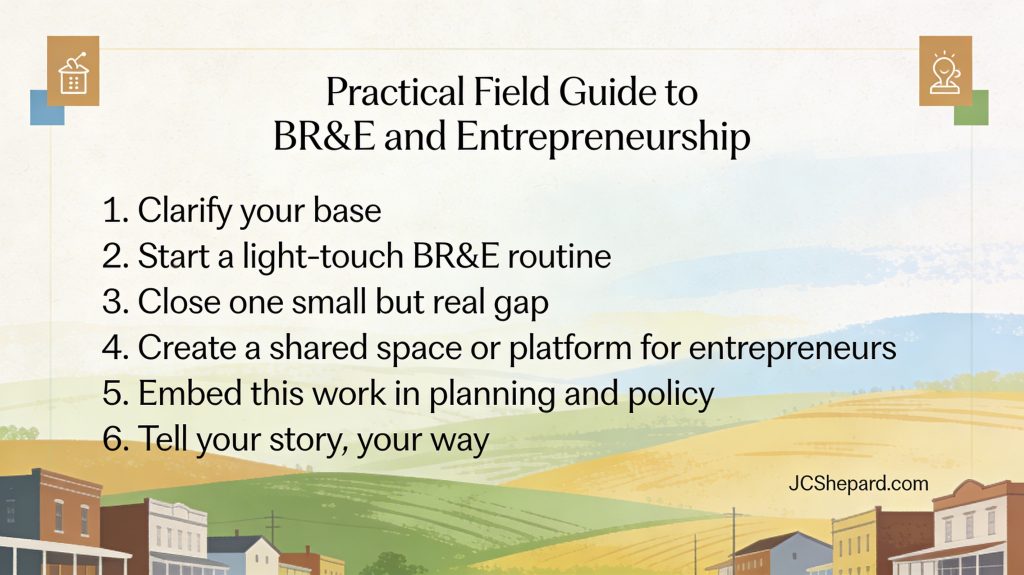
A Practical Field Guide to BR&E and Entrepreneurship
Whether you’re in a Great Plains county, a resort town in Montana, or a micropolitan region in Illinois, the basic economic development playbook can look similar.
1. Clarify your base
- Make a simple list of key employers and sectors
- Map your visible assets: farms, factories, rivers, railroads, parks, historic buildings, cultural anchors.
2. Start a light‑touch BR&E routine
- Commit to 10–20 structured business visits this year.
- Ask consistent questions about workforce, space, regulation, markets, and succession.
- Capture what you learn in a simple system and follow up.
3. Close one small but real gap
- Streamline a confusing permit.
- Launch or refresh a basic revolving loan or microgrant fund.
- Create an “ombudsman” role—even if it’s just you—so businesses know who to call.
4. Create a shared space or platform for entrepreneurs
- Start a monthly coffee for business owners and founders.
- Pilot a pop‑up market or shared storefront in a vacant space.
- Partner with Extension, SBDC, or a college to bring in training.
5. Embed this work in planning and policy
- Reflect BR&E findings and lessons from entrepreneurship programs in your comprehensive plan, downtown plan, and capital improvements.
- Make sure your zoning and incentives recognize small firms, home‑based businesses, and incremental development—not just big boxes and industrial parks.
6. Tell your story, your way
- Use your town’s heritage, landscapes, and culture as a brand, not a museum piece.
- Celebrate local owners and entrepreneurs as the protagonists of your economic story.
Economic Development in Modern America
Economic development in modern America isn’t about copying the flavor‑of‑the‑month strategy from somewhere else. It’s about becoming more fully yourselves: clearer about what you’re already good at, more honest about where people are struggling, and more deliberate about backing the neighbors who are quietly building your future.
If you treat BR&E and entrepreneurship as your daily discipline—showing up, listening well, fixing what you can—and treat entrepreneurship as your renewal engine, you start to see a different picture of “progress.” It looks like a grocery that finds a new owner instead of going dark, a shop that adds three good jobs instead of relocating, a young family that decides to stay because they can build something here and not somewhere else.
None of that makes for splashy groundbreakings. But stacked up over time, those wins are what keep the lights on downtown and the school bus running in the morning. That’s the work in front of us: not chasing the next big thing, but retaining and renewing the people and businesses already putting their livelihood on the line for the place you call home.
This is our 3rd post in this series on Economic Development for March 2026:
- What is Economic Development in Modern America? A Field Guide for Small Towns and Rural Places
- Understanding Your Rural Economy—Jobs and Income and Why Headlines Never Tell the Whole Story
Tune in next week for a discussion of Housing and Livability as Economic Development factors. This will follow-up a bit on February’s posts on the Housing crisis as well as explore some new ground. I’m on the road all week, so I’ll have to keep it focused and not be reading while I’m driving.

Resources
Books
- Business Retention & Expansion: Practical Steps for Local Leaders – Michael Darger et al.(Routledge, 2019)
- Small Town Economic Development: Reports on Growth Strategies in Rural America – Gonzalez, Kemp, & Rosenthal ed. (McFarland & Company, 2017)
- The Nature of Economies by Jane Jacobs (Random House Canada, 2000)
- Cities and the Wealth of Nations: Principles of Economic Life by Jane Jacobs (Random House, 1984)
- The Economy of Cities by Jane Jacobs (Vintage / Ebury, 1970)
- Proudly Made: A Memoir by Tataboline Enos (Catamount Press, 2025). YES, an endorsement, even though this is not strictly an economic development book, Ta offers some profound insights on life and the economy of rural America.
- The New Geography Of Jobs by Enrico Moretti (Houghton Mifflin Harcourt, 2012)
Links
- USDA Rural Development (USDA-RD)
- US Small Business Administration (US SBA)
- US Economic Development Administration (US EDA)
- National Association of Development Organizations (NADO)
- Southwest Regional Development Commission (SRDC), Minnesota
- Southeast Nebraska Development District (SENDD)
- The Center on Rural Innovation (CORI) Rural Innovation Network
- CORI Rural Economic Development Toolkit
- Headwaters Economics Economic Profile System
- Business Retention & Expansion International (professional association)
- IEDC – Why A Business Retention and Expansion Program Matters (PDF)
- Met Council (Minnesota) – Business Retention & Expansion – Local Planning Handbook (PDF)
- National Center for Economic Gardening
- Edward Lowe Foundation
- Ewing Marion Kauffman Economic Gardening Resources
- Rural opportunity, national prosperity: An Economic Development Strategy for rural Canada (website or PDF)
- Rural on Purpose (website)
More from JCShepard(dot)com
Our August 2025 series on Rural Development:
- Rethinking the Rural Economy: New Paths, New Possibilities for Growth
- Business Retention in Small Towns: The Quiet Powerhouse of Rural Job Growth
- From Main Street to the World: Rural Entrepreneurship in Action
- The Rural Comeback: How Small Town Innovation Sparks Growth
- The Canadian Perspective on Rural Resilience
2026: Bring Your Plans to Life – Monthly Themes Preview
RuralStrong Podcast (Season 1 Episode 36)
Now playing on Youtube (audio), Spotify, and Apple Podcasts (February 2026)
Rural-Ready Engagement: Practical Tools for Small Town Planners
 Watch the full replay: youtube.com/@Engaging-Communities (February 2026)
Community engagement can look very different in small towns and rural communities. This webcast was co-sponsored by the APA Community Engagement Interest Group and the Small Town & Rural Planning Division.
Popular posts on JCShepard.com
- Reviving Rural America: Why Heritage Tourism Is a Game-Changer Now (September 2025)
- How Small Towns Succeed: A Proven Playbook for Rural Action (November 2025)
- The Rural Comeback: How Small Town Innovation Sparks Growth (August 2025)
- How Small Towns Can Build a Strong Outdoor Economy Without Selling Out (June 2025)
Check out The 12 Planning & Sustainability Books You Need in 2026 and browse through the Small Town & Rural Community guides on our Resources page.
(As an Amazon Associate, we may earn commissions from qualifying purchases. Check your local library or bookshop, too.)
.