
Part One of our series on Implementation of your comprehensive plan.
Back on Standard Time
The clocks fell back overnight, back on Standard Time where we belong. The sun will be out before we go to work Monday morning here in the center of the Central Time Zone.
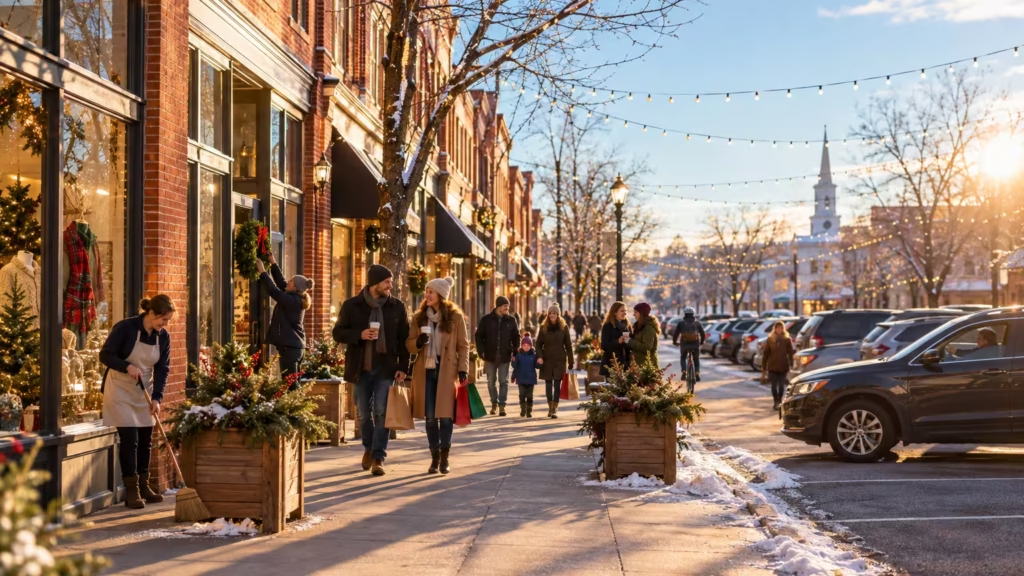
The trade-off is by the end of this week, the sun will set before 5:30 across much of the Great Plains, and the long stretch of early dark has begun. In a city, that hardly registers: the streetlights come on, the stores stay open, and life moves indoors. In a small town, early dark tells you something about the place. Either Main Street still has a reason to be there after five o’clock, or it doesn’t.
We have spent the year talking about planning: demographics and housing, economic development, community facilities, health and parks, utilities and energy, natural resources, hazard mitigation, land use, and transportation. This month, we put that practice to work. Planning that never leaves the binder is just a well-organized wish list. Implementation is where a community finds out whether its plan was ever really a plan.
There is no better place to start than the holiday season. Not because a community can really still launch something new for 2026; by November, most of that window has closed. The calendars are set, the volunteers are spoken for, and the vendor tables are already booked.
That is exactly the opportunity, though. This year, you don’t have to organize anything much. You only have to pay attention. Treat the next eight weeks as fieldwork—maybe just try a couple small, incremental adjustments to test new ideas. Then walk into 2027 with something most small towns never have: evidence.
What We’ve Already Said
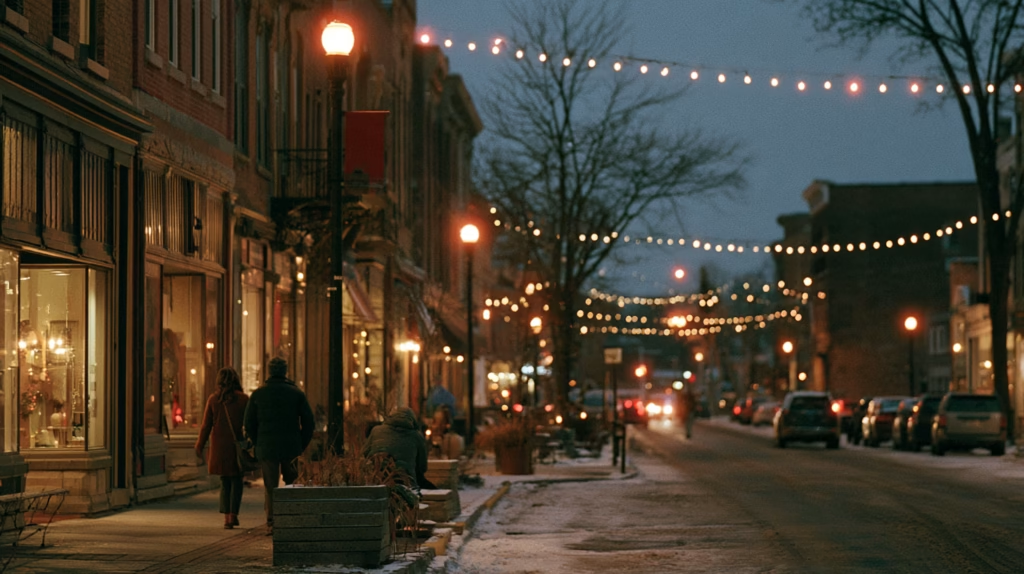
None of the ideas in this post are new to regular readers. Two Novembers ago, we looked at how holiday markets bring festive spirit to city spaces, from the European Weihnachtsmarkt tradition to cider mills, hayrides, and craft fairs. The same week, we made the economic case for seasonal arts and culture ideas that energize local economies. That month we also looked at agritainment: pumpkin patches, corn mazes, u-pick orchards, and harvest events, the farm-based attractions that bring visitors out to the countryside every fall. We argued then that local codes should plan for them and that permits for seasonal activities should be simple. Hold onto that thought.
That December, we asked how to transform your hometown into a destination you’ll love by bringing home the best of what we see on our holiday travels. Last December, we went to Sweden for Sankta Lucia. On December 13, processions of candle-bearers fill schools, churches, town halls, and workplaces before dawn, with saffron buns and coffee to follow. It is a reminder that people have always answered the darkest weeks of the year by gathering and bringing a little light. And this past February, we argued that you should make your small town a winter city, treating cold, dark months as something to design for rather than simply endure. We suggested back then that February is the time to start preparing for the next holiday season.
The rest of this year’s writing keeps coming back to the same ground. In May, we made the case that parks are infrastructure, not just amenities. Lighting and maintenance are part of the job, fairgrounds can host community markets, and improvements can come in phases, each with a named lead. In September, we argued that authenticity is the key to building better community: real local experiences beat manufactured attractions, and the way to start is to try something small and build on what works. Last month, The Stars Over Pagosa showed that good outdoor lighting is useful, shielded, warm, and no brighter than it needs to be. Keep that in mind as you walk Main Street this December.
Underneath all of it is a method we have borrowed more than once. In our reviews of Save Your Small Town and The Idea Friendly Guide, we came back to the same three steps: gather your crowd, build connections, and take small steps, learning by doing. A holiday season spent watching and testing is exactly that kind of small step. We’ll revisit these ideas later this month.
Those posts were about what is possible. The one that matters most this month is about what gets in the way. In September, When the Zoning Code Works Against the Plan walked through a scenario every holiday-market committee eventually meets: the pop-up market village, built from prefabricated sheds or the wooden chalets you see at Christmas markets around the world. It sounds simple. Then the questions start. Temporary structures are typically limited to about 180 consecutive days and must meet local wind and snow loads. Food vendors bring health department requirements. The fire code and the electrical code both have something to say. And the zoning code may not say anything at all about multiple temporary structures on one site. That leaves a volunteer committee wondering whether a simple special-event filing will do, or whether it needs a conditional use permit that takes months. It is the same simple-permit problem we raised about agritainment two years ago, showing up again on Main Street.
That is the implementation lesson in miniature. Most good holiday ideas don’t fail for lack of enthusiasm. They fail at the permit counter, in February, when nobody remembers why they were hard. This season is the time to find out where your community’s friction actually sits.
Use December as Fieldwork
Fieldwork doesn’t require a consultant, a budget line, or a council vote. It requires a planning commissioner, a council member, a Main Street volunteer, or a curious resident willing to go out on a few cold evenings with a notebook.
Here is what to look for between now and New Year’s.
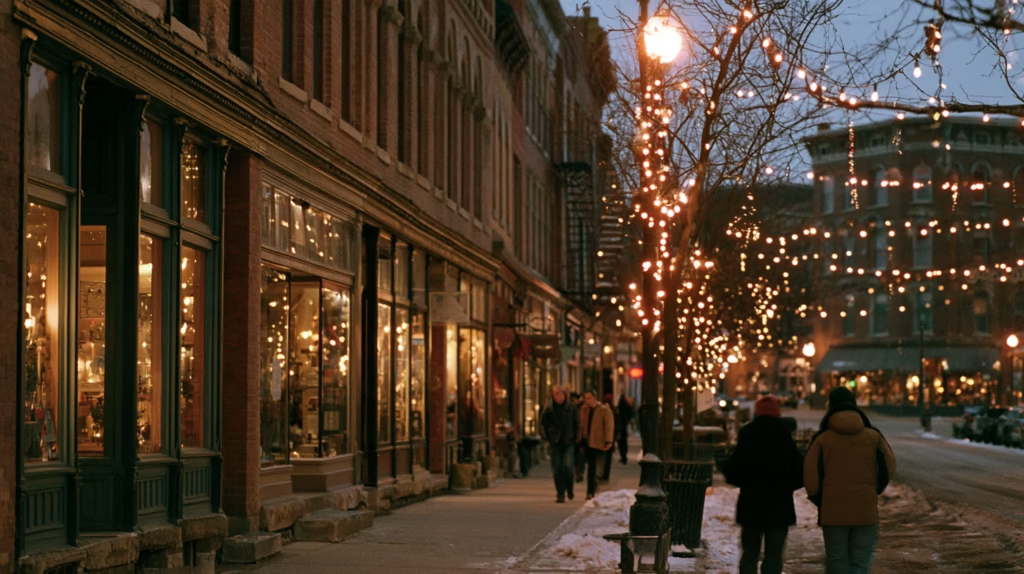
- Walk your own downtown after dark. Pick a weeknight in early December and walk Main Street between five and seven o’clock. Count the businesses that are open. Note which blocks are lit and which go dark, where you feel comfortable walking and where you don’t. Look at the sidewalks: are they cleared, and is there anywhere to sit, warm up, or wait for someone? Do a quick dark-skies compliant lighting check: is the lighting useful, shielded, warm, and no brighter than necessary?
- Visit a neighboring town’s event. Go to the holiday market, parade, or tree lighting one or two towns over, preferably one about your size. Notice where people park, how far they walk, where the restrooms are, and who is running it: the city, the chamber, a church, or a handful of volunteers. Ask one organizer what was hardest to get approved. Visiting a neighboring town is the low-cost local version of peer learning, plus it’s just being neighborly to support our friends next door.
- Talk to the people doing the work. Ask business owners whether staying open late for a holiday event paid off. Ask the volunteers what they would never do again. Ask the vendors what they needed that wasn’t there: power, water, a flat surface, a place to unload.
- Find the rule that got in the way. Every event that happens in your community this season had to clear some combination of zoning, building, fire, health, and street-closure requirements. Ask city staff which one caused the most delay. Write it down. That one sentence may be worth more than any brainstorming session in January.
- Count what you can. You don’t necessarily need a visitor study. A rough headcount at peak, the number of vendors, how many came from out of town, and whether downtown restaurants were full is enough to start. Count empty vs occupied parking spaces downtown. Take photos, especially of what didn’t work. Then check sources such as the Rural Economic Development Tool from the Center on Rural Innovation or the AARP Livability Index for an idea how your rough counts can feed into larger data sets.
- Notice who isn’t there. Older residents who don’t drive at night. Families without a way to get downtown. Farm families during a busy week. Youth, renters, working families, newcomers, low-income households, and people with disabilities. The people a holiday event misses are often the clearest guide to what it should become.
- Check the calendar. Save Your Small Town suggests that groups who sponsor events compare their calendars. In December, overlapping events (the church bazaar, the school concert, the tree lighting) are a common and easily-fixed source of friction.
None of this is glamorous. That is the point. Communities that do this kind of observation in December make better decisions in March, because they are arguing from what they saw rather than what they remember.
Ideas That Grow From Local Culture and Landscape
The best seasonal events don’t import a theme. They take something the community already has and put a light on it. As you do your fieldwork this year, keep a list of ideas that fit your own place. A few to test against your local conditions:
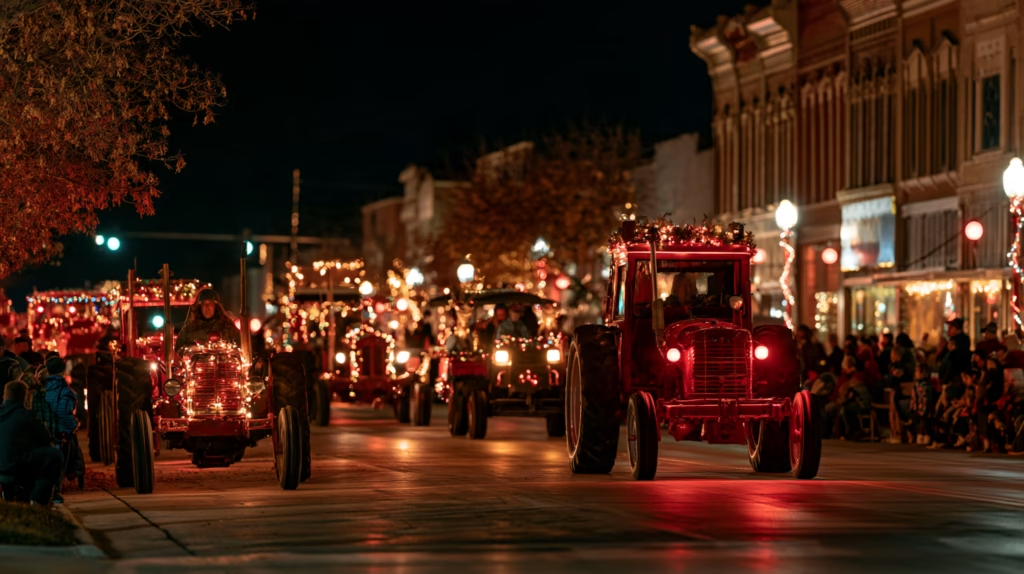
Lighted tractor parades. When I lived in Colorado, our small town had a holiday parade of lights. Few things say small town life like a line of tractors, combines, and grain trucks strung with lights, rolling down Main Street on a December evening. The equipment already exists, the farmers already know how to drive it, and the cost is mostly extension cords and a few volunteers. Though the generators for the pre-electric machines can be a bit noisy. Involve your local 4-H and FFA clubs.
Events like these bring families into town at a time of year when they have a little breathing room. The planning questions are practical ones: route, street closure, staging area, and where spectators can stand safely. And who is going to play Santa bringing up the end of the line.
Christmas tree farms and agritourism. A choose-and-cut tree farm a few miles outside town draws families from the region every weekend between Thanksgiving and Christmas. Most of them drive straight home. A little coordination changes that: a downtown map at the farm stand, a coffee shop that opens early on Saturdays, a joint promotion between the farm and Main Street merchants.
This is where the zoning questions from September come back. Can the farm sell cocoa, wreaths, and local crafts? Can it host a small event? Are they going to run into a parking problem? Your code should make that answer easy.
A walk of lights through a park or along a trail. We have argued all year that parks are infrastructure. A lighted walking loop in December turns that infrastructure into a reason to come outside. It can be as simple as luminaries placed by scout troops and church groups on one Saturday night, or as ambitious as a month-long display built by the parks department and local businesses.
A winter farmers market. Many rural communities have a summer farmers market that simply stops in October. Move a few vendors indoors to a grange hall, a fairground exhibit building, a church fellowship hall, or an empty storefront. Reach out to craftsmen or the local makerspace. Then you will have a reason to come downtown on a Saturday morning in December, plus a test of whether a vacant building can support public use.
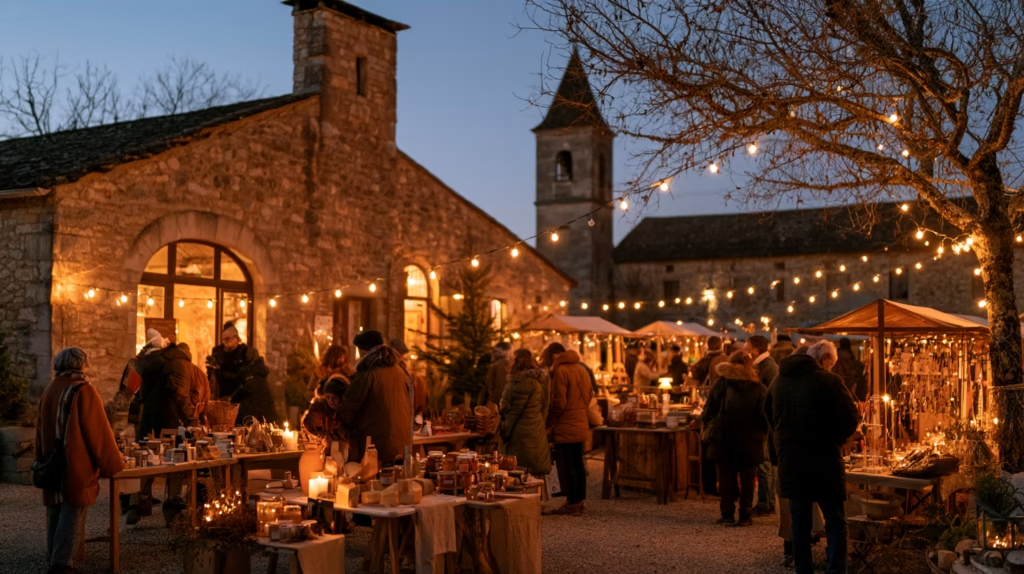
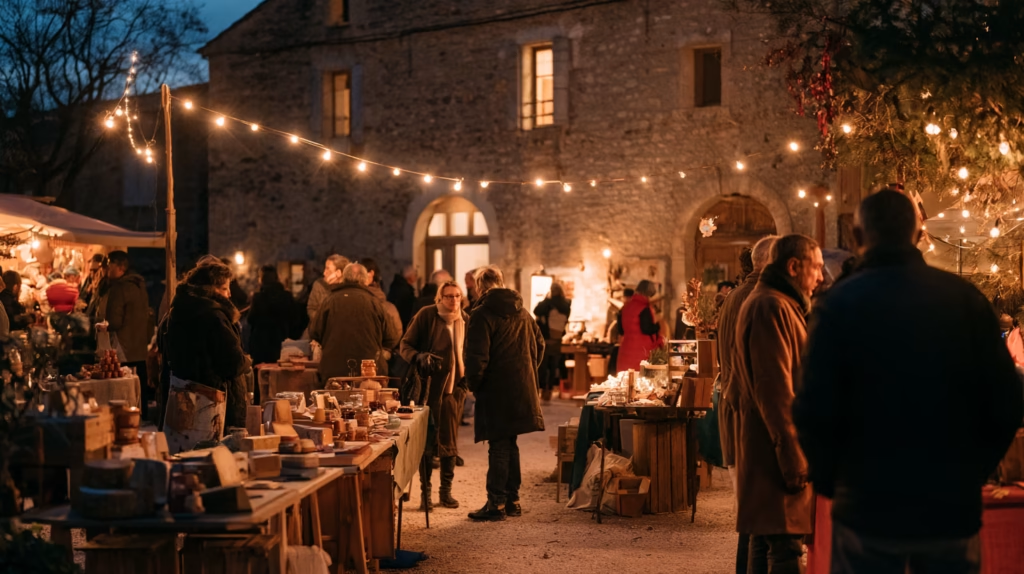
The village Christmas market, French style. We tend to picture European Christmas markets through their most famous examples, such as Strasbourg’s, which has been held since the sixteenth century and now draws visitors from around the world. That is not the model for a small town. The more useful model is what happens in thousands of French villages every December: a marché de Noël organized by the local comité des fêtes, a volunteer festival committee, held for a single weekend in the village hall and the square outside it. A few dozen tables. Local producers selling honey, cheese, preserves, and wine. Handmade crafts. Mulled wine and crêpes sold by the school parents’ association. A visit from Père Noël for the children. It runs on volunteers and borrowed tables, costs very little, and comes back every year because it belongs to the village rather than to an event company.
That is the lesson for American small towns. A holiday market does not need to be big. It needs to be repeatable. One weekend, run by people who live there, held in a building the community already owns, is a better first step than a month-long chalet village that exhausts its organizers in a single season.
From Fieldwork to the 2027 Work Plan
Observation only matters if someone does something with it. In January, while the season is still fresh, bring the notes together in one short meeting. It can be a planning commission work session, a chamber breakfast, or a kitchen table. Answer four questions:
- What worked, and why? Name the specific conditions: the location, the time of day, the people who made it happen.
- Who took part, and who was missing? Be honest about the gaps.
- Which rule needs to change? If a temporary-use permit, a vendor license, a sign rule, or a street-closure process caused the trouble, write down exactly which one and what a simpler version would look like. A code amendment adopted in the spring is ready in time for next November. One drafted in October is not.
- Who owns it next year? Every idea on the list needs a name next to it: the city, the chamber, the parks board, a church, a 4-H club, or one stubborn volunteer. Phase improvements, each with a lead entity, a funding source, and a time frame.
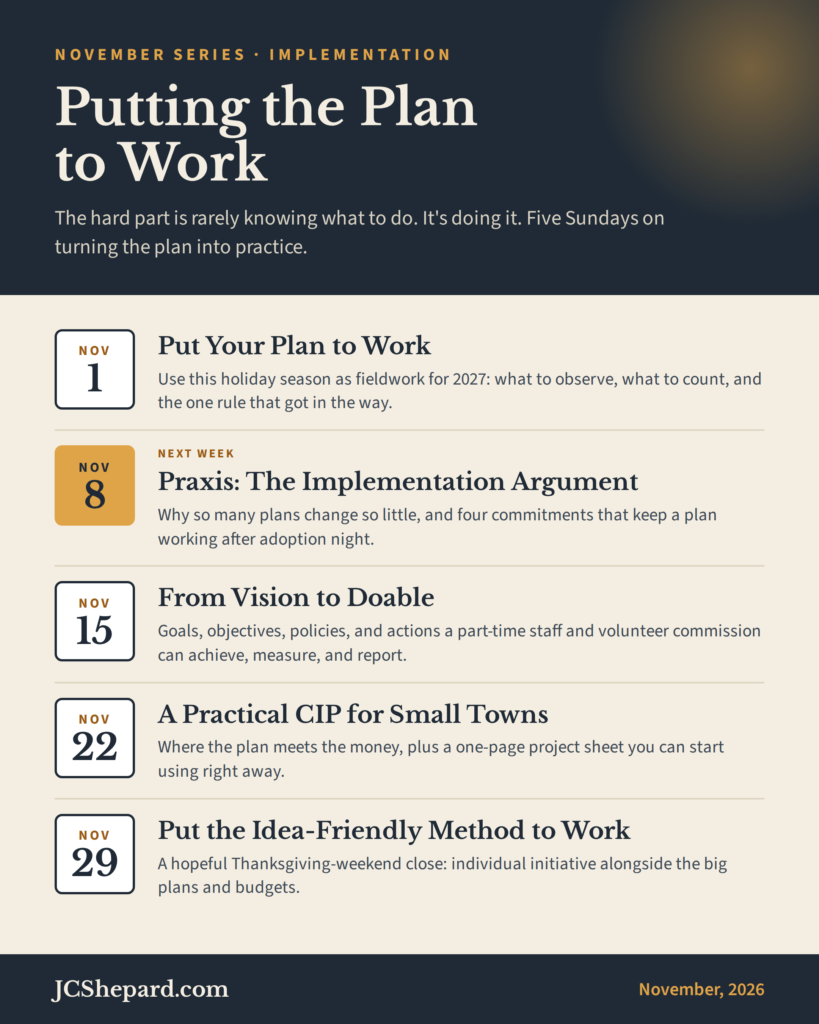
Wrap it up the Idea Friendly way: gather your crowd, build connections, and take small steps. Then put the answers where they can’t be forgotten: in the annual work plan, the budget conversation, and the next update of the comprehensive plan’s implementation chapter. That is the theme of the rest of this month. Next week, we’ll step back and look at the implementation argument we have been building all year. After that, we’ll get specific about writing goals and objectives a small community can actually achieve, and about planning for capital improvements with eyes open.
For now, the assignment is simple. Put on a warm coat, walk downtown after dark, and take notes. Your 2027 holiday season starts this December.
Next week: Praxis: The Implementation Argument We’ve Been Building All Year.

Further Reading
- Christmas Markets of America 2026-2027: A Region-by-Region Travel Guide to the Nation’s Best Holiday Villages, Winter Festivals, and Festive Getaways, by Kristoff E. Wenlake (2026)
Covers 15 destinations across the U.S. from New York, Chicago, and Denver, and small towns like Holland, Michigan, and Leavenworth, Washington. - Strong Towns: A Bottom-Up Revolution to Rebuild American Prosperity, by Charles L. Marohn Jr. (Wiley, 2019)
- Tactical Urbanism: Short-term Action for Long-term Change, by Mike Lydon and Anthony Garcia (Island Press, 2015)
- The Great Neighborhood Book: A Do-It-Yourself Guide to Placemaking, by Jay Walljasper and Project for Public Spaces (New Society Publishers, 2007)
- From Possibilities to Reality: Save Your Small Town with these Uniquely Do-able Ideas, Projects, and Success Stories by Deb Brown (2024)
- The Idea Friendly Guide: Practical, Immediate Steps to Break Free from Old-Way Thinking and Transform Your Community’s Future by Becky McCray (2025)
Our November 2026 featured book of the month; read our book review on the blog here.
Selections from JCShepard.com:
- Make Your Small Town a Winter City
- When the Zoning Code Works Against the Plan
- Home for the Holidays: How to Transform Your Hometown into a Destination You’ll Love
- How Authentic Rural Experiences Shape Identity and Belonging
- Revolutionizing Rural Life: How Makerspaces Build Innovation and Community
- The Airport at the Edge of Town
As an Amazon Associate, I earn from qualifying purchases. Links to books on this site may earn a small commission at no extra cost to you.
Resources
RURAL-READY ENGAGEMENT: PRACTICAL TOOLS FOR SMALL TOWN PLANNERS
 Watch the full replay: youtube.com/@Engaging-Communities (February 2026). Community engagement can look very different in small towns and rural communities. This webcast was co-sponsored by the APA Community Engagement Interest Group and the Small Town & Rural Planning Division.
THE RURAL IMPACT PODCAST (EPISODE #86)
“Pathways to Powering Rural America” My guest spot on Michelle Rathman’s podcast. Episode page here, listen on Apple Podcasts or Spotify, or watch (!) on youtube. We talked about energy, data centers, and good governance, plus so much more.
POPULAR POSTS ON JCSHEPARD.COM
- The Planning Process—From Vision to Action in Small Towns and Rural America (January 2026)
- Historic Preservation and Rural Economic Development: A Rural Growth Strategy (April 2026)
- Small Towns Can Build a Strong Outdoor Economy Without Selling Out (June 2026)
- The Rise of Rural Entrepreneurship: Building Economies from the Ground Up (January 2026 on Medium.com)
- When the Zoning Code Works Against the Plan (September 2026)
- Main Street America and the Revival of Downtown (June 2026)
- What is Economic Development in Modern America? A Field Guide for Small Towns and Rural Places (March 2026)
- Rethinking the Rural Economy: New Paths, New Possibilities for Growth (August 2025) / Rural Entrepreneurship: Building Economies from the Ground Up (August 2026 on Medium.com)
- Reviving Rural America: Why Heritage Tourism Is a Game-Changer Now (September 2025)
- Is Rural Really the Same as Non-Metro? (February 2026)
- Rural Housing Supply Crisis: Why Small Towns Are Running Out of Homes (February 2026)
- Revitalizing Main Street the Idea-Friendly Way (August 2026 on Medium.com)
.
