
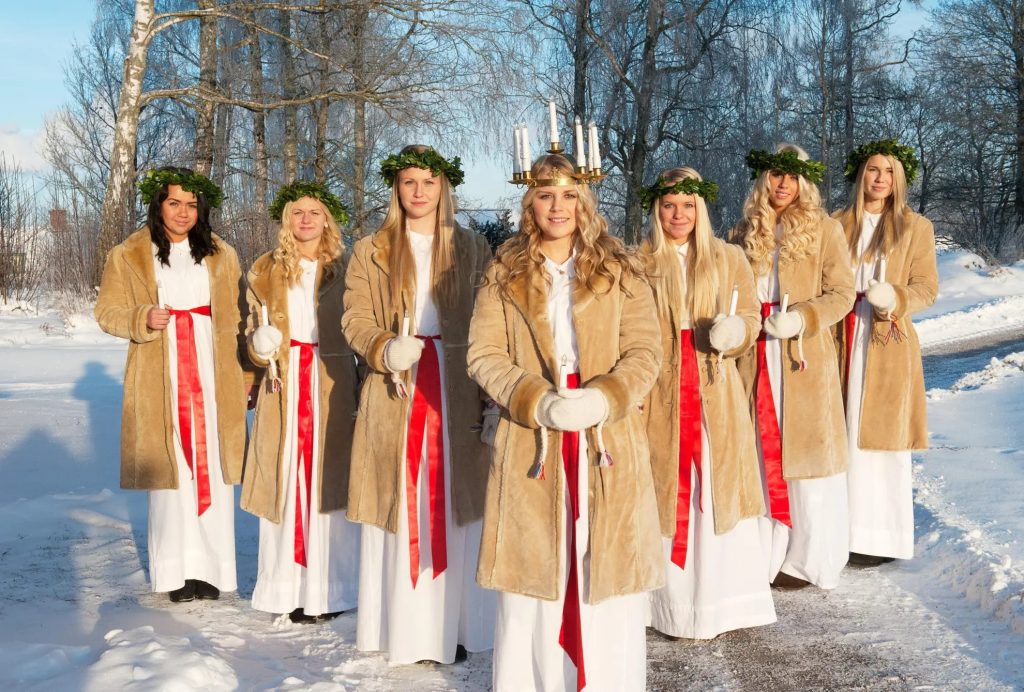
Sankta Lucia, or Saint Lucy’s Day, is one of Sweden’s most beloved midwinter traditions, blending Christian sainthood with older Nordic light-in-the-darkness customs. It is celebrated on December 13 and marks a kind of ceremonial opening of the Christmas season in Sweden and other parts of Scandinavia.
On the old Julian calendar, Lucia fell on what was considered the longest night of the year, a time when the dark felt heavy and the world needed extra candles and company. Swedes borrowed Saint Lucy of Syracuse—a Mediterranean martyr with a name tied to lux, “light”—and set her down in a Nordic farmstead winter, blending Christian legend with older folk habits of fending off the midwinter gloom.
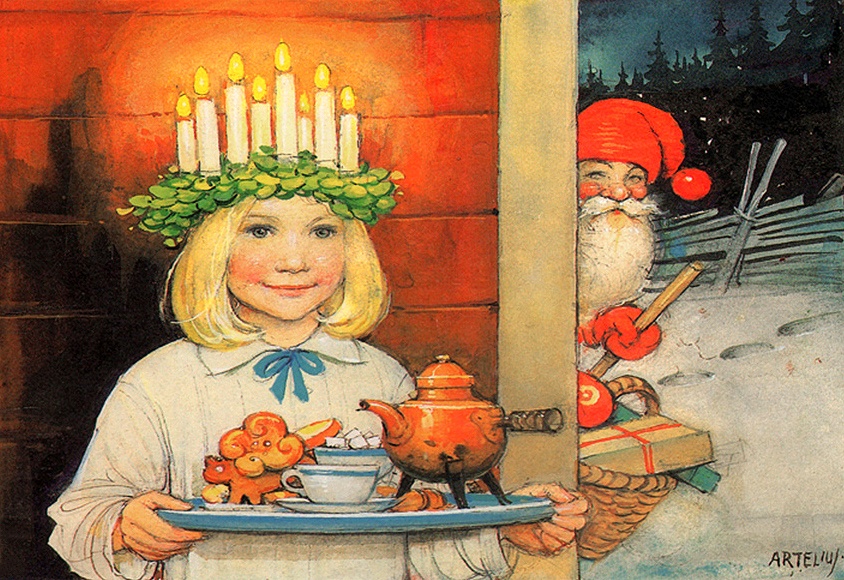
The Lucia Procession
The heart of the celebration is the Luciatåg, or Lucia procession, usually held before dawn in schools, churches, town halls, and even workplaces. Lucia leads the procession in a long white gown with a red sash and a wreath crowned with candles on her head—today usually electric for safety—followed by attendants also dressed in white, singing Lucia songs. The candlelight and music are meant to create a calm, almost hushed atmosphere, as Lucia “brings light” into the dark room and into the winter season.
Like any good community tradition, Lucia has its typical characters. Behind Lucia come the tärnor—handmaidens in white gowns with candles and tinsel—and the stjärngossar, “star boys,” in cone hats carrying star wands, plus the gingerbread figures (pepparkaksgubbar) in brown “cookie” costumes and gnome-like household spirits (tomtenissar) that show up especially in children’s processions. The result looks a bit like a small‑town Christmas program in the church basement: earnest, slightly chaotic at the edges, and utterly charming. The best-known Lucia song is “Sankta Lucia,” which almost every Swede learns and which is sung as Lucia enters with her candles.
No Swedish holiday is complete without food, and Lucia belongs as much to the kitchen as to the choir loft. The saffron lussekatter—bright yellow, S‑shaped buns—come out alongside gingerbread cookies, strong coffee, and sometimes mulled drink, turning the early-morning ceremony into a kind of communal breakfast, a Scandinavian cousin to the church potluck or volunteer fire hall pancake feed. Shared food makes the symbolism of “bringing light” concrete: you are not just watching a pageant, you are sitting at the table together.
Over the years, Lucia customs developed in rural western Sweden and were popularized nationally in the late 19th and early 20th centuries through museums and newspaper-organized Lucia “queens.” Today, the tradition remains widespread but has adapted: many communities choose Lucia by lottery rather than beauty-style contests, multiple children may be Lucias in the same event, and vegan or modern versions of traditional baked goods are common. The celebration has also spread to Swedish communities abroad, where it serves as a cultural touchstone linking diaspora families to their Scandinavian heritage.
Sankta Lucia is no frozen folk relic; the event has become an active piece of cultural infrastructure, holding together memory, identity, and midwinter hope.
.