
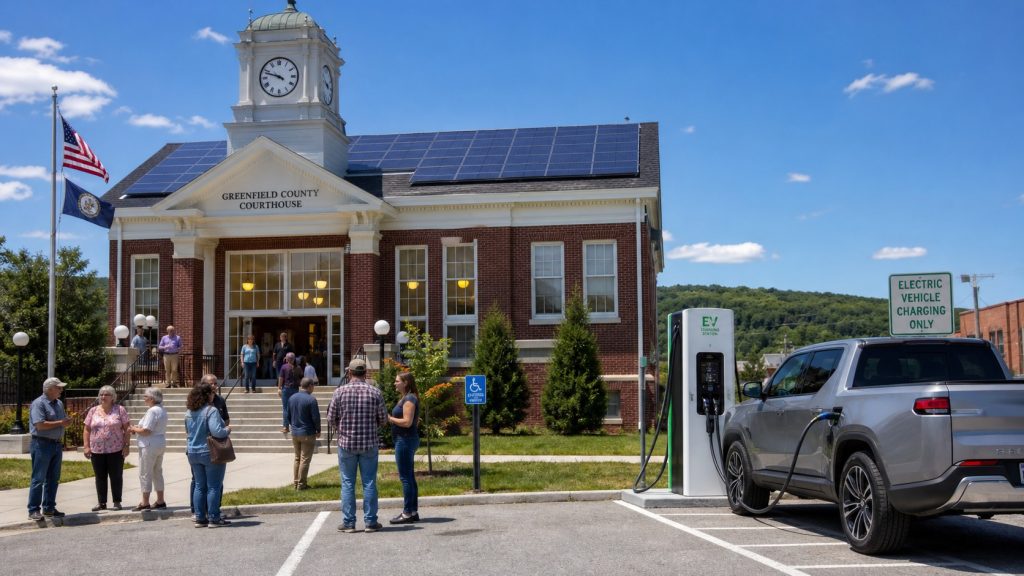
Energy isn’t usually what draws people into small‑town leadership. You run for the council or join the planning commission because you care about streets and schools, housing and jobs, maybe the new playground down by the river. But sooner or later, usually at budget time, the line items for electricity, natural gas, and fuel start to crowd out everything else, and somebody around the table asks a perfectly reasonable question: “Why are our utility bills so high?”
In most rural communities, the honest answer is that no one has really been asked to pay attention. Courthouses and libraries, fire halls and fairgrounds, water plants and street shops all keep running more or less the way they always have, even as rates creep up and equipment ages out. Working on energy efficiency is not about signing up for a particular political party; it is about being better stewards of the buildings and systems residents already paid for once, and making sure every dollar of public money stretches as far as it can. When a simple lighting retrofit or boiler replacement can pay for itself in a few years and keep saving money after that, “less” really does become “more” for the general fund.
This article is the fourth and final piece in our June 2026 series on communications, utilities, and energy, and it is aimed squarely at those of us who live with those budgets and plans every day: small‑town leaders, local planners, utility board members, and citizens who care enough to read past page one of the comprehensive plan. We start with the one place you already control—public buildings and operations—then look outward to the farms, small businesses, brownfields, and back roads where private decisions and public policy meet.
Along the way we lean on real examples from Nebraska towns and counties that have already started down this path, not because they wanted to win an award, but because they wanted to keep the lights on, hold the tax rate steady, and leave their communities a little better tuned than they found them.

I — Local Government Buildings and Operations: Management, Metrics, Better Decisionmaking
For small town and rural local governments, the most controllable energy story is the one inside their own buildings. County courthouses. Township halls. Libraries. Fire stations. Water treatment plants. Public works garages. These are buildings that local governments own or lease, operate, and pay utility bills on every month — and in most communities, those utility bills have been quietly climbing for years without systematic attention.
Working on energy efficiency is not ideological. It’s about being better stewards of taxpayer resources.
The case for starting with efficiency
Energy efficiency is the most reliable, most shovel-ready form of clean energy investment available to local governments.
Unlike renewable energy procurement — which requires developer relationships, utility negotiations, and often multi-year project timelines on top of community skepticism — efficiency upgrades can be planned, bid, and installed on a local government’s own schedule. And unlike most capital projects, efficiency upgrades can pay for themselves: reduced utility bills generate ongoing savings that can be used to repay the upfront investment or fund the next project.
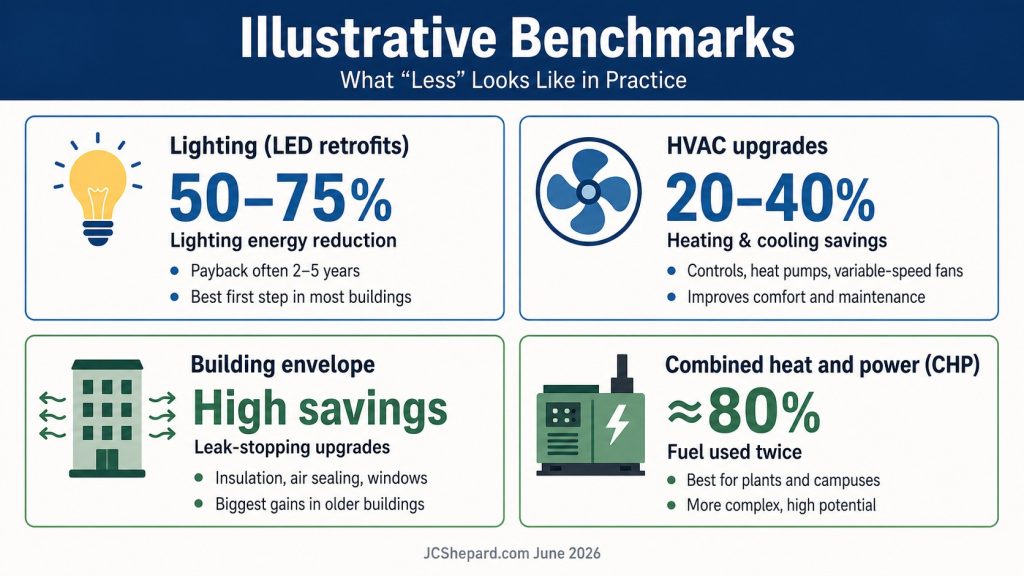
A few illustrative benchmarks:
- LED lighting retrofits typically reduce lighting energy use by 50–75% with payback periods of 2–5 years. (“Benefits of LED Lighting Retrofits”)
- HVAC upgrades (including controls, heat pumps, and variable-speed drives) can cut heating and cooling energy use by 20–40%. (US Department of Energy (DOE) HVAC Retrofits)
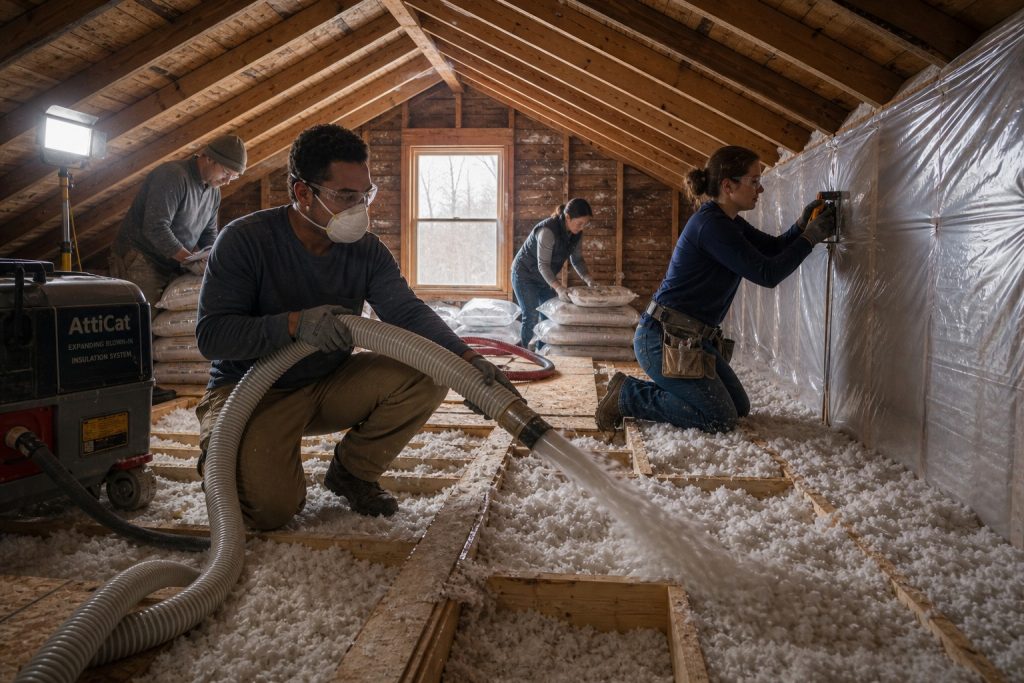
- Building envelope improvements — insulation, weatherstripping, window upgrades — are especially valuable in rural areas where older public buildings often have significant thermal losses. (Building Energy Exchange Anatomy of an Energy Efficient Building—not really small town, but interesting resource)
- Combined heat and power (CHP) systems can achieve overall efficiencies of 80% or more compared to 35–45% for separate generation and heating systems. (US Environmental Protection Agency (EPA) CHP Benefits)
Municipal energy management is an ongoing discipline with a focus on setting clear, realistic, and replicable goals for energy conservation, then defining scope (which buildings and fuels), baselines, and responsibility for implementation. Local government energy guidance stresses the importance of a clear scope and baselines (i.e. year-to-year vs. rolling average measurements), then tracking responsibility and progress.
There are specific tools that can inform local decision making. US DOE suggests portfolio-level benchmarking (e.g. ENERGY STAR Portfolio manager or similar platforms) as a first step before energy audits. This is also where the existing conditions assessment in your comprehensive plan can be leveraged with a profile of current energy use by building type, fuel, and emissions, which can then be used to set future targets for energy efficiency.
A simple three-step planning task:
- Inventory and benchmark public buildings.
- Conduct strategic audits of the worst performers.
- Sequence measures in the capital improvement plan (CIP) by payback, co-benefits, and funding.
This may look like just more paperwork for overworked staff, but it also looks like running government more like a business focused on controlling expenses.
The federal funding picture in 2026
The pandemic-era Inflation Reduction Act (IRA) and Infrastructure Investment and Jobs Act (IIJA) created an unusually strong federal funding environment for local government energy efficiency, though the picture has shifted since those laws were enacted.
IRA Elective/Direct Pay was a transformational provision for tax-exempt entities like local governments. Historically, federal clean energy tax credits were only available to entities that owed federal taxes — which excluded local governments, tribal nations, and nonprofits entirely. The IRA’s Elective Pay mechanism changed this: for the first time, tax-exempt entities could receive a direct cash payment equal to the full value of clean energy tax credits for qualifying projects.
The landscape for Elective Pay has been complicated by Trump’s One Big Beautiful Bill Act (HR 1 OBBBA), signed in 2025. Several key EV and vehicle-related tax credits have been curtailed: the commercial clean vehicle credit (45W) expired September 30, 2025, and the alternative fuel vehicle property tax credit (30C) is set to expire this week, on June 30, 2026. The solar Clean Electricity Investment Tax Credit (§48E) remains available for projects placed in service from 2025 forward, but supply chain requirements and construction timelines are still being clarified. For rural local governments with projects in development: move as quickly as possible on projects that are ready to proceed.
Energy Efficiency and Conservation Block Grants (EECBG) — funded through the IIJA at $550 million — provided formula grants to states, local governments, and tribes. Many rural communities received relatively modest direct allocations; larger opportunities came through state-administered programs. For communities that haven’t yet engaged their state energy office, it’s worth a conversation.
USDA’s Rural Energy for America Program (REAP) is arguably the most directly useful federal program for rural communities and agricultural operations. USDA REAP provides grants (up to 50% of project costs for qualifying projects) and guaranteed loan financing for renewable energy systems and energy efficiency improvements. USDA announced $145 million in a recent REAP funding round. The maximum grant size is $1 million for renewable energy systems and $500,000 for energy efficiency improvements. REAP is chronically underutilized relative to its potential.
Renewable energy procurement for local governments
Beyond efficiency, local governments have several options for procuring clean energy:
- Power Purchase Agreements (PPAs) allow local governments to host solar installations developed and owned by third parties, purchasing power at a fixed rate — eliminating upfront capital requirements.
- Community solar subscriptions allow local governments and residents to subscribe to shares of a nearby solar project and receive bill credits — the most accessible entry point for communities without suitable roof space.
- On-site generation with direct ownership — particularly rooftop solar — is often the most economical option for communities that can access Elective Pay or finance through energy savings performance contracts (ESPCs).
The City of Grand Island, Nebraska, is an example of a city that goes beyond rhetoric and calls out specific action items for conservation in addition to adding on-site solar to their local power generation capacity. Their comprehensive plan calls for water-energy audits in public buildings and sites, then planning improvements—a useful model for communities that want to move from aspiration to implementation.
The practical planning connection:
Every rural local government should conduct a systematic energy audit of its building portfolio — ideally through free technical assistance from state energy offices, USDA Rural Development, or other local government programs. The audit becomes the foundation for a capital improvement plan that sequences efficiency upgrades and renewable energy installations based on payback period, funding availability, and operational need. Don’t start with the solar; start with the building envelope.
II — Conservation and Energy Efficiency: Scaling What We Do Well
Local government buildings are the easiest place to start because a single decision-maker controls them. The private sector is harder — it requires programs, incentives, and outreach that reaches thousands of individual decisions made by households, farmers, and small businesses. But the scale of the opportunity is correspondingly larger.
Utility efficiency programs and demand-side management
Rural electric cooperatives, many public power suppliers, and some investor‑owned utilities typically offer demand‑side management (DSM) programs— incentives and rebates for efficiency improvements that reduce peak demand and overall load. These programs exist because it is often cheaper and less risky for a utility to treat efficiency and load reduction as a “resource,” investing in customer‑side savings instead of building new generating capacity or upgrading infrastructure, a principle highlighted in state energy efficiency toolkits and Energy Efficiency Resource Standard (EERS) guidance.
Common DSM offerings include rebates for ENERGY STAR appliances and high‑efficiency HVAC equipment, lighting upgrade incentives for businesses and farms, demand response programs that pay customers to shift usage away from peak hours, and on‑bill financing that lets households and small businesses repay efficiency upgrades directly through their utility bill. In many states, these utility programs do not exist in isolation: EERS policies require utilities to meet specific long‑term energy‑savings and peak‑demand reduction targets, while building energy codes and appliance and equipment efficiency standards set minimum performance levels that push the market toward more efficient technologies, all of which creates the backdrop for local DSM portfolios. Comprehensive plans can acknowledge this broader policy context by noting the role of DSM in meeting state savings goals, referencing applicable EERS or building code requirements, and encouraging coordination with utilities to align local efficiency initiatives with state‑level standards and targets.
In Kimball, Nebraska, for example, the Municipal Energy Agency of Nebraska offers named incentives for commercial LED lighting, smart thermostats, attic insulation, cooling-system tune-ups, and high-efficiency heat pumps—exactly the kind of utility-administered efficiency menu rural communities should publicize more aggressively.
Agricultural energy efficiency: the underinvested opportunity
Agriculture is a significant energy user, and agricultural energy efficiency is one of the most underinvested segments of the rural energy picture. Irrigation — particularly in the High Plains — is the largest single agricultural energy expense, and pump efficiency varies enormously. Grain drying, livestock ventilation, and controlled-environment facilities are also major energy users where improvements are technically straightforward and economically compelling.
USDA’s REAP program is specifically designed to fund these improvements—as noted earlier, grants and loan guarantees can often cover most of eligible project costs. The underutilization of REAP relative to demand suggests that outreach and technical assistance, not program design, is the primary barrier.
Small business energy efficiency
Rural small businesses—hardware stores, restaurants, auto repair shops, grain elevators—often operate in older buildings with aging HVAC systems, poor insulation, and inefficient lighting, which means a lot of their operating budget quietly leaks out through utility bills. The most effective small‑business efficiency initiatives, as highlighted in EPA, DOE, and local program guides, start with a truly low‑barrier entry point: a no‑cost, no‑obligation walk‑through energy assessment that identifies specific upgrades and bundles available rebates and incentives into a simple proposal.
From there, best‑practice programs connect the dots for the business owner by pairing that audit with easy financing—such as on‑bill repayment through the utility or long‑term Property Assessed Clean Energy (PACE) financing tied to the property tax bill—so projects can move forward without large upfront cash outlays. They also rely on vetted contractor networks, so the utility or program administrator can hand the owner a turnkey path from audit to installation, reducing the number of decisions a busy shop owner has to make from ten to one. Communications matter here: framing the audit as a “free business tune‑up” rather than a technical inspection, and offering visible recognition—window decals, inclusion on a local “efficient businesses” map or directory, shout‑outs at community events—helps turn participation into a marketing asset for small businesses while normalizing efficiency as part of doing business in the community.
The Weatherization Assistance Program: the rural equity tool
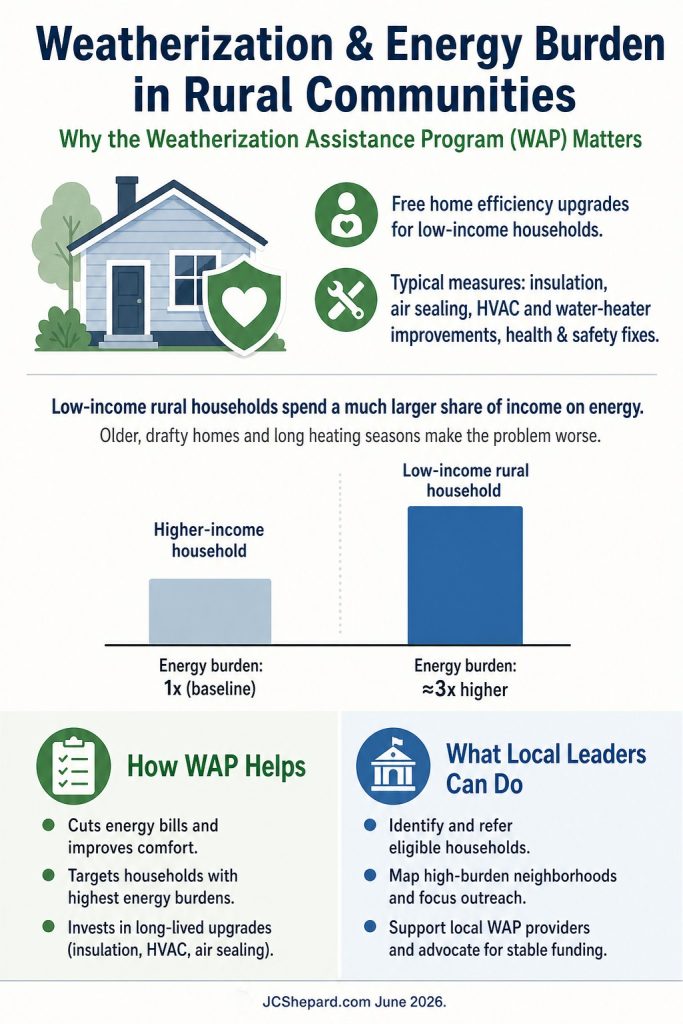
The US DOE Weatherization Assistance Program (WAP) provides free, whole‑house energy efficiency services to low‑income households—typically including insulation, air sealing, HVAC and water‑heater efficiency upgrades, and health and safety measures such as combustion‑safety testing and ventilation improvements. Nationally, WAP is framed as the country’s largest residential energy efficiency program and is explicitly designed to reduce energy costs for households facing high energy burdens while improving comfort and safety.
For small towns, this mission is particularly important because low‑income rural households tend to spend a larger share of their income on energy than their urban counterparts, a pattern linked to older and larger housing stock, more single‑family and manufactured homes, and less insulation on average. Energy‑burden research and federal program descriptions note that low‑income households can face energy burdens roughly three times those of higher‑income households, and that rural low‑income families have among the highest median burdens in the country, making targeted efficiency interventions a crucial equity strategy rather than a niche technical fix.
The practical challenge is that WAP has chronically limited funding relative to the number of eligible households, so many states and local agencies manage long waitlists and must prioritize households with the highest energy burdens, highest energy usage, or especially vulnerable residents. In this context, local governments and community organizations have a critical supporting role: they can help identify and refer eligible households, use tools such as DOE’s Low‑Income Energy Affordability Data (LEAD) Tool to map (yeah, maps!) high‑burden neighborhoods, support local WAP agencies in workforce development to expand the number of homes that can be weatherized each year, and advocate for adequate and sustained program funding so rural residents are not left waiting indefinitely for basic efficiency and health‑and‑safety upgrades.
Net metering
In addition to efficiency, don’t forget the potential of small-scale distributed energy production, such as roof-top solar coupled with home-based battery energy storage systems. Local progress often happens incrementally: Grand Island Public Utilities increased from 6 net-metered facilities in 2020 to 10 by 2023, while Southern Public Power District grew from 25 to 39 over the same period. It can take time and that’s all right.
The practical planning connection
Rural comprehensive plans should include an energy section that identifies the major private-sector energy users in the community, assesses utility efficiency program availability, and sets goals for reducing per-capita energy use. The plan should identify the technical assistance resources available — REAP, state energy offices, rural co-op programs, SBDCs — and connect them to local economic development priorities.
III — Brownfields: From Liability to Asset
There are approximately 450,000 brownfield sites in the United States, covering an estimated 15 million acres — former factories, abandoned rail yards, closed gas stations, landfills, mine sites, and Superfund properties scattered through virtually every community in America. In rural areas, brownfields often sit at the center of towns that grew up around them, representing both a drag on economic development and a stubborn reminder of the industrial past.
The brownfield-to-solar (brightfield) case
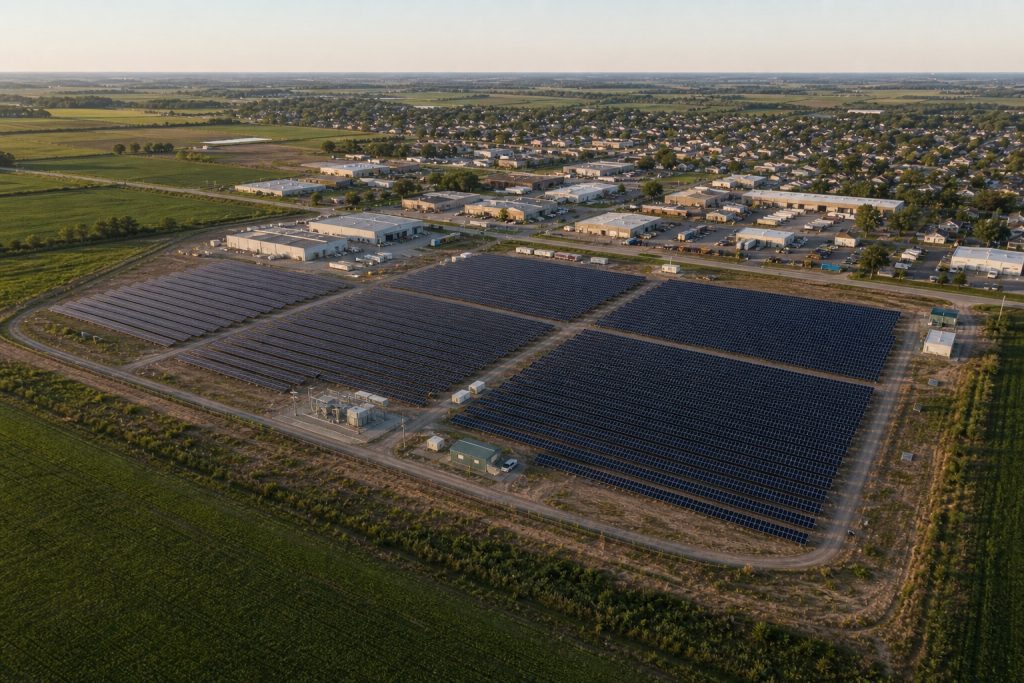
Solar development on brownfields — called “brightfield” development — turns environmental liabilities into energy assets. The logic is compelling: brownfields are often unusable for farming, housing, or commercial development due to contamination; they frequently have existing grid connections and industrial infrastructure; they are often located in communities that need economic development; and siting solar on them avoids the farmland conversion conflicts that have become one of the defining tensions of rural energy development.
EPA’s RE-Powering America’s Land initiative has pre-screened over 190,000 brownfield sites for renewable energy development potential. Yet through 2024, of the 313 GW of clean energy capacity installed in the U.S., only 4.4 GW — just 1.4% — was developed on brownfields, according to EPA analysis. This is largely because brightfield projects involve more specialized design and more costly site preparation than greenfield projects. Without policy support, they are not the default choice in most markets.
The policy and incentive landscape
- IRA brownfield bonus credit: Since 2022, many brightfield projects qualified for a 10% bonus to the federal Investment Tax Credit, on top of the base 30% credit. Congress accelerated the sunset of this incentive from 2035 to 2027 for solar and wind projects. The window is narrowing — communities with viable sites should be moving now.
- State programs: State brightfield policies matter for targets (e.g., requiring utilities to procure a share of power from brightfields), tax incentives, and expedited permitting which help make higher‑cost sites competitive. Illinois for example requires utilities to procure 3% of power from brightfields. Ohio created its “Priority Investment Area” program in May 2025 for former mining sites and brownfields, with property tax exemptions and expedited permitting. Michigan and Colorado have launched similar brightfield programs.
- EPA Brownfields grants (assessment, cleanup, and revolving loan fund grants) can be used to prepare sites for energy development. Completing the assessment phase is often the critical first step. My friends at Ayres Associates know a lot about brownfields and can help you put your grant proposal together.
EPA’s RE‑Powering initiative offers mapping tools (maps!) and pre‑screened site data (acreage, potential capacity), which we can treat like a “map layer” alongside zoning and infrastructure.
What makes a good brownfield energy site?
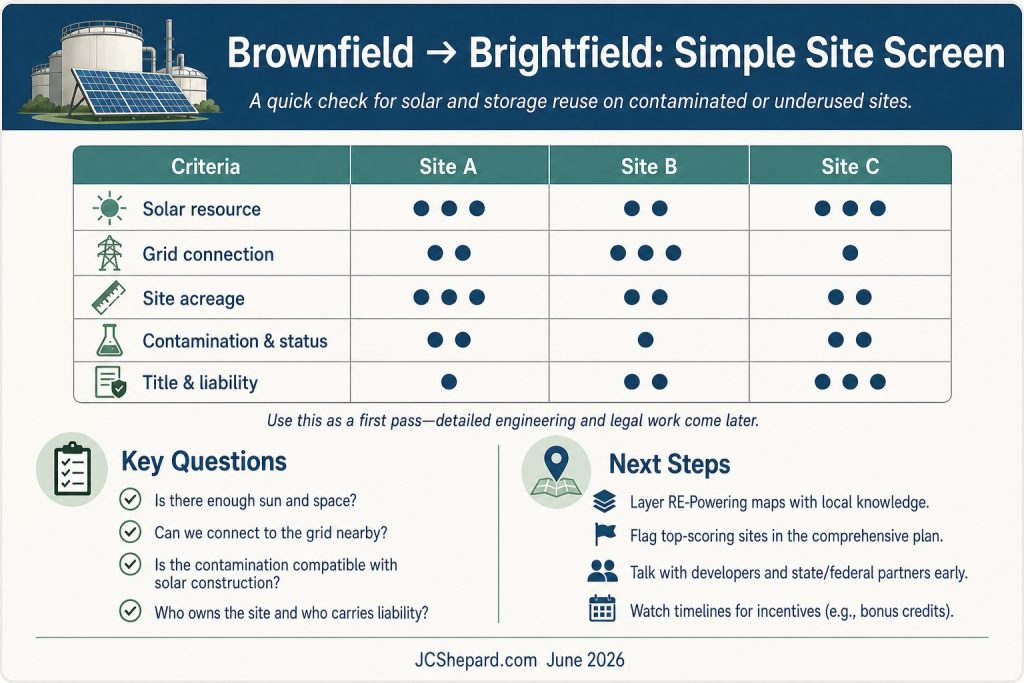
The most important variables:
- Solar resource: Is there adequate sun? Most of the contiguous U.S. has sufficient solar resource.
- Grid connection: Is the site near transmission or distribution infrastructure with available interconnection capacity? Contaminated former industrial sites often have existing electrical connections — a significant advantage.
- Site acreage: Utility-scale solar typically needs at least 20–50 acres if not much, much more. Smaller sites are better candidates for community solar or battery storage.
- Contamination type and status: Some contamination types are compatible with solar construction; others require expensive remediation.
- Title and liability: Establishing a clear development path requires legal work that many rural communities haven’t done.
RE‑Powering maps can help assess solar resource, grid proximity, and site acreage in early screening. A simple scoring matrix in the comprehensive plan or an implementation appendix could rank solar resource, grid access, contamination type, ownership clarity, and community support.
The practical planning connection:
Rural communities should inventory their brownfield sites — using EPA’s RE-Powering mapping tool and local knowledge — and assess which sites have the solar resource, grid connection, and site characteristics to be viable brightfield candidates. The IRA brownfield bonus credit window is closing; communities with viable sites should be in active conversations with developers now.
IV — Electrification and EV Charging: The Rural Mobility Challenge
Rural electrification in the 21st century builds on the tradition of rural electrification in the 20th century. A big part of the new rural electrification, though, is about ensuring that the transition to electric transportation doesn’t leave rural communities behind.
I myself am not a fan of electric vehicles outside major metro areas. Frankly, I often need to drive 400 miles on a single trip, and don’t want to have to wait around for a charger that might or might not work. While batteries don’t work so well in cold northern winters, well, neither do internal combustion engines. Perhaps Toyota is onto something sticking with hybrid (HEV) gas-electric systems at much more reasonable prices. Either way, innovations in both electric vehicle efficiency and in EV charging networks continue to address these concerns.
The rural EV charging divide
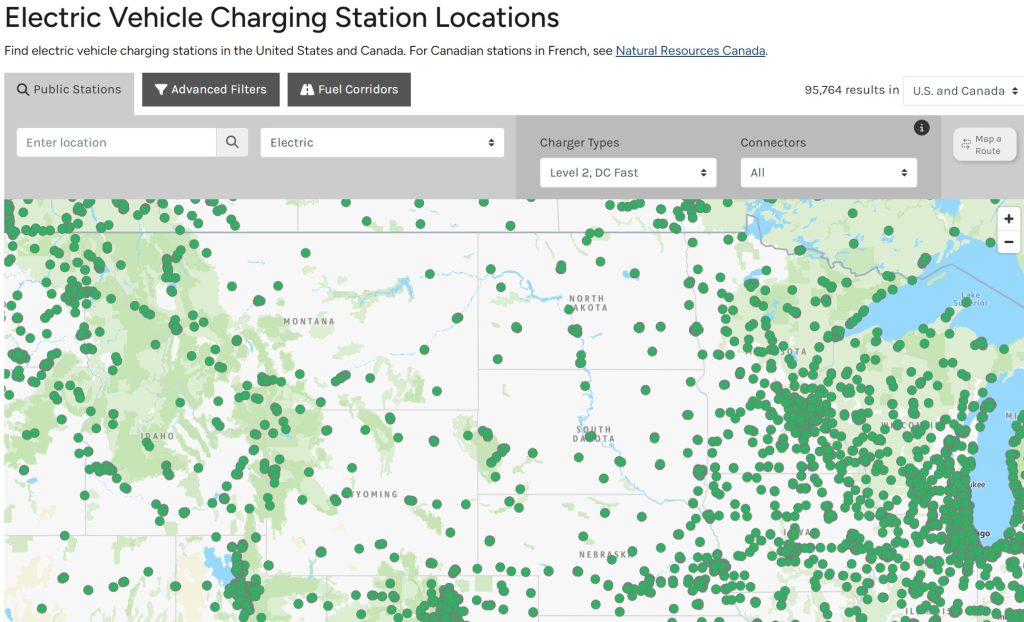
As of the first part of 2025, only 45% of rural counties had at least one fast EV charging port installed — compared to 76.5% of metropolitan counties. The United States has around 60,000 fast charging ports installed nationally, but their distribution is heavily skewed toward urban and interstate corridor locations.
Private EV charging operators typically need utilization rates of 15–25% or higher to break even. In rural areas with low traffic volumes, utilization rates often fall well below those thresholds. Without subsidy, private capital does not flow to rural charging infrastructure.
The NEVI program: promise, disruption, and reboot
The National Electric Vehicle Infrastructure (NEVI) Formula Program — created by the IIJA with $5 billion in federal funding — was designed to address the charging infrastructure gap. NEVI provides up to 80% federal funding for EV charging stations along designated Alternative Fuel Corridors (AFCs).
In February 2025, the Trump administration suspended NEVI funding pending guidance review. Of the $3.3 billion allocated to states through FY2025, only $527 million had been awarded when the freeze hit, and an estimated 57 NEVI-funded stations had opened across 15 states. The Government Accountability (GAO) Office found in May 2025, that DOT did not have authority to suspend NEVI, and litigation is ongoing. In August 2025, new streamlined NEVI guidance was released, rebooting the program — states had 30 days to resubmit plans, and by early 2026 many have resumed projects.
The updated guidance made several significant changes:
- Removed the strict 50-mile spacing requirement for AFCs, giving states flexibility (while retaining 50 miles as a planning benchmark)
- Added a dual-connector requirement — new NEVI sites must include both CCS and NACS connectors
- Expanded eligible uses to include medium and heavy-duty charging infrastructure and upgrades to existing stations
- Encouraged states to identify rural and secondary highway charging gaps beyond primary AFC corridors
North Carolina’s 2026 NEVI reboot strategy offers a model: NCDOT announced it was shifting from interstate corridor installations toward rural areas and communities “where less coverage exists” — explicitly prioritizing the charging deserts that initial NEVI implementation was not reaching.
Beyond NEVI: other EV charging approaches for rural communities
- FHWA CFI Discretionary Grant Program — $2.5 billion competitive program funding EV charging in community locations, explicitly designed to reach places NEVI doesn’t.
- Utility programs — rural electric cooperatives increasingly offer EV charging support: managed charging programs, grid interconnection assistance, and in some cases direct equipment incentives.
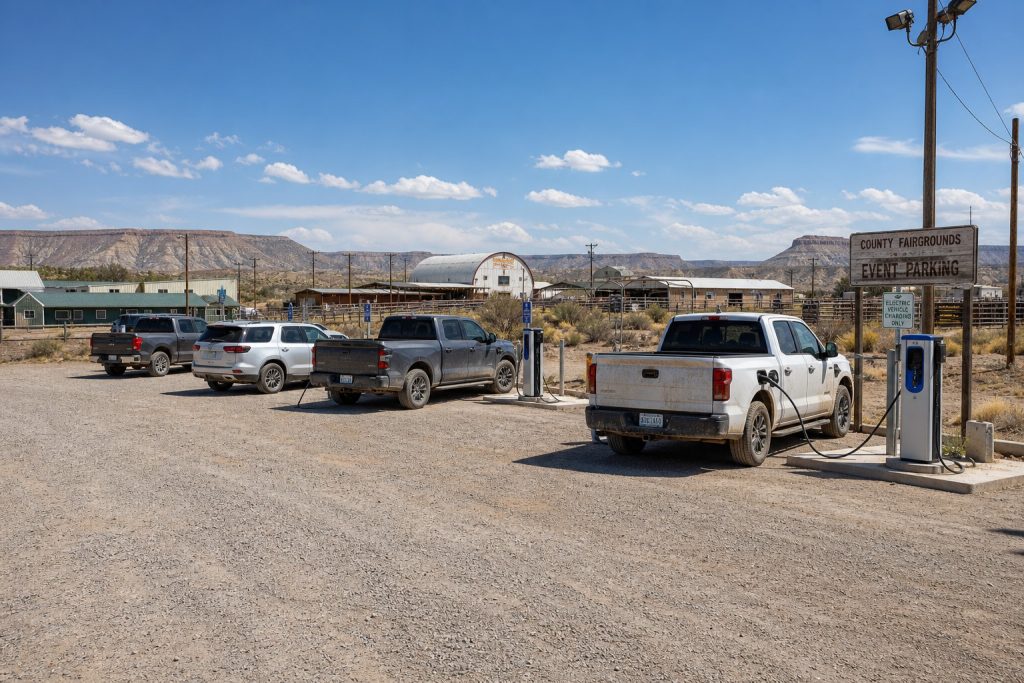
- Community charging locations — libraries, courthouses, fairgrounds, trailheads, and school parking lots are viable EV charging hosts that serve residents who can’t charge at home.
Any new or updated comprehensive plan should map EV charging stations and identify holes in the network, from both a Transportation user point-of-view as well as a Utility infrastructure perspective.
Electric school buses and fleet electrification
Electric school buses are a common entry point for rural electrification. The EPA’s Clean School Bus Program has provided significant federal funding for electric bus procurement, and rural school districts have been active applicants — both because diesel emissions affect rural children and because operational cost savings (lower fuel and maintenance costs) are particularly meaningful for small districts with tight budgets.
Grid impacts: the rural cooperative challenge
Every EV plugged in is a new electrical load on the system, and for rural electric cooperatives and public power districts already managing aging distribution infrastructure and tight capacity margins, large‑scale EV adoption introduces real grid planning and investment challenges. That is why national efforts like DOE’s EVGrid Assist resources and low‑carbon technology toolkits emphasize managed charging and load‑management strategies: coordinating when vehicles charge based on grid conditions, time‑of‑use prices, and system constraints can substantially reduce peak demand impacts, lower the need for expensive capacity upgrades, and keep reliability strong as transportation electrifies.
Bidirectional charging—vehicle‑to‑grid (V2G) and vehicle‑to‑building applications—can go a step further in rural settings, turning EV batteries into distributed storage that can support the local grid or critical facilities during peak periods or outages, a concept highlighted in DOE and utility technical assistance materials on battery storage for charging. For cooperatives and public power suppliers, tapping into these resources early and building EV integration into long‑range distribution planning, rate design, and demand‑side programs will make it easier to align charger deployment, managed‑charging programs, and potential V2G pilots with broader retrofit and resilience strategies for buildings and infrastructure.
Most rural zoning jurisdictions I am familiar with are just now adopting standards for battery energy storage systems (BESS). I helped incorporate BESS standards into zoning for renewable energy installations in several city and county land use regulations over the past couple years, most recently in Jefferson County, Nebraska. Just be sure your local zoning ordinance does not unintentionally classify V2G and small-scale BESS installation as a commercial power supply and make people jump through unnecessary hoops to install this public benefit.
Beyond grid logistics, the co‑benefits of proactive EV and charging planning are substantial: states and cities’ efficiency and clean‑energy toolkits point out that efficient transportation and electrification can reduce fuel costs for public fleets and households, cut local air pollution and associated health risks, and strengthen resilience by diversifying energy sources and enabling more local, clean generation. Rural cooperatives and communities that plan for EV integration now—using available technical assistance and framing EV charging and managed load as part of a broader efficiency and resilience strategy—will be better positioned than those that wait, with lower long‑term costs, cleaner air, and more reliable service for their members.
The practical planning connection:
Rural communities should identify their highest-priority public charging locations—including community “amenity” sites like the library or trailheads—then develop a siting plan before NEVI and CFI application cycles open. Coordinate with your electric utility on grid capacity and interconnection early — utility infrastructure upgrades can take years and are the most common constraint on charging project timelines. And don’t overlook the fleet: electric school buses and municipal vehicles can be the best first electrification investment, with the most predictable use patterns and the most controllable charging infrastructure.
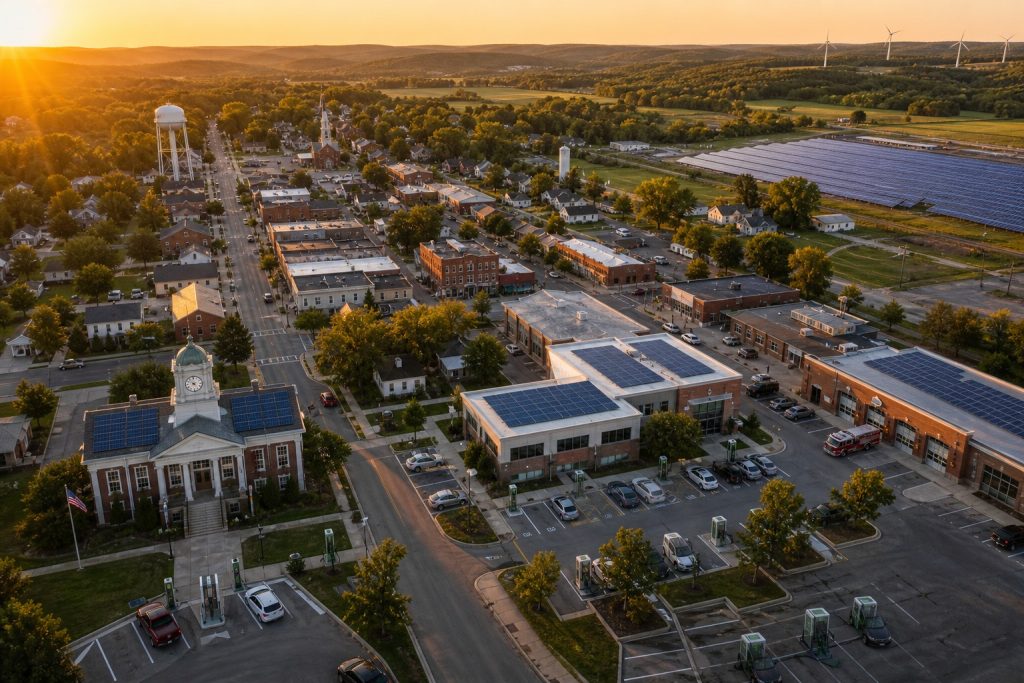
Closing the CUE Series: The Demand Side Matters
This post closes our June CUE series: four weeks on the infrastructure that quietly shapes rural community life—communications, utilities, water, waste, energy production, and now conservation and efficiency. There is a common thread running through all of it. Rural communities that plan ahead do better than those that wait for a crisis, a grant deadline, or a developer proposal to force the conversation.
Energy efficiency belongs in that same category. It is not a side issue for engineers or a niche concern for energy people. It is part of basic local stewardship: taking care of public buildings, helping households and businesses manage costs, and making sure the systems a community already owns are working as hard as they should.
That story also needs to be visible. If a comprehensive plan talks about energy at all, it should not bury it in a few generic sentences near the back. Put the public buildings on a map. Show the brownfield sites. Point to the water plant, the school, the library, the downtown block of older storefronts, and the neighborhoods where high energy burdens hit hardest. People understand places better than abstractions.
Just as important, tell the before-and-after stories. Show what happened when a town replaced old lights, tuned up an HVAC system, fixed a leaking public facility, reused a brownfield, or added charging where it was actually needed. Pair the big infrastructure conversation with the small, familiar actions people can picture in their own lives: insulation, weatherization, smarter thermostats, better pumps, better windows, and better timing of electric loads.
And then keep going. A good comprehensive plan should not treat energy efficiency as a one-time chapter written to satisfy a requirement. It should establish a baseline, track a few useful measures, and come back to them every few years—through an annual report, a dashboard, or a simple check-in before the next capital plan is written. That is how efficiency stops being a slogan and becomes part of how a community governs itself.
In the end, this is not really a story about using less for its own sake. It is about wasting less, paying less, and running small-town government and community infrastructure with a little more care and a little more foresight. In that sense, less really can be more.
Coming up in July, we’ll be looking at Natural Resources and the Environment, including more discussion on water, as well as soils, wetlands, and other environmental resources.
I am in transition between jobs at the moment. Does your city or county need help working out planning and development for the clean energy economy? Drop me a line and let’s see what I can do to help.

Resources
Energy efficiency — local government
- DOE Energy Efficiency and Conservation Block Grant Program (EECBG) — energy.gov/cmei/scep
- IRS Elective Pay / Direct Pay — irs.gov/credits-deductions/elective-pay-and-transferability
- USDA Rural Energy for America Program (REAP) — rd.usda.gov
Weatherization
- DOE Weatherization Assistance Program — energy.gov/cmei/scep/wap
- National Energy Assistance Referral (NEAR) / LIHEAP — acf.hhs.gov
Brownfields
- EPA RE-Powering America’s Land — epa.gov/re-powering
- EPA Brownfields Program — epa.gov/brownfields
- Smart Growth America Brightfields Map — smartgrowthamerica.org
EV charging
- US DOE Office of Critical Minerals and Energy Innovation, Alternative Fuels Data Center — afdc.energy.gov
- FHWA NEVI Program — fhwa.dot.gov/environment/nevi/
- FHWA Charging and Fueling Infrastructure (CFI) Program — www.transportation.gov
- DOT Rural EV Toolkit — www.transportation.gov
- EPA Clean School Bus Program — www.epa.gov/cleanschoolbus
Books
These books go deeper on this week’s themes: the case for electrifying everything, the policy barriers
to building clean energy infrastructure, and the optimistic vision for what a fully electrified rural America
could look like.
Charged: A History of Batteries and Lessons for a Clean Energy Future (Weyerhaeuser Environmental Books)
James Morton Turner (University of Washington Press, 2022)
A history of battery technology that traces the materials, communities, and supply chains behind the batteries now powering EVs and grid storage. Turner is an environmental historian, and his lens — where do lithium, graphite, and nickel come from, and who bears the costs of extracting them? — is a useful counterweight to the optimism of Griffith and Klein/Thompson. For rural planners evaluating BESS installations and EV charging networks, understanding the full supply chain of battery technology is increasingly relevant.
Electrify: An Optimist’s Playbook for Our Clean Energy Future
by Saul Griffith (The MIT Press, 2021)
Griffith is an Australian engineer and entrepreneur who argues that decarbonizing America is fundamentally an engineering and manufacturing challenge — not a political one — and that electrifying everything (cars, heat pumps, appliances, industrial processes) is both technically achievable and economically beneficial for most households. His analysis of household energy economics — what it actually costs to switch from gas to electric, and how the math changes with cheap solar — is the clearest treatment of the subject available. Essential reading for anyone working on rural electrification programs, EV charging policy, or home weatherization.
Rural Renaissance: Revitalizing America’s Hometowns through Clean Power
by L. Michelle Moore (Island Press, 2022)
Moore has provided both a deeply personal story and an informative, practical guide to local applications of renewable energy generation. The book was immediately useful to this small town and rural planner. Our June 2026 book of the month.
Read the full review here.
Abundance
by Ezra Klein & Derek Thompson (Simon & Schuster, 2025)
The buzziest policy book of 2025 argues that America’s core problem is that it has stopped building things — housing, clean energy infrastructure, transmission lines, EV charging networks — and that the regulatory and legal structures built in the 1970s to stop bad development now prevent good development too. Their energy chapter is directly relevant to the rural context: Klein and Thompson argue that permitting reform, streamlined utility interconnection, and government capacity to actually execute projects are more important than new subsidies. A provocation still on my To Be Read pile.
The War on the EPA: America’s Endangered Environmental Protections
Robin Kundis Craig (Bowman & Littlefield, 2020)
A somewhat older but still useful reference for understanding the legal and regulatory framework within which brownfield cleanup, Superfund sites, and environmental remediation operate. For rural planners working on brownfield-to-solar projects, understanding what EPA programs actually require — and how they interact with state environmental agencies — is critical to avoiding costly surprises mid-project. Craig’s accessible legal analysis is the best available starting point for non-lawyers navigating this terrain.
The CUE Series — Complete
- June Series Overview: Connected, Powered, and Sustained —
jcshepard.com/2026/06/rural-infrastructure-2026-communications-utilities-energy/ - Week 1: Signal and Story — Communications Infrastructure —
jcshepard.com/2026/06/rural-communications-infrastructure-2026-broadband-5g-local-media/ - Week 2: From Source to Tap to Treatment — Rural Utilities —
jcshepard.com/2026/06/rural-utilities-2026-water-wastewater-solid-waste/ - Week 3: Powering Rural America — The Full Energy Picture —
jcshepard.com/2026/06/rural-energy-infrastructure-2026-coal-renewables-land-use/ - Week 4: Less is More, Conservation, Efficiency, and Electrification in Rural Communities
Today’s post
Rural-Ready Engagement: Practical Tools for Small Town Planners
 Watch the full replay: youtube.com/@Engaging-Communities (February 2026)
Community engagement can look very different in small towns and rural communities. This webcast was co-sponsored by the APA Community Engagement Interest Group and the Small Town & Rural Planning Division.
Dynamic Decisions Podcast (Season 2 Episode 15)
“Stop Chasing Smokestacks. Grow What You Have” now playing on Youtube (audio), Apple Podcasts, Spotify (May 2026). Other listening links here.
Popular posts on JCShepard.com
- The Planning Process—From Vision to Action in Small Towns and Rural America (January 2026)
- Small Towns Can Build a Strong Outdoor Economy Without Selling Out (June 2026)
- Historic Preservation and Rural Economic Development: A Rural Growth Strategy (April 2026)
- Reviving Rural America: Why Heritage Tourism Is a Game-Changer Now (September 2025)
- What is Economic Development in Modern America? A Field Guide for Small Towns and Rural Places (March 2026)
- Rural Recreation and the Outdoor Economy: Trails, Fairs, Community Identity (May 2026)
- Rural Housing Supply Crisis: Why Small Towns Are Running Out of Homes (February 2026)
- Community Facilities: Why We Need to Rebuild Our Foundations (April 2026)
- Small Towns, Big Impact: How Rural Communities Are Designing Their Own Futures (November 2025)
- The Rural Comeback: How Small Town Innovation Sparks Growth (August 2025)
Check out The 12 Planning & Sustainability Books You Need in 2026 and browse through the Small Town & Rural Community guides on our Resources page.
(As an Amazon Associate, we may earn commissions from qualifying purchases. Check your local library or bookshop, too.)
.

