

JCShepard.com | June 14, 2026 | Category: Policy, Economy
Last week, we looked at the systems that rural communities use for communications. This week, we look at something even more fundamental: the systems that keep the water clean, take it away again when it’s been used, and manage what’s left over.
Drinking water, wastewater, and solid waste utilities rarely make headlines until something goes wrong. A boil-water notice. A failed lift station. An overflowing landfill. But for the roughly three-quarters of the nation’s public water systems that serve communities of 500 or fewer residents, “something going wrong” is not a remote possibility—it’s a recurring operational reality, managed by a handful of staff (sometimes one person) with budgets that would barely cover a single major repair in a larger city.
This article follows the full water‑to‑waste cycle—where source water comes from, what’s happening underground, how small systems treat what they collect, how trash and recyclables move through rural solid waste systems, and, critically, how any of this gets paid for. Along the way, we’ll flag the practical planning connections: what local officials and planning commissions can do in their comprehensive plans, capital improvement programs, and zoning ordinances to keep these mostly invisible systems working.

Surface Water Supply and Quality
For communities that draw drinking water from rivers, lakes, and reservoirs, the quantity and quality of water starts well beyond the treatment plant—it starts in the watershed.
Source water protection
For surface‑water systems, source water protection is the front line of drinking water security—managing the land and activities upstream of an intake so contaminants never reach the treatment plant in the first place. Instead of designing ever more complex treatment to handle whatever comes down the pipe, the focus shifts to the watershed: who is on the land, what they are doing, and how those practices translate into water quality at the intake. For rural communities, that almost always means working with agricultural landowners and operators, because cropland and pasture typically dominate the drainage area feeding small‑town reservoirs and river intakes.
A source water protection plan starts with mapping and hydrology. The utility (or a regional partner) delineates the watershed and, where feasible, refines the area that most directly influences water quality at the intake—sometimes broken into near‑field “critical zones” and broader contributing areas. Within that footprint, the plan inventories potential contamination sources: fuel and chemical storage; manure and nutrient management practices; pesticide and herbicide use; confined animal operations; failing septic systems; unprotected stream crossings; and legacy dump sites or industrial uses. The result is a clear picture of where the highest‑leverage risks sit on the landscape.
On the management side, source water protection leans heavily on collaboration and practical incentives. Communities work with farmers, ranchers, and rural homeowners to implement best management practices—buffer strips along streams, conservation tillage, nutrient management planning, controlled grazing, upgraded manure storage, or relocation and secondary containment of fuel tanks. In some jurisdictions, these measures remain largely voluntary but are supported by technical assistance and cost‑share dollars from conservation and water‑quality programs. Elsewhere, utilities and local governments layer in regulatory tools, such as ordinances limiting certain land uses near the intake, erosion‑control requirements on construction sites, or onsite wastewater rules targeted to sensitive zones.
For small systems, these plans are often the most cost‑effective investment on the table. Every pound of sediment or nutrient kept on the field is one that does not have to be removed with chemicals and energy at the plant, and every avoided spill or septic failure is a crisis that never materializes. In budget terms, a modest, well‑run source water protection program can defer or downsize major treatment upgrades, stabilize operating costs, and reduce the risk of regulatory violations tied to turbidity, disinfection by‑products, or microbial contamination. Over time, a strong source water protection plan becomes less an add‑on report and more the shared playbook that ties local land‑use decisions and farm management to the long‑term reliability of the town’s surface‑water supply.
Growing threats to surface waters
Surface water systems face a growing set of climate- and development-related pressures:
- Drought reduces reservoir levels and concentrates pollutants, sometimes pushing systems toward emergency restrictions or alternative sourcing.
- Flooding can overwhelm intakes with sediment and debris, and in agricultural areas, flush concentrated fertilizer and manure into waterways.
- Sedimentation from increased runoff (often linked to land use change and more intense storms) reduces reservoir storage capacity over time and increases treatment costs.
- Algal blooms, fueled by nutrient loading and warmer water temperatures, can produce toxins that require specialized treatment—or in severe cases, force systems to switch source water entirely.
Many states now offer Drinking Water State Revolving Fund (DWSRF) and Clean Water State Revolving Fund (CWSRF) set-aside funding specifically for resilience planning, helping systems develop emergency response plans and join Water and Wastewater Agency Response Networks (WARNs)—mutual aid networks that let utilities support each other during emergencies.

Clean Water Act compliance for small systems
The Clean Water Act’s core programs—permits, water quality standards, and planning requirements—apply whether you serve 500 people or 500,000, but the practical burden lands much heavier on small towns and rural utilities. A one‑ or two‑person water/wastewater department may be responsible not only for day‑to‑day operations, but also for navigating National Pollutant Discharge Elimination System (NPDES) permits, stormwater management requirements, and total maximum daily load (TMDL) allocations tied to their receiving streams. Meeting monitoring schedules, keeping up with changing effluent limits, preparing discharge monitoring reports, and understanding how their facility fits into a watershed‑wide TMDL can easily exceed in‑house technical capacity.
For wastewater facilities, NPDES permits drive everything from sampling frequency and lab work to capital planning, because tighter limits often mean new treatment processes or upgraded lagoons. Small mechanical plants or lagoon systems must interpret permit language, operate within narrow ranges, and troubleshoot upsets with limited automation and backup staff. Stormwater can add a separate layer of complexity: even small communities may be subject to construction‑site stormwater rules or, where designated, small municipal separate storm sewer system (MS4) permits that require outfall mapping, public education, and maintenance of stormwater infrastructure. On top of that, TMDLs translate watershed‑scale pollution reduction targets into specific wasteload allocations for individual dischargers, reshaping permit limits over time and forcing small facilities into regional nutrient or sediment reduction strategies.
Because the technical and administrative load is so high relative to staffing, outside help becomes a necessity rather than a luxury. State rural water associations, university extension programs, and nonprofit technical assistance providers often serve as the first line of support—helping operators interpret permit language, set up sampling and recordkeeping, troubleshoot operational changes needed to meet new limits, and participate in TMDL or watershed planning meetings. Regional partnerships can go a step further: shared operators, shared pretreatment or lab services, or even shared compliance staff spread specialized expertise across several small systems. Circuit‑rider models, where a single experienced technician or operator travels among systems on a fixed route, are particularly effective at turning complex compliance tasks—like updating an NPDES application, developing a stormwater pollution prevention plan, or responding to a new TMDL—into manageable, scheduled work.
Over time, these collaborative approaches make the difference between paper compliance and real resilience. Small utilities that plug into technical assistance networks and regional collaborations are better positioned to anticipate regulatory changes, plan capital upgrades in step with evolving permit limits, and use watershed‑scale tools like TMDLs to their advantage rather than experiencing them only as unfunded mandates. For elected officials and managers, the strategic question is less “Can we comply on our own?” and more “Who are our partners, and how do we formalize those relationships so compliance is sustainable for the long term?”

Runoff and non-point source pollution
Unlike point‑source pollution (a pipe discharging from a specific facility), non‑point source pollution is diffuse, comes from many small sources across the landscape, and is much harder to regulate directly. In agricultural watersheds, runoff from farm fields, livestock operations, and rural roads is often the dominant water quality challenge, but it is increasingly joined by urban and suburban sources such as lawns, streets, and parking lots. Lawns in particular can be significant contributors of nutrients and pesticides when they are heavily fertilized and irrigated, because stormwater and sprinkler runoff wash excess fertilizer, herbicides, and grass clippings into storm drains and nearby streams right alongside sediment and nutrients leaving cropland.
Nutrient runoff—nitrogen and phosphorus from fertilizer, manure, and turf applications—is the primary driver of algal blooms in downstream lakes and reservoirs and is a major contributor to hypoxic “dead zones” such as those in the Gulf of Mexico and Chesapeake Bay. Other important non‑point pollutants include pathogens and oxygen‑demanding material from manure and pet waste, fine sediment from eroding fields, construction sites, and unpaved roads, and hydrocarbons and metals from streets and parking lots. Taken together, these diffuse loads shape water quality far more than any single discharge, especially in predominantly agricultural or rapidly developing watersheds.
Voluntary conservation and stormwater practices remain the primary tools for tackling non‑point source pollution. On agricultural land, cover crops, riparian buffers, controlled drainage, nutrient management planning, rotational grazing, and improved manure storage and application practices are the workhorses for reducing sediment and nutrient losses. In towns and suburbs, “better lawn” and stormwater management practices—right‑rate and right‑time fertilizer use, reduced pesticide reliance, maintaining vegetated buffers, keeping clippings and leaves out of streets, rain gardens, and other infiltration practices—play a similar role for turf and developed land. USDA programs such as the Environmental Quality Incentives Program (EQIP) and Conservation Reserve Program (CRP) help fund many of the agricultural practices, while local soil and water conservation districts, watershed groups, and stormwater utilities are often the most effective partners for rural communities and small towns working to protect source water from both farm fields and front yards.
Aztec, New Mexico: Surface water, storm water, and source protection
The City of Aztec, New Mexico’s comprehensive plan linked FEMA floodplains (the Animas River runs through the city), arroyo behavior (intermittent streams prone to flash floods), and Army Corps of Engineers stormwater detention projects, directly tied into the city’s drainage plans. The comp plan then incorporates this waterscape with potential benefits of Low-Impact Development (LID) patterns as a greener, cheaper alternative to pure hardscape. This can include simple projects, such as rain gardens, bioswales, and pervious pavement to help manage stormwater and reduce both flooding and wastewater treatment costs.
The practical planning connection: Comprehensive plans should identify the watershed serving any community surface water intake and assess land uses within it. Partnerships with conservation districts and willing agricultural landowners—rather than regulatory mandates—are typically the most effective and politically durable approach for rural source water protection.

Groundwater Quantity and Quality
For the roughly 30 million Americans who get their drinking water from private wells—and the many community and rural public systems that rely on groundwater—the underground picture matters just as much as the surface picture.
Groundwater is the hidden backbone of water supply in both the United States and Canada, especially for drinking water and irrigation, but its importance, pressures, and management vary a lot from region to region.
In many rural counties, there is no surface reservoir to tap; domestic water comes almost entirely from groundwater wells—either public community systems or individual private wells. That’s as true in Nebraska counties sitting over the High Plains Aquifer as it is in small towns and farmsteads across the Canadian Prairies.
Groundwater: A hidden treasure
Groundwater is the quiet workhorse of the water cycle—out of sight under our feet, but carrying far more weight than most of us give it credit for. It lives in the pores and fractures of soil and rock, in aquifers that may stretch for miles across a county or an entire region. Unlike a reservoir you can drive past, an aquifer is a three‑dimensional storage system, slowly recharged as rainfall and snowmelt percolate down through the unsaturated zone. In wetter climates that recharge can be steady and forgiving; in semi‑arid country, it can be agonizingly slow, measured in decades rather than seasons.
Across North America, the balance sheet is striking: at any given time, there is more water stored underground than in all the rivers and lakes we can see. That quiet storage evens out the boom‑and‑bust of surface flows, feeding springs and baseflow long after the last rain. Yet in many regions we still behave as if the “real” water is what we can dam and divert on the surface, treating groundwater as a backup account rather than the primary capital. Where surface water is abundant that bias is easy to ignore; where it is not, the limits of that mindset show up quickly in declining water tables and stressed wells.
In the United States, groundwater supplies roughly a quarter to a third of all freshwater withdrawals, on the order of tens of billions of gallons every day. It is less visible in the headlines than big reservoirs or interstate compacts, but it is just as central to the way we live and work. Somewhere between two in five and one in two Americans depend on groundwater for drinking water when you add up both public systems and private wells, and roughly 13 million households rely on their own wells alone. That is not a niche; that is a backbone.
Regionally, groundwater’s importance sharpens into focus. On the Great Plains, in the interior West, and across parts of the Midwest, aquifers are what make irrigated agriculture possible in landscapes where rainfall and surface flows simply cannot carry the load by themselves. In many small towns, the municipal wellfield is the town’s only practical source of supply—no conveniently placed river to tap, no nearby lake to impound. In those places, groundwater is not just a hidden treasure; it is the town’s future, one pump test and one static‑water‑level reading at a time.
Groundwater is central to three big uses across the United States and Canada, as well as many other places.
1. Drinking water
- U.S.: Roughly 38–50% of people get drinking water from groundwater through public systems and private wells.
- Canada: About 30% of the population uses groundwater for domestic purposes, with rural reliance around 80%.
2. Agriculture and livestock
- In the U.S., groundwater is indispensable for irrigated agriculture in arid and semi‑arid regions; a large share of national groundwater withdrawals goes to irrigation and livestock.
- In Canada, groundwater supports irrigation and livestock in many agricultural regions, though surface water often carries more of the total volume where rivers and reservoirs are plentiful.
3. Industrial and economic uses
- In both countries, groundwater is used by manufacturing, mining, and energy sectors, and many municipal systems rely on it at least part‑time.
- In the U.S., an estimated 90% of public water systems rely on groundwater to help meet their demand, although many mix it with surface sources.
The competition between drinking water, agriculture, and industrial uses lies at the center of many contentious debates about resource scarcity and prioritization, such as community concern with large data centers and other industrial processes. We’ll talk more about data centers later in this series.

The Ogallala: a slow-motion crisis
The Ogallala Aquifer (making up a majority of the High Plains Aquifer system) underlies roughly 175,000 square miles beneath eight Great Plains states, from South Dakota to Texas. It provides roughly 30% of the groundwater used for irrigation in the U.S. and supports around a fifth of the country’s agricultural output—an agricultural economy valued at more than $35 billion.
The fundamental problem is one of timescales. The Ogallala is a “fossil” aquifer, formed thousands to millions of years ago, with a natural recharge rate of less than an inch per year in many areas. Withdrawal rates have far outpaced recharge for decades. In some areas of Texas and Kansas, water levels have dropped by more than 200 feet since large-scale irrigation began in the mid-20th century.
The picture varies significantly by geography. A 2026 University of Nebraska-Lincoln report found that, following years of persistent drought, 62% of measured wells in Nebraska recorded declines—while parts of the northern plains still have relatively healthy reserves. Southern areas face a more acute crisis: southwest Kansas lost 1.52 feet of water in 2024 alone, its steepest single-year drop on record.
The economic modeling is sobering. When aquifer depth drops below roughly 70 feet—the threshold below which many pump systems become uneconomical—the average annual present value of agricultural land returns in the High Plains is projected to fall significantly, primarily because farmers are forced from irrigated into dryland farming.
For rural communities, the Ogallala situation isn’t an abstraction—it’s a long-term water supply planning issue. Municipal wells draw from the same aquifer system as irrigation wells. Communities in the High Plains should be incorporating long-term aquifer trends into water supply planning now, not waiting for a crisis. If your community draws from an aquifer, your next comprehensive plan should map aquifer trends alongside growth areas, just as you already map wellhead protection areas and floodplains.
What’s working: Kansas Groundwater Management Districts and Local Enhanced Management Areas have demonstrated that precision irrigation, soil moisture sensors, and voluntary pumping limits can measurably slow depletion while largely preserving farm income—offering a model other High Plains states are watching closely.
Canada: An interconnected system
Despite Canada’s iconic lakes and rivers, groundwater volumes in Canadian aquifers are estimated to exceed the water stored in surface rivers and lakes. About one‑third of Canadians rely on groundwater for drinking water, and in rural areas the share rises to roughly 80%. Overall, around 30% of the domestic water supply comes directly from groundwater, with millions of people, especially in small towns and on farms, using wells rather than large surface‑water intakes.
Groundwater also feeds rivers and wetlands across much of temperate, humid Canada, helping maintain streamflow during dry periods and supporting aquatic ecosystems. Because surface water is so abundant in many provinces, groundwater can be somewhat “out of sight, out of mind,” yet it underpins rural water security and ecological baseflow in ways that only become obvious when levels drop or contamination occurs.

Private well contamination: the regulatory gap
Here’s a fact that surprises many people: private wells are not regulated under the Safe Drinking Water Act. More than 43 million Americans rely on private wells, and the responsibility for testing and treating that water falls entirely on the household.
This matters enormously for PFAS (“forever chemicals”). At least 45% of U.S. tap water is contaminated with PFAS to some degree (as of the latest counts), and the presence may be even greater in private wells, which are tested far less regularly than public systems. PFAS contamination disproportionately affects low-income, rural, Black, and Indigenous communities—often because of proximity to current or historical industrial sites, military installations, or areas where PFAS-containing firefighting foam was used.
The regulatory picture for PFAS has been in flux. EPA finalized enforceable Maximum Contaminant Levels (MCLs) for six PFAS compounds in 2024. In May 2026, EPA proposed two significant changes: one rule would extend the compliance deadline for PFOA and PFOS MCLs by two years, to 2031, and a second would rescind the 2024 standards for PFHxS, PFNA, HFPO-DA, and the Hazard Index mixture. Comment periods on both proposals close in July 2026.
EPA has framed the extended timeline as relief for small and rural systems that need more time to identify affordable treatment technologies, and the National Rural Water Association has welcomed the additional compliance time. At the same time, EPA’s PFAS OUT initiative—launched in 2026—aims to proactively engage roughly 3,000 drinking water systems nationwide with known PFOA/PFOS challenges, prioritizing smaller and rural systems for support before the 2031 deadline.
For private well owners, none of this regulatory activity changes their fundamental position: there’s no MCL that applies to them, no utility responsible for treatment, and often limited awareness that testing is even something they should consider. RCAP and other technical assistance providers run private well testing and education programs funded by EPA, but reach is limited relative to the scale of the issue.

Wellhead protection programs
For community water systems which pull from aquifers, wellhead protection is the groundwater counterpart to source‑water protection on rivers and reservoirs. These programs start by defining a wellhead protection area (WHPA): the land surface and subsurface zone that contributes water to a production well over a specified time of travel, often on the order of 5 to 10 years. Using hydrogeologic mapping, pumping tests, and flow modeling, utilities and regulators delineate that capture zone and then inventory the land uses and facilities within it that could threaten groundwater quality—from fueling stations and dry cleaners to intensive livestock operations, septic systems, and industrial sites.
Once the WHPA is mapped and the risk inventory is in hand, the focus turns to management. Local governments and systems apply a mix of tools—zoning and land‑use controls, development standards, operating permits, and best management practices—to reduce the likelihood that contaminants ever reach the aquifer. That might mean steering high‑risk uses away from the most sensitive areas, requiring secondary containment and spill‑prevention measures near wells, closing or properly sealing abandoned wells that can act as direct conduits, and promoting stormwater and recharge designs that protect rather than mobilize pollutants.
Our new comprehensive plan in Thayer County, Nebraska, recognized the existing mapped wellhead protection areas and we discussed the need for new ones as new municipal wells were established. The County Board had already adopted zoning protections in those areas, in cooperation with the cities and villages who drew their drinking water from wellfields out in the unincorporated areas. Like in many communities, the most effective programs are the ones that pull planning commissions, zoning boards, and system operators into the same conversation so that long‑lived land‑use decisions reflect long‑lived water‑supply assets.
For public systems relying on groundwater, these wellhead protection programs are increasingly tied to financing and compliance. Many states require, or strongly encourage, approved wellhead protection plans as a condition of eligibility for DWSRF assistance or similar low‑interest loans. That linkage nudges especially small and mid‑sized systems toward proactive source protection instead of waiting for a contamination event that triggers costly treatment upgrades, well replacement, or remediation. Done well, wellhead protection becomes less a one‑off regulatory box to check and more a standing framework that aligns land‑use, infrastructure investment, and groundwater stewardship over the life of the system.
Managed aquifer recharge
Managed aquifer recharge (MAR)—deliberately directing surface water (often floodwater or treated wastewater) into the ground to replenish aquifers—has moved from a niche technique to a genuine resilience strategy in water-stressed regions. Techniques range from simple infiltration basins to active injection wells. For rural communities sitting atop stressed aquifers, MAR can be a relatively low-cost complement to demand-side conservation, particularly where seasonal floodwater is otherwise lost to runoff.
Hall County, Nebraska: Groundwater and wellhead protection
Hall County, Nebraska, is a good example of how a largely groundwater‑dependent county can turn wellhead protection from a technical requirement into a planning tool. Domestic and irrigation supplies there are typically drawn from individual and shared wells, and every municipality in the county relies on groundwater for its public water systems.
The county’s comprehensive plan maps multiple wellhead protection areas—north of Cairo, at Wood River, and along the Platte River at Alda and around Grand Island—and explicitly treats them as overlay districts much like floodplains, with performance standards aimed at keeping contaminants off the land that feeds public wells.
The plan calls on each responsible jurisdiction to identify and manage potential contaminant sources within its wellhead protection area, participate in contingency and long‑term planning for replacement sources, and work with state agencies to inform the public about the program. In practice, that means wellhead protection shows up not just in engineering reports, but in zoning maps, subdivision review, and capital improvement planning—exactly the kind of crosswalk between groundwater science and local land‑use decisions that many rural counties still lack.
The practical planning connection: Communities relying on groundwater—especially in the High Plains—should incorporate long-term aquifer trend data into water system master plans. For communities with significant private well populations, partnering with RCAP or county health departments on well-testing outreach (especially for PFAS, nitrates, and arsenic) is a low-cost, high-value public health investment.

Wastewater Treatment
If drinking water is the most visible utility, wastewater is the most invisible—until a system fails.
Decentralized systems: the rural reality
Step outside the reach of town sewers, and the story of wastewater changes fast. Unlike urban neighborhoods, where a single collection system and treatment plant serve thousands of people, rural North America runs largely on decentralized wastewater treatment. That means the familiar onsite wastewater treatment system (OWTS)—the individual septic system in the backyard—alongside engineered onsite systems for tough soil conditions and small community “cluster” systems that may serve an unincorporated townsite, a lakeshore subdivision, or a First Nation or Tribal community without the cost of a full municipal network. The pattern is similar on both sides of the border: from New England to the Prairies, from Appalachia to the Canadian Shield, if the houses are far apart, the odds are good the wastewater is treated close to home.
This isn’t a stopgap to be “fixed” by running sewer lines to every gravel road and cul‑de‑sac. In Nebraska, for example, Title 124 sets standards for onsite systems and triggers Department of Water, Energy and Environment (DWEE) review for lots under three acres; other states and provinces have similar rules tucked into health or environmental codes
In low‑density landscapes, with minimum lot-sizes predicated on soil capacity, decentralized systems are often the most cost‑effective and environmentally appropriate solution available. The per‑household cost of extending a conventional sewer and building or expanding a centralized treatment plant can be astronomical when you only have a few users per mile of pipe. Properly sited and maintained septic systems can do an excellent job of treating wastewater, returning it to the shallow subsurface and, ultimately, to the local groundwater system. In places with thin soils over bedrock or sensitive shorelines, engineered onsite and cluster systems can provide a level of treatment comparable to a small municipal plant without the overhead of a full collection system.
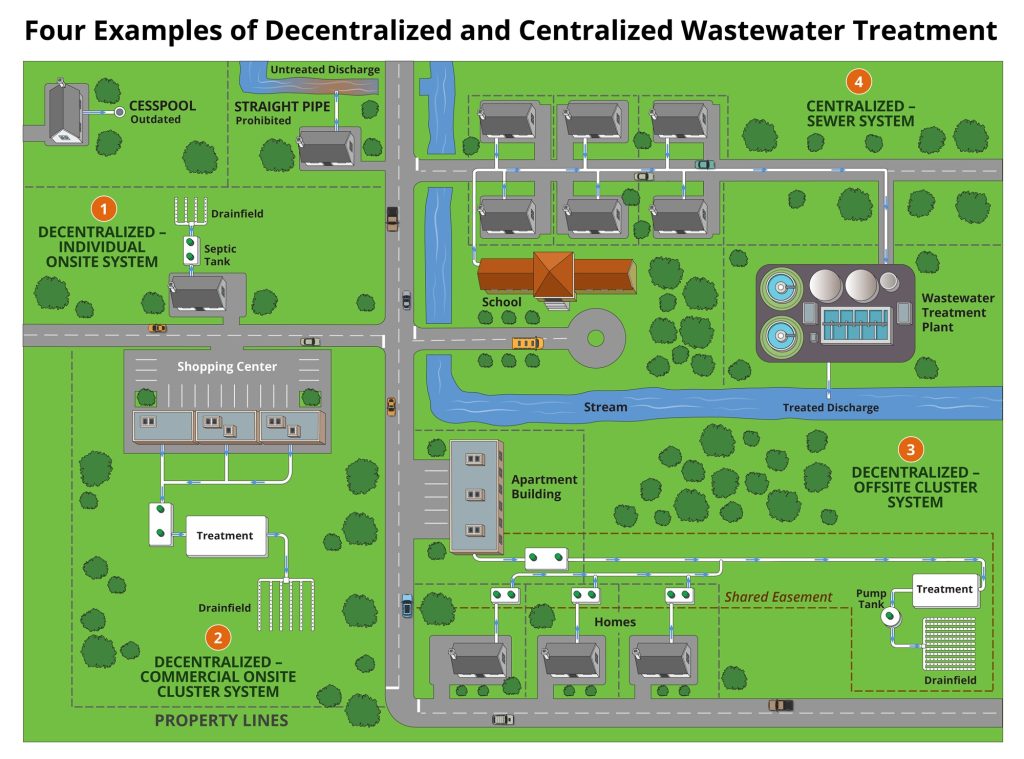
But decentralized systems live and die by details that are easy to overlook. A conventional OWTS depends on three things: a tank that retains solids and scum, a soil treatment area that can accept and treat the effluent, and a homeowner who does not unknowingly overload or neglect the system. When those pieces are missing or compromised—undersized tanks, compacted or saturated drainfields, no pumping for decades—the result is partial treatment at best. Effluent can short‑circuit to ditches, tile drains, or shallow groundwater, carrying nutrients, pathogens, and other contaminants toward wells and surface waters. In many rural villages and lakeshore communities in both the U.S. and Canada, legacy systems installed before modern standards are still in service, quietly drifting past their intended design life.
Oversight for decentralized systems also looks very different from a single discharge permit on a treatment plant. Instead of one pipe with one operator, a county or regional health unit might have thousands of small systems scattered across the countryside, built over many decades under changing codes. Some provinces and states have well‑developed inspection and maintenance frameworks—regular inspections at point of sale, operating permits for advanced treatment units, pump‑out reminders tied to property records. Others still rely heavily on one‑time installation approvals and complaints to flag problems. In First Nations, Tribal, and unincorporated rural settlements, gaps in funding and jurisdiction can leave homeowners with failing systems and few realistic options for repair.
That’s where the real rural challenge lies: not in the technology so much as in the lifecycle. Decentralized systems require a different kind of governance than centralized ones—steady, low‑level attention rather than occasional big projects. They need inspection programs that actually get out to the sites, maintenance requirements that are understandable and enforceable, and—critically—a practical plan for what happens when an aging system fails and the homeowner cannot afford replacement. In both the U.S. and Canada, that plan increasingly involves creative combinations of tools: low‑interest loan programs, grants for low‑income households, small‑scale cluster projects where individual replacements no longer make sense, and regional technical assistance to help rural governments sort through options.
For local officials and planners, the key shift is to stop treating septic systems as purely private appliances and start treating them as a distributed public health and water‑resource asset. In most rural counties, decentralized systems collectively handle as much wastewater as a decent‑sized treatment plant would. The question is not whether they are “good enough,” but whether we are organized enough—across building codes, health regulations, and financial tools—to keep them working for the next generation of rural homes.

Regulatory compliance for small wastewater utilities
Small wastewater utilities live in the same regulatory universe as their bigger peers, but with a fraction of the staff and budget to navigate it. NPDES discharge permits still set numeric limits for biochemical oxygen demand, total suspended solids, ammonia, nutrients, and sometimes bacteria and metals, along with operating conditions and special studies. The plant is still expected to collect representative samples, ship them to certified labs, interpret results, and submit accurate discharge monitoring reports on time, every time. When a new or revised permit tightens effluent limits, it can trigger the same level of engineering analysis and capital planning that a much larger city would undertake—just without the planning department, in‑house engineer, or utility finance team.
Layered onto that are all the ancillary requirements that ride along with a modern wastewater permit: industrial pretreatment in communities with even a handful of significant users, inflow and infiltration assessments, sewer‑system mapping and maintenance, emergency and resiliency planning, and participation in watershed‑level nutrient or TMDL implementation efforts. For a small plant with one certified operator who also fixes lift stations and plows snow, the technical and administrative capacity required to manage this stack of obligations often exceeds what the system’s rate base can reasonably support. The result is a persistent gap between what regulations on paper demand and what the smallest systems can deliver without outside help—one that has to be bridged with regional partnerships, technical assistance, and funding support if compliance is going to be more than an aspirational goal.
The funding tools I’ll touch on later—USDA loans and grants, SRF principal forgiveness, and rate‑study technical assistance—are, in practice, compliance tools; they’re how a one‑operator plant turns a paper permit into a feasible project list instead of a stack of violations.

Nutrient removal and emerging contaminants
Nutrient removal—reducing nitrogen and phosphorus in wastewater effluent—has become an increasingly common requirement as states implement nutrient reduction strategies tied to downstream water quality goals (Gulf hypoxia, Chesapeake Bay, and similar regional efforts). For small treatment plants, retrofitting for nutrient removal can be one of the most expensive upgrades they face.
Emerging contaminants—PFAS, pharmaceuticals, microplastics—are increasingly a wastewater issue as well as a drinking water issue. Wastewater treatment plants were never designed to remove these compounds, and as they’re identified in effluent and biosolids, treatment plants face new questions about whether (and how) to address them, often without dedicated funding streams to do so.
Technological innovations
A few innovations are particularly relevant for rural systems:
- Membrane bioreactors (MBRs) combine biological treatment with membrane filtration, producing high-quality effluent in a smaller footprint than conventional systems—useful for sites with limited space or stringent discharge requirements.
- Resource recovery approaches treat wastewater not as waste but as a source of recoverable nutrients (struvite for fertilizer), energy (biogas from anaerobic digestion), and even reclaimed water for irrigation.
- Low-energy systems—including constructed wetlands and other nature-based treatment approaches—can provide effective treatment at lower operating cost for the right site conditions, an important consideration given how energy costs factor into small utility budgets.

Failed systems and environmental justice
When wastewater systems fail in rural communities—whether a failing lagoon system, a collapsed sewer line, or a neighborhood of failing septic systems on unsuitable soils—the consequences fall hardest on communities that already have the fewest resources to fix them. Lowndes County, Alabama, became a national symbol of this problem: a rural Black Belt county where many households lack functioning septic systems entirely, resulting in raw sewage pooling in yards.
This is now explicitly an EPA enforcement and environmental justice priority in many regions, but the underlying fix—funding septic system replacement or extending sewer service to underserved rural areas—remains expensive and slow. For rural planners, recognizing failing wastewater infrastructure as an equity issue—not just an engineering problem—is essential to securing the kind of targeted funding (grants and principal forgiveness loans through DWSRF/CWSRF) that’s specifically designed for disadvantaged communities.
Thayer County, Nebraska: Regulatory compliance and technical capacity
Thayer County, Nebraska, is a good example of how rural regulatory compliance often depends less on in‑house specialization than on clearly defining local responsibilities and working through partners. The county’s comprehensive plan recognizes that most homes and businesses outside municipalities rely on onsite wastewater treatment systems, and it explicitly directs the county to assist property owners in conforming with state OWTS requirements rather than assuming every landowner can navigate those rules alone.
At the same time, the plan keeps a focus on coordination—working with municipalities and water providers such as rural water districts to assure the quantity and quality of domestic water supply, and promoting conservation in partnership with utility providers. That is a realistic small‑county approach to technical capacity: the plan does not pretend the county has a deep bench of engineers, operators, and compliance staff, but it does establish that local government has a role in helping residents and communities connect to the right systems, providers, and regulations.
In that sense, Thayer County shows how a rural comprehensive plan can serve as a practical compliance framework—less about administering every technical requirement directly, and more about identifying where coordination, assistance, and steady oversight are essential to keeping small systems functional and lawful.
The practical planning connection: Rural comprehensive plans should include an inventory of decentralized wastewater systems (septic, cluster systems) alongside any centralized infrastructure, with attention to soil suitability, system age, and failure risk. Areas with documented failing systems and limited household capacity to pay for repairs should be prioritized for DWSRF/CWSRF disadvantaged community set-asides.

Solid Waste and Recycling
Solid waste is the part of the utility picture that’s most visible to residents—and often the most underfunded relative to its visibility.
In my case, I only have to look out my window to the east to a wonderous view of “Mount Butler”, a municipal waste landfill rising like a mountain from the flat tall-gras prairies, flaring methane gas into the night.
The rural recycling gap
Recycling infrastructure is, at heart, a density‑and‑distance business, and that math rarely pencils out the same way on gravel roads as it does on city blocks. In cities, curbside garbage pickup and recycling programs make sense because routes are compact, trucks touch hundreds of households in a day, and they can deliver full loads to a nearby materials recovery facility at the end of each shift. The fixed costs of trucks, staff, and processing get spread over a lot of tonnage, which is why urban systems can offer weekly pickup and a long list of accepted materials without breaking their budgets.
Out in the country, those same trucks face a very different equation: long drives between stops, fewer households per mile, and in many regions no processing facility within a reasonable haul distance that will actually accept and sort separated recyclables. Each pound of material carries more fuel and labor cost, and it may have to be hauled again from a local transfer point to a distant regional hub. The result is that service bills are higher (if pickup is even available) and rural recycling rates lag urban rates, because the infrastructure and economics simply do not line up in their favor.
That is where regional solid waste planning can come in. Individual small towns or counties rarely have the population or tax base these days to support a full suite of recycling services and facilities on their own, but groups of jurisdictions working together often do. Regional plans can map existing transfer stations, landfills, and potential materials recovery facilities across multiple counties, identify realistic “hub‑and‑spoke” arrangements, and coordinate routes and contracts so that rural loads can be aggregated into something that looks more like urban volume. They also provide a forum for setting shared priorities—deciding, for example, which materials to target first, where to pilot drop‑off sites, and how to align local ordinances or zoning with the long‑term plan. Done well, regional planning does not erase the distance problem, but it can blunt it, turning scattered efforts into a coherent system that gives rural residents a fair shot at participating in recycling without asking any single township or county to carry the full load by itself.

Transfer stations and haul distances
For many rural counties, the “solid waste system” is not a local landfill at the edge of town; it is a patchwork of transfer stations where residents bring their trash and recyclables to be consolidated in roll‑offs or trailers. Those loads are then hauled—sometimes across county or even state lines—to a regional landfill or waste‑to‑energy facility. Haul distance is the dominant cost variable in this model. Every extra mile driven shows up directly in fuel, equipment wear, and driver time, which in turn shapes nearly every operational decision a board or commission has to make: how many transfer sites the county can afford to maintain, how many days a week they can be open, what fees they must charge to balance the budget, and whether it makes financial sense to collect recyclables that have to be hauled separately and may fetch only modest revenue at the other end.
When recycling enters the picture, the challenge multiplies. Commingled recyclables often need to go to a different facility than trash, and source‑separated materials like glass or cardboard may each need their own destination. In a low‑density county, that can mean multiple long‑haul streams for relatively small tonnages. Some counties respond by setting up “hub‑and‑spoke” systems—one or two staffed sites with full recycling options, supported by a scatter of unstaffed drop‑off points with more limited service. Others decide that the cost of collecting and hauling recyclables is more than they can responsibly pass on to ratepayers and scale back to only the most marketable materials, if they offer recycling at all.
Composting and food waste
Composting sits in an interesting middle ground for rural communities. On paper, rural areas have some natural advantages: more available land for composting operations, fewer immediate neighbors to complain about odors, and close proximity to farms, gardens, and landscaping businesses that can actually use finished compost. Many agricultural communities instinctively understand the value of returning organic material to the soil; the idea of turning food scraps and yard waste into a soil amendment fits neatly with the way they already think about nutrients and soil health.
In practice, though, rural composting runs into the same logistics wall as other specialized waste streams. Food waste needs more frequent collection than trash to avoid odors, pests, and bear or wildlife issues, especially in warm weather. Running extra routes or specialized organics trucks over long distances is expensive, and smaller volumes can make it hard to justify even a modest centralized composting facility. Some rural regions are finding creative ways around those constraints: co‑locating compost sites with existing landfills or transfer stations, building small regional organics hubs that serve multiple towns, or leaning into on‑farm composting partnerships where a producer is willing and permitted to accept source‑separated organics. Still, for many small towns, the barrier is not interest in composting; it is the upfront cost of infrastructure and the complexity of designing a collection system that fits their geography.

Illegal dumping: an enduring rural challenge
Where legal disposal is distant, inconvenient, or expensive, illegal dumping tends to fill the gap, and rural areas give people plenty of places to hide that behavior. Old quarries, abandoned farmsteads, remote pull‑offs, and timber roads become unofficial dump sites for everything from household trash to appliances, tires, and demolition debris. I’ve even found trash piled around my own trash cans at the end of my farm road, abandoned by somebody apparently too impatient to drive the extra mile to the landfill.
Long distances to transfer stations, limited hours of operation, and disposal fees that some residents cannot or will not pay all contribute. So does the perception that “it’s just the back forty” and no one is watching.
Effective responses almost always mix carrots and sticks. On the access side, counties and tribes experiment with free or reduced‑cost cleanup days, “amnesty” events for bulky items and tires, and more convenient transfer station hours that align with when working residents can realistically haul a load.
On the enforcement side, targeted patrols and cameras at chronic sites, coupled with meaningful—but fair—penalties, send a signal that dumping is not just a harmless shortcut. Then there is the cleanup piece: many of the most successful rural efforts rely on local volunteer groups, conservation districts, or youth organizations to help remove historic dump sites, often supported by small grants. Cleaning up a ravine or streambank once does not fix the systemic drivers, but it does reset expectations and make enforcement and education more credible.
Extended producer responsibility: a coming wave
Extended producer responsibility (EPR) laws for packaging and other hard‑to‑manage products are beginning to redraw the financial map for recycling, especially in the states that have moved first. The concept is straightforward: shift some of the cost of managing product waste—particularly packaging—from local governments and taxpayers to the companies that design and sell those products. Most of the early programs have been designed with large, urban recycling systems in mind: dense routes, nearby processing facilities, and relatively predictable streams of material.
For rural communities, the implications are still taking shape. On the upside, EPR programs typically come with funding mechanisms that could finally help underwrite some of the basic infrastructure rural recycling has lacked: better collection containers, upgraded transfer station layouts, transportation subsidies, or even small‑scale processing equipment. Properly structured, those dollars can help close the gap between the cost of moving recyclables over long distances and the modest revenue they generate, making it possible for rural residents to participate meaningfully in statewide recycling systems.
The risk is in the details. If program rules assume short haul distances, year‑round curbside service, or minimum tonnages that small counties cannot realistically meet, EPR can become yet another layer of compliance that rural officials struggle to navigate. Rural local governments and their associations have a strong stake in being at the table as these policies are drafted and implemented—pressing for flexibility around service models, explicit recognition of transportation costs, and funding formulas that do not leave low‑population counties on the margins of systems their residents help pay for at the checkout line.

Technical assistance and the federal role
Against this shifting policy backdrop, technical assistance remains critical. Programs like USDA’s Solid Waste Management Grant Program, administered in part through regional assistance providers, give rural communities something they rarely have on their own: access to people who think full‑time about solid waste and recycling. Those advisors can help counties and small towns assess transfer station layouts, analyze haul and tip fee options, design or refine recycling and composting pilots, and update ordinances to reflect new realities such as EPR or organics diversion. They also help local boards make sense of a fast‑changing funding environment—braiding together grants, loans, and producer‑funded dollars in ways that fit local capacity.
For rural leaders, the solid waste challenge is not just about where the trash goes; it is about how to build a system that is financially sustainable, environmentally responsible, and realistic about the distances and densities they live with every day. Recycling, composting, and illegal dumping are all part of that story. So is making sure that new policy tools, from EPR to organics mandates, are written with gravel roads on the map, not just urban grids.
Burwell, Nebraska: A cooperative approach to regional waste management
Burwell, Nebraska, offers a straightforward example of how a very small city can structure solid waste and recycling in a way that fits its scale. The city contracts with the Loup Central Landfill outside Elba, Nebraska, and operates a transfer station affiliated with that landfill. The Burwell Comprehensive plan also commits to providing recycling service for local residents as a core utility goal, which may be a stretch just now but is a long-term goal vital to extending the future viability of the regional landfill.
For other small towns, Burwell’s approach illustrates a realistic rural model: treat basic recycling as part of the utility portfolio, rely on regional disposal capacity rather than a local landfill, and use the comprehensive plan to keep modest but concrete recycling services on the same planning horizon as pipes, pumps, and power lines.
The practical planning connection: Solid waste planning in rural counties should be regional by default—few individual rural jurisdictions can support standalone systems. If your state is considering EPR legislation, engage early to ensure haul-distance realities and population density are reflected in program design.

Financing and Technical Assistance: How It All Gets Paid For
Everything in this article—source water protection, wellhead programs, treatment upgrades, transfer stations—costs money. For rural communities, the financing and technical assistance landscape is as important as the engineering.
US National and State Programs
USDA Rural Development: Water & Waste Disposal programs
USDA’s Water & Waste Disposal Loan & Grant Program is one of the largest federal funding sources for rural water infrastructure, providing grants, direct loans, and guaranteed loans for drinking water, wastewater, stormwater, and solid waste systems in communities of 10,000 or fewer residents. Grant percentages scale with community income levels, with the poorest communities eligible for grant funding covering up to 75% of project costs.
Two often-underused components of the program deserve more attention:
- Predevelopment planning grants (up to $30,000, or 75% of predevelopment costs) fund the preliminary engineering report and environmental review that form the foundation of a full construction application. Communities that skip this step often submit weaker applications—or fund predevelopment costs out of already-stretched local budgets.
- Emergency community water assistance grants (up to $500,000) are designed for situations where a water supply has failed or is about to fail—a critical tool for communities facing acute crises.
EPA State Revolving Funds: DWSRF and CWSRF
The Drinking Water State Revolving Fund (DWSRF) and Clean Water State Revolving Fund (CWSRF) remain the backbone of water infrastructure financing nationally, providing below-market loans (and, increasingly, grants and principal forgiveness for disadvantaged communities) to water systems. For FY2026, EPA announced $7.2 billion in combined SRF allotments to states, tribes, and territories.
That said, the funding trajectory for SRFs is uncertain. The administration’s FY2026 budget proposal sought a $2.46 billion reduction in SRF funding from 2025 levels, reflecting a stated policy preference for shifting more responsibility to states. Under the 2021 infrastructure law, roughly $11.7 billion in supplemental DWSRF funding has been made available, with the requirement that nearly half go to underserved or disadvantaged communities as grants or principal forgiveness loans—but whether that level of supplemental funding continues in future years remains a live budget question.
For rural systems, the practical takeaway is that DWSRF and CWSRF should be approached through your state revolving fund office, which administers the program and sets state-specific priorities, application cycles, and disadvantaged community criteria. Engaging early with your state SRF program—ideally well before a project becomes urgent—remains the most reliable way to access this funding.
Technical assistance: RCAP, RCAC, and the network behind small systems
The Rural Community Assistance Partnership (RCAP) is a national network of more than 350 technical assistance providers, prioritizing communities under 10,000 residents—a category that includes the 72% of U.S. public water systems serving 500 or fewer people. RCAP’s services span an enormous range: helping communities prepare USDA and SRF funding applications, training operators, conducting rate studies, troubleshooting failing septic systems, and—critically—helping systems develop the long-term financial and managerial capacity that funders increasingly require as a condition of assistance.
RCAP also administers USDA’s Solid Waste Management technical assistance program and EPA-funded private well owner training—making it one of the few organizations addressing the full water-to-waste spectrum for small communities in an integrated way.
For communities that haven’t worked with RCAP (or their regional affiliate, such as RCAC in the West or Midwest Assistance Program, Inc. (MAP) in my part of the world): this assistance is free, and predevelopment planning is the point at which engagement is most valuable.

Regionalization and consolidation: when does it make sense?
Regionalization—merging or interconnecting small systems into larger regional utilities—is often presented as the obvious solution to the “too many small systems” problem. And in some cases, it is: shared administrative costs, shared technical staff, and economies of scale in treatment can meaningfully reduce per-household costs.
But regionalization isn’t automatically the right answer. The economics depend heavily on geography (how far apart are the systems? what would interconnection infrastructure cost?), on governance (can communities agree on rate structures, capital cost allocation, and decision-making authority?), and on the specific deficiencies being addressed (a water quality problem at one system doesn’t necessarily require physically interconnecting with another).
What’s more broadly applicable than full regionalization is shared services: joint operator positions, shared equipment, cooperative purchasing, and regional technical assistance arrangements that capture some economies of scale without requiring full system consolidation. For many rural areas, this middle path—shared services without full regionalization—may be the more realistic near-term opportunity.

Rate affordability and low-income assistance
Underlying all of this is a basic tension: small systems need adequate rates to fund operations, maintenance, and debt service, but rural communities often have lower median incomes and can least afford rate increases. Affordability assessments—comparing utility rates to median household income—are increasingly part of state SRF intended use plans, and several states now require or encourage low-income rate assistance programs as part of utility rate structures.
For rural systems, the honest framing is this: deferred rate increases are a form of deferred infrastructure investment, and the systems that defer rates longest often face the most expensive emergency repairs later. Rate-setting workshops—offered free by RCAP and similar providers—are among the highest-value technical assistance available to small systems, helping boards set rates that are both adequate and as equitable as possible.
The practical planning connection: Every small rural utility should have a current rate study and a relationship with its regional RCAP affiliate. Predevelopment planning grants and emergency assistance grants from USDA are underused tools that can make the difference between a manageable capital project and a true crisis.

The Bigger Picture: The Infrastructure We Don’t See
There’s a reason this week’s topics don’t generate headlines the way broadband or renewable energy do. Water that comes out of the tap clean, waste that disappears when you flush, and garbage that gets disposed of properly are the very definition of infrastructure working as intended—invisible by design.
But that invisibility cuts both ways. It means rural utilities rarely get the political attention or sustained investment that more visible infrastructure attracts—until something fails dramatically enough to make the news. By then, the cost of fixing the problem is almost always higher than the cost of preventing it would have been.
The themes that run through this week—aging infrastructure serving small populations, a regulatory framework that doesn’t always account for the realities of small systems, a financing landscape that’s real but requires technical capacity to access, and an emerging set of equity concerns around who bears the cost of failing systems—aren’t unique to water and waste. They’re the connecting infrastructure for everything else.
Next week, we turn to energy: the full 2026 picture of how rural America produces and uses power, from coal to small modular reactors to agrivoltaics—and what it means for the land, water, and communities we’ve spent this month exploring.

Read More
Want to go beyond this blog post? Here are three books that bring this week’s topics to life in very different ways.
📖 Running Out: In Search of Water on the High Plains — Lucas Bessire (Princeton University Press, 2021)
This National Book Award finalist is an intimate reckoning with aquifer depletion in America’s heartland.
📖 Waste: One Woman’s Fight Against America’s Dirty Secret — Catherine Coleman Flowers (The New Press, 2020)
A MacArthur grant–winning environmental justice activist’s riveting memoir of a life fighting for a cleaner future for America’s most vulnerable.
📖 River of Lost Souls: the Science, Politics, and Greed Behind the Gold King Mine Disaster — Jonathan P. Thompson (Torrey House Press, 2018)
A love story for the Animas River, this compelling read digs into the science, politics, and greed behind the 2015 Gold King Mine disaster at Silverton, Colorado, and the impacts far downstream. Thompson writes on substack these days, link at LandDesk.org.
📖 Water without Borders?: Canada, the United States, and Shared Waters — Norman, Cohen, & Bakker, ed. (University of Toronto Press, 2013)
This title investigates the legal and geopolitical relationship governing shared US-Canadian boundary waters.
📖 A Twenty-First Century U.S. Water Policy — Christian-Smith, et al. (Oxford University Press, 2012)
This title investigates the legal and geopolitical relationship governing shared US-Canadian boundary waters.
📖 The Big Thirst: The Secret Life and Turbulent Future of Water — Charles Fishman (Free Press, 2011)
A MacArthur grant–winning environmental justice activist’s riveting memoir of a life fighting for a cleaner future for America’s most vulnerable
📖 Cadillac Desert: The American West and Its Disappearing Water — Marc Reisner (Viking, 1986; revised edition by Penguin Books, 1993)
A critical history of water development in the American West, this landmark book explores the political corruption, greed, and environmental consequences behind water in the West.
Resources
Federal programs
- USDA Rural Development: Water & Waste Disposal Loan & Grant Program — Primary federal funding source for rural water/wastewater/solid waste infrastructure
- EPA Drinking Water State Revolving Fund — State-administered low-cost financing for drinking water systems
- EPA Clean Water State Revolving Fund — State-administered financing for wastewater and stormwater
- EPA PFAS OUT Initiative — Proactive support for systems with PFOA/PFOS challenges
- Canada Water Agency — Works with provinces, territories, Indigenous peoples, local authorities, scientists and others to find the best ways to keep our water safe, clean and well-managed for future generations.
Technical assistance
- Rural Community Assistance Partnership (RCAP) — Free technical assistance for water, wastewater, and solid waste in communities under 10,000 across the US
- National Rural Water Association (NRWA) — US circuit-rider technical assistance and operator training
- National Collaborating Centre for Environmental Health (Canada) — One of six National Collaborating Centres created in 2005 to foster linkages and provide knowledge translation within Canada’s public health community.
Data and research
- USGS Water Resources Mission Area — Dashboard for data on water resources in the US
- USGS High Plains Aquifer studies — Groundwater level monitoring for the Ogallala Aquifer
- EPA ECHO Database — Compliance and enforcement data for water systems
- Water Survey of Canada (WSC) — National authority responsible for the collection, interpretation, and dissemination of standardized water resource data and information in Canada
- World Bank Water Data — One-stop shop for all water-related open data at the World Bank
💧 Dig Deeper: Resources for Rural Utilities
Want to take this from “interesting read” to “actual plan”? Here’s where to start:
- 🏛️ USDA Water & Waste Disposal Loan & Grant Program — grants, loans, and predevelopment funding for rural water systems
- 💰 EPA Drinking Water State Revolving Fund — low-cost financing, administered by your state
- 🚽 EPA Clean Water State Revolving Fund — for wastewater and stormwater projects
- 🤝 RCAP — Rural Community Assistance Partnership — free technical assistance, rate studies, and well-testing support for communities under 10,000
- 🔬 EPA PFAS OUT Initiative — proactive support for systems facing PFOA/PFOS challenges
- 📊 USGS High Plains Aquifer Data — for the Ogallala-watchers among us
📚 Continuing the series: catch up on the June overview or last week’s post on rural communications — and join us next week as we dig into rural energy! ⚡
Next in the series: Week 3 — Powering Rural America: The Full Energy Picture in 2026 (June 21)
Missed previous posts? Start with the series overview: Connected, Powered, and Sustained: Rural Infrastructure and the CUE Agenda, or last week’s post: Signal and Story: Communications Infrastructure in Rural America
What’s Coming in June
| Date | Post |
|---|---|
| Monday June 1 | June Series Overview — Rural Infrastructure 2026: Communications, Utilities & Energy |
| Sunday, June 7 | Week 1 — Signal and Story: Communications Infrastructure |
| Sunday, June 14 (Flag Day) | Week 2 — From Source to Tap to Treatment: Rural Utilities (Today!) |
| Sunday, June 21 (Father’s Day) | Week 3 — Powering Rural America: Energy in 2026 |
| Sunday, June 28 | Week 4 — Less Is More: Conservation, Efficiency & Electrification |
We’ll also have a feature on our Book of the Month mid-month, L. Michelle Moore’s Rural Renaissance: Revitalizing America’s Hometowns through Clean Power, one of our Off-Grid Living & Energy Innovation books among “The 12 Planning & Sustainability Books You Need in 2026”.
Visit the Resources page for community guides, planning tools, and curated reading lists.
Rural-Ready Engagement: Practical Tools for Small Town Planners
 Watch the full replay: youtube.com/@Engaging-Communities (February 2026)
Community engagement can look very different in small towns and rural communities. This webcast was co-sponsored by the APA Community Engagement Interest Group and the Small Town & Rural Planning Division.
Dynamic Decisions Podcast (Season 2 Episode 15)
“Stop Chasing Smokestacks. Grow What You Have” now playing on Youtube (audio), Apple Podcasts, Spotify (May 2026). Other listening links here.
Popular posts on JCShepard.com
- The Planning Process—From Vision to Action in Small Towns and Rural America (January 2026)
- Historic Preservation and Rural Economic Development: A Rural Growth Strategy (April 2026)
- Reviving Rural America: Why Heritage Tourism Is a Game-Changer Now (September 2025)
- What is Economic Development in Modern America? A Field Guide for Small Towns and Rural Places (March 2026)
- Rural Recreation and the Outdoor Economy: Trails, Fairs, Community Identity (May 2026)
- Rural Housing Supply Crisis: Why Small Towns Are Running Out of Homes (February 2026)
- Community Facilities: Why We Need to Rebuild Our Foundations (April 2026)
- Small Towns, Big Impact: How Rural Communities Are Designing Their Own Futures (November 2025)
- The Rural Comeback: How Small Town Innovation Sparks Growth (August 2025)
- How Small Towns Succeed: A Proven Playbook for Rural Action (November 2025)
Check out The 12 Planning & Sustainability Books You Need in 2026 and browse through the Small Town & Rural Community guides on our Resources page.
(As an Amazon Associate, we may earn commissions from qualifying purchases. Check your local library or bookshop, too.)
.

1 Comment
Michelle Andahl shares a good introduction to the proposed federal Water Infrastructure Modernization Act (HR 6075).
https://nebraskacolumns.com/guest/smart-water-technology-will-keep-nebraska-s-rates-affordable