

JCShepard.com | June 21, 2026 | Category: Policy, Economy
Rural America is about to feel the energy transition in a very literal way: not as a headline about megawatts and gigatons, but as center pivots moved for a transmission line, prime farmland plowed under for a bright new data center lighting up the night sky, or a solar array staked into ground that has grown corn for three generations. As electric demand climbs from new manufacturing, server farms, and electric vehicles, the question for small towns and counties is no longer whether this infrastructure will arrive, but on whose terms it will be planned, sited, and eventually taken down.
This essay looks at that challenge from the ground level—through public hearings and kitchen‑table maps, late‑night planning commission meetings and red‑lined draft ordinances—as rural communities wrestle with how to fold “communications, utilities, and energy” into the living landscape they call home.
In October 2025, JCShepard.com published a seven-part series on rural energy — the most ambitious content project we’d undertaken to that point. Eight months later, the picture has shifted enough to warrant a thorough update. New EIA data is out. Coal retirements have slowed, then stalled, then partially resumed. Small modular reactor projects have cleared major regulatory milestones. Solar had another record-breaking year. The land use tensions between energy development and agriculture are louder than ever in rural planning offices. And the ordinance landscape for wind and solar has grown more complex — and in many places, more restrictive.
This post does two things: it consolidates the core threads of the October 2025 series into a single updated reference, and it adds everything that’s changed since then. Think of it as the 2026 edition of the rural energy almanac.
Previous coverage from October 2025:
- Rural Energy Economy — October Series Overview
- Rural Energy Revolution: Electricity Demand
- Wind Energy, Wildlife, and the New Rules of Rural Zoning
- Rural Renaissance: Clean Energy
- Solar Energy, Agrivoltaic Frontier
- Rural Energy Shift: Emerging Technologies
- Rural Energy Stack: Layering Renewables for Resilience

I — Where the Numbers Stand: EIA’s 2026 Energy Picture
Every rural energy conversation should start with data. The U.S. Energy Information Administration (EIA) is the authoritative source, and the 2026 numbers tell a story that is more complicated — and more interesting — than either the clean energy is “winning” or “fossil fuels are back” narrative suggests.
A record year for generation — and demand
In 2025, total production of energy in the United States amounted to 106,913 Quadrillion Btu, up from 103,537 in 2024, and a 16.4% increase from 2020. Of this total, 84% came from fossil fuels production, 7.5% from nuclear electric power, and 8.5% from renewable energy sources.
U.S. electricity generation totaled approximately 4,260 billion kilowatthours (BkWh) in 2025 — a new high, and the continuation of a trend that has fundamentally changed the energy planning environment. After nearly two decades of flat electricity demand (a phenomenon that confounded utility planners who had built their infrastructure assumptions around perpetual load growth), demand has now grown for three consecutive years — the first such streak since 2005–2007.
What’s driving it? Three intersecting forces: data centers and AI infrastructure, which are consuming power at rates that were difficult to model even two years ago; manufacturing expansion, including advanced manufacturing plants, many coming online as a result of the CHIPS Act and IRA industrial incentives; and the early stages of transportation electrification, as EV adoption begins to register in utility load data even if it’s still a small share of total transportation energy.
We are seeing these impacts in the field. In 2023, the Hall County, Nebraska, Board of County Commissioners approved a Conditional Use Permit for a 14-megawatt data center to be located in the Southern Public Power District’s Energy Park, on the former Cornhusker Army Ammunition Plant — an industrial use on an industrial site far from residential neighbors. They later turned down other data centers which did not adequately mitigate their impacts on neighborhoods. In another county we were working with, a large “green” manufacturing plant was proposed that would have brought in many jobs, but it would have taken years to build sufficient electric transmission capacity and didn’t move forward. The need to reinforce city electrical grids for at-home EV charging came up in our Burwell, Nebraska, planning process with the engineers doing their best to keep capital improvements planning up to task.
Over the past 25 years, total consumption of all fuels decreased by 0.1% per year due to increasing energy efficiency. However, the EIA’s Annual Energy Outlook 2026 projects “electricity consumption will continue growing through 2050 at a rate of 0.9% to 1.6%, with data center server energy use a major factor.” For rural communities, this matters: rising demand means rising pressure to build new generating capacity, and much of that capacity — particularly renewables — will be sited on rural land.
The fuel mix: renewables up, coal down, gas steady, nuclear reassessed
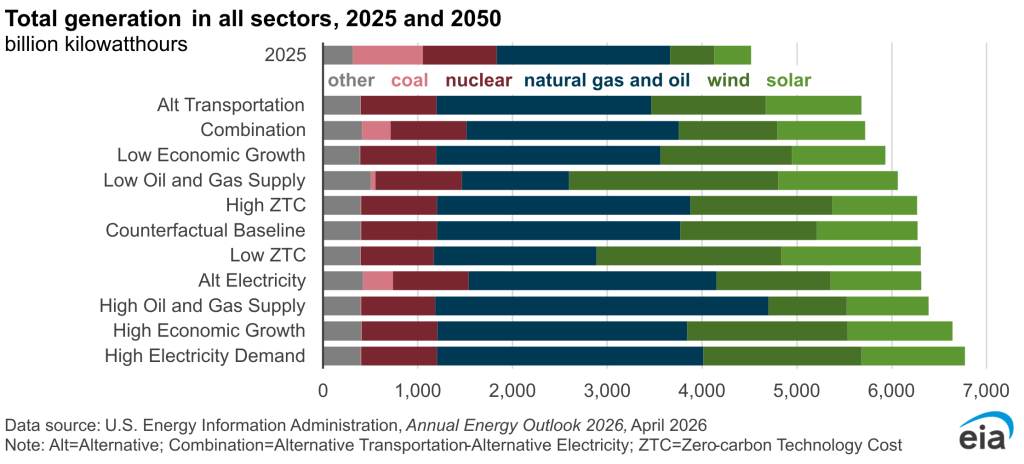
The composition of the U.S. electricity mix is shifting, but the pace and pattern vary by fuel:
Renewables provided approximately 26% of U.S. electricity generation in 2025 — up from around 20% just three years earlier. Wind and solar together hit a combined record of 17%, generating 760,000 gigawatthours (GWh). EIA projects that combined solar and wind generation will rise to about 21% of total U.S. generation by 2027. Battery storage capacity — the technology that makes renewable generation dispatchable — grew by 58% in 2025 and is projected to grow by another 57% in 2026.
Natural gas remains the single largest source of U.S. electricity generation, and its share is holding roughly steady as rising demand absorbs new generation from all sources simultaneously. Gas is also the dominant backup fuel when renewables are not generating. EIA projects Henry Hub natural gas prices around $3.34/MMBtu in the second half of 2026 — relatively flat, with supply growth keeping pace with demand growth.
Coal is in structural decline, but the pace of retirement has slowed sharply in 2025–2026 due to DOE emergency orders keeping plants online. The coal story is addressed in detail in Section 2.
Nuclear provides roughly 18–19% of U.S. electricity generation and is increasingly viewed as a long-term strategic asset rather than a liability. The nuclear story in 2026 is dominated by small modular reactors — also addressed in Section 2.
State-level variation: why rural communities experience energy so differently
National averages obscure geographic variation that matters enormously for rural planning. A few illustrative examples:
High production states: Texas leads U.S. energy production across multiple categories — oil, natural gas, wind, and increasingly solar. North Dakota and Wyoming rank among the top producers of coal and natural gas. Oklahoma generates nearly 40% of its electricity from wind. These are states where rural communities have lived with the economic benefits and land use pressures of energy extraction for generations.
Iowa is worth highlighting: the state generates more than 60% of its electricity from wind — the highest percentage of any state — nearly all from turbines sited on agricultural land. Iowa wind has coexisted with corn and soybean production for decades, and the resulting property tax revenues to rural counties and lease payments to farmland owners have made wind broadly popular in many communities. Iowa is the clearest case study for what rural energy development that works for agriculture looks like.
Here in Nebraska, public power districts blend coal, hydropower contracts, and growing wind and solar portfolios, while cities like Grand Island have added 1 MW of solar (with another 10 MW planned) on city-owned land. Some utilities like Omaha Public Power District are adding natural gas turbines to their peaking plant inventory, but that only works if you are on an interstate natural gas pipeline with extra capacity. We’re not exactly making it easy to build pipelines these days.
Low-carbon leaders: Vermont generates close to 100% of its electricity from renewable and nuclear sources. California leads in utility-scale solar, with more solar capacity installed than the next five states combined. Hawaii is pursuing 100% renewable electricity.
The rural cooperative picture: Much of rural America is served not by investor-owned utilities but by rural electric cooperatives (RECs) — member-owned utilities that often serve the most remote and hardest-to-decarbonize territories. Many cooperatives purchase power from generation and transmission (G&T) cooperatives that long relied heavily on coal plants. The energy transition looks different for a rural co-op in the Dakotas than for a large investor-owned utility in California, and it typically moves more slowly — not because of indifference to clean energy, but because the economics of early coal plant retirement are harder to absorb when you can’t spread costs across a large urban customer base.
Michelle Moore wrote about the history of rural electric co-ops and public power in the US, as well as how distributed local power can jumpstart rural economic development today, in her book Rural Renaissance: Revitalizing America’s Hometowns through Clean Power (Island Press, 2022). It’s our June book of the month. As I wrote last week, her organization, Groundswell, is putting on a conference this fall the Rural Renaissance Roadshow, coming up November 4 – 6, 2026, at Decatur, Alabama: https://ruralrenaissance.com/.
A brief international comparison
For planners curious about how U.S. rural energy compares with similar economies:
Canada presents a striking internal contrast. Alberta and Saskatchewan are energy-producing provinces analogous in some ways to Texas and North Dakota — dominated by oil, gas, and coal extraction, with rural economies closely tied to energy prices. British Columbia and Quebec are dominated by large-scale hydropower and have among the lowest-carbon electricity grids in North America. Canada overall generates about 80% of its electricity from non-emitting sources, primarily hydro.
United Kingdom and Ireland have undergone remarkably rapid decarbonization. The UK’s electricity grid now gets more power from wind than from any other source, with offshore wind as the fastest-growing component. Rural Scotland and Wales host significant onshore wind development. Ireland generates over 40% of its electricity from wind — primarily onshore — on a land mass roughly the size of West Virginia, and is targeting 80% renewable electricity by 2030.
Australia and New Zealand offer contrasting pictures: Australia has abundant coal and natural gas but is deploying solar and wind at one of the fastest per-capita rates in the world, driven partly by economics (solar and wind are simply the cheapest new electricity in most parts of the country) and partly by state-level policy. New Zealand already generates approximately 85% of its electricity from renewables, primarily hydro and geothermal — a model of what a resource-rich, low-density country can achieve.
The planning lesson from international comparisons: the energy transition is happening across all of these economies, but it looks different depending on geography, resource endowment, existing infrastructure, and policy environment. There is no single template, but there are lessons in all directions.
The practical planning connection: Rural comprehensive plans should include a current energy profile — where local electricity comes from, who provides it (IOU, cooperative, or public utility), what the state’s renewable energy targets are, and what major energy facilities or projects exist or are proposed in or near the planning area. This baseline is the starting point for any meaningful local energy planning.

II — Traditional Energy Production: Coal, Gas, and the Nuclear Moment
Coal: the retirement that keeps not happening
The coal story of 2025–2026 is one of policy whiplash. After years of accelerating retirements driven primarily by economics — coal increasingly cannot compete with cheap natural gas and rapidly falling renewables — the pace slowed sharply when the federal Department of Energy began issuing emergency orders to extend the operation of coal plants scheduled for closure.
The numbers are stark. At the start of 2025, plant operators had planned to retire 8.5 gigawatts (GW) of coal capacity. By year’s end, only 2.6 GW had actually retired — the least since 2010. Emergency orders delayed 4.8 GW of planned retirements outright, and operators of plants totaling 1.1 GW cancelled their retirement plans entirely. In addition, 1.2 GW of capacity planned for retirement in 2027 cancelled closure plans, and one facility shifted its retirement from 2026 all the way to 2029.
For 2026, 6.4 GW of coal-fired capacity is currently on the scheduled retirement list — roughly 4% of the remaining U.S. coal fleet. But given the 2025 pattern, actual retirements may again fall short of the schedule.
What does this mean for rural communities? In coal-dependent areas — In Wyoming, and in West Virginia and parts of the Ohio Valley — this is a reprieve. It buys time for workers and local economies that are genuinely at risk. But it does not change the long-term structural trajectory. Coal plants are expensive to maintain as they age. Their workforces have been shrinking for years regardless of whether plants remain open. The utilities that own them face shareholder, regulatory, and increasingly customer pressure to accelerate transition. And the economics of coal versus new renewable generation plus storage continue to move in one direction.
For rural planners in coal communities, the strategic question is not whether transition will happen, but how to plan for economic disruption when it does — and how to position coal plant sites (with their existing grid interconnections, transmission lines, industrial infrastructure, and trained workforce) for future productive use. The TerraPower Natrium project in Kemmerer, Wyoming — a small modular reactor deliberately sited on a retiring PacificCorp coal plant — is the most prominent example of what that repositioning can look like.
Natural gas: the indispensable bridge
Natural gas has positioned itself as the essential bridging fuel of the energy transition — cheap, dispatchable, and capable of ramping up and down in hours to complement the variability of wind and solar. In rural areas, natural gas extraction remains a significant economic driver in the Permian Basin (West Texas and New Mexico), Appalachian shale plays (Pennsylvania, West Virginia, Ohio), the Bakken Formation (North Dakota and Montana), and the Anadarko Basin (Oklahoma and Kansas).
The planning concerns around natural gas in rural areas are real and multi-layered:
Pipeline corridors require siting across private land, often through condemnation if voluntary easements aren’t obtained. Rural landowners along proposed pipeline routes face a long and often contentious negotiation process with significant information asymmetry. I would not wish the interstate pipeline permitting process on anyone.
Well pad proximity to homes, schools, and water sources is a contested land use issue in many states. I saw this first hand working on oil and gas permitting in Colorado, Wyoming, and New Mexico. Research on health effects from well pad proximity has also grown considerably in the past decade, though findings vary by context and exposure level.
Methane leakage — natural gas that escapes unburned from wells, pipelines, and compressor stations — is both a climate concern (methane is a potent short-term greenhouse gas) and a measure of economic inefficiency. EPA rules on methane from oil and gas operations have been a regulatory flashpoint, with the regulatory status currently in flux. Journalist Jonathan P. Thompson has written extensively on the issue in the US Southwest on his substack The Land Desk and for High Country News (soft paywall). His latest: “San Juan Basin fossil fuel industries keep polluting, even as they fade away” (9 June 26).
Stranded asset risk is the long-term planning concern: infrastructure built today with a 30-40-year economic life may need to be retired earlier as the energy transition accelerates. Rural communities and landowners who have pipeline easements, compressor stations, or processing facilities on or near their property have an interest in understanding what long-term decommissioning and remediation obligations look like.
None of this means rural communities should oppose natural gas development as a matter of principle — the economics and energy security arguments remain real. But it does mean that natural gas infrastructure decisions deserve the same careful siting and land use analysis that any other major industrial infrastructure warrants.
Nuclear and SMRs: the most important energy story of 2026
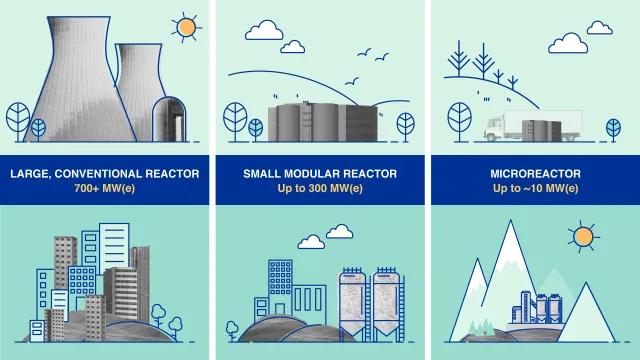
If you had told a rural planner in 2020 that nuclear power would be the hottest investment topic in American energy by 2026, they would have been skeptical. But here we are — and the driver is something most energy planners didn’t model well just five years ago: artificial intelligence and data centers.
Data centers now consume extraordinary quantities of electricity, and the technology companies building them have made a discovery that changes the energy planning calculus: they want carbon-free power that runs 24 hours a day, seven days a week, regardless of whether the wind is blowing or the sun is shining. Wind and solar alone cannot reliably provide that. Nuclear can. Microsoft, Google, Meta, and Amazon have collectively committed to over 10 GW of new nuclear capacity — a number that would have seemed fantastical in the era of post-Fukushima nuclear pessimism.
The vehicle for much of this nuclear ambition is the small modular reactor (SMR): a class of reactor designs smaller than conventional gigawatt-scale plants, theoretically faster and cheaper to build, and more flexible in siting. The 2026 SMR landscape:
NuScale Power holds the distinction of being the first SMR developer with US Nuclear Regulatory Commission (NRC) design certification — having received approval for its 50 MWe design in 2023 and for an uprated 77 MWe design in May 2025. NuScale’s commercialization partner ENTRA1 has a nonbinding agreement with the Tennessee Valley Authority to deploy up to 6 GW of NuScale capacity across TVA’s seven-state service region — a commitment that, if it proceeds, would be transformational for nuclear in the rural Southeast.
TerraPower’s Natrium reactor — a liquid-sodium-cooled design backed by Bill Gates, (as earlier noted) deliberately sited at a retiring coal plant in Kemmerer, Wyoming — completed NRC environmental review in October 2025 and received its final safety evaluation in December 2025. A construction permit was formally approved in March 2026. The Kemmerer project is worth attention beyond its technical specifications: it is a conscious coal-to-nuclear transition on a site already connected to the transmission grid, in a rural Wyoming community with deep energy-industry roots and a workforce with relevant technical skills. If it succeeds, it establishes a template that rural coal communities across the country will be watching closely.
X-Energy completed its Nasdaq IPO in April 2026, raising over $1 billion in an upsized offering — adding another publicly traded SMR developer to a field that is attracting serious institutional capital. The NRC is expected to issue licensing decisions on SMR construction permits during 2026 — a genuine milestone in an industry where regulatory milestones have historically been rare and slow.
The cautions are equally real. No SMR has yet begun commercial operation in the Western world. NuScale’s own flagship project — the Carbon Free Power Project in Idaho — was cancelled in late 2023, when cost projections escalated beyond what the utility consortium participants were willing to commit. The first grid-scale SMR in North America is currently under construction at the Darlington Nuclear Generating Station in Ontario. SMRs have a long history of optimistic cost projections and difficult construction realities; the technology seems sound but the economics remain unproven at commercial scale.
The HALEU fuel supply challenge is the industry’s most acute near-term bottleneck. High-assay low-enriched uranium (HALEU) — the fuel most advanced reactor designs require — was historically supplied almost entirely by Russia. The U.S. banned Russian enriched uranium imports in 2024, and domestic HALEU production is only beginning to scale. Until fuel supply is secure and predictable, the commercial deployment of most advanced reactor designs is constrained regardless of how much capital is committed or how many permits are issued.
Update: The NRC has accepted a Construction Permit Application of NANO Nuclear Energy & the University of Illinois to construct the 15MW KRONOS Micro Modular Reactor on campus. This demonstration project will partially repower the Abbott coal plant as an instructional facility.
The practical planning connection: Rural communities in or near coal country should actively inventory their coal plant assets — transmission connections, industrial land, workforce skills, water supply, rail access — and evaluate whether those assets position them for SMR development, data center co-location, or other energy-adjacent economic uses. Waiting until a plant closes is not a strategy.
III — Renewable Energy Production: The 2026 Scorecard
Solar: the number that keeps going up
Solar energy’s trajectory is simply remarkable. Utility-scale solar generation grew 34% in 2025, reaching 296,000 GWh. Distributed (small-scale) solar added another 93,000 GWh, up 11%. EIA projects utility-scale solar capacity additions of 44,470 MW in 2026 — significantly more than the record 27,738 MW added in 2025, which was itself a record. Solar, wind, and battery storage are projected to add over 60% more generating capacity in 2026 than in 2025.
For rural communities, the solar story is increasingly about where panels go and what happens to the land underneath them. We address this directly in the next section below. But two technology developments deserve attention here.
Bifacial solar panels — which capture sunlight on both faces, gaining additional energy from ground reflectivity — are becoming the industry standard. They allow more flexible installation geometries, including vertical mounting between crop rows, which has significant implications for agrivoltaic design.
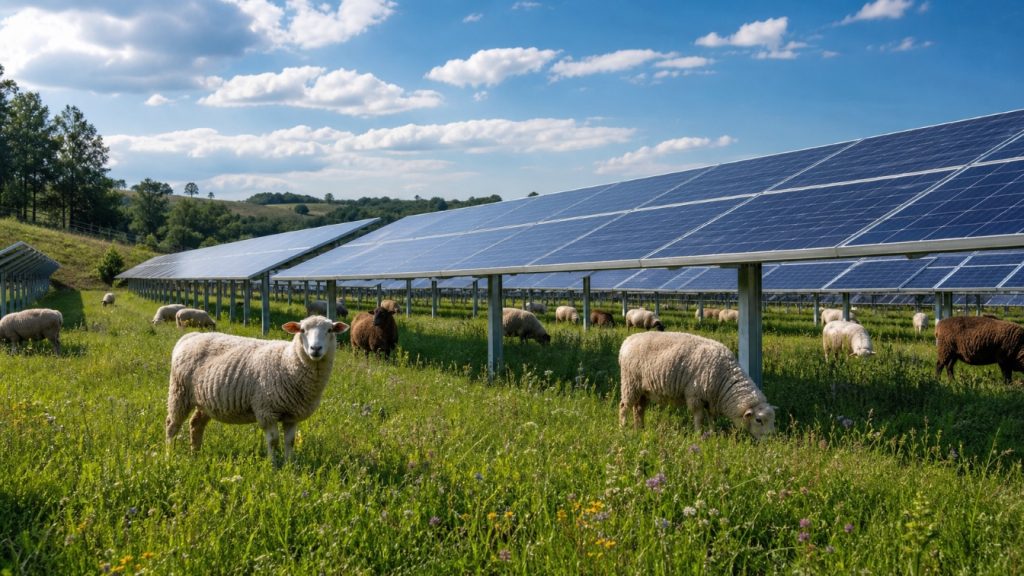
Agrivoltaics — the deliberate co-location of solar energy production and agricultural use on the same land — has moved from a niche research concept to an active area of policy debate and real-world deployment. The practice is surprisingly versatile: solar panels can be installed between crops, elevated above crops, on greenhouse structures, or arranged to support pollinators beneath the array. Research shows that certain crops actually benefit from the partial shade — leafy greens, turmeric, ginger, and forage crops have shown yield maintenance or improvement under elevated panels. Crops that need maximum sun exposure (corn, soybeans, wheat) face more significant trade-offs, though row spacing and panel height can be designed to minimize impact.
The broader agrivoltaic case is compelling: a 2023 study found that installing agrivoltaic systems on just 1% of Canada’s agricultural land could generate between 25% and 33% of the country’s electricity needs. The U.S. numbers are similarly striking. For rural planners, the question is whether local zoning can be designed to make agrivoltaics the default rather than the exception on prime agricultural land. If you are interested in dual-use agriculture and power generation, check out Rebekah Pierce’s new book Agri-Energy: Growing Power, Growing Food (Island Press, 2025).
Wind: still the largest renewable, but facing new headwinds
Wind power generated 464,000 GWh in 2025, making it the largest single renewable electricity source in the U.S. — larger than utility-scale solar, hydropower, and biomass combined. EIA projects capacity additions of over 10,369 MW onshore and 1,515 MW offshore in 2026 — nearly double the 2025 onshore additions.
But wind development is running into local resistance at a scale that is beginning to materially affect the industry’s pipeline. Approximately one in five U.S. counties now restricts or bans the development of new wind and solar power — part of what one analysis called a “regulatory sea change” that’s stalling clean energy development and driving up costs for utility ratepayers. Between 2018 and 2023, at least 30% of utility-scale wind and solar projects were cancelled during the siting process, largely due to community opposition, local ordinances, or zoning restrictions.
The ordinance landscape reflects genuine community concerns: visual impact of turbines that now commonly exceed 600 feet in height, noise (particularly low-frequency noise and shadow flicker), property value questions, wildlife and bat mortality, and the straightforward disruption of rural landscape character that many residents moved to rural areas to preserve. These concerns are legitimate, and they deserve thoughtful responses in the planning process — not dismissal as NIMBYism.
What makes the current moment particularly challenging for rural planners is the wide variation in local ordinance setback requirements — from less than 1,000 feet to over a mile from the nearest residence in some recently adopted ordinances. NREL’s analysis has found that setback distances for both wind and solar projects have generally increased in recent years, and that uniquely large setback requirements can effectively prohibit development across the majority of a county’s land area. Some states have responded with preemption legislation overriding local restrictions; others have moved in the opposite direction, strengthening local authority over energy facility siting.
Over the last few years I’ve worked with a number of counties, some with moratoria on accepting, approving, or issuing permits for utility-scale wind energy systems and battery storage installations, while we worked through comprehensive plan and zoning regulation revision processes. This is a common pattern — a development proposal arrives before local standards exist, local officials feel unprepared, a moratorium is adopted while an ordinance is developed, and a multi-year process ensues. The lesson for rural planners is obvious: don’t wait for the first application to start developing your wind and solar siting standards.
During my time at Marvin Planning Consultants here in Nebraska, I developed a model renewable energy zoning regulation section. It covered Battery Energy Storage Systems (BESS), solar energy and wind energy generation (small-scale and utility/commercial-scale), and decommissioning bond requirements. If you are concerned about the adequacy of your local city or county land use regulations, drop me a line or look me up on LinkedIn.
Hydropower: the dispatchable workhorse
Hydropower is easy to overlook in conversations dominated by solar and wind, but it remains one of the most valuable generating resources in the U.S. portfolio for one reason that neither solar nor wind can match: it is dispatchable on demand. A hydroelectric facility can ramp from zero to full output in minutes, making it an essential grid-balancing resource in regions where it’s available.
Hydropower provides roughly 6% of U.S. electricity generation overall, but its regional role is much larger: in the Pacific Northwest, hydro provides more than half of all electricity generation in many years, and the Bonneville Power Administration’s hydroelectric system is effectively the grid battery for the entire region. In the rural Southeast, TVA’s large hydro system plays a similar role. Even Nebraska relies on steady hydroelectric power, generating over 300 megawatts across several plants on the Platte and Loup rivers.
The current hydropower story involves three overlapping dynamics:
Federal relicensing is the dominant regulatory reality for existing dams. Most U.S. hydropower dams were licensed by the Federal Energy Regulatory Commission (FERC) for 30–50-year terms, and many are now in the process of relicensing — a lengthy, expensive, and often contentious process that typically takes 7–10 years and requires negotiating updated fisheries protections, recreation requirements, water temperature standards, and minimum flow conditions. Oak Ridge National Labs recently published a comprehensive nationwide snapshot of hydropower relicensing across the country. For rural communities whose economies depend on existing hydro facilities, active engagement in the relicensing process is not optional.
Dam removal is accelerating, particularly in the Pacific Northwest and New England. Dams that no longer generate power — or whose power value is outweighed by their fisheries impacts — are being removed at rates not seen in previous decades. The 2023–2024 removal of four dams on the Klamath River in California and Oregon was the largest dam removal project in U.S. history, restoring hundreds of miles of salmon habitat. For rural communities downstream of dams under removal consideration, the implications for floodplain land use, water supply, and recreation planning can be significant.
Small hydro (generally projects under 10 MW) offers opportunity for rural communities with appropriate stream resources. FERC licensing requirements for small projects are streamlined relative to large facilities, and run-of-river projects — which generate power from flowing water without creating a significant storage reservoir — can often be developed with minimal environmental impact. For communities in mountainous regions with reliable stream flows, small hydro deserves a place in local energy planning conversations.
Geothermal: ready for its moment?
Conventional geothermal energy — using naturally occurring hydrothermal heat to generate electricity — has long been limited to a handful of western states with accessible high-temperature resources: California’s Geysers complex (the world’s largest geothermal power plant), the Nevada basin and range terrain, Utah, Idaho, and parts of the Pacific Northwest. These resources are real and valuable, but they cover a small fraction of the country’s land area.
Enhanced geothermal systems (EGS) — a technology that drills deep into hot dry rock, fractures it to create a permeable heat reservoir, and circulates fluid to extract heat — could change that geography dramatically. The DOE’s GeoVision report, produced before the technology had reached current maturity levels, projected that EGS could ultimately provide up to 120 GW of generating capacity in the U.S. — enough to power a substantial fraction of the country’s electricity demand.
In 2026, EGS is early-stage but advancing. The DOE’s Enhanced Geothermal Earthshot aims to reduce the cost of EGS to $45 per megawatt-hour by 2035, and demonstration projects are underway in multiple states. The technology draws on techniques developed in the oil and gas industry — specifically, the directional drilling and hydraulic fracturing expertise that transformed shale gas production — giving it a potential deployment pathway in rural communities where that expertise already exists.
For rural planners, geothermal has one of the smallest land footprints of any power generation technology, produces electricity 24/7 at a consistent output level, generates minimal noise or visual impact once operational, and has essentially no air or water emissions. It is a technology worth understanding — even if commercial deployment in most rural communities is still years away.
Biomass and carbon sequestration: the complicated carbon story
Biomass energy — producing power from organic material (wood pellets, agricultural residues, methane from livestock operations, dedicated energy crops) for heat and power — occupies a contested space in the rural energy picture. Its defenders argue that it can be carbon-neutral or carbon-negative when feedstocks are sustainably managed, that it provides dispatchable power unlike wind and solar, and that it creates genuine rural economic opportunities through forest and agricultural byproduct markets. Its critics argue that biomass combustion produces real air emissions, that the carbon accounting is more complicated than its proponents acknowledge, and that large-scale energy crop production competes with food production for land.
Both sets of arguments have merit, and the truth depends heavily on:
- Feedstock sourcing — waste wood from sawmill operations or forest thinning that would otherwise decompose or burn anyway has a very different carbon profile than harvesting additional trees or clearing land for energy crops
- Time horizon — biomass may be effectively carbon-neutral over a 50-100 year cycle but net positive in emissions over a 10-20 year window, which matters for near-term climate goals
- What it replaces — biomass burning is considerably better for the climate than coal or petroleum, and considerably worse than solar or wind
I’ve been a partisan for ethanol production for a long time. When we lived in Minnesota corn country we filled our van with E-88 (well, other than the dead of winter when it would freeze up). The United States is the world’s largest producer of ethanol, manufacturing over 16 billion gallons annually. Over half of that production capacity is located in Iowa, Nebraska, and Illinois — local jobs and local income to American farmers. Demand for biodiesel and other forms of renewable diesel fuel made from soybean oil and other fats has also steadily grown over the last 20 years.
For rural planners, the practical questions are: What biomass resources exist locally — logging residuals, agricultural waste, livestock methane? What infrastructure would be needed to develop them? And what are the local air quality implications of biomass combustion, particularly in communities that already deal with agricultural dust and smoke from crop residue burning?
Bioenergy with carbon capture and sequestration (BECCS) remains largely theoretical at commercial scale, but deserves mention here because multiple climate scenarios that meet Paris Agreement goals include significant BECCS deployment. The concept: burn biomass (or ferment it to ethanol), capture the CO₂ emitted, and inject it underground. If the biomass was grown recently, this process removes more CO₂ from the atmosphere than it emits — making it “carbon negative.” Rural geology and agriculture are both relevant to BECCS potential: appropriate underground storage formations exist in many agricultural regions, and agricultural land is a natural feedstock source.
Battery Energy Storage Systems (BESS): the fastest-moving technology in energy
Battery storage is the technology that makes variable renewables work at scale. By charging during periods of excess generation and discharging when demand exceeds supply, BESS transforms solar and wind from intermittent resources into more controllable, dispatchable ones. Nearly all new utility-scale solar projects are now being proposed with co-located battery storage.
The numbers reflect explosive growth: utility-scale battery storage capacity grew 58% in 2025, adding 15,775 MW of new capacity. Planned additions for 2026 total another 24,268 MW — a further 57% increase. This is the fastest sustained growth of any energy technology in the current period.
For rural local governments, BESS siting has become an urgent and underappreciated planning issue. Large battery installations — typically rows of shipping container-sized lithium battery modules, sometimes covering 10–30 acres — are appearing in agricultural landscapes faster than local ordinances can address them. The specific concerns:
Fire safety is the primary concern, and it’s legitimate. Lithium battery fires are difficult to extinguish, can reignite hours or days after initial suppression, and can produce toxic smoke and off-gases. Rural fire departments — often volunteer, usually without specialized lithium battery fire training or equipment — are being asked to respond to incidents at facilities they have no experience with.
NFPA 855, the National Fire Protection Association standard for stationary energy storage systems, establishes minimum requirements for siting, fire suppression, ventilation, and emergency response planning for BESS facilities. It is the appropriate reference standard for local government ordinances, but it was not written with rural volunteer fire departments in mind, and its implementation requires coordination between facility operators, local governments, and fire agencies that doesn’t always happen proactively.
Setbacks from residences are a straightforward provision that many rural counties are beginning to require — perhaps 500 to 1,500 feet, depending on project scale. The logic is the same as for any industrial facility that poses a potential hazard.
Decommissioning is a concern that is beginning to receive more attention as the first generation of large BESS installations approaches end of useful life. Lithium battery modules contain materials that require specialized recycling or disposal. Local governments that approve BESS projects without decommissioning bonds for BESS or other energy generation facilities face the risk of abandonment and cleanup costs falling on the county.
The practical planning connection: Rural counties that have not yet seen a BESS application but are in areas with active solar or wind development should adopt BESS provisions in their zoning ordinances now. NFPA 855 compliance, emergency response plan requirements, minimum setbacks, and decommissioning bonds are the four non-negotiable elements. Getting the ordinance in place before the first application arrives is far easier than negotiating standards mid-review under developer timeline pressure.

IV — Energy and Natural Resources: The Land Use Tensions
This is where rural planners live. The energy transition requires land — enormous amounts of it — and most of that land is in rural America. This section addresses the four land use tensions that rural energy planning must navigate.
Transmission: the bottleneck that constrains everything else
The United States has abundant renewable energy resources and increasingly abundant renewable generating capacity. What it often lacks is the transmission infrastructure to move power from where it’s generated — rural, remote, and increasingly windy or sunny — to where it’s consumed — urban, dense, and hungry for electricity.
There have been few new long-range high-energy transmission lines completed as of late. After about 20 years of development, the SunZia Wind and Transmission Project just went operational last week. This 550-mile power line feeds 3.6 gigawatts of wind energy produced on the eastern Plains of New Mexico to growing electricity demand in Arizona and southern California.
The transmission gap is not a new observation, but its consequences are becoming more acute as renewable capacity additions accelerate. FERC Order 1920, finalized in 2024, represents the most significant transmission planning reform in decades: it requires utilities to undertake long-term, regional transmission planning with a 20-year horizon, to explicitly consider the need for transmission to access remote renewable resources, and to allocate costs among beneficiaries more fairly than previous processes required. Whether we will see a meaningfully accelerated pace of rural transmission development remains to be seen — the history of transmission planning reform in the U.S. is one of slow implementation — but the regulatory framework is stronger than it has been.
For rural communities, transmission brings mixed implications that deserve honest acknowledgment. New high-voltage transmission lines mean:
- New easements across private land, typically negotiated or condemned — a genuine imposition on rural landowners
- Changed viewsheds, particularly on ridge lines and open prairie where lines are highly visible
- Construction disruption along corridor routes
- But also: new property tax revenue to rural counties and school districts, new grid connections that can attract economic development, and — for communities with developable renewable resources — the ability to export locally generated power to distant markets at competitive prices
Wildlife conflicts: real, complex, and genuinely unresolved
The collision between renewable energy development and wildlife is one of the most genuinely difficult issues in rural energy planning. There are no easy answers here, and planners who present it as simple — in either direction — are not being honest with their communities.
Wind and birds: Utility-scale wind turbines kill an estimated 140,000 to 500,000 birds annually in the U.S., based on multiple peer-reviewed studies. Raptors — particularly golden eagles, which are protected under the Bald and Golden Eagle Protection Act — are a priority concern in western wind development areas. A single eagle kill can expose a developer to significant federal liability. In Nebraska, as across the central Great Plains, the Central Flyway poses a real barrier to wind energy development, with over 100 National Wildlife Refuges along this migration route.
The U.S. Fish and Wildlife Service’s Eagle Conservation Plan Guidance provides a framework for siting and operating wind facilities to minimize eagle mortality, but compliance is voluntary and monitoring is inconsistent. Avian radar systems — which can detect approaching raptors and temporarily pause turbine rotation during high-risk periods — are becoming more common but remain expensive relative to a rural county’s planning resources.
Wind and bats: Bats are killed at wind facilities in even larger numbers than birds — estimates range from 700,000 to 1.3 million annually. Bat mortality is particularly concerning because bat populations reproduce slowly (most species have only one pup per year), and because bats provide economically valuable pest control services for agriculture — one study estimated the value of bat pest suppression to U.S. agriculture at $3.7 billion per year. Curtailment protocols — slowing or stopping turbines during low-wind, high-bat-activity periods — can significantly reduce bat mortality, and some states now require curtailment as a condition of wind development permits.
Solar and desert/grassland species: Utility-scale solar development in the desert Southwest has raised significant concerns about impacts on Mojave desert tortoise, desert kit fox, and other sensitive species. In the Great Plains and Midwest, solar development on native grassland or high-quality wildlife habitat can fragment the already-reduced landscapes that support grassland birds — a taxonomic group experiencing some of the steepest population declines of any bird guild in North America.
What planners can do: The most defensible approach is to require mitigation rather than treat wildlife concerns as binary grounds for approval or denial. Mitigation options include: pre-construction wildlife surveys, avoidance of the highest-sensitivity areas, seasonal construction restrictions during nesting or migration, avian radar and curtailment requirements, habitat conservation easements that offset development impacts, and post-construction monitoring with adaptive management requirements. For rural counties, building these expectations into the conditional use permit process — rather than addressing them ad hoc — creates a more predictable process for both communities and developers.
Biodiversity impacts: the landscape-level picture
Beyond direct wildlife mortality, energy infrastructure contributes to habitat fragmentation — the breaking of connected habitat into smaller, more isolated patches that are less resilient for wildlife populations even if individual animals are not directly harmed. A network of wind turbines, access roads, and electrical collection infrastructure across a native grassland landscape doesn’t just kill individual birds; it can fragment the landscape in ways that affect population viability for multiple species across a wide area.
Cumulative impact assessment — evaluating the combined effect of multiple energy projects across a landscape, rather than reviewing each in isolation — is a planning tool that rural counties can use to make better decisions. A single 100-turbine wind project may be acceptable in a given landscape; the same project plus three more of similar scale within the same viewshed and habitat matrix may cross a threshold that individual project review would never identify. Regional energy planning frameworks — ideally developed at the county or multi-county level before major development proposals arrive — can incorporate cumulative impact thinking into local decision-making.
Conversion of prime farmland: the defining rural land use conflict of the decade
If there is one energy-land use issue generating the most heat in rural planning offices in 2026, it is the conversion of prime agricultural soils to utility-scale solar energy development.
The scale is significant. Utility-scale solar facilities typically require 3,000–5,000 acres or more for projects in the 200–500 MW range. A 150 MW project recently proposed in Minnesota would place 318 acres on prime farmland and 658 acres on prime farmland if drained — all of it currently in row crop production, covering 99.4% of the site. That’s one project, one county. Multiply it across the national solar development pipeline and the cumulative farmland implication is substantial.
The controversy is real and the arguments on both sides are legitimate. Farmers who own land can choose to lease it to solar developers for payments that often run 10–15 times higher than crop rental rates — a legitimate exercise of private property rights that also provides income security in an industry with volatile commodity prices. Neighboring farmers who don’t sign leases can find themselves surrounded by solar arrays, cut off from agricultural neighbors, and facing questions about the long-term agricultural character of their community. Local officials are caught between respecting property rights, protecting the agricultural economy, and responding to community concerns about landscape change.
LESA (Land Evaluation and Site Assessment) scoring is a recognized methodology — developed by USDA — for evaluating the significance of agricultural land impacts in project review. LESA assigns numerical scores based on soil quality (the land evaluation component) and site characteristics like parcel size, adjacency to protected farmland, and distance to agricultural support infrastructure (the site assessment component). Many states have incorporated LESA or equivalent approaches into their solar siting frameworks. The basic principle is straightforward: projects on lower-quality agricultural land deserve lower scrutiny than projects on prime soils, and an alternatives analysis should be required before approving development on the best agricultural land.
Even if you don’t formally adopt the LESA methodology, I’ve worked with counties adopting maximum coverage of prime agricultural land as mapped by the National Cooperative Soil Survey and shown on Soil Survey Geographic Database (SSURGO) online Web Soil Survey mapping services.
In recent comprehensive plan updates for Hall County and Clay County, Nebraska, for example, we have not adopted LESA by name, but we are already moving in that direction: mapping wellhead protection areas, recognizing that transmission constraints limit where wind and solar make sense, and pointing planning commissions toward marginal ground and already‑disturbed land as the first‑best locations for energy projects.
Agrivoltaic requirements are an emerging best practice: requiring or incentivizing dual agricultural-solar use on prime farmland as a condition of project approval. Several states are beginning to move in this direction, requiring that a minimum percentage of a project’s acreage maintain active agricultural production — whether crops, grazing, or pollinator habitat — throughout the project’s operational life. In plans for Hall County and Grand Island, we explicitly cited American Farmland Trust’s guidance on solar siting and agrivoltaics, and frame solar as one line in a broader rural energy portfolio that has to coexist with irrigated row crops, ethanol plants, and cattle.
For local leaders maybe more than planners, decommissioning is an underappreciated aspect of solar siting policy. Solar panels have operational lives of 25–35 years. When a project reaches end of life, what happens to the panels, the wiring, the racking infrastructure, and the land? Decommissioning plans backed by credit-rated bonds — financial instruments that ensure the developer has resources set aside for site restoration — are the appropriate risk management tool, and they should be required before project approval, not addressed as an afterthought five years down the road.
One last note: In many places we’re seeing flashbacks to the 1970s with strong demand for off‑grid living, solar‑ready acreage, and recreational parcels for homesteaders and investors. This is driving both prices and interest in “prepper” and amenity‑rich rural properties. That feeds directly into conversations about exurban sprawl, septic and well oversight, and how counties regulate large‑lot subdivisions versus working lands. I wrote a bit about that in my review of Ryan Mitchell’s book Living Off Grid: 50 Steps to Unplug, Become Self-Sufficient, and Build the Homestead of Your Dreams (Island Press, 2025), one of our Top 12 Planning & Sustainability Books for 2026.
The practical planning connection: Rural counties should adopt explicit policies on solar and wind siting relative to agricultural land quality before large projects arrive — not in response to the first application. LESA scoring, agrivoltaic requirements on prime farmland, wildlife mitigation standards, cumulative impact provisions, and mandatory decommissioning bonds are the five elements of a defensible rural energy ordinance. The American Clean Power Association’s Model Wind Ordinance and NREL’s local ordinance guidance are useful starting points.

The Bigger Picture: Rural America as Energy Landscape
Here is the fundamental reality that should inform every conversation about rural energy: rural America is not merely an energy consumer. It is an energy landscape.
The coal that powered the last century came from rural mines. The oil and gas that still powers most transportation comes from rural wells and flows through rural pipelines. The hydropower that lights the Pacific Northwest was built on rural rivers. And the renewable energy that will power the next century — the wind, the solar, the geothermal, the battery storage that makes it all work — will be sited overwhelmingly on rural land.
Drive across Nebraska and you can see that landscape in one windshield: oil and gas wells in Kimball County, the coal‑fired Platte Generating Station on the edge of Grand Island, ethanol and biofuels plants strung along the Platte valley, and new utility‑scale wind turbines and solar arrays feeding into Nebraska Public Power District’s transmission lines.
This creates both opportunity and obligation. And that’s not theoretical. In recent Nebraska plans, small cities like Burwell and Kimball and rural areas like Clay and Hall counties are treating “Communications, Utilities, and Energy” as a full chapter of their comprehensive plan—linking public power portfolios, data centers, EV charging, and even potential carbon pipelines to land use, wellhead protection, and long‑term agricultural preservation.
The opportunity is real: rural communities that plan proactively for energy development — with clear and fair siting standards, reasonable decommissioning requirements, local ownership or revenue-sharing provisions, and policies that protect both landowner choice and community character — can capture genuine, lasting economic benefits from the energy transition. Lease payments, property tax revenues, local employment during construction and operations, and community benefit agreements are all available to communities that plan well.
The obligation is equally real: the communities that host this infrastructure — that live with the turbines, the panels, the transmission lines, and the battery farms — have a right and a responsibility to insist that energy development is sited, built, and operated in ways that respect the land, the wildlife, the viewscapes, and the people who make rural places their home. In Hall County’s comprehensive plan, for example, the same document that maps wellhead protection areas and onsite wastewater standards also walks through wind, solar, ethanol, and carbon‑pipeline issues—on the theory that if you are going to live with turbines, panels, pipelines, and data centers, you should also be the ones to write the rules of the game.
Energy planning is not optional for rural communities. It is one of the most consequential planning tasks of the next decade. The question is not whether energy development will come to rural America — it will — but whether communities are prepared, organized, and equipped to shape it on terms that work for them.
Next week, we close out the CUE series with the demand side: conservation, energy efficiency, electrification, and the programs that help rural communities use energy smarter. Most of these themes—prime soils vs. marginal land, agrivoltaics, decommissioning, data‑center loads, and carbon pipelines—are not abstract for me; they’re the stuff of public meetings and planning commission packets in places like Clay County, Hall County, and the cities of Grand Island, Burwell, and Kimball, where rural energy debates are already reshaping the maps in the back of the comprehensive plan.
I am in transition between jobs at the moment. Does your small town or rural county need help working out planning and land use regulations for the clean energy economy? Drop me a line and let’s see what I can do to help.

Read More on Energy
Statistics and policy programs tell one side of the story. These books tell the other — the people, the places, and the years-long fights behind the numbers.
Agri-Energy: Growing Power, Growing Food
Rebekah Pierce · 2025
Pierce explores the intersection of agriculture and renewable energy, offering practical solutions for sustainable food and power production from a writer who actually works with agri-voltaics on her own farm. It explains how we can combine solar, wind, and other renewables with grazing or cropping on the same land to keep farms profitable, maintain food production, and support rural economies, using real-world case studies and step‑by‑step guidance on design, management, and partnerships. One of our 12 Planning & Sustainability Books You Need in 2026.
agrivoltaics solar energy energy policyLiving Off Grid: 50 Steps to Unplug, Become Self-Sufficient, and Build the Homestead of Your Dreams
Ryan Mitchell · 2025
A step-by-step guide for anyone dreaming of a self-sufficient lifestyle, from energy independence to homesteading. Mitchell walks you through 50 key decisions for unplugging from utilities, becoming more self‑sufficient, and building an off‑grid homestead that fits your budget and life, based on his own personal experiences. One of our 12 Planning & Sustainability Books You Need in 2026.
solar energy off-grid living sustainabilityRural Renaissance: Revitalizing America’s Hometowns through Clean Power
L. Michelle Moore · 2022
A practical guide to clean energy development in rural communities, covering energy efficiency, renewables, and electrification. The book walks local leaders, co‑ops, and residents through five “pathways” to a rural clean energy future—efficiency upgrades, community-scale renewable power, resilient microgrids and storage, electric vehicles, and broadband—showing how any town can start now, use existing policies and funding, and design projects that keep benefits local while advancing equity and long-term community vitality. Another of our 12 Planning & Sustainability Books You Need in 2026 and June 2026 book of the month.
clean energy cooperative development energy policyThe Grid: The Fraying Wires Between Americans and Our Energy Future
Gretchen Bakke · 2016
The essential book on U.S. electricity infrastructure — why the grid was an engineering triumph of the 20th century and why it’s struggling to handle the 21st. Bakke is a cultural anthropologist, which makes for an unusual and illuminating read: less interested in the engineering than in the human systems and assumptions that built the grid and now make it so hard to change.
transmission grid infrastructure energy policySuperpower: One Man’s Quest to Transform American Energy
Russell Gold · 2019
The story of Michael Skelly and Clean Line Energy — the company that tried to build new transmission lines to carry wind power from the Great Plains to cities in the South and East. Gold is one of the best energy journalists working today, and this reads like a thriller: farmers, financiers, utilities, regulators, and the physics of long-distance electricity transmission all collide. Essential for anyone working on rural transmission corridors or wind development.
wind energy transmission rural planningThe New Map: Energy, Climate, and the Clash of Nations
Daniel Yergin · 2020
Yergin won the Pulitzer Prize for The Prize, his history of oil, and The New Map is its successor — a comprehensive account of how the shale revolution, the rise of renewables, and geopolitics are redrawing the world’s energy map. Essential context for understanding why U.S. natural gas exports are growing, why coal retirements keep getting delayed, and how the international comparisons in this week’s article fit into a larger global picture.
geopolitics natural gas coal renewablesShorting the Grid: The Hidden Fragility of Our Electric Grid
Meredith Angwin · 2020
A more technical and skeptical counterpoint to Bakke’s Grid — Angwin argues that the grid is more fragile than most people realize, and that renewable energy’s variability creates risks that operators are not fully prepared for. Her section on how regional transmission organizations work is the clearest explanation of that opaque world around. A useful corrective for anyone who thinks the energy transition is simply a matter of building enough solar and wind.
grid stability BESS renewablesAs an Amazon Associate, JCShepard.com may earn commissions from qualifying purchases. Check your local library too — these belong on rural library shelves.
Resources
Data
- EIA Electric Power Monthly — Current generation data by fuel type and state; updated monthly
- EIA Annual Energy Outlook 2026 — Long-term projections through 2050
- EIA Short-Term Energy Outlook — 18-month forecasts; updated monthly
- NREL Land-Based Wind Market Report — Annual tracking of U.S. wind development, costs, and capacity
- Lawrence Berkeley Lab Tracking the Sun — Distributed solar installation data
- Lawrence Berkeley Lab Utility-Scale Solar — Utility-scale solar project data and trends
Policy and planning
- FERC Order 1920 — Long-term regional transmission planning reform
- U.S. Fish and Wildlife Service Eagle Conservation Plan Guidance — Framework for wind energy siting and eagle protection
- USDA LESA — Land Evaluation and Site Assessment methodology
- DOE WINDExchange Ordinance Database — Database of local wind energy ordinances nationwide
- American Clean Power Association Model Wind Ordinance — Industry-developed template for local wind siting standards
- DOE GeoVision Report — Enhanced geothermal systems potential in the U.S.
- NFPA 855 — Standard for stationary energy storage systems (BESS)
Rural electric cooperatives
- National Rural Electric Cooperative Association (NRECA) — Policy, data, and resources for the 900+ rural electric cooperatives serving 42 million Americans
Next in the series: Week 4 — Less Is More: Conservation, Efficiency & Electrification in Rural Communities (June 28)
Catching up? Start with the June series overview, Week 1 on Communications, or Week 2 on Rural Utilities.
Rural-Ready Engagement: Practical Tools for Small Town Planners
 Watch the full replay: youtube.com/@Engaging-Communities (February 2026)
Community engagement can look very different in small towns and rural communities. This webcast was co-sponsored by the APA Community Engagement Interest Group and the Small Town & Rural Planning Division.
Dynamic Decisions Podcast (Season 2 Episode 15)
“Stop Chasing Smokestacks. Grow What You Have” now playing on Youtube (audio), Apple Podcasts, Spotify (May 2026). Other listening links here.
Popular posts on JCShepard.com
- The Planning Process—From Vision to Action in Small Towns and Rural America (January 2026)
- Historic Preservation and Rural Economic Development: A Rural Growth Strategy (April 2026)
- Reviving Rural America: Why Heritage Tourism Is a Game-Changer Now (September 2025)
- What is Economic Development in Modern America? A Field Guide for Small Towns and Rural Places (March 2026)
- Rural Recreation and the Outdoor Economy: Trails, Fairs, Community Identity (May 2026)
- Rural Housing Supply Crisis: Why Small Towns Are Running Out of Homes (February 2026)
- Community Facilities: Why We Need to Rebuild Our Foundations (April 2026)
- Small Towns, Big Impact: How Rural Communities Are Designing Their Own Futures (November 2025)
- The Rural Comeback: How Small Town Innovation Sparks Growth (August 2025)
- How Small Towns Succeed: A Proven Playbook for Rural Action (November 2025)
Check out The 12 Planning & Sustainability Books You Need in 2026 and browse through the Small Town & Rural Community guides on our Resources page.
(As an Amazon Associate, we may earn commissions from qualifying purchases. Check your local library or bookshop, too.)


