

What Does a Healthy Rural Community Actually Look Like?
Planners have long known that where you live shapes how long you live. Here is how smaller communities are using real tools — County Health Rankings, the AARP Livability Index, and Health Impact Assessments — to make rural health and livability visible, and actionable.
not just for people who can afford to move.”
Picture two mornings in rural America. In the first, a resident walks a short block to a sidewalk that connects to the town’s trail system. She picks up a coffee from a shop on Main Street, drops her kid at an elementary school two blocks away, and arrives at her doctor’s office in the same building as the pharmacy. In the second morning, someone drives fifteen minutes for gas station coffee, drops a child at a consolidated school twenty miles out, and skips a follow-up appointment because the nearest clinic doesn’t take her insurance and the copay is steep.
Both are real rural experiences. The difference is not one of luck or personal discipline. It is one of planning—or the absence of it.
The month of May on JCShepard.com is about public health, parks, and the outdoors as planning subjects. Not as amenities that communities earn after they become prosperous, but as conditions that make prosperity possible in the first place. Public Health should be part of your local planning process. This first piece sets the foundation: the tools planners use to measure livability, and what those tools tell us about the gap between what rural communities have and what they need.

Why Public Health Belongs in Small‑Town Planning
The built environment is the frame around our everyday choices, especially in rural and small‑town places where there may only be one way to get from here to there. Public health is about more than just health, and as I wrote last fall, active living matters, especially in rural areas.
A sidewalk or off-street path means a kid can walk to school or the library; a missing link means a parent has to rearrange their day to play chauffeur. Street design sets the tone: a narrow lane with on‑street parking and reasonable speeds invites people to stroll, bike, and linger, while a wide, fast road pushes everybody back behind the windshield. In small towns, distances to daily needs are make‑or‑break—if housing, school, groceries, the clinic, and a decent park sit within a short walk or a five‑minute drive, it’s easier to fit activity into the margins of the day.
Spread those same destinations out along a highway, with big parking lots and no safe crossing, and you’ve quietly designed movement, and health, out of the local routine. Every “small” decision about where to put a driveway, how to stripe a crossing, or whether to connect one subdivision street to the next adds up. Over time, you either get a connected network that supports daily walking and short trips, or a patchwork of disconnected islands that demand a motor vehicle for every errand. In a region where incomes vary and older adults want to age in place, that difference matters more than we often admit.
When we talk about “livability” in small towns, we’re really talking about the texture of ordinary life, not a marketing slogan. It’s clean air you don’t have to think about, safe streets where you’re comfortable letting your grandkids bike to practice, and public spaces where you’re likely to bump into three people you know without trying. It’s the sense that you belong here—that the built fabric, from the historic courthouse to the ballfields and the grain elevator on the horizon, adds up to a place rather than a collection of parcels.
Economic growth still matters, but if the new jobs come at the cost of nonstop truck traffic down Main, disappearing trees, or kids who never walk anywhere, most people will tell you something important has been lost. Livability is the mix: enough opportunity to keep young families, enough safety and comfort for elders, and enough social connection that people show up when it’s time to fix what’s broken. You can feel it on a summer evening when people choose to linger on porches and in parks instead of retreating indoors.
This is another way of saying that every big local decision is also a quiet health decision, whether we admit it or not. Put a new school on the edge of town (or in a cornfield miles from town) and you’ve decided kids will ride a bus or be driven, instead of walking through their own neighborhoods. Rewrite zoning so homes, stores, and jobs can only be separated by distance and traffic, and you’ve decided daily errands will happen by car, with all the knock‑on effects for activity, air quality, and who gets left out if they can’t drive. Design streets only for fast through‑traffic, and you’ve decided how safe it feels to walk a dog, push a stroller, or ride a bike to coffee.
A day in the life of a resident makes this concrete. She walks on a narrow sidewalk to drop a child at school, then detours to avoid a busy crossing with no marked crosswalk. Later, she drives across town for groceries because the corner store closed years ago and there’s no safe way to bike with kids along the highway. In the evening she parks under a lone tree at the ballfield while her kids play on equipment that’s seen better days, and then heads home on a street with no streetlights and no shoulder for anyone on foot. At each step, the town’s past choices either ease her way or add friction to basic routines.
For local leaders, the most practical habit is to pause and ask a few simple questions about every project on the agenda. Will this make it easier for people to walk or roll where they need to go? Will this make it safer for kids and older adults to cross the street and use our public spaces? Will this make it more inviting to spend time outside—in our parks, on our sidewalks, in our downtown? And if the answer is no, what small design change would nudge it toward yes? Those questions cost nothing, but over time they can reshape a town’s built environment toward the kind of everyday livability people quietly expect and deeply appreciate.
Two Key Tools for Measuring Rural Health and Livability
If you open a well-written community comprehensive plan and turn to the public health section, you are likely to find two frameworks working alongside each other. The first is County Health Rankings, produced annually by the University of Wisconsin Population Health Institute in partnership with the Robert Wood Johnson Foundation. The second is the AARP Livability Index.
They measure different things, and that is precisely the point.
County Health Rankings
Breaks health outcomes into four drivers, helping planners understand not just how healthy a county is, but why.
AARP Livability Index
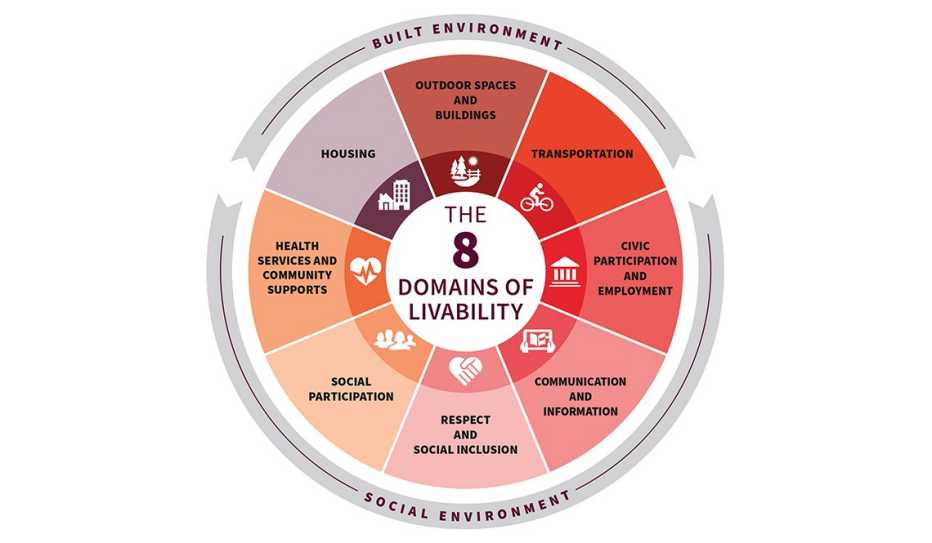
Scores neighborhoods across seven categories using more than 50 data sources, updated annually. Works at the neighborhood level—useful for showing variation within a county.
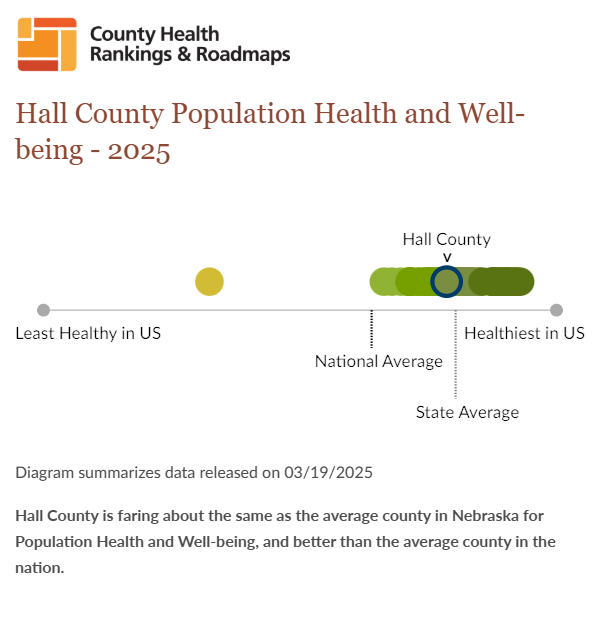
Marvin Planning Consultants (MPC) worked with Hall County (Grand Island), Nebraska, on their new comprehensive plan, which included a chapter on Public Health. Their County Health Rankings are about average in the state for population health and well-being, and for community conditions. Jefferson County, Nebraska, on the Kansas state line, ranks about the same on well-being, but a bit lower on community conditions, while Thayer County, Nebraska, next door ranks a bit lower on well-being but average on conditions—the website has a detailed dashboard indicating areas community leaders could work to improve.
On the Livability Index, Hall County ranks just above average with a 53 Overall Livability Score—housing affordability and access is good at 60, while civic engagement at 43 is a challenging area across the state. Jefferson County scores at 53, ranging from 36 in the neighborhood category (it’s a long way to urban services, and folks there like it that way) to 63 points for housing affordability. Thayer County scores right at the average at 50 points with 66 for housing and 32 for neighborhoods.
Together, these tools give county planners a clear picture of what is driving poor health outcomes—and a framework for identifying the levers that local government can actually pull. A county might score poorly on clinical care access but reasonably well on environment. That is a different planning problem than one where both scores are low. The data point you toward the intervention.
“Making the healthy choice the easy choice”—this phrase appears in more than a few comprehensive plans we’ve written, and it is a useful idea. It shifts the conversation from blaming individuals to designing environments.

What Planners Can Do to Improve Rural Public Health
This is where the conversation often stalls. A county commissioner can understand that poor walkability contributes to obesity, which contributes to diabetes, which drives up health costs and reduces workforce productivity. But what is the specific planning action that addresses that chain?
The answer lies in what planning and policy documents sometimes call “levers of change.” The most relevant for rural health include:
- Smart Growth and compact development — directing new growth into existing town centers, where sidewalks, services, and social connections already exist or can be efficiently added. Rural counties that allow low-density sprawl along county roads are not just creating infrastructure problems; they are creating health problems.
- Active Living policy —add explicit language in zoning and subdivision codes that requires pedestrian and bicycle infrastructure in new and redevelopment projects. This is not about building expensive urban amenities. It is about paved shoulders, trail connections, and sidewalks that make a daily walk possible.
- Health Impact Assessments (HIAs) — a structured review process that asks, before a major development or infrastructure decision is made: who will be affected, and how? HIAs are increasingly integrated into comprehensive plan processes as a way to make health considerations explicit.
- Local food infrastructure — farmers markets, community gardens, cottage food policies, and food hub development that reduce food deserts and give residents access to fresh produce. Hall County, Nebraska’s comprehensive plan addresses this directly, connecting local food systems to both health and economic development goals.
- Support for local health departments and CHIPs — county planners are not health professionals, but comprehensive plans can explicitly support the work of county health departments and align land use decisions with the priorities identified in Community Health Improvement Plans. The Community Health Assessment and Community Health Improvement Plan which covers Jefferson, Thayer and several other counties in southern Nebraska, for example, identified environmental health as one of four primary priorities, with a collective vision of “Healthy opportunities where we live, learn, work, and play.”
Universal Ideas, Local Leadership
Dedicated community leaders and professionals are working to bridge the gap between public health, community development, and planning. As consultant Andrew Moran mentioned to me, sometimes the best thing a small town can do for public health and equality is to create good places with good jobs. A few years ago, I worked on an Active Living project in a couple rural counties led by Jill Chamberlain with Blue Cross and Blue Shield of Minnesota’s Community Health programs. We didn’t just talk about being active. Jill took us on walks out in the community, even bring along a wheel chair to demonstrate accessibility in practice. It was all about making the right choice the easy choice.
Leadership in uniting public health and planning is trying new ideas around the world. Some of the folks I’ve connected to in this space include:
- In Tennessee, Shay Smith, the Healthy Development Coordinator at Tennessee Department of Health, works to encourage physical activity and access to healthy foods; she was nominated recently for the Governor’s Excellence in Service Award for her work in the Volunteer State.
- In Illinois, Michelle Rathman, a health care industry strategist, also hosts the Rural Impact podcast, which focuses on rural health, business, and education.
- In Australia, Anna Gurnhill, Advisor-Active Living with the Heart Foundation, works to ensure people can lead healthy, active lifestyles, primarily though walking, cycling, and being outdoors.
- In Wales, Veronika Rasic, a rural General Practitioner, researcher, and social entrepreneur, founded Rural Health Compass to foster connection, knowledge translation, and rural health advocacy across rural communities in Europe.
- In Scotland, Ruthanne Baxter at the University of Edinburgh is working on the role of heritage engagement in boosting mental health.
- In England, Jenny Hartnoll, a community development consultant in medical practice, has helped people in the rural village of Frome build social connections to others in the community; she now shares their work with communities across the UK and abroad. Read more about her work in Frome in The New York Times (2021).
These are just a few real-world examples of people bringing together public health and planning, turning old silos into new bridges for better health and community vitality. Victoria Azarov, a self-described “Later-in-life Medical Student” and podcast host in Hungary, puts it well: “It struck me how closely community planning and healthcare are connected. At their core, it seems both are about building stronger, well-cared-for communities where people can live healthier, more connected lives and truly flourish.”
Real Examples of Healthy Rural Community Planning
Theory is useful. Practice is more useful. Here are three real-world cases where rural counties connected planning tools to measurable health outcomes.
Klickitat County, Washington — Building health infrastructure from the ground up
Klickitat County is a large, sparsely populated county in the Columbia Gorge. Residents historically faced higher rates of obesity and limited access to safe places for physical activity—a 2007 community environment assessment found few walkable areas and few community groups supporting low-cost physical activity in most towns.
The county health department, working through a coalition called the Healthy People Alliance, used a structured community health assessment to identify priorities and build an action plan. Rather than waiting for large capital investments, the coalition focused on what could be done immediately and incrementally. With support from a National Park Service planning grant, they developed the Little Klickitat River Trail—adding accessible gravel paths, bridges for disability access, plant identification signs, and a trail map—and established three community gardens tied to partnerships with Head Start programs and a local transitional housing program.
The coalition also worked with two major local employers to develop worksite wellness programs, recognizing that worksites are one of the few places where rural residents gather consistently.
Read Full Rural Planning ExampleSource: CDC Preventing Chronic Disease journal, ACHIEVE model implementation documentation
Indiana County, Pennsylvania — Putting walkability into the comprehensive plan
Indiana County had something many rural counties lack: a comprehensive plan, a pedestrian and bicycle transportation plan, and an open space and greenways plan—all pointing in the same direction. The housing section of the comprehensive plan called for “well-designed developments and walkable and bikeable neighborhoods that offer healthy lifestyle opportunities.” The land use section acknowledged explicitly that street widths, sidewalk requirements, setbacks, parking standards, and landscaping rules collectively determine whether walking in a community is practical or dangerous.
The county’s planning department used this policy foundation to begin aligning zoning and subdivision ordinances with the health goals already documented in their plans. Action items called for amending subdivision codes to require bicycle and pedestrian accommodations in conjunction with new development and redevelopment projects—a direct planning tool with direct health implications.
What makes this case useful for other rural counties is not that Indiana County had exceptional resources. It is that they had explicit language in multiple adopted plans that gave staff and elected officials a clear mandate. When a developer proposed a project without sidewalks or trail connections, the plan provided the basis for requiring them.
Read Full Rural Planning ExampleSource: Indiana County Office of Planning and Development case study documentation
The AARP Age-Friendly Network — A decade of measurable civic progress
This is not a single county story. It is a decade-long data story that should matter to every rural planner and local leader. Cornell University researchers Xue Zhang and Mildred Warner analyzed AARP Livability Index data for 646 communities that participated in the AARP Age-Friendly Network between 2015 and 2024—and found that 70 percent improved their livability scores over that period.
The findings reveal something important about where rural communities can realistically make progress. The greatest improvements were not in housing (scores there actually declined, driven by affordability pressures beyond local control) or in health care access (constrained by provider shortages and insurance markets). The biggest gains were in the categories where local governments have the most direct control: neighborhood design, transportation, and civic engagement.
Civic engagement—how people of all ages participate in the civic and social life of their communities—showed the strongest improvement among network members. And unlike trail construction or clinic development, many civic engagement improvements are low-cost and fast to implement. A seniors advisory committee. A volunteer transportation program. A monthly community health fair. A public comment process that actually reaches people without internet access.
Source: Zhang & Warner, Cornell University / Penn State University, SocArXiv (2025); AARP Public Policy Institute Livability Index data, 2024

The Biggest Health Challenges in Rural Communities
Rural communities face a specific challenge that the AARP data underscores: communities with larger percentages of older, lower-income residents are the least likely to be part of structured age-friendly or livability networks—even though they stand to benefit most from the tools those networks provide.
The built environment challenge in rural areas is also different from urban settings. Research on healthy rural community design has found that planning tools developed for cities do not always transfer. Rural barriers to physical activity include lower density, few recreational facilities, limited food access, and pedestrian infrastructure built for high-speed traffic rather than walkers. A rural comprehensive plan health scorecard needs to address paved shoulders as much as sidewalks, and safe crossings at highway junctions as much as downtown streetscapes.
This is why county comprehensive plans matter. They are the document that translates health data into land use decisions. When a plan explicitly states that development review should consider impacts on health facilities, that active living should be incorporated into subdivision proposals, and that the county supports its local health department’s priorities—those are not just words. They are the legal and policy basis for a planner to require a sidewalk, support a trail grant, or flag a proposed development that would increase food desert conditions.
The value of the data tools—County Health Rankings, the AARP Livability Index, community health assessments—is that they make the invisible visible. They show elected officials and residents what is already affecting community health, before it becomes a crisis.

A Practical Checklist for Rural Community Health
The goals and actions in comprehensive plans like Hall County, Jefferson County, or Thayer County here in Nebraska (each MPC projects) translate into a practical set of things local leaders can actually do. Here are the most actionable, drawn directly from the planning frameworks discussed above. Public Health is an important part of your local planning process.
What local leaders can do now
Review your county’s County Health Rankings and identify whether your weakest driver is health behaviors, clinical care, social/economic factors, or physical environment. That determines where planning intervention can make the most difference.
Use the AARP Livability Index to score your community and identify which of the seven categories is lowest. Share it with your planning commission—it is a useful, visual starting point for a policy conversation.
Update zoning and subdivision ordinances to require pedestrian and bicycle infrastructure in new development. Even rural subdivisions should include paved shoulders and connections to any nearby trail or sidewalk system.
Include a Health Impact Assessment step in your development review process for projects above a certain size or type. It does not need to be elaborate—a two-page review of likely health-related impacts is enough to start.
Support your local health department explicitly in your comprehensive plan—with commitments to align zoning decisions with the priorities in your Community Health Improvement Plan.
Enable local food enterprises—farmers markets, cottage food production, community gardens—through explicit zoning permission and streamlined permitting. This is one of the fastest levers for improving food access in areas without a grocery store.
Invest in civic engagement infrastructure—the AARP data shows this is where rural communities can make the fastest gains. Advisory committees, volunteer transportation programs, and accessible public participation all improve livability scores and strengthen community trust.

Next week: Parks and Recreation as Health Infrastructure
The livability tools and planning levers discussed here are the foundation. Next week, we look at what they connect to on the ground: the parks, trails, fairgrounds, and open spaces that translate policy into daily life. A trail with exercise stations. A school field with a shared-use agreement. A county fairgrounds that doubles as an emergency staging area.
These are not amenities. They are infrastructure—and in many rural counties, they are already there, waiting for the planning framework that allows communities to use them well.
MAY 2026 SERIES: HEALTH, PARKS & THE OUTDOORS
Week 1 (this article) Public health and livability — tools, data, and what local government can do
Week 2 Parks and recreation — from fairgrounds to trail networks as community assets
Week 3 Sustainability and Smart Growth — land conservation, local food, and compact development
Week 4 Outdoor recreation (Memorial Day) — economic development, identity, and health
Week 5 A county-level playbook — synthesizing five weeks into Monday morning actions

Further Reading & Resources
This section collects the tools, reports, books, and websites most useful to planners, local officials, and engaged residents who want to go deeper on public health and livability in rural communities. Resources are grouped by type and annotated for practical use.
A Practical Guide to Rural Health, Livability & Planning Tools
Building a healthier rural community requires more than good intentions—it requires the right tools, data, and frameworks to turn insight into action.
This companion guide brings together the most useful data platforms, planning frameworks, research reports, and field-tested resources for planners, local officials, and engaged residents working at the intersection of public health and rural development.
Whether you are updating a comprehensive plan, supporting a local health initiative, or simply trying to better understand the conditions shaping your community, these resources provide a practical starting point—and a path forward.
1. Data Tools & Interactive Platforms
These are the core tools referenced in the article. All are free and publicly accessible.
County Health Rankings & Roadmaps
The essential starting point. Look up your county’s rankings across health behaviors, clinical care, social/economic factors, and physical environment. The Roadmaps section includes action strategies tied to each measure. Updated annually.
AARP Livability Index
Score any neighborhood or community across seven livability categories. Useful for comparing towns within a county, presenting data to planning commissions, and tracking progress over time. The 2025 Top 100 Communities list is a useful benchmark.
CDC PLACES: Local Data for Better Health
Provides health data at the county, city, census tract, and ZIP code level—making it possible to map health disparities within rural counties, not just between them. Covers chronic disease, health behaviors, preventive services, and disability.
Rural Data Explorer
An interactive map for exploring rural health data by county—health workforce, demographics, health disparities, and more. Built specifically for rural contexts, unlike many national tools calibrated to urban data.
Health Impact Assessment (HIA) Community Commons Database
A searchable database of completed Health Impact Assessments from across the US, including rural examples. Useful for finding models when drafting your own HIA or understanding what other communities have done.
2. Reports, Guides & Frameworks
Foundational documents and practical guides for integrating health into rural planning.
2025 County Health Rankings National Findings Report
The annual national report contextualizing county-level data within broader equity and structural health trends. The 2025 edition focuses on community power and social determinants. Worth reading alongside your own county’s rankings.
Development of a comprehensive plan scorecard for healthy, active rural communities
Research note on a new comprehensive plan assessment tool to help rural and small town communities promote active living and healthy eating Identifies strengths and gaps in comprehensive plan language around active living and healthy eating. The peer-reviewed article is open access.
Smart Growth in Small Towns and Rural Communities
EPA’s primary landing page for rural smart growth resources, case studies, and publications. Includes the ‘Putting Smart Growth to Work in Rural Communities’ guide (co-published with ICMA) and links to community-specific technical assistance examples.
Vermont Healthy Community Design Resource: Active Living & Healthy Eating
A well-organized, rural-focused toolkit built around four strategies: active transportation, local food access, land use, and healthy buildings. Includes community audit tools and plain-language guidance for planners and health professionals. Highly transferable beyond Vermont.
Progress in Building Livable Communities: What do the AARP Livability Data Show?
The peer-reviewed study behind the 10-year AARP data referenced in the article’s third case study. Analyzes 646 age-friendly network communities from 2015 to 2024. Key finding: civic engagement is the fastest-improving and most accessible category for rural communities.
Community Development in Rural Health Toolkit
A step-by-step toolkit for building rural community health programs, from needs assessment to long-term evaluation. Introduces five core frameworks (Social Capital, Asset-Based Community Development, Collective Impact, etc.) with rural-specific case studies and templates.
3. Key Websites & Organizations
Ongoing resources worth bookmarking for anyone working at the intersection of rural planning and public health.
Rural Health Information Hub (RHIhub)
The most comprehensive single resource for rural health topics in the US. Includes evidence-based toolkits, topic guides, funding databases, a rural data explorer, and a model program library. The built environment and social determinants sections are particularly relevant for planners.
Healthy Places by Design
A national nonprofit focused on community-driven health improvement through policy, systems, and environment change. Their resources on active living policy, community engagement, and built environment strategy are practical and field-tested.
APA Planning & Community Health Center
APA’s hub for resources connecting planning practice to public health. Includes guidance on Health Impact Assessments, healthy comprehensive plan standards, and the Small Town & Rural Planning Division—worth joining if you practice in this space.
Healthy People 2030
The federal framework for national public health goals. The social determinants and built environment objectives directly support comprehensive planning goals. Useful when writing grant applications or justifying health-based zoning changes.
4. Books Worth Reading
A short shelf of books that bridge public health, community design, and rural planning. Check your local library or bookshop first.
Rural Public Health: Best Practices and Preventive Models
The most practice-oriented academic text on rural public health. Covers service delivery challenges, chronic disease, workforce shortages, and community-based health approaches. Each chapter includes best practice recommendations and evidence-based prevention programs.
Foundations of Rural Public Health in America
A comprehensive textbook covering rural health systems, disparities, environmental health, mental health, and planning and intervention strategies. Well-suited for planners who want a solid grounding in rural public health before diving into policy work.
Urban Sprawl and Public Health: Designing, Planning, and Building for Healthy Communities
The foundational text connecting land use, transportation, and community design to health outcomes. Written by three leading public health and urban planning scholars, it makes the case—with evidence—that physical environments directly shape disease rates, physical activity, and mental health. Essential reading for anyone making the case for healthier planning. It’s on my shelf.
The Routledge Handbook of Planning for Health and Well-Being
A comprehensive handbook covering planning for health across settings and scales, with international case studies. The section on rural and small-town planning is particularly useful, as is the coverage of HIAs, healthy urban planning tools, and active travel policy.
Strong Towns: A Bottom-Up Revolution to Rebuild American Prosperity
Not a health book, but essential reading for rural planners thinking about incremental, fiscally sound improvement. Marohn’s argument—that small, smart steps in the built environment compound over time—maps directly onto the health planning framework in this article. Practical and readable.
More from JCShepard(dot)com
Related posts:
- November 2025: Wins for Active Living: Simple Infrastructure to Unlock Rural Health
- July 2025: The New Rural Playbook: Planning Trends That Matter
- April 2025: From Vision to Reality: Why Good Planning Powers Good Governance
Our April 2026 series on Community Facilities:
- Rural Civic Infrastructure Is Driving a New Future for Small Town Communities
- Historic Preservation and Rural Economic Development: A Rural Growth Strategy
- Good Governance and Trust in Rural America
- How Education as Infrastructure Is Powering Rural Economic Growth
2026: Bring Your Plans to Life – Monthly Themes Preview
RuralStrong Podcast (Season 1 Episode 36)
Now playing on Youtube (audio), Spotify, and Apple Podcasts (February 2026). Transcription on the blog here.
Rural-Ready Engagement: Practical Tools for Small Town Planners
 Watch the full replay: youtube.com/@Engaging-Communities (February 2026)
Community engagement can look very different in small towns and rural communities. This webcast was co-sponsored by the APA Community Engagement Interest Group and the Small Town & Rural Planning Division.
Popular posts on JCShepard.com
- The Planning Process—From Vision to Action in Small Towns and Rural America (January 2026)
- Reviving Rural America: Why Heritage Tourism Is a Game-Changer Now (September 2025)
- What is Economic Development in Modern America? A Field Guide for Small Towns and Rural Places (March 2026)
- Rural Housing Supply Crisis: Why Small Towns Are Running Out of Homes (February 2026)
- How Small Towns Succeed: A Proven Playbook for Rural Action (November 2025)
- The Rural Comeback: How Small Town Innovation Sparks Growth (August 2025)
- How Small Towns Can Build a Strong Outdoor Economy Without Selling Out (June 2025)
Check out The 12 Planning & Sustainability Books You Need in 2026 and browse through the Small Town & Rural Community guides on our Resources page.
(As an Amazon Associate, we may earn commissions from qualifying purchases. Check your local library or bookshop, too.)

