
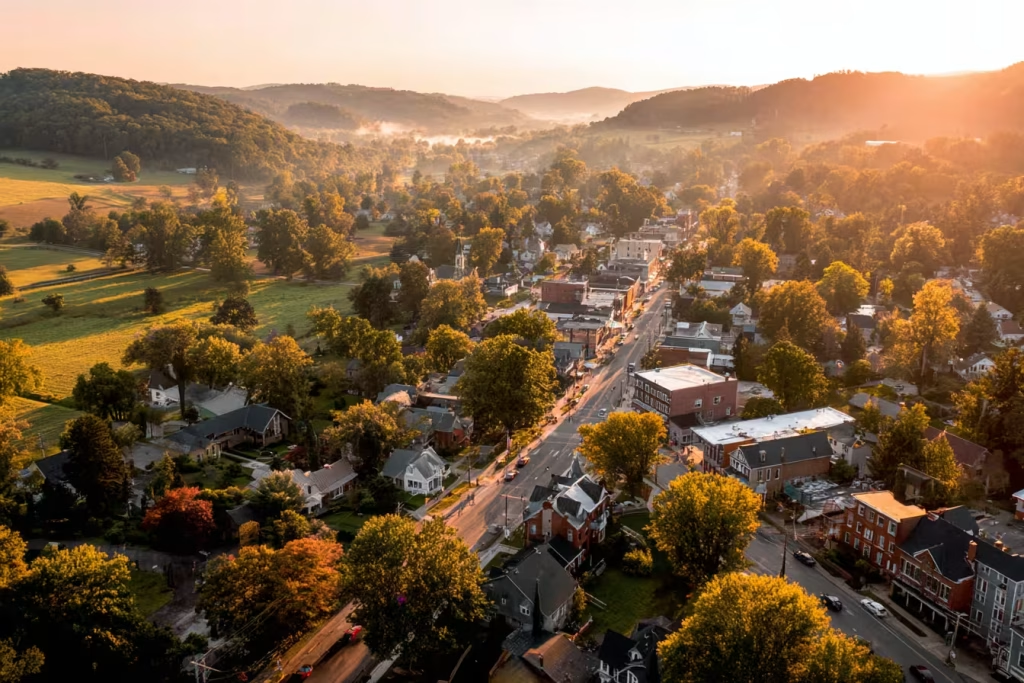
When rural communities face big challenges, they often turn to their greatest strength: each other. Across the United States and Canada, small towns are not just exchanging ideas—they’re creating policy that works. From cross-sector partnerships and locally led innovation to smart governance reform, rural America is building solutions grounded in collaboration, flexibility, and place-based leadership.
In this second installment of our July series on Policy Exchange, we explore four ways that rural communities are innovating from within—cross-sector and interagency collaboration, locally-led solutions, investment-ready communities, and zoning reform for rural communities — creating more responsive, resilient, and investment-ready places.

Cross-Sector and Interagency Collaboration
Rural challenges—whether they involve workforce housing, healthcare access, broadband expansion, or environmental resilience—don’t respect bureaucratic boundaries. No single agency or sector can address them in isolation. That’s why collaboration isn’t a luxury in rural planning—it’s a necessity.
More and more states and regions are recognizing this and responding by fostering intentional, structured partnerships across public, private, and nonprofit sectors. These efforts bring together a diverse mix of players, including:
- Local governments, who understand community context and daily constraints
- Tribal nations, bringing sovereign leadership and long-range stewardship
- Nonprofits and foundations, offering expertise, trust, and flexible resources
- Universities and extension programs, contributing research, facilitation, and technical assistance
- Regional planning organizations, providing coordination across jurisdictions
- Private sector partners, who bring capital, innovation, and implementation capacity
Why It Works
These cross-sector tables enable rural communities to:
- Break out of silos by aligning infrastructure, housing, and workforce goals
- Share proven models and lessons learned across geography and discipline
- Co-design investment strategies that pool funding, capacity, and credibility
- Speak with a stronger, unified voice when advocating at the state or federal level
By working together, rural stakeholders can scale solutions that would be unfeasible alone—and influence policy design to reflect the nuances of rural life.
Examples in Action
- State-Level Rural Prosperity Task Forces
In states like Georgia, Colorado, and North Dakota, governors have convened rural prosperity task forces that blend agency heads, rural mayors, business leaders, and nonprofit partners to develop integrated development roadmaps. - Regional Planning Hubs Serving Multi-County Coalitions
In the Midwest, multi-county planning districts coordinate transportation, housing, and hazard mitigation plans—helping small towns access funding they wouldn’t qualify for on their own. - University-Led Policy Labs
Institutions like the University of Wisconsin, University of Oregon, and land-grant colleges nationwide are creating “rural innovation labs” that pair student research and faculty expertise with local planning goals, providing capacity while building community-academic trust. The Extension Service in several states, especially across the Midwest, also provide practical land use advice to small towns and rural communities.
From Participation to Power
Too often, rural communities are invited into policy conversations after the key decisions have been made. These collaborative models shift that dynamic. They don’t just give small towns a seat at the table—they allow them to shape the table, helping define priorities, design policy mechanisms, and track outcomes.
For rural America, cross-sector collaboration is more than a governance method. It’s a strategy for building alignment, unlocking resources, and planning for systems-level change—from the grassroots up.

Locally Led Solutions, Not One-Size-Fits-All
For decades, rural communities have been on the receiving end of policies and programs designed somewhere else—usually with urban assumptions in mind. Too often, these efforts fail not because the goals are wrong, but because the model doesn’t fit. Rural success depends on local knowledge, trust, and flexibility.
That’s why a growing number of states and federal agencies are shifting their approach—placing rural communities in the lead, and building programs around their expertise. This change is more than symbolic. It’s transforming how rural initiatives are designed, funded, and measured.
Instead of asking, “How can we get small towns to adopt our solution?” the better question has become: “How can we build a framework that supports local solutions already emerging?”
This mindset is now reflected in federal and state policy:
- USDA’s Rural Partners Network emphasizes locally led development plans, tailored to each region’s strengths and goals.
- HUD’s rural housing pilots are testing flexible funding and locally determined design criteria to better match community needs.
- Broadband coalitions in tribal and rural regions are developing their own connectivity strategies—combining public investment with community-driven digital inclusion efforts.
These initiatives work because they trust communities to define their own priorities. That trust is backed up with flexible tools: streamlined applications, open-ended funding parameters, and technical assistance that adapts to local capacity—not the other way around.
Ultimately, locally led doesn’t mean isolated. Rural communities thrive when they can partner, learn, and adapt—but those partnerships need to start with the understanding that no one knows the local landscape better than the people who live there.
By shifting power closer to the ground, these policies are unlocking not just better outcomes, but stronger civic ownership and long-term resilience.
Next Steps: Putting Locally Led Solutions into Practice
For Planners:
- Start with listening. Host facilitated listening sessions with community members—including youth, elders, and marginalized groups—to surface goals before defining projects.
- Co-create tools. Develop flexible planning frameworks or funding guides that communities can adapt to their context, rather than prescriptive templates.
- Build local capacity. Partner with extension services, interns, or planning students to increase support for under-resourced towns during visioning or application phases.
For Decision Makers:
- Audit your program design. Are application processes, reporting rules, or match requirements unintentionally excluding smaller or rural applicants?
- Embrace flexibility. Allow for locally determined metrics of success and timelines that reflect rural capacity and seasonal cycles.
- Fund leadership, not just projects. Invest in the people and partnerships that make local implementation work—community organizers, coordinators, or regional conveners.
Bottom line: Empowerment isn’t just a philosophy—it’s a policy choice. Implementation is the watchword. When you start by listening and build for local adaptation, rural communities are more than ready to lead.

Building Investment-Ready Communities
Many small towns and rural communities have strong ideas and committed leadership—but face a familiar barrier: they’re not seen as “investment-ready.” As Joshua Gutierrez from Cibola County, New Mexico, noted in a post on LinkedIn last week, “for investors, developers, and public agencies, that word [rural] often comes with unspoken baggage.” Whether it’s a housing project, industrial site, or infrastructure upgrade, too many small towns lack the technical capacity, staff bandwidth, or predevelopment resources to compete for funds or attract partners.
That’s not a failure of vision—it’s a gap in support. And forward-thinking states, foundations, and federal agencies are working to close it. As Joshua followed up the next day, “It’s time we stop treating rural like the “junior partner” in the economic conversation and start recognizing it as a different kind of powerhouse, one built on relationships, land, and legacy.”
Being investment-ready doesn’t just mean having a good idea. It means having:
- Realistic pro formas based on solid research and analysis
- A vetted site or plan
- Local approvals or zoning alignment
- Pre-development work completed (designs, permits, partnerships)
- Capacity to manage funding, reporting, and timelines
For many small communities, getting there requires help. That’s why new models are emerging to level the playing field.
Examples in Action
- Local Match Waivers: Some federal and state programs now offer reduced or waived local match requirements for rural or high-need applicants—removing one of the biggest financial barriers to entry.
- Predevelopment and Technical Assistance Funds: These programs cover the “in-between” costs—site plans, feasibility studies, or architectural renderings—that move a project from concept to shovel-ready.
- Shared Staffing Models: Multi-county collaboratives and regional development organizations are hiring shared grant writers, engineers, or planners to serve multiple small towns—bringing high-level expertise within reach.
- Investment Readiness Scorecards: A few regions are building databases that assess and track the readiness of sites and communities, helping align resources and signal opportunities to investors or agencies.
Next Steps: Becoming Investment-Ready
For Planners:
- Map your project pipeline. Identify which ideas have local support but are stalled due to planning or funding gaps.
- Leverage regional resources. Partner with regional planning agencies or development districts that may already have grantwriting or engineering capacity in-house.
- Document readiness. Create a local “investment profile” or fact sheet for key sites or projects to have on hand for funders.
For Decision Makers:
- Fund the middle. Advocate for programs that support design, engineering, or permitting work—not just construction.
- Reduce barriers. Push for policies that waive or scale local match requirements in high-need areas.
- Invest in people. Support regional planning positions, circuit riders, or technical assistance roles that serve rural towns collaboratively.
In rural America, the bottleneck isn’t always vision—it’s bandwidth. When policy shifts to support capacity and readiness, small towns are more than prepared to deliver transformative projects.

Zoning Reform That Works for Rural Communities
Zoning is a powerful planning tool—but in many small towns and rural communities, it’s also a barrier. Across the United States, small towns are working with outdated zoning codes that reflect past realities or were imported wholesale from urban models. These codes often make it harder—not easier—to adapt to today’s challenges: housing shortages, downtown vacancies, and shifting land use patterns.
Today, a new wave of zoning reform is taking hold, Unfortunately, national zoning reform efforts are too often led by big city urbanists who think a “small town” is under half a million population. Even worse, many of these well-meaning activists are urging State legislatures and Congress to pre-empt local decision making, forcing one-size-fits all solutions just like the bad old days of urban renewal and slum clearance.
Rural planners, local leaders, and policy innovators need to ask themselves a simple but essential question: What kind of zoning actually works for small towns and rural places?
Instead of trying to replicate complex urban form-based codes or planned unit development, a number of small towns and rural counties are embracing more flexible, streamlined approaches tailored to rural conditions. A good focused comprehensive plan provides the rational basis for zoning reform, in places of any side. These reforms aren’t necessarily about deregulation—they’re about right-sizing the rules so they support, rather than stifle, thoughtful development.
Common Rural Zoning Challenges
- Strict use separation that prohibits mixed-use or adaptive reuse
- Minimum lot sizes out-of-scale with traditional town development patterns
- Parking requirements that push downtown development away to the outskirts of town
- Lack of clarity or consistency, leading to unpredictable decisions
- Unwillingness to back local startups and expansions over glitzy out-of-state chain stores
- Codes that overlook modern housing types (ADUs, tiny homes, co-housing)
In small towns with limited staff, complicated zoning can paralyze progress. Reforming it—without losing community character—is increasingly seen as essential to unlocking development potential.
Examples in Action
- Binary or Hybrid Zoning Codes: Some rural communities are adopting two-tier systems (developable vs. non-developable) or simplified hybrid codes that prioritize land use goals over rigid categories.
- Adaptive Reuse Provisions: Towns are updating codes to allow vacant schools, churches, and storefronts to be reused for housing, coworking, or community space without requiring full rezoning.
- Outcome-Based Standards: Instead of long technical checklists, planners are shifting toward performance metrics—like traffic impact or design quality—to guide approvals.
- Housing Flexibility Measures: Many communities are allowing accessory dwelling units (ADUs), duplexes, or cottage clusters by right—expanding options without adding administrative burden.
Next Steps: Zoning That Enables, Not Obstructs
For Planners:
- Conduct a zoning audit. Identify code sections that are consistently waived, appealed, or ignored—these are strong candidates for reform.
- Pilot test changes. Use overlays, special districts, or temporary ordinances to trial reforms before full adoption.
- Engage your community. Host workshops using visual examples to explore what types of development people want—and what’s currently allowed.
For Decision Makers:
- Fund technical assistance. Support local code updates with grant programs or consultant pools to help towns modernize without overwhelming staff.
- Streamline approvals. Promote by-right permitting for infill housing, reuse projects, or priority areas.
- Champion reform as pro-community. Emphasize that zoning updates are about enabling rural growth, not loosening standards.
For rural communities facing housing shortages and economic transition, zoning reform isn’t a silver bullet—but it is a powerful lever. When codes reflect local values and today’s realities, they become tools for resilience, not roadblocks to it.

Conclusion: Rural Innovation Starts with Exchange
As these four strategies show—cross-sector collaboration, locally led action, investment-readiness, and tailored zoning reform—rural America is not waiting for solutions. It’s building them. These innovations aren’t happening in isolation; they’re part of a broader shift toward more responsive, community-driven policy that honors local knowledge and aligns with rural realities.
Policy exchange is becoming a standard part of rural governance—whether it’s through partnerships across agencies, adaptations in funding rules, or shared learning between towns and regions. The result is a planning culture that’s more flexible, more connected, and more effective at addressing the complex challenges rural communities face today.
Next week, we’ll explore how that culture of innovation is shaping day-to-day planning practice and trends. We’ll look at how rural communities are navigating the tension between tradition and innovation, rethinking digital vs. in-person engagement, and integrating nature-based strategies to build sustainability and resilience from the ground up.
Join us as we continue to highlight how rural planning isn’t just keeping up—it’s leading with purpose.
Ready to bring policy that works to your community?
Explore how these strategies can be adapted to your local context—and share your own success stories or challenges. Let’s keep the exchange going. Reach out to JC Shepard, or tag us in your planning wins. Rural resilience starts with real conversation.
“We need to privilege regional and local over national and transnational space … these facets of planning are not everywhere the same, and it is the specificities of place that should be our guide.”
— Dr John Friedmann, JAPA (59:4) 1993

Planning That Works: Books and Tools for Rural Policy Innovation
Recommended Books & Reports
There are not a lot of books out there on innovations on rural policy. International policy may be relevant for US and Canadian readers, or at least interesting. Here’s a few to try (I’ve reviewed the first book, from Island Press, it’s pretty good).
- Rural Renaissance: Revitalizing America’s Hometowns through Clean Power – L. Michelle Moore
Tools needed to bring the far-reaching benefits of clean power to small communities, particularly in rural America - Rural Transformations Globalization and Its Implications for Rural People, Land, and Economies –
Barcus, Jones, and Schmitz
Demographic change, rural-urban partnerships and innovations, and landscape change - Local Government Administration in Small Town America – Clinger, Handley, Easton, ed.
Unique challenges rural communities face, as well as the policy tools that their governments employ to address them - Rural Places and Planning: Stories from the Global Countryside – Gkartzios, Gallent, and Scott
A study across twelve international cases, examining the values that guide the pursuit of the ‘good countryside’
Online Tools & Networks
- American Planning Association – Small Town & Rural Division
Publications, forums, and technical guidance specifically for rural and small-town planners.
planning.org - Citizens’ Institute on Rural Design (CIRD)
Resources, toolkits, and grants for community-led design and planning in rural spaces.
rural-design.org - USDA Community Facilities Programs
Grants, loans, and technical assistance for rural libraries, schools, and public infrastructure.
rd.usda.gov - Maptionnaire – Rural Engagement Resources
Digital mapping and participation tools tailored for small-town public engagement.
maptionnaire.com - Smart Growth America – Rural Policy Resources
Strategies, reports, and technical assistance for sustainable rural development.
smartgrowthamerica.org - National Zoning Atlas
A project which aims to illuminate critical information about the land use regulations that shape our lives.
Looking for more insights? These resources offer a starting point for anyone working to strengthen policy that works for rural communities—whether you’re a planner, council member, or community leader.
The Best Books for Rural Development and Planning in 2025
(As an Amazon Associate, we may earn commissions from qualifying purchases. Check your local library or local bookshop, too.)