

Part III in our November series on Implementation and Your Comprehensive Plan
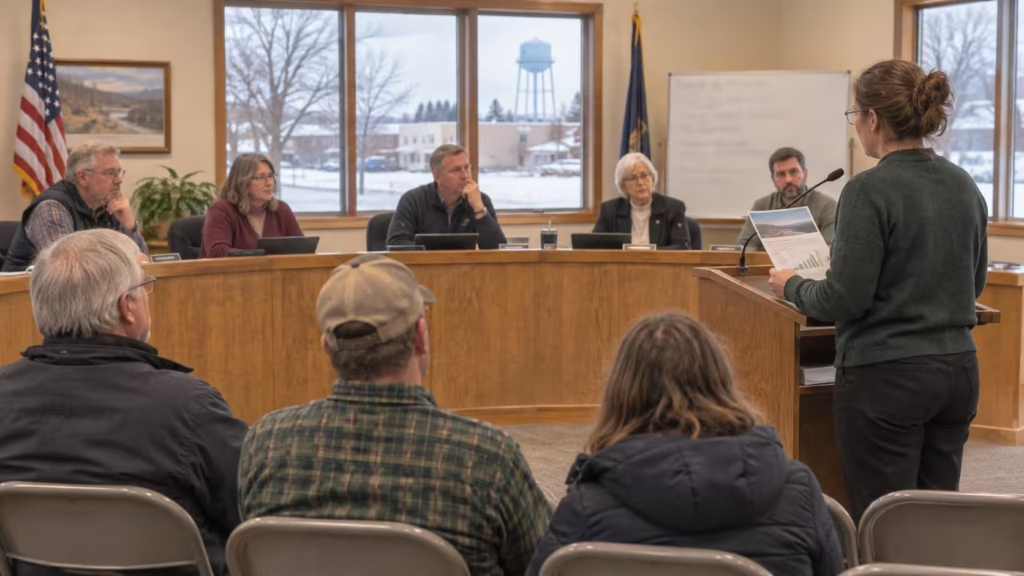
The planning commission has a subdivision request on the agenda. The council is trying to decide whether to replace the water tower at its present capacity or build for growth. Across the street, someone wants to put a bakery downstairs and an apartment upstairs in an old Main Street building. The comprehensive plan supports housing, economic development, responsible infrastructure investment, and community character. Everyone in the room can find a sentence in it to support their position. What they cannot find is much help deciding.
Last week, we argued that a plan is something a community does, not something it has. That argument rested on four questions any community can ask of its own plan: Can it be used when a decision gets hard? Do the community’s operating systems carry it out? Is it sized to the people and money actually available? And who reviews the work, in public, every year? Those questions were about the plan as a whole. This week moves from the whole plan down to the sentence. Every statement in a plan is doing one of four jobs: setting a goal, stating an objective, guiding a decision as a policy, or assigning an action. Most of the confusion in implementation starts when we can’t tell which job a sentence is supposed to do.
Most comprehensive plans begin with a vision, and many visions sound alike: a safe, vibrant, welcoming community with a strong economy and a high quality of life. There is nothing wrong with wanting those things. A vision is supposed to describe the kind of place people want to live in, and as we discussed in January, it is what gives the plan its legitimacy. But agreement on the destination does not settle the choices along the way. A vision alone cannot tell a planning commission where a subdivision belongs, tell the council which infrastructure investment comes first, or explain what has to change before someone can live above the bakery.
That is the work of the rest of the plan. As an American Planning Association guide to best practices in comprehensive planning puts it, a plan should contain “a consistent set of visions, goals, policies, objectives, and actions” grounded in evidence about community conditions, and it should state clearly who is responsible for carrying it out and how progress will be measured (APA, PAS Report 578). That sounds straightforward, and on paper it is. Writing it into a plan that a part-time staff and a volunteer commission can actually use is harder, and it is where most plans quietly lose their grip on implementation.
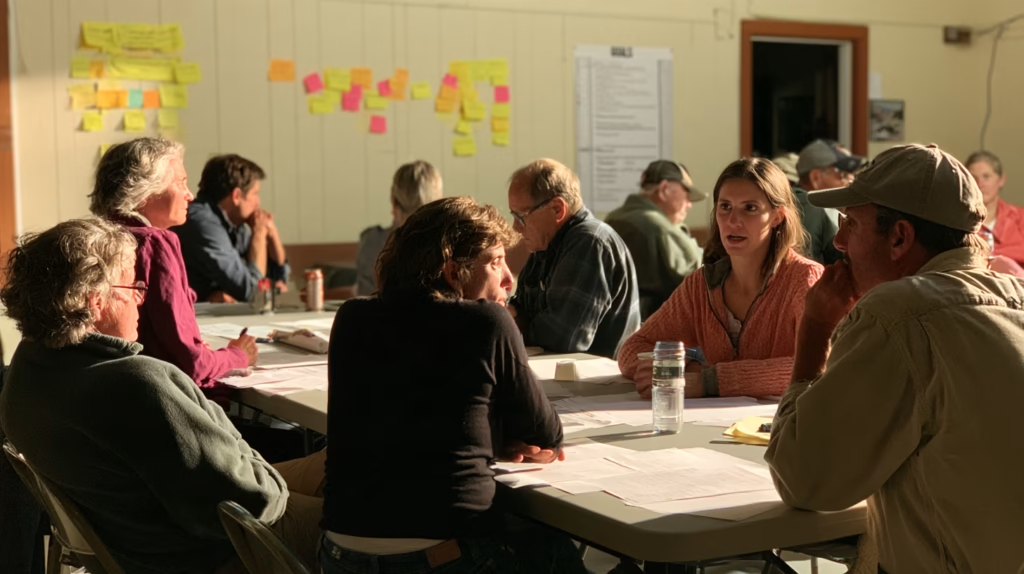
What Goals and Objectives are Really For
I have always understood goals as where we want to be in the future, what we want to be when we grow up. Objectives are where the distinction gets slippery. How specific does a goal have to become before it turns into an objective? And when an objective says to adopt an ordinance or prepare a study, how is that different from an action? Policies and actions blur together, too. In land use planning, I tend to use policies to evaluate development proposals, and I think of actions as the specific tasks someone needs to perform. But plans often put both under the same heading, sometimes alongside objectives that read much the same way, and I have written my share of those plans.
The American Planning Association gives us a useful foundation. Sustaining Places: Best Practices for Comprehensive Plans, by David R. Godschalk and David C. Rouse, was published in 2015 as PAS Report 578 (APA). It treats consistent content and accountable implementation as two of the essential attributes of a good plan, and it defines each of the four terms in a sentence. Goals are “statements of community aspirations for achieving the vision.” Objectives are “measurable targets to be met through community action in carrying out the goals.” Policies are “the specification of principles guiding public and private actions to achieve the goals and objectives presented in the plan.” Actions are the implementation commitments, identified with “timeframes, responsibilities, funding sources, and provisions for plan monitoring and updating” (PAS 578). The working vocabulary in this article follows the distinctions in that framework. The value is not the labels by themselves. It is knowing whether a statement describes a result, guides a choice, or assigns work.
Each statement in a plan has one of four jobs:
| Element | The question it answers | Its job in the plan | In plain words |
| Goal | What future condition do we want to create or sustain? | Establish the desired direction | Where we want to be |
| Objective | What specific result would demonstrate progress? | Make the desired change assessable | How we’ll know |
| Policy | How should we decide when a relevant choice arises? | Guide decisions consistently | How we’ll decide |
| Action | What work will someone undertake? | Assign an implementation task | What we’ll do |
A goal tells us what future we want. An objective tells us what progress would look like. A policy tells us how to decide. An action tells us what work to do. We do not need to settle the vocabulary for the entire planning profession. We do need to settle it within the plan someone is expected to use.
Same sentence, different labels
If this sounds like hair-splitting, open a few plans side by side. The plans I have worked on in Nebraska, New Mexico, and Colorado use at least three vocabularies from three different organizations. The Grand Island and Clay County plans, for example, use goals, policies, and action items. The New Mexico plans for Raton, Aztec, Bernalillo, and Ruidoso Downs use goals, objectives, and strategies, and Aztec’s plan says plainly that “the strategies are action items.” Archuleta County’s community plan uses goals, policies, and action items, and describes its goals as “vision statements for desired future conditions.” The smaller Nebraska plans, including Kimball and Burwell, use goals and a single list of actions under each one.
That last choice was deliberate. In smaller communities like Kimball, with limited implementation capacity, we did not separate policies from actions. A town of about 2,200 people with a small city staff and a volunteer planning commission is better served by one list under each goal than by four tiers of statements to maintain, report on, and keep consistent. It is the same principle we discussed last week under matching ambition to capacity, applied to the structure of the plan itself. The result is that sentences doing different jobs sit side by side on the same list. Kimball’s transportation goal, “The city’s street network continues to meet the needs of local users and those passing through the city,” is followed by actions such as “Annually review the City’s One and Six Year Plan for conformance with the Comprehensive Plan,” which is a recurring practice, and “Review and update Subdivision Regulations so that Plats with new subdivision streets accommodate transit stop pull-off areas,” which is a task with a finish line. A related goal to avoid land use conflicts along the railroad corridor includes “Buffer residential development along the Union Pacific railroad rights-of-way,” which does its work when an application comes in. That one is a policy, wherever it sits.
The larger plans show the same thing from the other direction, because both of them have a policy tier. Clay County lists “Direct residential development away from prime farmland and environmentally sensitive areas” as a policy. Grand Island lists “Direct development away from prime farmland and environmentally sensitive areas” as an action. Grand Island also lists “Prioritize public funding for projects which incorporate affordable, missing middle, and/or workforce housing” as a policy, while Kimball and Burwell list nearly the same sentence as an action because they have no policy tier to put it in. Archuleta County runs the other way: “Develop a long-range Transportation Plan” is listed as Policy 5.2, and “Regularly review effectiveness and efficiency of the Land Use Regulations” is Policy 6.7, although both are work someone has to do.
These are good plans, and the sentences are sound. The labels perhaps aren’t doing consistent work. A commissioner trying to decide whether the farmland sentence applies to tonight’s subdivision, or a clerk trying to decide whether it belongs on this year’s work list, gets less help from the heading above it. Under the test in this article, both the farmland sentence and the funding sentence are policies. Each one tells someone how to decide when a development application or a funding request comes in, and neither one is ever finished. The two Archuleta examples are actions. Each one ends when the plan is prepared or the review is complete.
The fix is not always more headings. In a small plan with one action list, it can be as simple as knowing, and marking, which items guide decisions and which ones are work to finish. A one-letter tag could do it: D for decision guidance, T for a task. Kimball’s implementation tables already assign organization and funding-source codes to every action, so there is already a column where that tag could go. The point is not to make a small plan look like a big one. The point is that a reader should be able to tell what each sentence asks of them.
These are all things I keep trying to get better at, plan to plan, year by year.
Goals describe the condition we seek
A goal should describe something that matters to the community beyond the completion of a particular project. “Residents have reliable, accessible places to gather throughout the year” is a goal. It describes a condition people would experience. “Build a new community center” describes one possible way to provide it. The difference matters because there may be several ways to meet the need. A school gym, a shared-use agreement, a renovated downtown building, or better transportation to an existing facility might accomplish more than new construction, at less cost, and sooner. Starting with the desired condition keeps those alternatives in the conversation.
Grammar makes a bigger difference here than it might seem. Compare three ways of writing the same housing goal in plans prepared by the same consultant team. Grand Island’s says, “Increase the number and types of housing units to meet the needs of Grand Island’s current and future residents.” Nemaha County’s draft says, “Provide safe, affordable, and diverse housing options.” Kimball’s says, “There is an increase in the number and types of housing units to meet the needs of Kimball’s current and future residents.” The first two are instructions. The third describes the town it hopes to become, and that makes it easier to ask later whether it happened. A goal written as a condition invites a simple follow-up question at every annual review: is this true yet?
A goal can also describe something the community wants to keep. Not every rural community is trying to become larger. Some are trying to retain reliable water service, productive farmland, a functioning Main Street, or access to basic services as population and economic conditions change, and maintaining those conditions can require considerable work. Archuleta County’s community plan states one of its goals simply: “The scenic beauty of Archuleta County remains intact.” That goal will never be checked off, and it shouldn’t be. It describes a condition the county has to protect every time it makes a land use decision. Kimball’s goal is one to reach. Archuleta’s is one to keep. Both are written as conditions, and both give the people using the plan something to measure their decisions against.
The Nebraska plans add two useful guardrails. They say that “a goal should be stated in a manner which allows it to be accomplished,” and that goals and policies “are focused on the next 10 years,” while the plan as a whole looks out twenty. That is not in conflict with a goal that describes a lasting condition. The ten-year horizon is about the work the plan expects to do toward the goal, not about when the community stops caring. The goal should be broad enough to remain useful as circumstances change, but clear enough that people can recognize what it means locally and tell whether they are getting closer to it.
Objectives describe the results that show progress
An objective takes part of that desired future and makes it specific enough to assess. For our gathering-space goal, an illustrative objective might be:
- By the end of 2029, each of the county’s two identified underserved towns has an accessible indoor gathering space available to the public at least one evening and one weekend period each week.
That statement describes a service residents would receive. It does not decide whether the space will be new, renovated, shared, publicly owned, or operated through a partnership. The details in the example are illustrative. A real community would need evidence for identifying the underserved towns, choosing the service level, and setting the deadline, and the numbers should come from the need and the capacity to respond, not from a desire to make the sentence look rigorous.
A goal may need several objectives because the desired condition has several dimensions. A room can be open but unaffordable. It can be affordable but inaccessible. It can be accessible inside the building but unreachable for residents who do not drive. One measure rarely captures the whole goal, which is why the practical distinction is between the condition we seek and the particular evidence that would show progress toward it.
This is also where the plans I have worked on most often fall short of Godschalk & Rouse’s guidelines (APA PAS Report 578, referenced above). The New Mexico plans list objectives under each goal, but many of them do read as purposes. Ruidoso Downs’s community services goal is to “provide and expand access to community facilities to meet the social and educational needs of the community,” and one of its objectives is “to support the ability of seniors to remain active and maintain meaningful social connections.” That is a worthy aim, but it is a second goal, not a measurable target. Nobody could look at it in five years and say whether it had been met.
Drafting goals and objectives is as much art as science, and knowing your audience is part of that. We’ll come back to where measurable objectives actually come from in the second of the six principles below.
Policies guide decisions
A policy is a standing direction that applies when someone faces a relevant choice. APA’s definition is worth reading closely: policies are principles “guiding public and private actions.” The words “and private” are the reason policies belong in development review. An applicant for a subdivision or a conditional use permit is a private actor, and the plan’s policies are how the community tells that applicant, in advance, what it will weigh.
For the same gathering-space goal, a policy might read:
- When considering investment in community gathering facilities, evaluate shared use and reuse of existing buildings before funding new construction.
That does not assign a construction project. It tells the council what to consider when deciding how to invest. It can guide more than one decision, and it remains useful after any particular project is finished.
Using policies to evaluate development proposals is the same kind of work, and the bakery with the apartment upstairs is a good example because it isn’t hypothetical. Burwell’s plan describes its Downtown Commercial district as the town’s “center for trade, service, and civic life,” with buildings “at the sidewalk line” and parking and storage in the alleys, where “second-story residential units provide flexible and affordable housing choices.” It lists “upper-floor apartments over retail/services” among the compatible uses and “ground-floor residential development” among the incompatible ones. That is a policy, even though it doesn’t sit under a heading called “Policies.” It has a place, a decision context, and a clear direction. A commissioner reviewing a proposal for a bakery downstairs and an apartment upstairs knows what the plan supports, and a commissioner reviewing a proposal to convert the storefront itself into an apartment knows what the plan discourages. That is far more useful than “encourage appropriate mixed-use development.”
Many of the most useful policies in the Nebraska plans live in the same place: the future land use chapter, where each district has its own list of compatible uses, incompatible uses, and “Special Policies.” Kimball’s Transitional Agriculture district, which maps much of the adjacent Extraterritorial Jurisdiction or ETJ, covers “the area where agriculture will likely continue; however, there may be urban-scale development when city utilities can be extended.” Its first Special Policy says residential density “should be on average no more than four dwellings per quarter section.” A volunteer commissioner can hold an application up against that sentence and reach a decision. That is exactly the kind of policy a small plan needs, and it is one of the reasons Kimball’s element chapters could work with a single action list. Much of the decision guidance was already on the map.
Policy also reaches beyond development review. It can guide utility extensions, property acquisition, facility reuse, grant applications, and capital investment. Wherever the community makes repeated choices, a clear policy helps keep those choices pointed in a consistent direction, and it gives the people making them something to point to when a neighbor asks why.
Actions assign work
An action identifies a task that someone can undertake and report on. Best practices for comprehensive plan implementation says actions should indicate “the responsible agency, recommended timeframe, and possible sources of funding,” and notes that these are “often provided in a matrix” (PAS 578). For the gathering-space example:
- The county planning director (lead), with the town clerks and the school district superintendent (support), will inventory existing gathering spaces, including their accessibility, operating hours, rental costs, and use restrictions, and report the results to the county board by June 2027. Funding: staff time within the existing budget.
There is a deliverable, a lead identified by position, named partners, a deadline, and a funding source, even if the funding source is only staff time. The inventory may reveal a need for a shared-use agreement, an accessibility improvement, an operating subsidy, or new construction. Those would become additional actions. An action can also recur. Preparing an annual progress report is still an action because it assigns identifiable work. The distinction is not simply permanent versus temporary. It is decision guidance versus an implementation task.
One caution about the word “assign.” Most comprehensive plans don’t actually assign anything, and the good ones say so. Grand Island’s implementation chapter says its action items “provide a toolbox,” and adds, “They are suggestions — what might be done, who might be involved in completing actions, potential sources of funding, and suggested timeframes for implementation.” As we noted last week, the New Mexico plans describe their implementation schedules as “not binding” and dependent on available funding, staff resources, and partnerships. That is honest. A plan adopted by a planning commission and a council can’t commit next year’s budget, and it certainly can’t commit a school board’s staff.
Commitment happens later, when the council puts an action into the work program and funds it. So the useful question about an action in the plan is not whether it is binding. It is whether the action is specific enough that the council could commit to it when the time comes. Burwell’s housing chapter includes an action to “Explore feasibility of a Downtown Housing Initiative to rehabilitate/repurpose vacant upper story building spaces.” That passes the test if the plan, or the first annual work program, also says who explores it, what they will produce, and when it comes back to the council. Without those, it is still a suggestion, and suggestions tend to wait for someone with spare time. The six principles below, and especially the prioritizing and annual review steps, are where a plan’s suggestions become the community’s commitments.
They need to connect, but not always in a straight line
It is tempting to arrange these terms as a rigid ladder: vision, goal, objective, policy, action. That can be a useful introduction, but it can also make the plan more complicated than it needs to be. Godschalk & Rouse’s guidance itself doesn’t treat the terms as a strict ladder. Its list runs “visions, goals, policies, objectives, and actions,” with policies ahead of objectives. A policy may guide hundreds of decisions without producing a separate project. An action may be needed to put a policy into the zoning code. Several actions may contribute to one objective, and one action may serve several goals.
Consider the bakery again. The housing goal establishes the desired condition: more people living downtown. An objective identifies the additional occupied dwellings the community seeks. A policy, like Burwell’s Downtown Commercial district guidance, tells the commission where upper-floor housing belongs and what should stay on the ground floor. An action assigns the work that makes the policy real, such as reviewing whether the zoning code actually allows what the land use plan says it should, or exploring the downtown housing initiative Burwell’s plan proposes. After the zoning amendment is adopted, that action is complete. The policy still guides decisions. The objective still asks whether more people actually live downtown.
That last distinction is important. Completing an action is evidence that work occurred. Meeting an objective is evidence that the intended result occurred. The community needs to know both, and a plan that only tracks the first can report steady progress for years while nothing changes on Main Street.
There is a second way to see how the pieces fit, and it comes from APA’s planning resources. In a 2011 guide, William Klein described five strategic points of intervention in the local planning system, “the points where participants translate ideas into intentions and intentions into actions.” APA’s later report on planners and water names them as “visioning; plan making; standards, policies, and incentives; development work; and public investments.” The four statements in this article are how a comprehensive plan reaches each of them:
| Point of intervention | Where it shows up | Which statements carry the plan there |
| Visioning | The community vision | Vision and goals |
| Plan making | The comprehensive plan’s chapters and maps | Goals, objectives, and policies |
| Standards, policies, and incentives | Zoning, subdivision regulations, incentive programs | Policies, plus the actions that amend the codes |
| Development work | Development review and public-private projects | Policies applied to individual applications |
| Public investments | The capital improvements program and the annual budget | Actions, with objectives tracked through the budget |
Goals carry the vision into the plan. Policies carry the plan into the codes and into development review. Actions and objectives carry it into the budget, which is where we’ll pick up next week.
Six Ways to Get It Done
The test running through all six of these principles is simple: is it doable? A good set of goals is not the most inspiring one. It is the one a part-time staff, a volunteer commission, and a council with competing priorities can actually work toward, measure, and report on. The six principles are not a new framework to set beside last week’s four questions. They are what those questions look like when you are writing goals and objectives:
| Last week’s question | This week’s principles |
| Design for use: Can the plan be used when a decision gets hard? | 1. Begin with local conditions; 2. Make objectives measurable |
| Close the gap: Do the community’s operating systems carry the plan out? | 5. Test the framework against maps, codes, and budgets |
| Match ambition to capacity: Is the plan sized to the people and money available? | 3. Separate control from influence; 4. Prioritize around capacity |
| Recurring responsibility: Who reviews the work, in public, every year? | 6. Review the plan with the annual work program and budget |

1. Begin With Local Conditions, Not the Preferred Project
Every planning process has someone who arrives with the answer already in hand. We need a community center. We need a splash pad. We need a bypass. Sometimes they are right. But a goal written around a project skips the most important question: what problem is the project supposed to solve? “Build a new community center” narrows the conversation before the need has been established. “Residents have reliable, accessible places to gather throughout the year” leaves room to investigate.
Maybe the school gym is available on weekends but nobody has negotiated access. Maybe the church fellowship hall would welcome a partnership. Maybe a downtown building could be reused. Maybe the problem is not a shortage of rooms but the cost of staffing them, or perhaps older residents have nowhere to gather because they cannot drive after dark. Those are different problems, and they call for different responses. A new building would solve only one of them, and it would bring its own operating costs to the council every year after the ribbon cutting.
We worked through this sequence with Ruidoso Downs, New Mexico, in their 2021 plan. Its community services goal is about access to facilities that meet the community’s “social and educational needs,” and one of its objectives is to support seniors in staying active and connected. The first strategy under that goal is not “build a new senior center.” It is to “complete a needs assessment that determines existing and future facility needs of the Ruidoso Downs Senior Center,” and the plan adds that “this strategy should include securing funding to meet the identified facility needs.” The implementation table names Public Works and Lincoln County Senior Centers as the responsible entities. A companion strategy calls for an ongoing preventive maintenance and replacement program for the building the city already has, and the schedule starts that program first. That is the right order: take care of what you have, understand the need, and then decide what to build. It also shows the partner category from the third principle at work, because the city cannot meet the objective by itself.
Starting with conditions also changes how a community uses its background information. Population trends, school enrollment, building permits, utility records, facility reservations, and resident interviews should do more than fill the first half of the plan. They should explain why the goals matter and help shape the response. This is central to APA’s consistent-content standard: the plan’s recommendations should rest on evidence about community conditions, major issues, and likely impacts. The background and the recommendations are not separate assignments. One should lead to the other, and a reader should be able to trace each goal back to something the community learned about itself.
Local evidence includes lived experience, too. A facility schedule may show that a room is available. Residents may explain that the rental charge, the stairs, the lack of transportation, or the reservation procedure keeps them from using it. APA treats authentic participation as one of the two processes every good plan depends on, calling for a planning process that “actively involves all segments of the community in analyzing issues, generating visions, developing plans, and monitoring outcomes” (PAS 578). That means more than asking people to react to a preferred proposal. It means asking them to help define the problem.
For each draft goal, ask: if this particular project were never built, would the goal still matter? If the answer is yes, we are probably describing a need or a desired condition. If the answer is no, we may have a project presented as a goal. The project may still deserve support, but it should compete with other ways to meet the need.
Write the goal around the need. Let the project compete for the job.

2. Make Objectives Measurable Without Inventing Precision
This is a part I struggle with in long-range comprehensive plans, particularly in rural counties and smaller communities. We need objectives specific enough to assess, but we also need to be honest about what a small community knows and can reasonably track.
There are two ways to get it wrong. The first is the objective that never becomes more specific than the goal: “Improve the quality of life.” “Enhance downtown.” “Support agriculture.” Those may express legitimate intentions, but they do not tell anyone what change would count as progress. The second is false precision: “Increase downtown retail occupancy by 23 percent by 2035.” That might be a defensible target if the community knows its starting point, understands the market, and has a reason for choosing the number. Without that foundation, the number creates the appearance of rigor without the substance.
The New Mexico plans I worked on show both sides of the problem, sometimes in the same document. Raton’s land use objectives read like purpose: “To create a more compact urban form,” and “To achieve more efficient and cost-effective delivery of City services.” Nobody would argue with them, and nobody could tell you today whether they had been met. The same plan’s housing chapter includes a table titled “Raton Goals, Quantifiable Objectives, and Housing Targets.” It sets targets of 5 to 10 transitional housing units for homeless and special-needs residents, 25 units for renters at or below 30 percent of area median income, 100 units across the rental income bands from 30 to 120 percent of area median income, 30 first-time homebuyers, and 50 home rehabilitations, each paired with specific strategies.
Those numbers were not invented for the comprehensive plan. The table’s source line credits the 2020 Colfax County Affordable Housing Plan, which had already done the counting. Kimball’s plan does the same thing in a different form: its housing actions, the plan says, “represent the strategies identified in the Housing Study.” That is a practical lesson for any small community. Measurable objectives usually come from a functional plan that has already collected the evidence: a housing study, a hazard mitigation plan, a utility master plan, a parks needs assessment, or the capital improvements program. The comprehensive plan can adopt those targets by reference and tie them to its goals. It doesn’t have to make up its own numbers, and it shouldn’t.
Indicators, benchmarks, and targets
Godschalk & Rouse’s framework calls for indicators, benchmarks, and targets as part of accountable implementation, and its definitions are more specific than the way the words are often used. In APA’s terms, an indicator is what we measure. “Benchmarks are measurements of existing conditions against which progress towards plan goals can be measured,” and targets are “aspirational levels of achievement for a specific goal or objective often tied to a specific timeframe” (PAS 578). In other words, APA’s benchmark is what many of us would call the baseline. Some communities also compare themselves to peer towns or to the county as a whole, which can be useful context, but that isn’t what APA means by a benchmark.
Here is how that works in practice. Suppose a downtown inventory in early 2027 counts 12 occupied upper-floor dwellings. The occupied-dwelling count is the indicator, and 12 is the benchmark. After looking at building conditions, rehabilitation costs, and what comparable projects in nearby towns have produced, the town sets a target of 18 occupied dwellings by the end of 2030. The target then means something. It describes six more homes above the storefronts, a number the council can understand, track, and explain to anyone who asks, rather than an unexplained percentage.
Use information the community can maintain
A measure is useful only if someone can produce it consistently, year after year, with the staff the community actually has. A few practical rules help:
- Start with records the community already maintains, while checking whether they actually measure the result being discussed.
- Define the geography and the unit being counted so that next year’s number means the same thing as this year’s.
- Establish the benchmark before selecting a numerical target.
- Explain why the target is reasonable in light of need, capacity, and the expected effects of the proposed work.
- Assign responsibility for updating the measure and reporting what it means.
Records can mislead if we ask too much of them. Building permits are not the same as completed homes, and completed homes are not necessarily occupied homes. A new utility account may indicate a connection, but it does not tell us whether the housing is affordable. We should use available information without asking it to prove something it cannot show.
Where no benchmark exists, gathering it is a legitimate first action. The implementation program can assign the inventory and set a date for bringing a proposed target back through the appropriate review process, which is often the first annual review. It should not quietly substitute “we will find out later” for a measurable commitment. A directional statement can also be useful while better information is developed. “Increase occupied upper-floor housing downtown” provides direction, but it is not as strong an accountability tool as a justified target with a deadline, and we should say so rather than pretend every statement is equally measurable.
Track completed work and changed conditions separately
Adopting a zoning amendment is an implementation milestone. Additional occupied downtown homes are a community outcome. Both matter, but they tell us different things. Suppose the town adopts the amendment on schedule and no apartments follow. That does not necessarily mean the amendment was a mistake. It may mean that financing, building condition, fire separation, infrastructure, or the local rental market is the next obstacle. Reporting only the completed amendment would miss the problem entirely.
I have tended to typically handle half of this well. Bernalillo’s implementation chapter says its matrices are intended to help the Town Council, the Planning and Zoning Commission, staff, and the community “in measuring the successful progress and overall implementation of the Comprehensive Plan.” That is a good checklist of work done. Our Nebraska plans describe the other half in their annual review, which is meant to “evaluate the effectiveness of planning activities” and “make mid-plan corrections.” Those are the two halves of a good annual report, and they are worth keeping separate on the page. One is a checklist of work done. The other is a short set of community indicators showing whether anything changed. A report that covers only the first half can show progress on every action while nothing improves downtown.
Godschalk & Rouse’s guidance for APA supports the same rhythm. It calls for evaluating and reporting progress “to both the public and elected officials,” and notes that “such evaluation is typically done on an annual basis” (PAS 578). It also repeats the old adage that “what gets measured, gets done.” That’s true as far as it goes, but in a small town the more useful version may be that what gets measured gets discussed. The annual review should ask two things: did we do the work, and did the work contribute to the result we wanted? The point is not to turn a small town into a data department. It is to choose a manageable set of measures that helps people decide what to do next.
3. Separate What Local Government Controls from What It Influences
A comprehensive plan should address the issues that shape the community’s future. That does not mean the city or county can deliver every outcome by itself. Local authority, ownership, and administrative arrangements vary widely. A town may own its water system, purchase water from another provider, or depend on a separate district. A county may have zoning authority but no utility of its own. Schools, health care, broadband, housing construction, and major employment decisions involve organizations with their own boards, budgets, and constraints. A plan that ignores those relationships will promise things the council cannot deliver, and a plan that makes them visible gives everyone a more honest picture of the work.
For each major objective and its supporting work, identify the local government’s role:
- Control means the responsible local body can directly undertake the work through its own lawful authority, services, property, or spending.
- Partner means delivery depends on an agreement or coordinated commitment with another organization.
- Influence means the desired outcome depends substantially on decisions others make, while local government can advocate, convene, provide information, or remove obstacles.
Archuleta County’s community plan shows why these categories matter, and it does so in two adjacent policies. Policy 5.5 supports new high-to-medium density development “only with the extension of central water and sewer service,” naming the Pagosa Area Water and Sanitation District and the Town of Pagosa Springs as the providers. The county controls the land use decision. It does not control the pipes. The policy works because it ties the county’s decision to a service the county has to secure through partners, and the action item beneath it says exactly that: “Work with property owners and service providers to plan strategic extensions of service.” Policy 6.3 is the opposite case. It continues the county’s 35-acre base density “in all un-platted areas without central water or sewer services.” The county can apply that rule on its own, application by application, without asking anyone’s permission.
(Hot take: Since I moved on, the County Board has, apparently, not read that 35-acre policy section again. And future landowners will pay the price. Sigh.)
For the gathering-space example, a town might control the operating hours of its own community room. Opening a school gym on weekends would require a partnership with the school district. Encouraging a privately operated facility to offer public programming would be a matter of influence unless a specific agreement established otherwise. The distinction should carry through to accountability. If the school district has not agreed to participate, the plan should not list it as though the council can assign its staff. The local action may first be to negotiate an agreement. The desired service result remains the objective, but its dependencies should be explicit.
APA’s framework makes the same point at a larger scale. Its Responsible Regionalism principle notes that regional planning agencies, “although typically without regulatory authority,” provide a setting for decisions that cross jurisdictional lines, and its best practice for implementation calls on communities to “establish interagency and organizational cooperation” (PAS 578). In a rural county, the regional partners are often the natural resources district, the school district, the regional development district, the public power district, and the towns themselves. An influence objective is not less important than a control objective. It simply needs a different kind of work and an honest explanation of what local government can promise.

4. Prioritize Around Capacity, Not Just Enthusiasm
Public engagement generates ideas. That is part of its purpose. The difficulty comes when the final plan treats every idea as an equally urgent commitment. A long list of unranked actions leaves the real priorities to be decided later, often by whoever has the most available time, the most persistent advocate, or the next grant deadline. The plan may appear inclusive while giving elected officials very little guidance about what comes first.
Prioritizing requires more than asking which idea people like best. For each proposed action, work through five considerations:
- Lead and effort: Who will lead the work, and how much staff or volunteer time will it require?
- Full cost: What will it cost to start, operate, maintain, and eventually replace?
- Dependencies: What authority, agreement, or preceding task does it depend on?
- Contribution: How much will it contribute to the objective, and who will benefit?
- Cost of waiting: What happens if the community waits?
APA treats priorities, responsibilities, timeframes, and resource allocation as central implementation practices. Those are not details to add after the plan is written. They help determine whether its commitments are credible.
Counting actions is one of the easiest ways to misjudge capacity, because some actions are much bigger than they look. Kimball’s implementation chapter recommends five “immediate tasks”: zoning regulations, subdivision regulations, floodplain regulations and mapping, the capital improvements program, and plan maintenance. That’s five lines on a page. The first two are rewrites of the community’s development code, the third depends on floodplain mapping, and the fourth is a multi-year capital program that Part IV will take up on its own. For a small city staff working with a consultant, that list is a full program for a year or more, and the plan is honest that the city was already reviewing its regulations while the plan was being prepared. Aztec’s plan has a single strategy, scheduled for 2021 to 2023, that calls for a “comprehensive update” to the city’s Local Economic Development Act (LEDA) ordinance. That one update would identify target industries, revise definitions to match state law, set up joint powers agreements with San Juan County and Four Corners Economic Development, and rewrite implementation procedures, including clawback provisions. Every one of those pieces is worth doing. Together, they are a negotiation with two partners and an ordinance rewrite in one line item. When you count actions to see what fits, count the work, not the line items. A five-item list that includes a full code rewrite may be more than a twenty-item list of small tasks.
Last week we sorted the work by what it needs: within reach now, a partner, or new money. This week we add when it happens. One practical approach is to sort actions into three groups:
- An active work program that the community commits to starting within a defined period. For a small organization, that might be five substantial actions rather than twenty, but the right number depends on the workload, not the count. Five major capital projects can exceed capacity just as easily as fifty minor tasks.
- A sequenced list of actions that become ready when earlier work is completed, resources become available, or partners make commitments.
- A parking lot of supported ideas that are not presently scheduled. A parking lot can be useful, provided everyone understands that it is a place for reconsideration at the annual review, not a concealed promise of eventual funding.
The two sorting systems work together. Most of the active work program will be within reach now. Much of the sequenced list will be waiting on a partner or new money. The parking lot is where ideas wait until one of those conditions changes.
Prioritizing actions does not mean suspending the rest of the plan. A standing policy about locating new development within an appropriate service area should continue to guide decisions even when a facility project has first call on staff time. Policies are applied when relevant decisions arise; actions compete for implementation resources. This is another reason the D-and-T distinction matters even in a plan with a single action list. When the council narrows the active work program to five items, the decision-guidance items don’t drop off the list. They keep working every time an application comes in.
Enthusiasm still matters. A committed volunteer organization, a willing property owner, or a partner prepared to contribute money can change what is feasible. That is real capacity, and the plan should recognize it without assuming that volunteers can absorb an indefinite public responsibility.
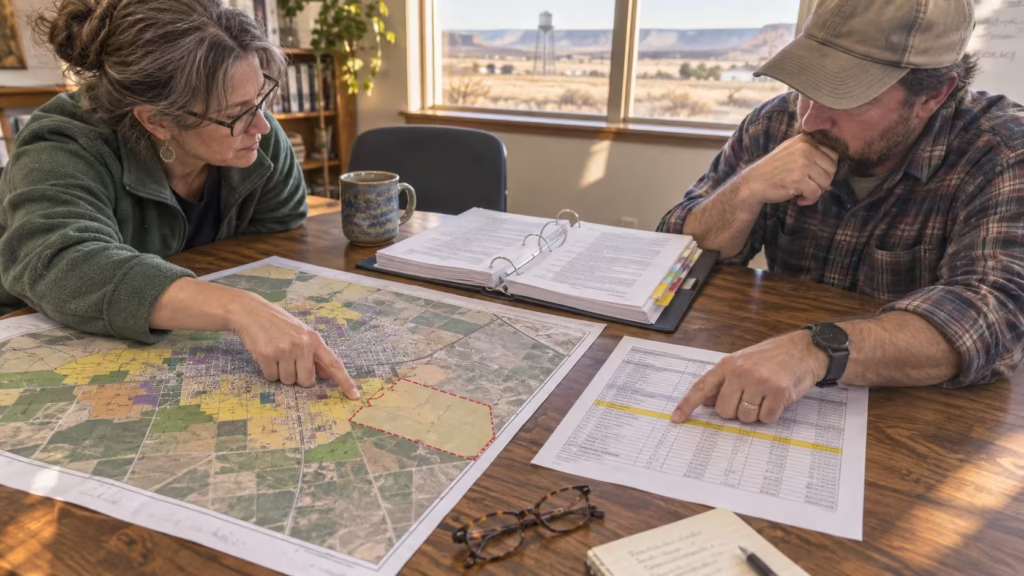
5. Test the Framework Against Maps, Codes, and Budgets Before Adoption
A plan should not encounter its first realistic decision after adoption. Before the draft is finished, put several likely cases on the table, and ask the planning commission, staff, and elected officials to work through them using the proposed goals, objectives, policies, maps, and implementation program. These are not tricks designed to make the plan fail. They are opportunities to discover where its language, maps, and operating systems do not yet agree. Godschalk & Rouse’s Coordinated Characteristics attribute calls for a plan that coordinates its recommendations “internally with each other, vertically with federal and state requirements, and horizontally with plans of adjacent jurisdictions” (PAS 578). A few hours with real cases is the cheapest way to find out whether it does, and three cases cover most of the ground.
The eighty acres. Suppose a farmer’s heirs want to sell eighty acres at the edge of town for a subdivision. The plan calls for housing choice, agricultural conservation, and efficient infrastructure. Last week we offered an example of a usable policy: “Direct new residential subdivisions to areas within the city’s sewer service area shown on the future land use map; outside that area, support rezoning only where the applicant demonstrates soils suitable for on-site systems and access to a maintained road.” Run the eighty acres through it. Is the property inside the sewer service area on the map? If not, what do the soils show, and which road provides access? If the land sits in a district like Kimball’s Transitional Agriculture area, where urban-scale development is expected only “when city utilities can be extended” and rural density is limited to an average of four dwellings per quarter section, the plan is telling the commission that this is a question about utility extension before it is a question about lot layout. What information would the applicant need to provide? Who decides whether the sewer gets extended, and on whose dime? What conflict, if any, must the commission resolve between the housing goal and the farmland goal?
The water tower. Suppose the water tower needs replacement. Does the plan identify the area expected to receive service over the life of the new tower? Is its growth assumption consistent with the utility’s planning? Does the community understand the operating and financial implications of building additional capacity now, and the cost of not building it?
The bakery. Suppose someone wants a bakery downstairs and an apartment upstairs. Does the plan support that use in this location? Does the zoning code allow it? What building, fire, accessibility, or infrastructure questions need to be resolved before the apartment can be occupied?
The map test
For location-dependent goals, can someone find the intended result on the ground? A goal to direct growth toward existing infrastructure should have a geographic meaning. A policy to protect productive agricultural areas should be understandable alongside the future land use map. If the text and map point in different directions, the plan should resolve the conflict or explain how the competing considerations will be weighed. Not every goal needs a mapped designation. But where location is central to the decision, a general sentence is not a substitute for geographic guidance. The Nebraska plans’ future land use districts, with their compatible uses and Special Policies, are a good model precisely because they put the policy and the map in the same place.
The code test
Do the applicable regulations allow what the plan encourages, and do they establish the standards needed to carry out its policies? Here we need to keep policy and regulation distinct. The legal effect of a comprehensive plan depends on the state, the jurisdiction, and the decision involved. A policy statement should not be presented as though it automatically creates a new permit requirement or overrides adopted regulations.
The plans themselves can blur that line, and often we lean on aspirations where we can. Grand Island’s Land Use Policy 13.1.1 and Clay County’s Housing Policy 4.1.1 both say, “Development projects shall follow the goals and policies of the Comprehensive Plan.” Grand Island’s implementation chapter says, just as clearly, “This plan is not regulatory.” Both statements are trying to do something reasonable, and in Nebraska zoning is meant to be based on the plan. It may be the better pattern is the one the same implementation chapter goes on to describe: each application should “address how the specific proposal meets the policies,” and where it doesn’t, the developer is encouraged to bring it into conformance. The plan guides. The code regulates. The two should be written to agree.
Where the plan calls for a different development pattern, identify the regulatory work needed to make that pattern possible, and write it as an action. This is Klein’s third point of intervention, standards, policies, and incentives, at work. For the bakery and apartment, “support downtown housing” is not enough if the zoning code prohibits residential use in the downtown district, or requires off-street parking the building can’t provide. The action is to prepare and consider the necessary amendment. The policy explains the direction that amendment is intended to serve. Kimball’s housing chapter does this directly, with an action to “Revise zoning code to accommodate mixed-use development.”
The budget test
Is there a plausible way to fund and staff the first actions? A long-range plan does not need a final appropriation for every future investment. It does need to distinguish a funded commitment from a potential project, and a potential funding source from money the community actually has.
If implementation depends on a grant, what happens if the application is unsuccessful? Nearly every Nebraska plan I worked on lists the state’s Civic and Community Center Financing Fund among its resources, and it is a natural place to look for help with a gathering space. It is also a state program with limited funds, and an award is never guaranteed. A plan that schedules the renovation for the year after the first application should also say what happens if the first application isn’t funded: whether the town reapplies, phases the project, or turns to a local campaign.
If a facility is donated, who pays the utilities and maintenance? If an agreement provides access to a school gym, who opens the building, who cleans it, and who carries the liability? Ruidoso Downs’s senior center strategy anticipates part of this by pairing the needs assessment with “securing funding to meet the identified facility needs.” The purpose of the budget test is not to eliminate every uncertainty. It is to expose the assumptions that must be resolved before a recommendation becomes a commitment.
6. Review the Plan With the Annual Work Program and Budget
A comprehensive plan looks well beyond the next budget year. Implementation happens through decisions made this year, next year, and the year after that, and the connection between the plan and those decisions has to be renewed every year or it fades. Godschalk & Rouse’s best practices for APA are direct about this. Plan objectives “linked to budget categories and the timeframe of the community’s annual budgeting process” make it easier for elected and appointed officials to make decisions about desired outcomes, and the plan should include a process for “adjusting plan goals, strategies, and priorities over time as conditions change or targets are not met” (PAS 578).
We described the January review last week, and the details belong there. What matters for goals and objectives is what the review looks at. Before the annual budget is drafted, review the active actions alongside the work programs of the departments, boards, and partners responsible for them. What was completed? What is under way? What is stuck? What should begin next? Then look beyond the task list. Did the completed work contribute to the objective? Are the indicators moving in the expected direction? Were the plan’s assumptions reasonable? Are the policies being used consistently in development review and public investment?
That last question is where the Nebraska plans’ provision on nonconforming approvals earns its place. As we noted last week, the plans say that approving a proposal that doesn’t conform to the plan “would point to the need to review and update the plan.” For this article’s purposes, the practical step is to keep a record. Each time the commission or council approves something the plan’s policies didn’t support, note the policy number, the decision, and the reason. A year’s worth of those notes is the best evidence a small community will ever have about which policies still match what it actually decides, and which ones need to be rewritten, clarified, or retired. It costs nothing but a column in the staff report.
The review should come early enough to influence resource decisions. A report presented after the budget is adopted may be informative, but it has missed the chance to shape what happens next. Raton’s plan makes the same point from the capital side: “One of the more deliberate ways to ensure the strategies are implemented is to link the Comprehensive Plan to the City’s Infrastructure Capital Improvement Plan (ICIP).” In New Mexico, the ICIP is the five-year list local governments use to request state capital funding, and a strategy that never appears on it is unlikely to be built.
A strategic plan can help bridge the timeframes. One workable arrangement is a three-to-five-year program that translates the comprehensive plan’s long-term direction into a focused set of commitments, followed by an annual work program and budget. But another document is not the objective. A small town may be able to accomplish the same coordination through a concise implementation schedule and a disciplined annual review. The relationship matters more than the packaging:
- The comprehensive plan establishes long-term direction and decision guidance.
- A near-term implementation program sequences the work and identifies responsibilities and resource needs.
- The annual work program and budget determine what the organization will undertake and fund this year.
- Progress reporting, on both completed work and changed conditions, informs the next round of decisions.
Review should allow adaptation without making every missed deadline an excuse to abandon the goal. A stalled project may need a different funding approach. An unmet objective may reveal that the chosen actions were insufficient. A changed condition may justify reconsidering the objective itself. The APA guide describes monitoring and feedback as part of an adaptive approach to implementation. The plan is not weakened by learning. It is weakened when nobody checks whether its assumptions still hold.

A Practical Check Before Adoption
There is no magic number of goals, no universally correct percentage target, and no formatting system that makes implementation automatic. Godschalk & Rouse are emphatic on this point. Its framework, the report says, “is not a prescription or a recipe” (PAS 578). If these standards sound like a big-city exercise, consider that the pilot communities that tested them ranged from the Village of Savona, New York, with fewer than 1,000 residents, to the Memphis and Shelby County region. The scoring system includes a “Not Applicable” category so that practices that don’t fit local conditions can be set aside without penalty, and APA’s own example is “transit-oriented development in a rural community lacking transit service.” The standards were built to be scaled, which is exactly what Kimball’s single action list does.
For a small community, a useful minimum is simpler: a reader should be able to understand what the community seeks, how decisions will support it, what work comes next, and how progress will be reported. Before the plan or update goes to adoption, run each major goal and its supporting statements through seven checks. They are grouped under last week’s four questions, because they are the same questions asked of each goal:
Design for use
- Does the goal describe a meaningful condition the community wants to create or sustain, rather than only a preferred project?
- Do the objectives identify observable results, with a benchmark, a justified target, and a timeframe, while keeping task-completion milestones distinct?
- Do the policies give usable decision guidance, and can a reader tell which statements are policies, whether they sit under a separate heading or are marked within a single action list?
Match ambition to capacity
- Does each action identify whether the local government controls it, needs a partner, or can only influence the outcome?
- Is the near-term action program realistic about priorities, capacity, costs, and dependencies, counting the work rather than the line items?
Close the gap
- Have the recommendations been tested against the future land use map, the development regulations, infrastructure plans, and realistic funding?
Recurring responsibility
- Will a named lead report on both completed work and changed conditions, including any decisions that departed from the plan’s policies, before the next round of budget decisions?
Those checks do not guarantee implementation. They make it harder to adopt commitments nobody understands, assign work nobody has agreed to do, or celebrate completed tasks without asking whether anything improved.

Getting It Done
Return to the planning commission meeting. The subdivision request is still on the agenda. The water tower still needs a decision. The bakery owner still needs an answer.
A useful plan does not make those choices effortless. It gives people a common basis for making them. The goal explains the future the community seeks, whether that is a condition to reach or one to keep. The objective identifies the result the community is working toward and the evidence it will use to know. The policy tells decision-makers what direction to follow and what considerations matter, whether it sits under its own heading, in a future land use district, or on a single list marked as decision guidance. The action identifies the work required to close the gap between the plan and current practice, and says who will lead it, when, and with what money.
That is the practical meaning of moving from vision to getting it done. It is not simply replacing broad words with smaller words, or adding dates to a wish list. It is making commitments clear enough to guide decisions, assign responsibility, and learn from what happens. The community may still disagree about the subdivision. The council may still have to choose between worthwhile investments. But those disagreements can take place within a framework people can see and understand, rather than starting over with every application and every budget.
Next week, in Part IV, Planning for Capital Improvements: A Practical CIP for Small Towns, we take the budget test one step further. If Raton is right that one of the most deliberate ways to implement a plan is to tie it to the capital improvements plan, then the CIP is where many of a plan’s goals and objectives finally meet the money. We’ll look at how to distinguish the plan, the program, and the appropriation, and how a town or county can build a capital improvements program it can realistically carry out.
John C. Shepard, AICP, is an independent planning consultant with 30+ years of experience in policy and planning, economic development, and community engagement. Could you use a hand with implementing your comprehensive plan? Let’s talk.

Read More
- Praxis: The Implementation Argument We’ve Been Building All Year (confirm URL after publishing on November 8)
- Put Your Plan to Work: Use This Holiday Season as Fieldwork for 2027 (confirm URL after publishing on November 1)
- When the Zoning Code Works Against the Plan
- Godschalk, David R., and David C. Rouse. 2015. Sustaining Places: Best Practices for Comprehensive Plans. PAS Report 578. Chicago: American Planning Association. Publication page; full text (PDF).
- Klein, William. 2011. The Five Strategic Points of Intervention. PAS QuickNotes 31. American Planning Association. planning.org.
- Cesanek, William, Vicki Elmer, and Jennifer Graeff. 2017. Planners and Water. PAS Report 588. American Planning Association. planning.org.
Further Reading
- The Small Town Planning Handbook (3rd edition), Thomas L. Daniels, John W. Keller, and Mark B. Lapping (APA Planners Press, 3rd edition, 2007) – out of print, check your library
- Rural by Design: Planning for Town and Country (2nd edition), Randall Arendt (Routledge/APA Planners Press, 2017) – out of print, check your library
- Strong Towns: A Bottom-Up Revolution to Rebuild American Prosperity, by Charles L. Marohn, Jr. (Wiley, 2019) – not out of print, but hardcover only, so check your library
- From Possibilities to Reality: Save Your Small Town with these Uniquely Do-able Ideas, Projects, and Success Stories by Deb Brown (2024)
- The Idea Friendly Guide: Practical, Immediate Steps to Break Free from Old-Way Thinking and Transform Your Community’s Future by Becky McCray (2025)
Our November 2026 featured book of the month; read our book review on the blog here.
As an Amazon Associate, I earn from qualifying purchases. Links to books on this site may earn a small commission at no extra cost to you.
Resources
RURAL-READY ENGAGEMENT: PRACTICAL TOOLS FOR SMALL TOWN PLANNERS
 Watch the full replay: youtube.com/@Engaging-Communities (February 2026). Community engagement can look very different in small towns and rural communities. This webcast was co-sponsored by the APA Community Engagement Interest Group and the Small Town & Rural Planning Division.
THE RURAL IMPACT PODCAST (EPISODE #86)
“Pathways to Powering Rural America” My guest spot on Michelle Rathman’s podcast. Episode page here, listen on Apple Podcasts or Spotify, or watch on youtube. We talked about energy, data centers, and good governance, plus so much more.
POPULAR POSTS ON JCSHEPARD.COM
- The Planning Process—From Vision to Action in Small Towns and Rural America (January 2026)
- Historic Preservation and Rural Economic Development: A Rural Growth Strategy (April 2026)
- Small Towns Can Build a Strong Outdoor Economy Without Selling Out (June 2026)
- The Rise of Rural Entrepreneurship: Building Economies from the Ground Up (January 2026 on Medium.com)
- When the Zoning Code Works Against the Plan (September 2026)
- Main Street America and the Revival of Downtown (June 2026)
- What is Economic Development in Modern America? A Field Guide for Small Towns and Rural Places (March 2026)
- Rethinking the Rural Economy: New Paths, New Possibilities for Growth (August 2025) / Rural Entrepreneurship: Building Economies from the Ground Up (August 2026 on Medium.com)
- How Small Towns Succeed: A Proven Playbook for Rural Action (November 2025)
- Reviving Rural America: Why Heritage Tourism Is a Game-Changer Now (September 2025)
- Is Rural Really the Same as Non-Metro? (February 2026)
- Rural Housing Supply Crisis: Why Small Towns Are Running Out of Homes (February 2026)
- Small Towns, Big Impact: How Rural Communities Are Designing Their Own Futures (November 2025)
.
