
Somewhere in your county, there’s a parcel that’s about to become a question.
The family that farmed it for three generations has kids who moved away years ago. They’ve got their own lives, their own mortgages, their own reasons for wanting to convert that ground into something they can sell. They find a developer who’s interested. The developer calls the county. And suddenly, what was a family decision becomes a public one.
Who decides what happens next?
Your land use framework does — or it should.
Land use planning sounds like it belongs in a graduate seminar. It doesn’t.
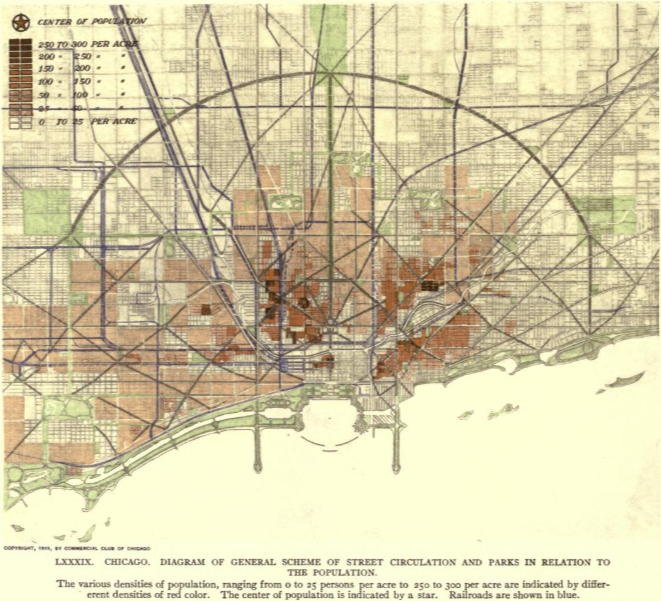
As architect Daniel Burnham is said to have said, “Make no small plans; they have no magic to stir men’s blood.” Land use planning as part of a comprehensive planning process is the answer to a practical question every community eventually faces: what goes where, and why? Not just today, but over the next ten, twenty, thirty years. Where do homes belong? Where does agriculture stay agriculture? Where does the county draw the line — and how does it hold it when someone shows up with a proposal?
The future land use map, the comprehensive plan, the zoning ordinance, the subdivision regulations — these aren’t bureaucratic paperwork. They’re the blueprint the community drew up, usually after a lot of town hall meetings and hard conversations, that says: this is the kind of place we want to be.
That blueprint gets tested one parcel at a time.
This month, we’re going to follow one proposal through the full land use framework — from the map to the policy to the code to the long-term cost — and see what happens at each step.
Here’s what’s coming every Sunday in September:
September 7 — The Future Land Use Map
First we do the land use inventory. Then we do the FLUM. The gracefully titled Future Land Use Map sets the basis for most every planning decision in your small town or rural county — and it’s the first place any development proposal gets measured.
September 14 — Ag First: How Rural Land Use Policy Protects Working Ground
In most of the places I’ve worked with, agriculture isn’t just an economic sector. It’s the land use framework’s starting point. This week is about what that means in practice — and why “Ag First” isn’t an anti-development argument. It’s a growth management strategy.
September 21 — Zoning Is a Tool, Not the Plan
Many traditional small towns weren’t built according to their own current zoning code. The pattern people call “small-town character” — houses close to the sidewalk, corner businesses, apartments over shops — is exactly what a lot of Euclidean codes make difficult or impossible. The question isn’t which zoning system is theoretically best. It’s whether your code actually implements the land use pattern your comprehensive plan says you want.
September 28 — Growth Has a Price: Who Pays When Development Sprawls?
A new subdivision outside city limits looks like new tax base. The harder question is whether anyone has calculated what it will cost the county over the next thirty years. This week, we run the growth management numbers.
Four Sundays. Four layers of the same question: are your land use decisions building the community you planned for — or just responding to whoever shows up next?
We’ll see you Sunday.
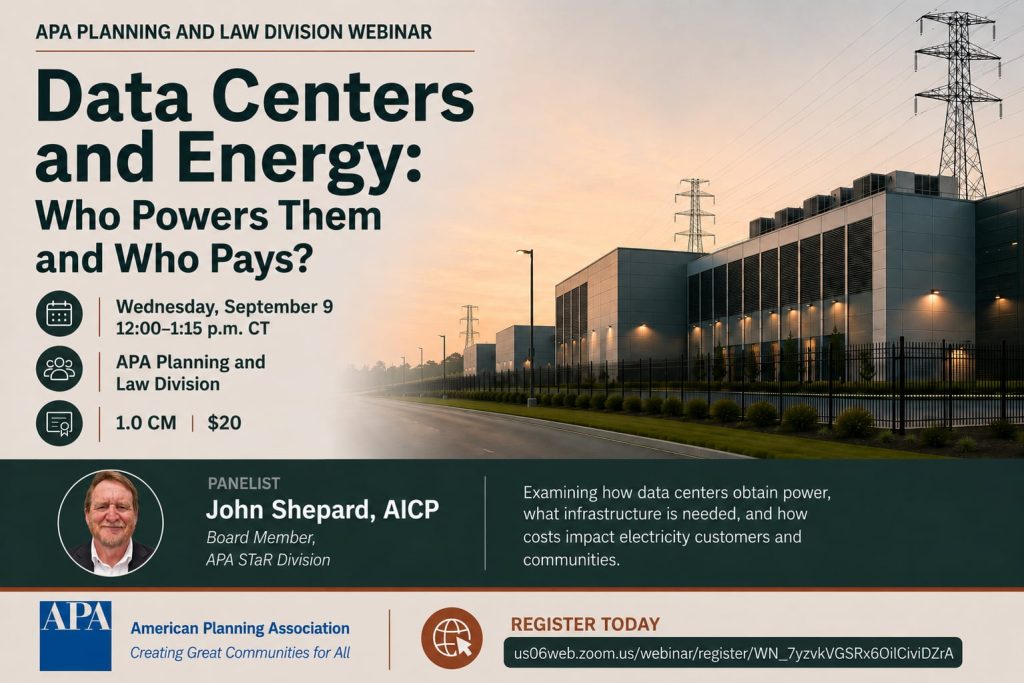
Energy generation and data centers are at the center of many local land use debates these days.
Join us on 9/9/2026 at Noon Central Time for a webinar, Data Centers and Energy: Who Powers Them and Who Pays? sponsored by the APA Planning & Law Division. I am one of three panelists:
• Ari Peskoe, J.D., Director of the Electricity Law Initiative at Harvard Law School
• Hannah Wiseman, J.D., Professor of Law at Penn State and Co-Director of the Center for Energy Law and Policy
• John Shepard, AICP (that’s me!), Board Member of APA’s Small Town and Rural Planning (STaR) Division
There is a modest fee to support the Division. Registration here: https://us06web.zoom.us/webinar/register/WN_7yzvkVGSRx6OilCiviDZrA#/registration
2026: Bring Your Plans to Life
JCShepard.com Monthly Themes for 2026
- January: An Introduction to Small Town & Rural Planning and Community Engagement
- February: Population and Housing Trends
- March: Economic Development
- April: Community Facilities / Historic Sites / Education
- May: Public Health / Parks & Recreation
- June: Communications, Utilities & Energy
- July: Natural Resources
- August: Public Safety & Hazard Mitigation
- September: Land Use (Today!)
- October: Transportation
- November: Implementation
- December: Reflections
.