
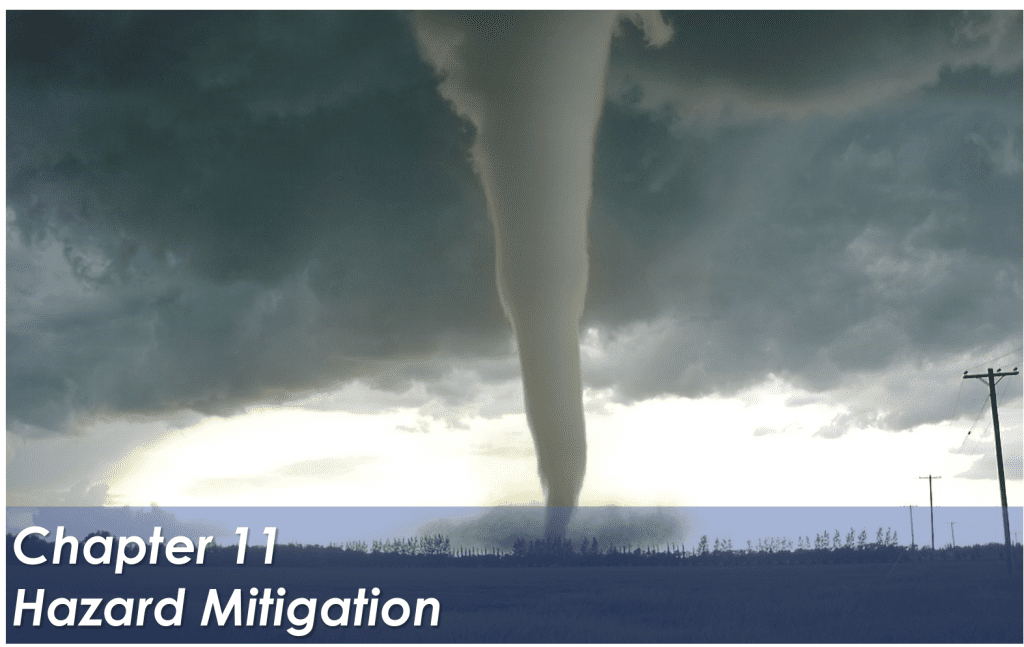
Community resilience can be greatly improved by engaging in hazard mitigation planning. In the US, Congress has passed legislation encouraging this… and making it a requirement for certain FEMA funding. Now, in early 2025, there is a great deal of uncertainty with what the new Presidential administration will do with Congressional intent. There is even talk of eliminating FEMA as an agency. That said, currently FEMA continues to do its work, even with fewer staff and resources.
Stafford Act
FEMA implements the federal Robert T. Stafford Disaster Relief and Emergency Assistance Act among other legislation. Policy guidance relates:
Community resilience is the ability of a community to prepare for anticipated hazards, adapt to changing conditions, and withstand and recover rapidly from disruptions. Activities such as disaster preparedness (which includes prevention, protection, mitigation, response and recovery) and reducing community stressors (the underlying social, economic and environmental conditions that can weaken a community) are key steps to resilience.
In the hazard mitigation process, FEMA requires review and incorporation of existing plans, studies, reports, and technical information (44 CFR § 201.6(b)(3)). Top among these are the community’s comprehensive/master/general land use plan. These may also include economic development, capital improvement plans, affordable housing, resource management, resilience and other plans. Jurisdictions with structures in a regulatory floodplain must include regulatory flood mapping products as appropriate.
FEMA requires the hazard mitigation strategy include a section which identifies and analyzes a comprehensive range of mitigation actions and project—in particular related to the jurisdiction’s participation in the National Flood Insurance Program (NFIP). There are a variety of natural and man-made hazards in any jurisdiction, yet flooding is one of the most common and one of the most expensive for the US taxpayers.
FEMA also requires local government to integrate the requirements of the mitigation plan into other planning mechanisms, such as the comprehensive plan (44 CFR § 201.6(c)(4)(ii)). The hazard plan should outline how this will be accomplished. At a minimum, the comprehensive plan should reference the hazard mitigation planning process with an update coincident with FEMA’s 5-year review cycle. More effective is incorporation of the hazard mitigation plan’s substantive data and analysis, goals, and implementation action items.

Community Examples–Archuleta County, Colorado
In the fast-growing Four Corners region of Colorado, Archuleta County (population 13,000) and the Town of Pagosa Springs (population 1,500 and the only incorporated municipality in the county) updated each of their comprehensive plans in 2017-2018. The County Planning Commission and staff worked in-house while the Town worked with a consulting firm. An update of the countywide hazard mitigation was on the agenda, so each comprehensive plan used the adopted plan with the intention to update hazard information if necessary.
The County Community Plan briefly describes high significance hazards identified in the hazard mitigation plan. It includes more detail on flood hazards, due to the growing popularity of seasonal homes along the San Juan River headwaters. Policies to mitigate hazards are included.
The Town’s Plan also includes a specific goal and action items to avoid development in natural hazard areas, and work to implement recommendations of the hazard mitigation plan. It also references Colorado’s Planning for Hazards Guide, which was newly released at the time.
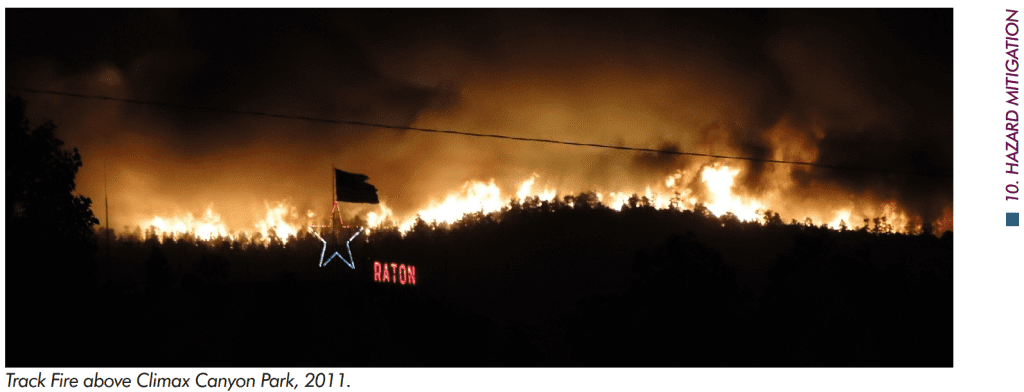
City of Raton, New Mexico.
Raton, New Mexico, population 6,000, is the county seat of Colfax County. The community has historically been a trading post at the edge of the Great Plains and Rocky Mountains at the base of Raton Pass. The mountain route of the Santa Fe Trail passed thru the pass until the railroad arrived in 1879. Raton quickly developed as a railroad, mining, and ranching center for the northeast part of the New Mexico territory, and more recently faced challenges as those industries contracted.
The city hired a consultant to facilitate the process for a new Comprehensive Plan which kicked off in 2020, right as the COVID pandemic began. Raton had previously completed a standalone Hazard Mitigation Plan, separate from Colfax County, which was due to expire in 2020.
The small city’s comprehensive plan has an entire chapter on Hazard Mitigation. It described emergency preparedness plans, including goals and actions of the then-current hazard mitigation plan. It describes existing hazards as documented in the mitigation plan, then also describes other mitigation efforts such as reducing wildfire risk in the Wildland-Urban Interface. Goals and objectives are put forth, in part as a head start on the next Hazard Mitigation plan.
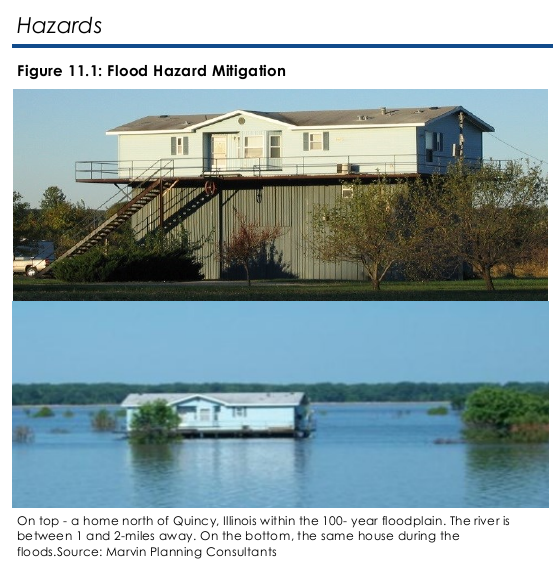
Hall County, Nebraska.
In 2022, Hall County, Nebraska, embarked on a cooperative effort to update the comprehensive development plan and zoning regulations for the county, the county seat of Grand Island, and two villages, Alda and Doniphan. Hall County, with 62,000 residents, is part of the smallest metropolitan area in Nebraska, with a lot of very rural land, including farmland and floodplains along the Platte River. The village of Alda has a population of about 600 and Doniphan has about 800.
The Hall County Regional Planning Commission hired a consultant to facilitate the planning process. Working with county and village staff, they drafted plans for each jurisdiction with a chapter dedicated to Hazard Mitigation. Nebraska has a unique system composing regional hazard mitigation plans with the Natural Resource Districts (NRDs). The Central Platte NRD Hazard Mitigation Plan was updated in 2022, so offered fresh data and analysis for the community planning process.
The village plans mirror text and data from the county plan, much of which is taken verbatim from the regional NRD plan. However, the mitigation strategies in the regional plan are unique for each participating jurisdiction, which is reflected in the local comprehensive plans. Each plan does go into some more detail on Floodplain Administration, which is coordinated through the Regional Planning Commission, due to the close relationship with land use and zoning. Goals and actions specifically focus on implementing the regional NRD hazard mitigation plan, as well as updating the comprehensive plan when FEMA requires any updates. Hall County, the City of Grand Island, and the Village of Alda and Doniphan adopted their new comprehensive plans in December, January, and February 2025.
Summary
There are a variety of ways to integrate hazard mitigation planning and comprehensive planning to become more resilient. Planners need to participate in both, as do emergency managers. And the plans need to be implemented, not just sit on the shelf until the next update rolls around. And let’s be careful out there, it’s a hazardous world we live in.
Resources
FEMA, Local Mitigation Planning Policy Guide, FP206-21-0002 (2022)
Colorado Planning for Hazards: Land Use Solutions website.