

By Bob Shepard
County Fair Memories in Rural Michigan
I remember the Shiawassee County Free Fair as a great gathering of rural folks with many youth bringing the culmination of their 4-H projects to be judged, whether they were of blue, red, or white ribbon caliber or even grand champion worthy. The county fair had the grandstand with a variety of entertainment acts, somewhat less exciting than the touring circus acts, and of course, the midway where thrilling rides like the tall Ferris wheel dared the public to be scared. Corunna is the county seat and, along with its sister city, Owasso, had the largest population in the county (about 10,000 in 1960). It was called the Free Fair because there was no admission charge, but it did cost $2.00 to park a vehicle.
There was never any question about whether I would participate in 4-H projects. It was just assumed that of course, I would. That was what farm kids did, and both of my older brothers did. My eldest brother, Don, did really well showing dairy cattle and market hogs. He was able to take his best cow and best group of market pigs to the State Fair in Detroit, then sell the pigs for significant money. Brother Vic didn’t do as well at the fair, but he sure enjoyed spending time with his friends there.
My First Calf and a Hard Lesson
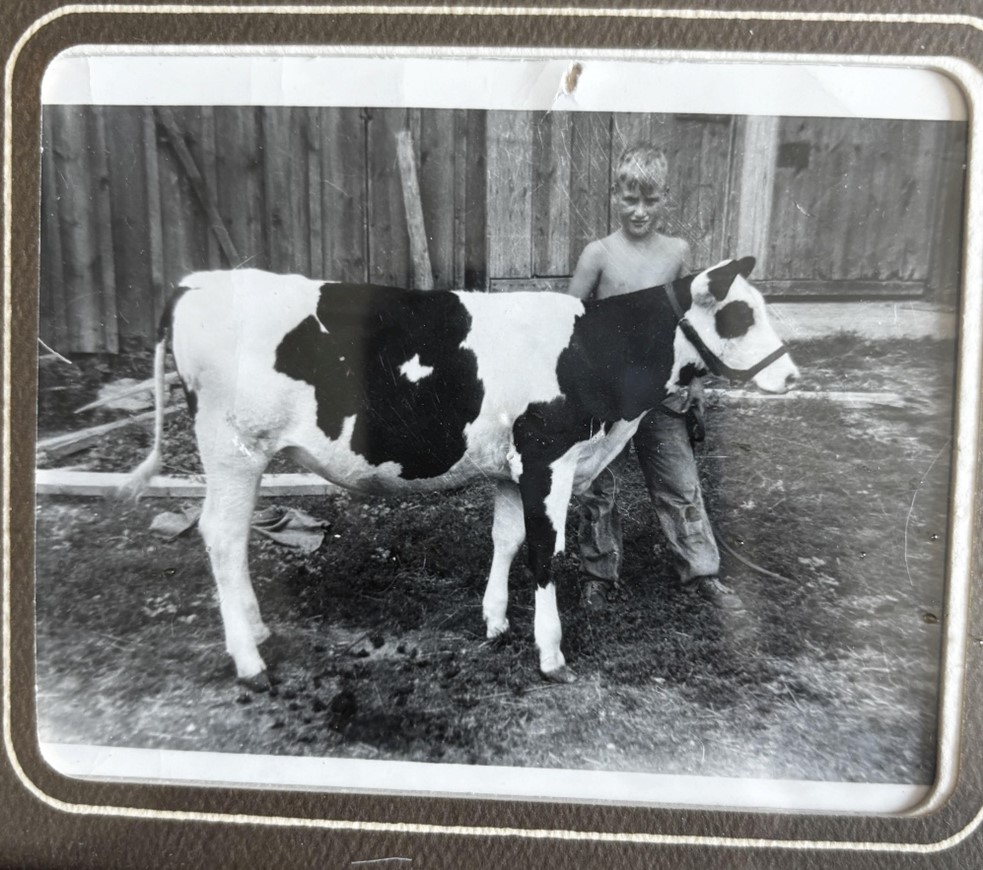
My first experience with showing a dairy calf did not turn out so well. Dad helped me choose a young calf that had a good prospect of being awarded a blue ribbon. Young dairy animals are judged on the straightness of their backs, the structure of their legs and hooves, and the width and depth of their chest. A mature dairy cow would also be judged on their udder capacity and both rear and front attachment to its body. It was customary for beginning 4-Her to start with a young calf, which is what I did.
The most critical skill in showing animals in a competitive event is to train them to respect and respond to a halter. An animal’s natural inclination is to resist being constrained by a halter. During the winter months, the 4H club leader would teach us how to plan rations for the project animal so that it would have a shiny coat, and we also learned how to weave a halter out of a length of rope. In late April or May, I began training my calf by placing the rope halter on its head and leading it around the farmyard. It was important that the calf learned to place its feet just so- front feet firmly under the front of the chest and the back feet placed with the right leg ahead of the left. When the animal matured, the placement of the rear legs would show the udder attachments.
My calf was responding well until one day in July, when I found it in its pen lying down with its head pulled tightly against its chest. I nudged the poor animal with my knees, trying to get it to move, to no avail. We called our veterinarian, who diagnosed the calf with a fatal brain tumor. And I was left without a show animal. Dad and I quickly selected a replacement calf, which I attempted to train. Unfortunately, the calf resisted the halter training, and we ended up in last place in the class of about 20 calves. Dad was not happy, and neither was I.
Holstein Association USA
From Grade to Registered: A Turnaround with Lindy
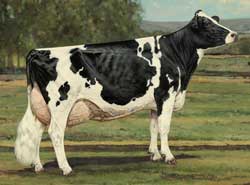
In the dairy cattle world, there is a distinction between animals with a recorded pedigree and those more common which we have never tracked their ancestors. Those who have a pedigree are called registered, and those without are referred to as grade. In the Holstein world (mostly black and white), the animals were registered with the Holstein-Friesian Association in Brattleboro, Vermont. Nearly all the cows on our farm were grade cattle, as the registered cattle cost more, and Dad wasn’t too keen on maintaining the breeding records. He kept milk and butterfat production records for each mature cow. That may have been because, at one time, Dad was a milk tester. In fact, that was how my mom and dad met. The milk tester would stay overnight at the dairy farm once a month so he could weigh each cow’s production and test for percent butterfat for both the evening and morning milking. He stayed overnight at my grandparents’ farm in Berrien County, Michigan, and walla, my mom and dad got together. (That does not imply any inappropriate behavior on their part.)
The summer after my grade calf placed last in her class, Dad bought a beautiful registered calf with a notable pedigree. Her name was Lindy. She was mostly black and had a desirable body structure. Dad was determined that I would not place last again. The first year I showed her at the County Fair, she was placed first in her class with a Blue ribbon. The second year, we received another blue ribbon and reserve grand-champion.
Showmanship, Success, and a Lasting Lesson
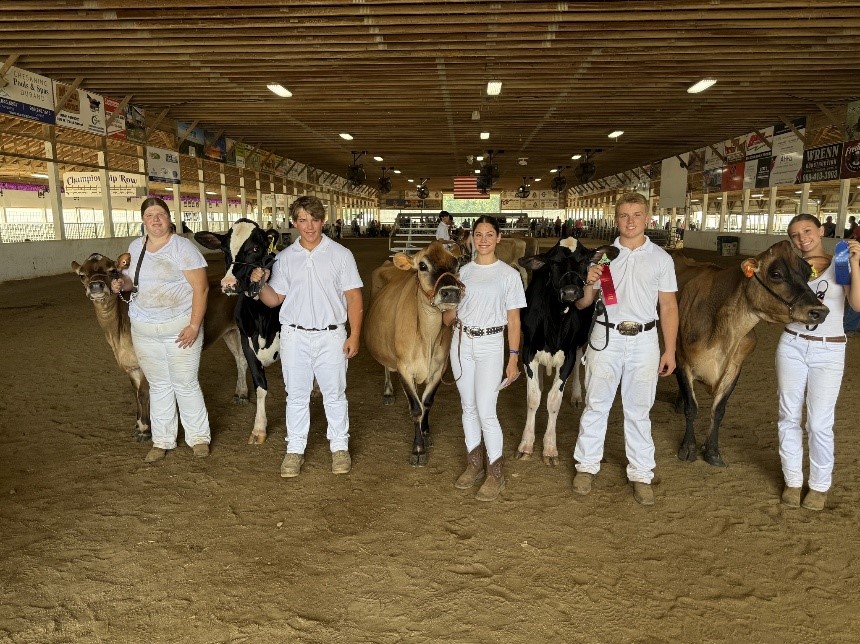
There was another competition at the County Fair called showmanship. In this group the 4-Her’s skills in training and presenting the animal were judged. Of course, the first year with the calf I hardly had a chance to work with, we received a White ribbon. But with Lindy, it was just the opposite. I was awarded another blue ribbon for my showmanship skills.
As Lindy grew into breeding age, she had mostly bull calves and maybe one heifer. She didn’t increase my herd much, but I enjoyed having an animal that did well at competition in succeeding county fairs.
At the Shiawassee County Fair, I experienced the disappointment of being judged with a calf of poor quality and for having poor showmanship skills. I also experienced being judged as one of the best in both categories. Perhaps that experience set the stage for me to always want to do better than most at whatever I took on.
Bob Shepard grew up on a family farm in Michigan. His is retired from a career with Farm Bureau.
Editor’s note: This year on jcshepard.com, we’ve spent a good amount of time on rural cultural preservation—emphasizing how traditions, stories, agricultural practices, and heritage tourism shape the resilience, sustainability, and vibrancy of rural communities. We have worked on highlights on the power of agricultural heritage, the role of youth and intergenerational learning, and the practical value of maintaining living traditions rather than merely honoring them as artifacts of the past. Today’s guest post is a personal reflection from the Shepard family.
Editor’s note: To learn more about the history, government, and community events of the area, visit the official site at shiawassee.net
If you enjoyed this story, you might also like:
- Secrets of the Land: How Rural Traditions Shape Stronger Communities
Exploring how family farming, folk practices, and intergenerational learning help rural communities thrive. - The Power of Heritage: Fueling Rural Identity and Growth
Why heritage is more than history—it’s the foundation of local pride and rural prosperity. - Saving Rural Identity: How Old Buildings Shape Strong Communities
A look at how preserving rural architecture helps sustain both culture and community.
