
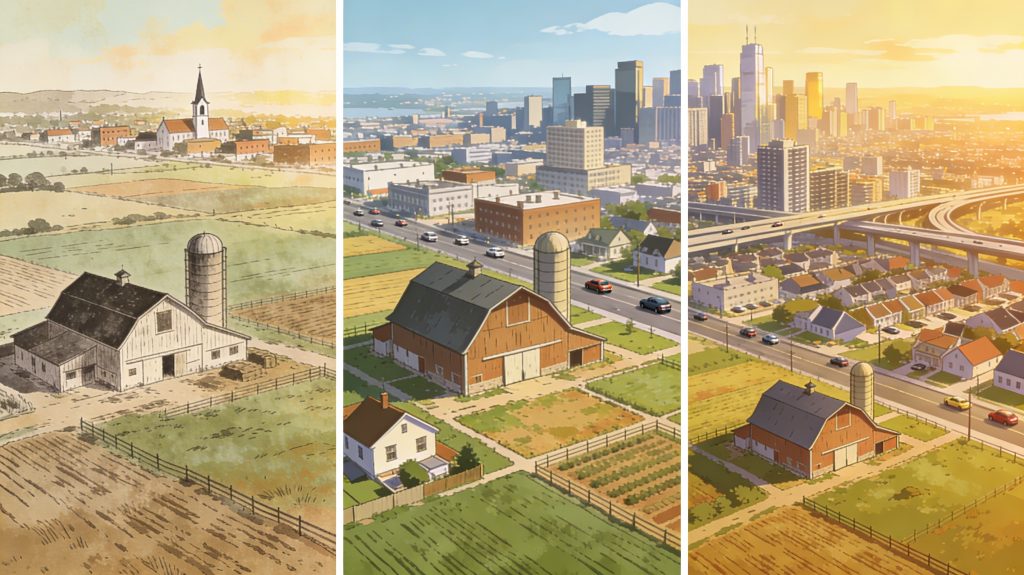
Through the years, the United Kingdom and the nations founded by the British Crown have followed some similar trends in urban and rural development. While each country has unique natural resources and development patterns, the share of people living in rural areas has contracted as people move to the cities for jobs and housing. It’s been going on for a long time.
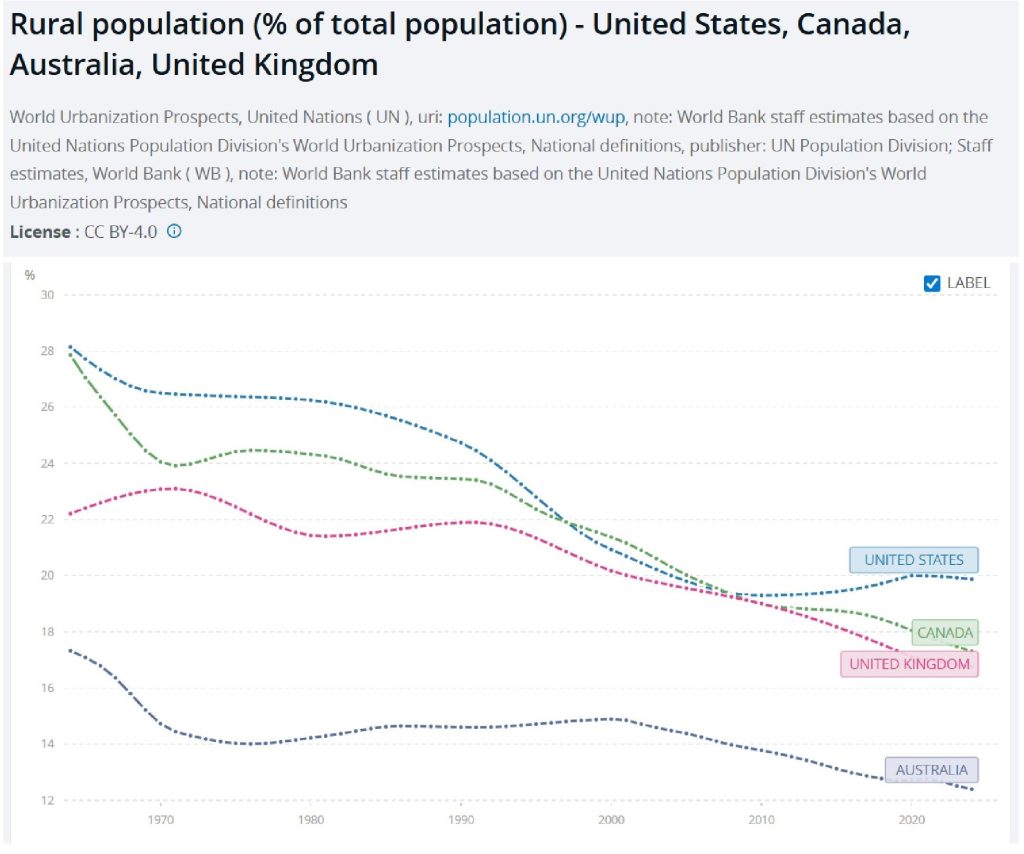
Back in 1960, 21% of the United Kingdom’s population lived in rural areas (as defined by that nation and tracked by the World Bank). Canada was 31% rural, and the United States was close at 30% rural. In the Pacific, Australia’s rural share was lower at 18%. These proportions dropped precipitously until the early 1970s, except in the UK where the share of rural population peeked at about 23% at that time.
Rural population was fairly stable in all three nations through the 1970s and 1980s. The US rural population stayed about 26% through the 1970s, dropping to 25% by 1990. Canada stayed at 23-24% rural through 1994. The UK also stayed at about 22-23% rural through 1994. Australia, on the other hand, was stable for a longer period of time at 14-15% through 2012.
We’ve seen rural populations in the four countries converge around 2010 then diverge again. The most recent estimates show the US at 16.5% rural population in 2024, Canada about 18.0%, the UK at 15.1% and Australia about 13.1%.
Follow the Head Count
Yet below that trend line, the absolute number of rural residents has grown, even as areas are reclassified from urban to rural. Here in the United States, for example, the rural population has expanded from over 54 million in 1964 to 67.6 million in 2024. Canada’s rural population hit low ebb at 5.2 million in 1971 then grew to 7.4 million by 2024. Australia’s rural population grew from 1.9 million in 1964 to almost 3.4 million in 2024.
The UK, though does run counter to the colonial trend, with rural population peaking at 12.8 million in 1971, falling throu 1981, recovering to about 12.5 million by 1991, then falling precipitously since 2001 to about 10.5 million in 2024 (as reported by Statbase.org).
It’s a good idea to benchmark our communities—what gets measured gets done, they say. Take the measure of your measures and make a mark of their context.
Data source: World Bank Open Data https://data.worldbank.org/.
We’ve spent February discussing demographics and rural housing. If you found this post first, check out the long-reads:
- Demography is Destiny… Except When It Isn’t (1 February 2026)
- Who Can Afford to Live Rural? Global Pressures on Small-Town Housing Markets (8 Feb 2026)
- Rural Housing Supply Crisis: Why Small Towns Are Running Out of Homes (15 Feb 2026)
- Rural Housing Futures: Policy Tools for Livable Small Towns (22 Feb 2026)
.
