Despite a slight rebound from October’s five‑year low, Creighton University’s latest Rural Mainstreet Index report shows the Midwest & Northern Rockies heartland still mired below growth neutral, with weak grain prices, soft ag land values, and cautious rural bankers keeping recession risks elevated.
November’s RMI: Off the Floor, Still in the Red
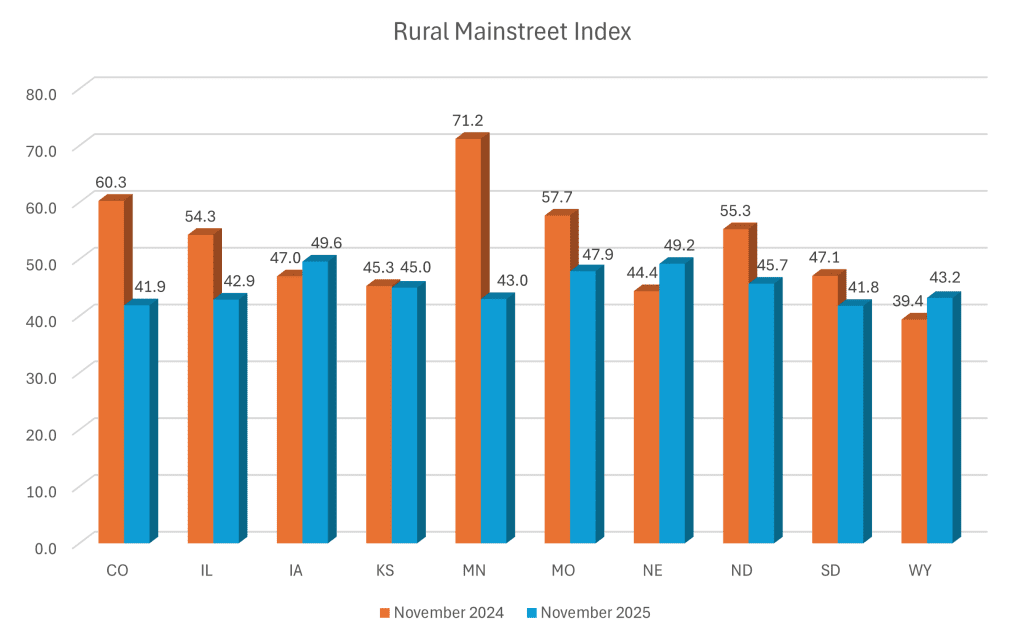
The Rural Mainstreet Index covers 10 states from Illinois to Colorado, focusing on 200 rural communities with an average population of 1,300. The October 2025 RMI reading of 34.6 marked the weakest level since May 2020 and the eighth month this year below growth‑neutral 50.0. In November, the index bounced to about 44.0, better than October’s shock but still below 50 and counted as the ninth time in 2025 the region stayed on the contraction side of the line.
Ernie Goss, Regional Economic chair at Creight, explains the RMI continues a familiar story: weak grain prices, higher costs, and nervous lenders. Roughly one‑third of surveyed bank CEOs now describe their local economy as in recession, and a clear majority expect recessionary conditions sometime in the coming year.
As Jeff Bonnett, president of Havana National Bank in Havana, Ill., to Business Record: “In talking with our small business owners on Main Street in the communities we serve, the stories are all the same: customers are struggling with tight cashflows so their business suffers. This is a reality throughout rural America here in the Midwest. We are in an ag crisis and relief is needed. No business can survive operating at below breakeven for two to three consecutive years. Capital and cash reserves are almost depleted for many farm operators.”
While the overall index was still in sorry shape, the numbers improved year-on-year in Iowa, Nebraska, and Wyoming, all strong livestock states.
Land, Credit, and Equipment: Slow Grind
Farmland and ranchland values remain under pressure, with Creighton’s farmland price index below growth neutral in 18 of the last 19 months. October’s land index was 37.0, down sharply from September’s mid‑40s, and November readings suggest continued softness rather than a rebound.
Farm loan delinquencies are still low in absolute terms but have risen from just over 1% in mid‑2025 to the mid‑1% range this fall, a noticeable move for conservative rural portfolios. Farm equipment sales remain the tell: the equipment‑sales component has been stuck in contraction territory for more than two years, with only minor month‑to‑month improvement from very depressed levels.
Bankers’ Sentiment and Rural Recession Talk
The confidence/expectations gauge in the RMI has been mired in the 30s on a 0–100 scale, well below the 50 mark that would indicate neutral sentiment about the next six months. Survey commentary from across the 10‑state region increasingly uses the language of “ag crisis” and “rural recession,” even as some individual states report slightly better short‑term numbers than the regional average.
That tension matches what many of us see on the ground: strong balance sheets coming out of the 2022–23 crop price run‑up, but cash‑flow statements that are getting harder to pencil as commodity prices fall faster than input costs. The RMI is capturing that shift from discomfort to real stress.
What This Means for Rural America
The RMI provides a valuable recent snapshot of the regional economy since many state-level economic statistics are delayed (or were not collected) during the Federal government shutdown. The most recent full state unemployment snapshot is August 2025 from the Bureau of Labor Statistics’ State Employment and Unemployment (LAUS) program. In that release, the national unemployment rate was 4.3 percent, little changed over the month and from August 2024. South Dakota (1.9%) and North Dakota (2.5%) in the RMI had the nation’s lowest unemployment rates at that time.
Taken together, the October plunge and November’s partial rebound suggest a rural Midwestern economy that is fragile rather than collapsing. For local leaders and lenders, the signals are pretty clear:
- Assume continued pressure on grain‑dependent operations and the Main Street businesses that serve them.
- Watch ag land, delinquencies, and equipment orders as early‑warning lights for deeper distress.
For rural leaders across the US this is another reminder that resilience work—diversifying local economies, backing value‑added ag, and broadening the tax base beyond commodity cycles—is not a side project; it is the work.
.