
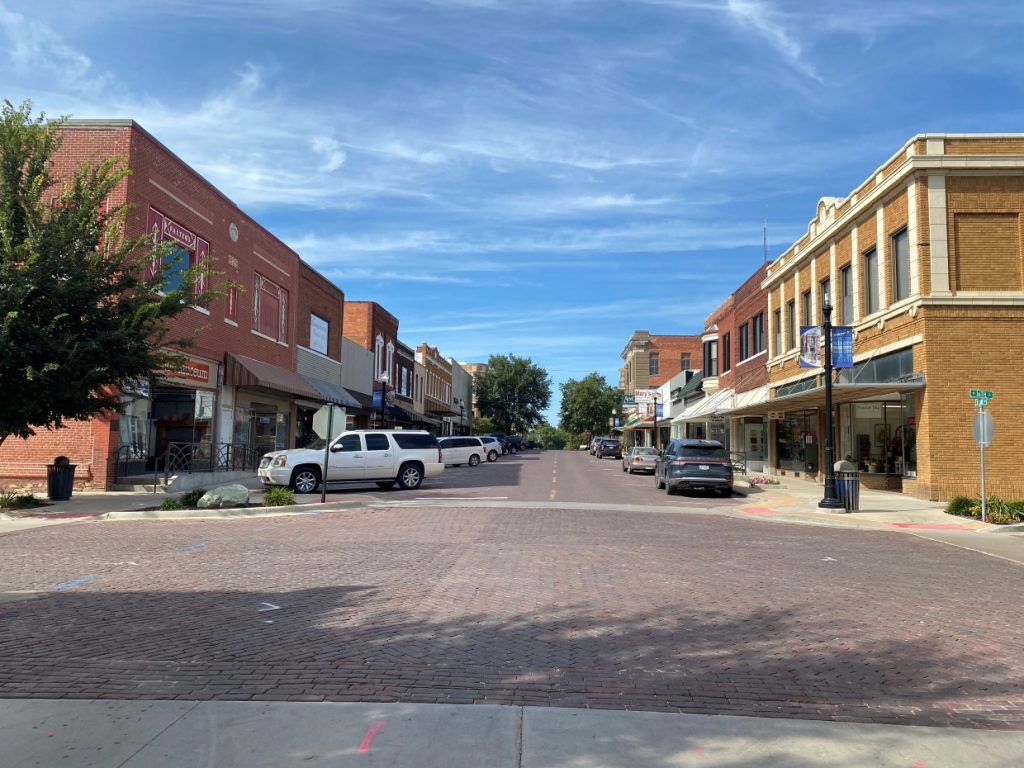
Downtowns are enjoying a renaissance as the malls across suburban America shrivel up and get bulldozed by the dozens.
It wasn’t so many years ago the big legacy department stores like Sears and Wards fled downtowns for the malls. Now those stores are no more—replaced in turn by Amazon and its online copycats—while the authenticity and character of Main Streets draw shoppers back to small town and city centers.
The National Trust for Historic Preservation’s Main Street program has had a lot to do with that revival in communities across the country. No revitalized as Main Street America, this preservation-based downtown revitalization movement helps core commercial districts rebuild their economies while keeping their historic character.
A pilot program in 1977 tested the Main Street model in three towns—Galesburg, Illinois; Madison, Indiana; and Hot Springs, South Dakota. This lead to creation of the National Main Street Center and a national demonstration project in six states. Today, the program operates as Main Street America, an affiliate of the National Trust.
The Main Street program promotes “place-based economic development,” pairing historic preservation with practical business and marketing strategies. The Main Street Approach, as it is known, helps communities identify local assets, define a competitive niche, and organize revitalization work around clear goals and strategies.

This approach is organized around the Four Points:
- Design: Enhance the appearance of downtown through public/private partnerships
- Organization: Bring development and preservation groups together
- Promotion: Market historic downtowns as a group
- Economic Vitality/Restructuring: Strengthen and adapt to changing economies
Communities typically join though state or coordinating Main Street programs, which provide training, technical assistance, and standards based on the tested Main Street Approach. Local success depends heavily on community leadership and participation. My own observation of early successful programs found they commonly had broad-based community support, clear continuity in operations, a knack for dealing with political flux, and sometimes, well, just good timing.
According to Main Street America, these efforts have helped to generate over $115 billion in local reinvestment, rehab almost 346,000 buildings, create about 816,000 new jobs, and start over 180,000 new businesses in over 2,000 communities. Here in Nebraska, for example, Downtown Grand Island’s Railside Business Improvement District participates in the Main Street America program. Other participating communities here range from Geneva with a population just over 2,000 (and a really great library) to Falls City (featured on the Christmas 1946 cover of the Saturday Evening Post) and the Elkhorn neighborhood in Omaha, the largest city in the state.
Downtowns don’t come back by accident. They find new life because people remember that real places matter, and because local leaders like you roll up their sleeves and do the slow, often unglamorous work of putting Main Street principles into practice. When a community invests in its historic core, it creates the kind of walkable, memorable, stubbornly local downtown no mall or algorithm can duplicate. That’s the quiet power of Main Street America, and it can be the power of your Main Street too.
Resources
I will be speaking at the Inland Northwest Partners Summer Meeting coming up on the 9th of July on the EWU Campus in Cheney, Washington, on measuring success on Main Street. Registration info here: https://inwp.org/events/
Books
- Main Street’s Comeback: And How It Can Come Back Again by Mary Means (BookBaby, 2021)
- Revitalizing Main Street: A Practitioner’s Guide to Comprehensive Commercial District Revitalization, Andrea L. Dono, ed. (National Trust Main Street Center, 2009)
- Keeping Time: The History and Theory of Preservation in America, 3rd edition (Wiley, 2008)
(As an Amazon Associate, we may earn commissions from qualifying purchases. Check your local library or local bookshop, too.)
.
1 Comment
The Nebraska State Historical Society explained a bit about John Falter’s “Christmas in Falls City” original painting.
https://history.nebraska.gov/christmas-in-falls-city/