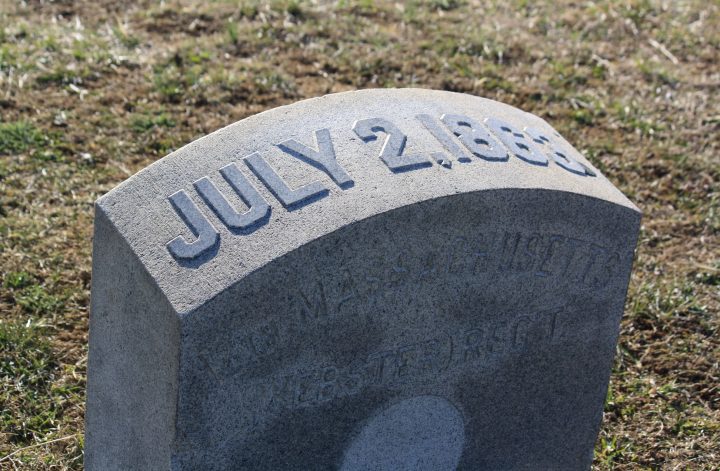

I treasure the time I lived and worked in Colorado. Fort Collins, remains one of my favorite cities anywhere, with the state capital of Denver close behind it. My grandmother lived with her cousins on the West Slope of Colorado for a time before she married, and I feel I inherited her memories in my bones. Even though I’ve moved back to the Great Plains, I feel I am as much a Coloradan as anything.
Yet what does it mean to be “Coloradan”? Our historic sites help answer that, or at least give us clues.
The State Historical Society of Colorado (aka Colorado Historical Society) was founded in 1879. In 2008, the society adopted the name “History Colorado“, indicating a change in direction from the traditional presentation to the NEW and IMPROVED interpretation of history. I myself am not a fan of woke history, nor the recent direction of academic historians, so I understand some of President Trump’s crackdown on redefining history in federally-funded programs. Yet I also realize history reflects reality, and we can’t understand history without studying many different perspectives of real-world events.

The “new” History Colorado Center opened in 2012, but I only recently visited for the first time while in Denver for the National Planning Conference. From 1976 to 2010, the previous Colorado History Museum shared a block with the Colorado Judicial Complex. The new museum is located a block south at 1200 Broadway. I used to ride my bike right past here on my way to and from classes back in the 1990s.
That change from the Historical Society to “History Colorado” reflects a lot of the changes in Colorado overall. The Colorado my grandmother’s cousins grew up in in the 1920s and 1930s was a lot different than the Colorado I moved to 60 years later. The Colorado I visited this month is a lot different from the Colorado I visited 35 years since graduation.
Telling Stories about how we became “Colorado”
History Colorado is telling the story of the land and the people who lived in Colorado before it was “Colorado”. They are telling our story when we became “Colorado” and times since as territory and State and as an idea. As early as 1541, Spanish explorers may have reached what is currently Colorado from their expeditions to the Tiwa pueblos along the Rio Grande River, where they were met by many tribes inhabiting this area for some time.

History Colorado tells a story about the Ute tribe of Native Americans. The Ute did not always live here, but they lived here the longest of which we know. They tell the story of miners and tribal leaders and US government agents. They tell the story of the Southern Ute Reservation, which takes up about 1/3 of Archuleta County where I worked and lived in Pagosa Springs. The tell about Ute Mountain Reservation and Mesa Verde.
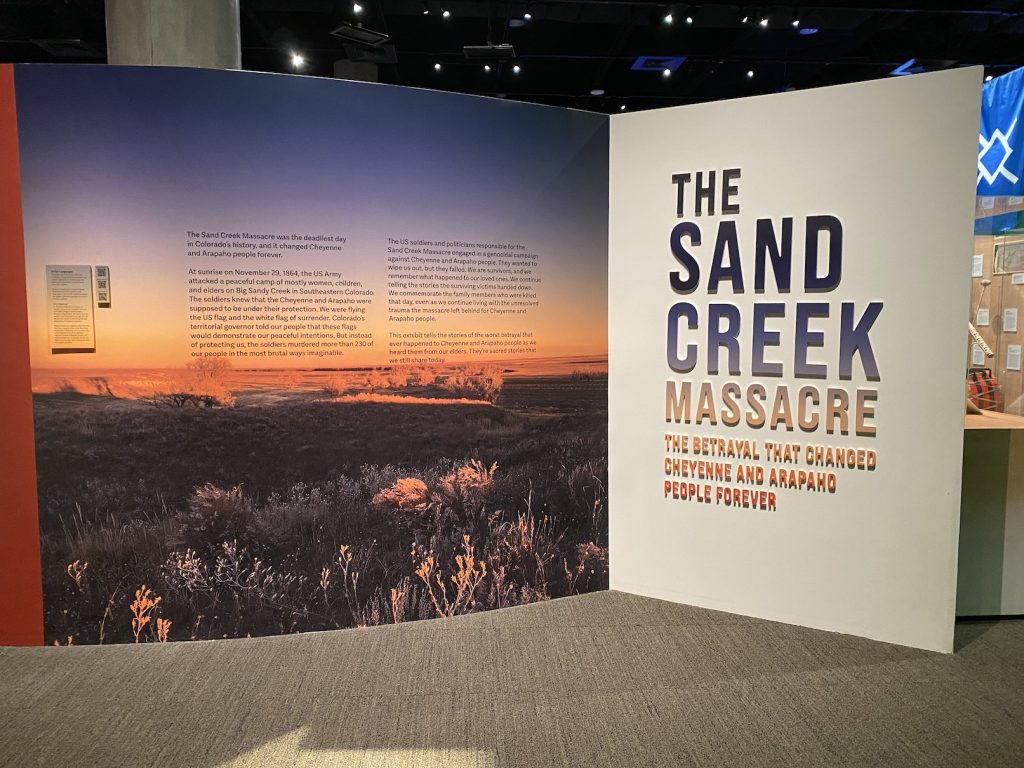
The tell about the other Ute tribes and the Plains tribes and the lies and double-ealing of US government agents and leadership. Many of the men who risked life and fortune to settle the West were also cruel and bigoted individuals who committed atrocities in the name of progress. The exhibit on the Sand Creek Massacre turned my stomach. Colonel John M. Chivington led about 700 U.S. volunteer soldiers on Nov. 29, 1864 to a village of about 500 Cheyenne and Arapaho camped along the Big Sandy Creek banks in southeastern Colorado. While the Cheyenne and Arapaho peoples thought that they were under the U.S. Army’s protection, Chivington’s troops targeted and killed more than 150 civilians, mostly women, children, and the elderly.
You don’t need to be “woke” to see the deceit and dishonor of our forefathers in Indian Country. That said, we cannot erase history–we can only learn from history.
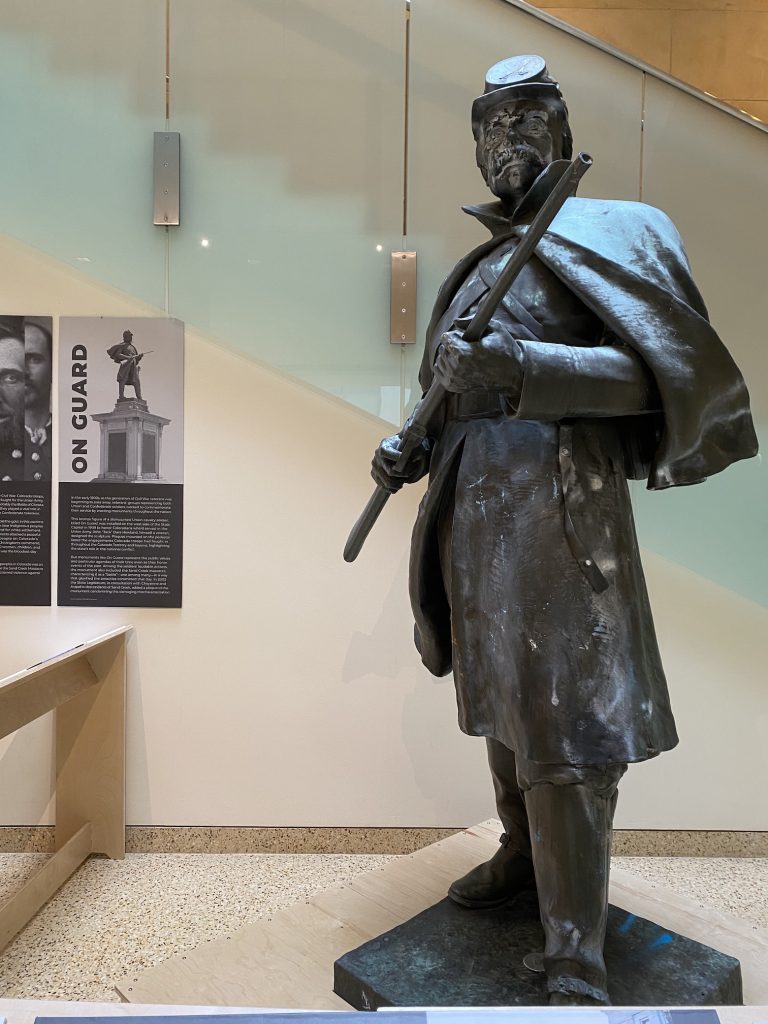
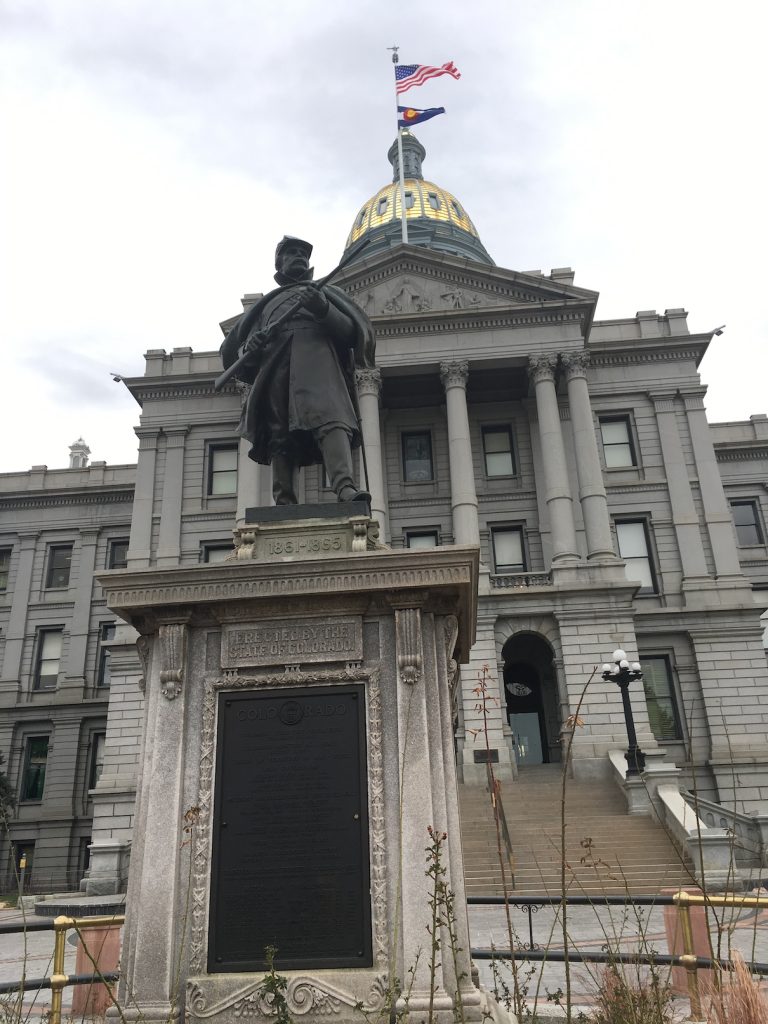
The statue “On Guard” was installed on the west side of the Colorado State Capitol in 1909, to honor Coloradoans who had served in the Union Army during the Civil War. Colorado veteran Jack Dare Howland designed the sculpture. The statue stood On Guard until protestors illegally tore it down during Black Lives Matter protests in 2020. This statue, honoring veterans of our most horrible war, became a rallying point for atrocities at Sand Creek and other places.
The Centennial State in 100 Objects
The Colorado History Center also has many other exhibits which are less political, if no less thought provoking. One exhibit on the Third Floor presented the Centennial State in 100 Objects.
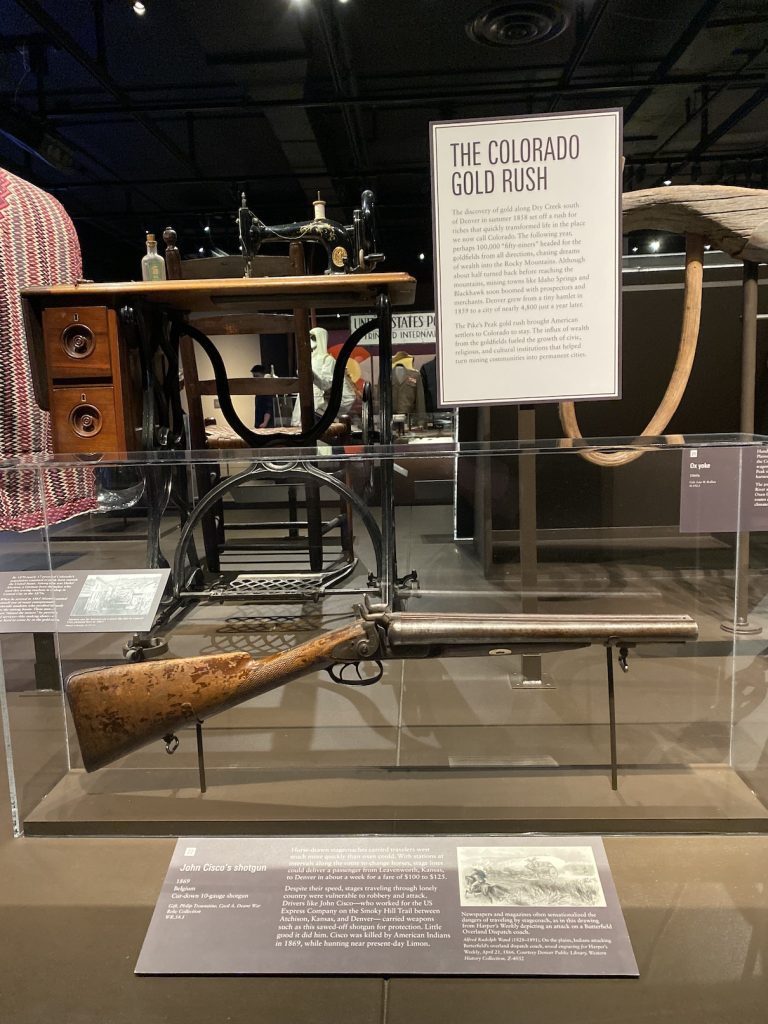
Among these were Old West shotguns and pistols.
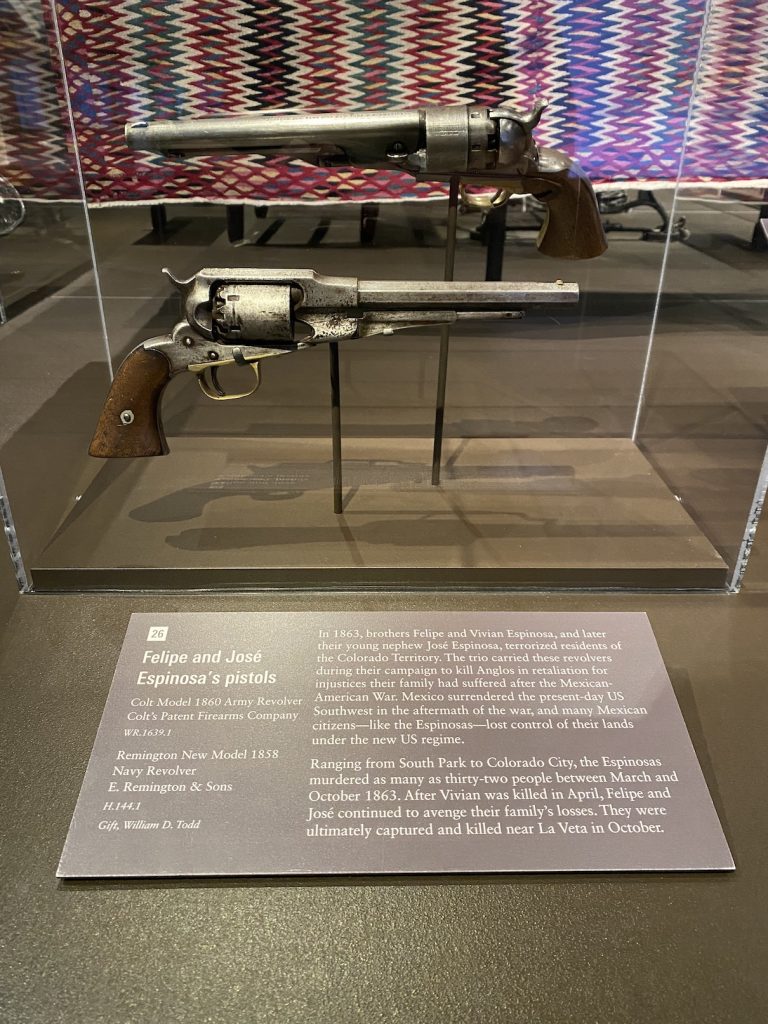
#26 presented pistols belonging to outlaws Felipe and José Espinosa, a Colt Model 1860 Army Revolver and a Remington New Model 1858 Navy Revolver. Their story reads stranger than fiction–it would make a blockbuster Western if it hasn’t already.
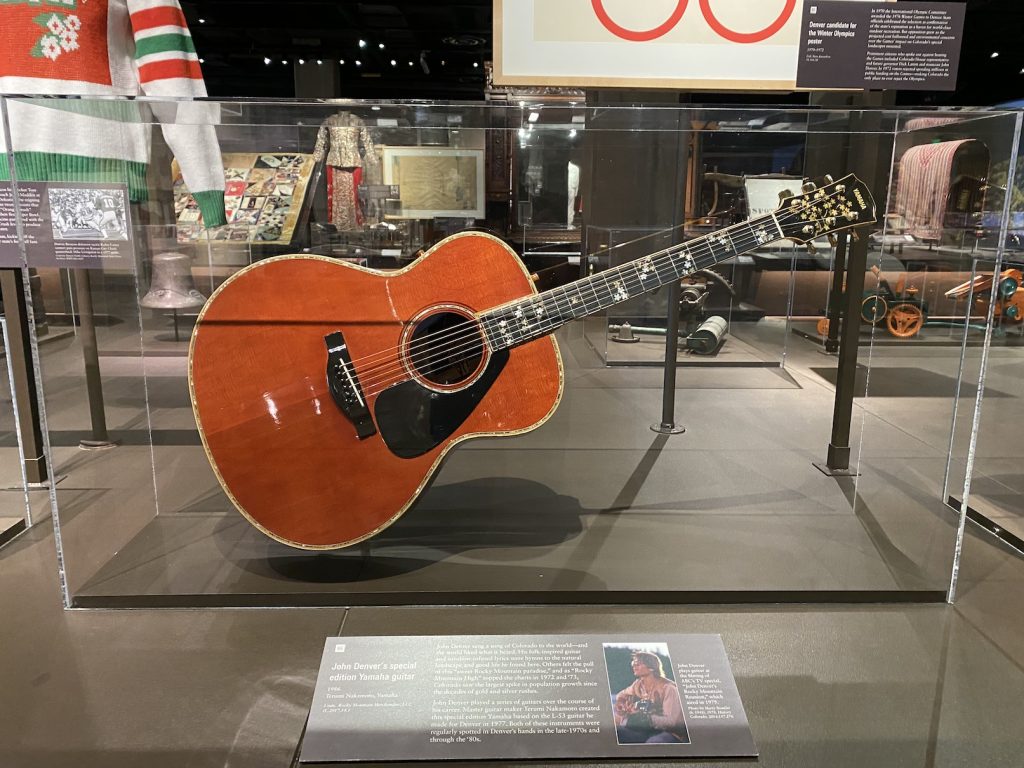
The exhibit also had, later along the timeline, one of John Denver’s guitars. The special edition Yamaha was crafted by Terumi Nakamoto in 1986.
Condi Rice and Temple Grandin
Among the many individuals honored among the displays, I took particular note of Condoleeza Rice and Dr Temple Grandin.
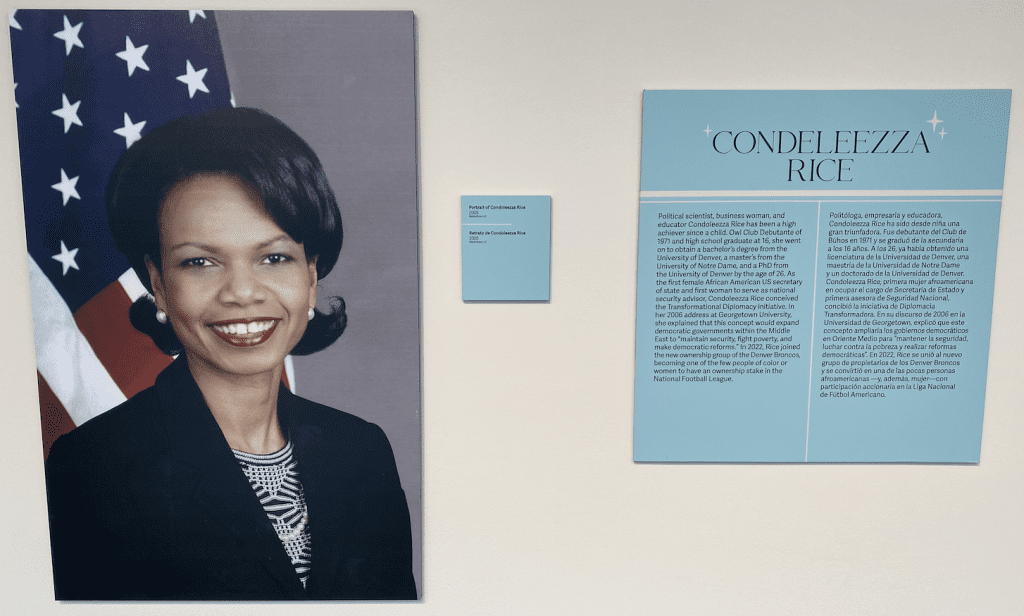
Condoleezza “Condi” Rice was born in Birmingham, Alabama, then earned her bachelor’s degree at the University of Denver. The went to grad school at Notre Dame before returning for her PhD from the School of International Studies at the University of Denver. She went onto become US Secretary of State and national Security Advisor. The Owl Club of Denver, of which she was a member, was created to recognize the academic excellence of young African American women in Denver.
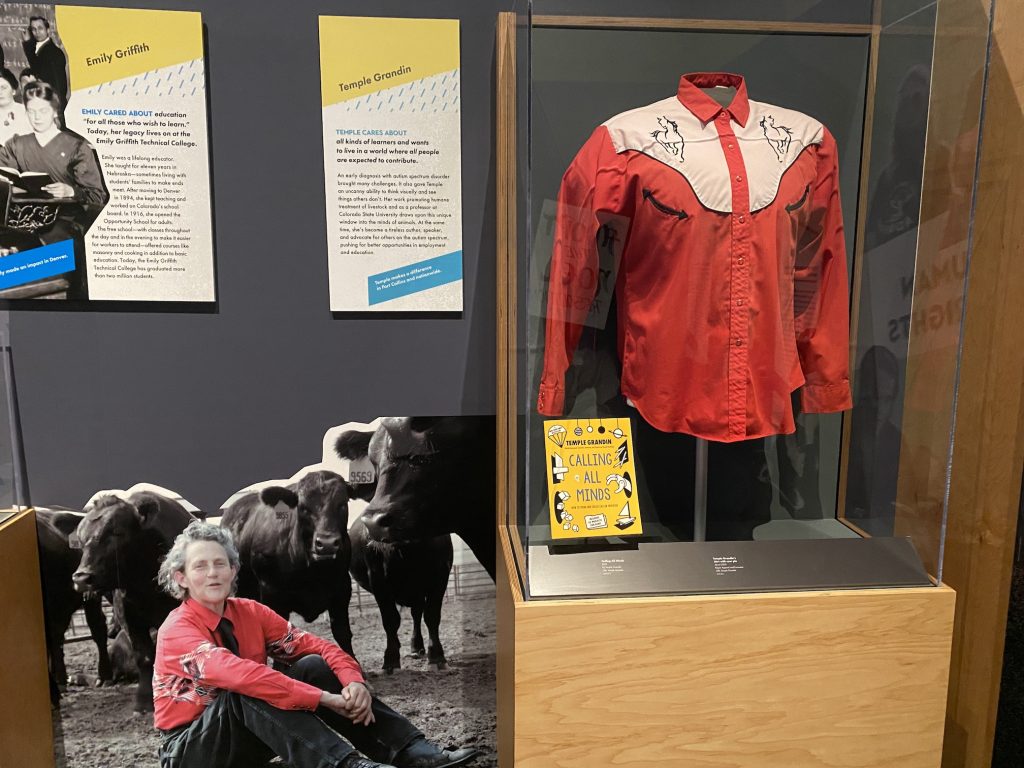
Dr. Mary Temple Grandin is a professor at Colorado State University, researcher, and inventor, prominent in the study of humane treatment of livestock. Grandin is also an advocate for autistic people and neurodiversity, all along the spectrum. Actress Claire Daines starred in a semi-autobiographical movie in 2010, based on Grandin’s life. She is also known for her Western shirts.
History Colorado also has several other museums and historic sites across the state.
Times change
Colorado is no longer the state which voted for Wendell Willkie and Thomas E. Dewey over Franklin D. Roosevelt in 1940 and 1944, or Richard Nixon over John F. Kennedy in 1960. It is not the state which voted for Nixon again in 1968 and 1972; Gerald Ford in 1976; Ronald Reagan in 1980 and 1984; and George H.W. Bush in 1988. It is not the State which voted for Bob Dole in 1996, and George W. Bush in 2000 and 2004. Colorado was a “purple state”–a leave-me-along Libertarian state where the ranchers and the ski bums usually got along to get along. But as the Colorado History Society changed to History Colorado, Colorado’s purple washed out and the state has voted solid Democrat since 2008. There are inholdings on the eastern Plains and in pockets of the Mountains, but Colorado is no longer the Colorado I moved to in 1990.
Life goes on. And I believe History Colorado has done a pretty good job keeping up with the times. It’s worth the price of admission to learn a bit about the Centennial State and those of us who have called Colorado home.
Remember When
- Telluride, Bluegrass, and the Cross of Gold – Musings on William Jennings Bryan and the history of roots music and Colorado.
Books
- Colorado: A Historical Atlas, by Tom Noel and Carol Zuber-Mallison.
- Colorado: A History of the Centennial State, by Carl Abbott, Stephen J. Leonard, Tom Noel
- Denver: Mining Camp to Metropolis, by Steve Leonard and Tom Noel (out-of-print but worth it).
(As an Amazon Associate, I earn from qualifying purchases.)