

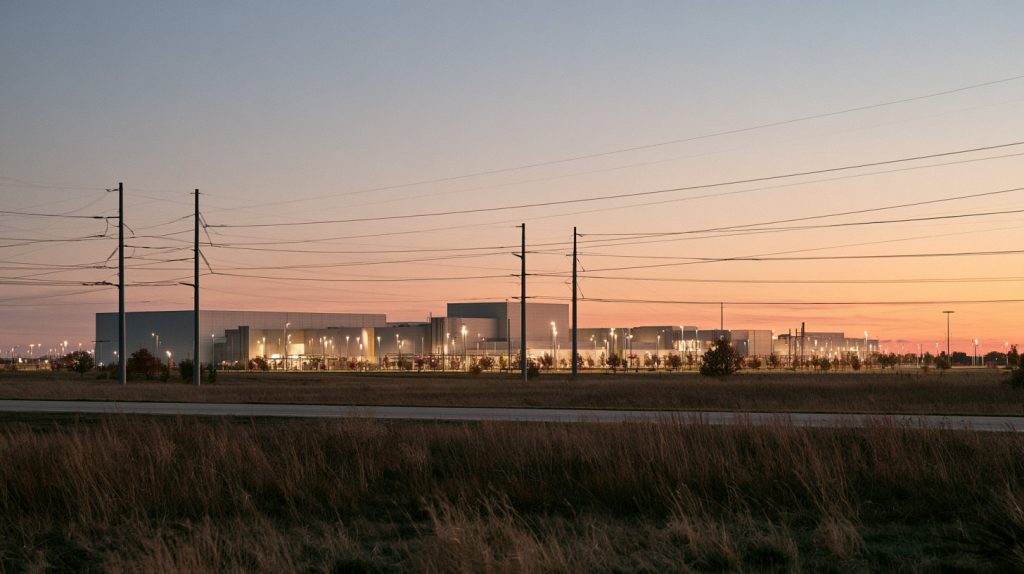
At the edge of a section of irrigated ground on the Great Plains, you can sometimes see the history of a decision. A center pivot that ran a full circle for thirty years now stops short and backs up. Its wheel tracks end where a new set of steel transmission poles crosses the field. Two miles away, behind a temporary chain-link fence, cranes are raising a building as long as several football fields on land that grew corn the summer before. Nothing in that scene is illegal or unusual anymore. It is simply what the rural energy revolution looks like from the fence line, and in the twelve months since I first wrote about it, scenes like this have become more common and the stakes behind them have grown.
Last October, I argued that artificial intelligence and data center growth were pushing electricity demand into small towns, farm country, and cooperative service territories, and that rural communities had a choice between shaping that growth and having it happen around them. That argument has held up.
What has changed is nearly everything around it: the size of the forecasts, the public mood, the federal funding landscape, and, most importantly, the policy conversation about who pays for the power plants, substations, and transmission lines these facilities require. This update revisits the numbers, follows up on one of last year’s examples, and revises the practical steps I offered local leaders, drawing on what I have written and researched since, including this June’s series on Communications, Utilities, and Energy.

What Changed in a Year
Three shifts stand out. The first is scale. Every major forecast of data-center electricity demand has been revised upward, in some cases more than once, and the industry is now running into the physical limits of how fast the grid can connect new load.
The second is public opinion. A year ago the typical community conversation about a data center was whether one could be attracted at all. Today, in many places, the conversation starts with skepticism about water, noise, farmland, and the monthly electric bill.
The third shift, and the one that matters most for local planning, is that ratepayer protection has moved from the margins to the center of energy policy. Legislatures, utility commissions, federal regulators, and public power districts, including here in Nebraska, have spent 2026 writing rules that ask large new customers to pay the full cost of serving them.
These shifts reinforce one another. Bigger forecasts mean bigger infrastructure bills, bigger bills sharpen public concern, and public concern produces policy. For a county commissioner or a small-city planner, the practical result is that the questions to ask a data-center developer today are more specific, and the tools to get answers are stronger, than they were when I wrote the original article.
The Numbers, Revisited
Demand Forecasts Have Roughly Doubled
Last year I cited BloombergNEF’s projection that U.S. data-center power demand would more than double, from almost 35 gigawatts in 2024 to 78 gigawatts by 2035. By December 2025, BloombergNEF had raised that figure to 106 GW. In July 2026 it raised it again, to 118 GW by 2030 and 194 GW by 2035, an 83 percent increase over the forecast it had issued just seven months earlier. By BloombergNEF’s estimate, data centers could consume about 20 percent of the nation’s electricity by 2035, up from 5.9 percent today.
Planners should treat any single number with caution, and the spread among credible estimates is itself useful information. The Electric Power Research Institute projects data centers will consume 9 to 17 percent of U.S. electricity by 2030, up from 4 to 5 percent today, while Lawrence Berkeley National Laboratory’s 2025 update estimates 11.8 percent by 2030, within a range of 9.5 to 15.3 percent. The national averages also hide sharp regional concentration: EPRI notes that the data-center share of electricity already exceeds 10 percent in several states and 25 percent in Virginia. For a rural utility, the relevant comparison is not the national percentage but the size of a single customer. A large load of 100 to 500 megawatts is comparable to a small city, and in a cooperative or public power territory built to serve farms and small towns, one such customer can change the entire system plan.
The forecasts also contain an important caution about the grid itself. BloombergNEF estimates that the most new data-center demand the U.S. grid has ever connected in a single year is about 10 GW. If that pace does not accelerate, it calculates that 48 GW of on-site gas generation would be needed by 2035 to meet its base case. That is a land-use issue as much as an energy issue, because turbines and generator yards behind a data center’s fence bring air permits, noise, fuel supply, and emergency-response questions directly into local zoning.
The Global Picture
Worldwide, energy use set another record in 2025. Global energy supply rose 1.7 percent to more than 600 exajoules for the first time, and fossil fuels still supplied about 86 percent of the total. Electricity tells a different story. In 2025, according to Ember, renewables generated 33.8 percent of global electricity and overtook coal, at 33.0 percent, for the first time in a century. The 2026 Statistical Review of World Energy counted data centers separately for the first time, finding they used 788 terawatt-hours in 2025, about 2 percent of global electricity demand but 15 percent of its growth. The International Energy Agency projects global data-center consumption will reach around 945 TWh by 2030, slightly more than Japan uses today.
The U.S. Picture
Closer to home, U.S. electricity demand has grown for several consecutive years after a long plateau. EIA reports that retail electricity sales reached a record 4,195 billion kilowatt-hours in 2025 and are forecast to reach 4,269 billion kWh in 2026 and 4,399 billion kWh in 2027. Sales grew in every sector in 2025, residential by 2.2 percent, commercial by 2.9 percent, and industrial by 0.7 percent. Data centers fall largely within the commercial category, which is why that sector is now growing fastest. I covered the broader U.S. generation mix, from coal retirements to small modular reactors, in The Full Energy Picture in 2026, and won’t repeat it here, except to note that hyperscale companies have now committed to more than 10 GW of new nuclear capacity, part of a wider search for around-the-clock power that goes well beyond wind and solar.
Prices and Energy Burden
Electricity prices remain the issue residents feel most directly. The Consumer Price Index for electricity was up 3.8 percent over the twelve months ending August 2026, and EIA expects residential customers to pay an average of 18.2 cents per kilowatt-hour in 2026, about 5 percent more than last year. Lawrence Berkeley National Laboratory finds that nominal residential rates have risen 33 percent since 2019 and that utility rate-increase requests reached $18 billion in 2025. Not all of that increase is attributable to data centers, since wildfire mitigation, aging distribution systems, and fuel costs all play a part, but the trajectory matters for rural households, which already carry heavier burdens. ACEEE’s rural research found a median rural household energy burden of 4.4 percent of income, compared with 3.3 percent nationally, and LBNL’s newest analysis reports that one-third of households earning under $50,000 a year now pay at least 5 percent of their income for electricity alone.
The Public Mood
The shift in public opinion over the past year is striking. In a Heatmap Pro poll conducted in May 2026, seven in ten registered voters opposed a data center near their home, up from four in ten in August 2025, and more than half blamed new data-center construction “a lot” for rising electricity prices. Whether or not that blame is fully deserved in a particular service territory, local officials should expect it to shape every public hearing. I made this point in June about wind and solar siting, and it applies equally here: communities that write clear standards before the first application arrives are far better positioned than those that wait, react, and then adopt a moratorium while they figure out what to ask.
From “Can We Attract It?” to “Who Pays?”
The most important change since last October is that cost allocation has become the main policy response to data-center growth. In 2025 I raised affordability as a concern but offered no recommendation on how to protect existing customers. In 2026, governments at every level have started answering that question, and rural planners need to understand the answers because they directly affect what a local land-use approval can and should require.
Nebraska’s Public Power Response
Nebraska is a useful example because public power gives local utilities unusual direct authority over large new customers. Nebraska Public Power District, which serves 84 of the state’s 93 counties, reported this summer that hyperscale developers had grown noticeably more interested in rural Nebraska over the prior six months, and that smaller data centers were also coming forward with expected loads below 100 MW, some as small as 5 MW, according to the American Public Power Association. The Legislature responded this spring. LB 1261, passed April 14, 2026, requires data-center customers to bear 100 percent of the cost of new generation infrastructure and to sign long-term contracts with the local public power district.
A companion measure, LB1010, which incorporated provisions of LB1064 and LB1111, passed 49-0. It requires public power suppliers to establish interconnection standards for any retail customer adding more than 20 megawatts at a single site, and requires those customers to pay for initial load studies. It allows suppliers to require data centers to pay the full cost of their electric service, and requires data-center owners to report facility size, location, annual electricity demand, and water use each year, to cover decommissioning costs, and to enter into community benefit agreements with affected communities. Last year I cautioned readers to consult an attorney before negotiating a community benefit agreement, because not every state allows them. In Nebraska, for data centers, the question has largely flipped from whether such an agreement is permitted to what a good one should contain.
Federal Regulators and Other States
Federal regulators have moved as well. In October 2025, the Secretary of Energy directed the Federal Energy Regulatory Commission to standardize interconnection for large loads, and on June 18, 2026, FERC issued show-cause orders to six grid operators, including the Southwest Power Pool and MISO. FERC found preliminarily that their rules for connecting loads over 50 MW were inadequate, and called for a real interconnection process, clear rules for co-location and behind-the-meter generation, and cost transparency so that new loads do not shift network-upgrade costs onto existing customers. For Nebraska, Kansas, Oklahoma, and the Dakotas, where SPP operates the bulk grid, that proceeding will shape how and at what cost large data centers connect.
States have not waited for FERC. Clean Energy Group’s tracker lists enacted measures including Texas SB 6 and Minnesota HF 16 in 2025, Oregon HB 3546, South Dakota SB 135, Oklahoma HB 2992, and Florida SB 484, with approaches ranging from separate large-load rate classes to outright prohibitions on shifting infrastructure costs to other customers. Florida’s law is notable for local governments because it also preserves local authority to approve or deny data-center siting. At the federal level, the White House announced a Ratepayer Protection Pledge in March 2026, under which major technology companies committed to pay the full cost of energy and infrastructure for their data centers, and the House passed the Ratepayer Protection Act in September. The pledge is voluntary, and the bill has not become law, so local officials should treat both as signals of direction rather than protections they can rely on.
Some utilities have adopted the same posture on their own. Kansas City’s Board of Public Utilities, for example, offers no data-center incentives or discounts, requires large customers to pay their fair share, and seeks to protect existing customers from costs if a facility closes. That is a reasonable default for any rural utility, and it gives local planners a clear expectation to build into the development review process.
The Federal Funding Landscape Has Shifted
Last year’s article ended its action steps with a section on tapping federal funding, noting that billions were available but often went unclaimed by rural communities without grant-writing capacity. That advice needs a candid revision. The problem in 2026 is less that money goes unclaimed than that much of it is no longer there.
In October 2025, the Department of Energy canceled 321 awards. They included $464 million in Grid Resilience and Innovation Partnerships funding for transmission planning on five high-voltage lines spanning Iowa, Kansas, Minnesota, Missouri, Nebraska, North Dakota, and South Dakota, exactly the kind of regional grid investment rural Plains communities need. A group of former DOE employees counted 356 terminated awards worth $12.5 billion since January 2025, and many of the canceled projects remain in limbo amid litigation. The GRIP program itself has been rebranded as SPARK.
Tax policy has changed as well. Under the One Big Beautiful Bill Act, signed July 4, 2025, wind and solar projects had to begin construction by July 4, 2026, or be placed in service by December 31, 2027 to qualify for the main clean-electricity credits. The construction deadline has now passed. A June 2026 federal court ruling vacated an IRS notice that had narrowed the rules for establishing the start of construction, which may help some projects already underway. Rural governments with projects in the pipeline should confirm their status with counsel rather than assume eligibility.
USDA’s Rural Energy for America Program, which I highlighted last year, has also narrowed. In August 2025, USDA announced that ground-mounted solar systems larger than 50 kilowatts would no longer be eligible for REAP guaranteed loans or receive priority points for grants, along with restrictions on projects on productive farmland and on components from foreign adversaries. Farmers and others sued USDA over those restrictions in late September. REAP remains a valuable tool for efficiency improvements, grain drying, irrigation, and smaller systems, as I described in Less Is More, but it is no longer a reliable path for larger farm solar. Even the federal technical-assistance landscape has new names: the National Renewable Energy Laboratory, a resource I recommended last year, was renamed the National Laboratory of the Rockies in December 2025.
None of this means rural communities should stop looking for outside resources. It means the resources that remain, including state energy offices, utility and cooperative programs, EPA brownfield tools, and whatever federal credits and Elective Pay options still apply, should be pursued with clear eyes and without assuming that canceled or contested programs will return on any particular schedule.
A Year Later: Harwood, North Dakota, and Iowa
Last October, I described Applied Digital’s proposed Polaris Forge 2 campus at Harwood, a small town on I-29 north of Fargo where I grew up. Residents have expressed concerns about the power and water the facility would need. A year later, it is no longer a proposal. Applied Digital expects the initial 200 MW to begin coming online in 2026 and reach full capacity in 2027, and regional reporting describes a campus that is expected to be partially operational near the end of 2026. For planners elsewhere, Harwood’s experience is a reminder of how quickly these projects move from rezoning debate to construction, and therefore how little time a community has to settle questions about utility service, water, roads, and long-term commitments once an application is filed.
Iowa, which I described last year as a wind-powered technology hub, has continued along that path. Google announced a $7 billion investment in Iowa in May 2025, expanding its Council Bluffs complex and building a new campus in Cedar Rapids. In October 2025, Google and NextEra announced plans to restart the Duane Arnold nuclear plant near Palo, Iowa, by early 2029. That pairing of a hyperscale campus and a revived nuclear plant shows how the industry’s search for firm, around-the-clock power has broadened beyond the wind and solar co-location model I emphasized a year ago. Greene County’s Rippey wind farm, backed by Google’s $75 million equity investment in 2012, still shows how energy infrastructure can bring lease payments and property-tax revenue to a farm county. The difference in 2026 is that the next wave of investment is larger, more varied in its power sources, and more contested.
Closer to my own work, Hall County, Nebraska, approved a conditional use permit in 2023, for a 14-megawatt data center at Southern Public Power District’s Energy Park on the former Cornhusker Army Ammunition Plant. It was an industrial site well removed from residential neighbors, and that location was part of why it worked. Later proposals that did not adequately address neighborhood impacts were turned down. The lesson I take from that experience, and from Harwood, is that the strongest local position is not a general welcome or a general refusal but a clear set of expectations about where these facilities belong and what they must demonstrate.
Leading the Rural Energy Revolution: Five Steps for 2026
Last year I offered three steps: assess your energy readiness, pursue strategic partnerships, and tap into funding. They remain sound, but the past year has shown that each needs more specific content, and that two additional steps, confirming the power and its price and planning for the full life of a facility, deserve their own place.
1. Put Energy in the Comprehensive Plan
Energy belongs in the comprehensive plan as a full chapter, not an afterthought in the utilities section. As I wrote in June, a Communications, Utilities, and Energy chapter should profile where local electricity comes from, who provides it (an investor-owned utility, a cooperative, or a public power district), the state’s energy policies, and the major energy facilities in and near the planning area. It should then connect energy to land use, wellhead protection, transportation, and farmland preservation. A future land use map that identifies where high-intensity industrial uses, including data centers, may be considered, near transmission, substations, fiber, and adequate water and away from prime soils and residential neighborhoods, gives a planning commission an adopted policy to point to when an application arrives.
2. Define Data Centers by What They Demand
Zoning codes should not treat all data centers as one use, and they should not rely on industry labels. A distributed “edge” facility in a converted commercial building and a gigawatt hyperscale campus share a name but little else. Ordinances should define data centers, hyperscale campuses, colocation facilities, and cryptocurrency mining separately. They should set review thresholds based on measurable characteristics: electrical load in megawatts, water demand, site area, backup and on-site generation, and planned phases of expansion. Larger facilities should go through a conditional use or similar discretionary process, with submittal requirements that cover noise, lighting, generator emissions, fire protection, traffic during construction and operation, and stormwater. The American Planning Association, Urban Land Institute, and Southern Environmental Law Center have each published model approaches, and NADO’s collection gathers them in one place.
3. Confirm the Power, the Water, and Who Pays
Before a land use approval, a community should know that power can actually be delivered and on what terms. A utility-confirmed service letter, not a developer’s announcement, should be a submittal requirement, and the planning staff should ask the serving utility or cooperative directly whether it has a large-load tariff, a separate rate class, or contract terms that assign generation, transmission, and distribution costs to the new customer. In Nebraska, LB 1261 and LB1010 now give public power suppliers that authority; elsewhere, state law and utility commission rules vary, and planners should understand them. Water deserves the same scrutiny. Applications should distinguish water withdrawal, consumption, and discharge. They should identify drought contingencies and address effects on nearby wells, aquifers, and agricultural users. Where on-site gas turbines or large generator yards are proposed, the zoning review should treat them as the power plants they are.
4. Count the Real Costs and Benefits
A data center can add substantial assessed value to a county’s tax rolls, and that revenue matters to rural schools and road budgets. But fiscal analysis should be net, independently reviewed, and matched to the length of any incentive. It should separate temporary construction jobs from permanent employment, which is usually modest relative to the size of the investment. It should include public infrastructure costs and ratepayer exposure, and distinguish incentives created by the state from those a city, county, or school district chooses to offer. Community benefit agreements should be binding, with measurable commitments and performance tracking rather than general promises, as Brookings and others have argued. Because these facilities draw on power, water, roads, and labor across county lines, Economic Development Districts and regional planning organizations are well suited to build a shared fiscal model and keep neighboring jurisdictions from bidding against one another.
5. Plan for the Whole Life of the Facility
The commitments that matter most are the ones that last. Permits and development agreements can set phased limits tied to demonstrated infrastructure capacity, require annual reporting of electricity and water use, trigger new review before major expansion, and require financial security for closure and decommissioning. In June, I described decommissioning bonds as non-negotiable for battery storage and utility-scale solar, and the same logic applies to data centers. These buildings are specialized and expensive to reuse, and a county should not be left holding a vacant facility with no one responsible for it. Funding pursuits belong here too, approached realistically: confirm which state, utility, and federal programs actually remain before building a capital plan around them.
Rural Energy Readiness in 2026
| Step | What to Do | Why It Matters |
| 1. Put energy in the comprehensive plan | Adopt a Communications, Utilities, and Energy chapter; map where high-intensity uses may be considered | Gives decision-makers adopted policy before an application arrives |
| 2. Define data centers by demand | Separate use definitions; thresholds for megawatts, water, site area, and generation | Matches review to actual impact rather than labels |
| 3. Confirm power, water, and who pays | Utility service letters; large-load tariff questions; water and on-site generation review | Protects existing ratepayers and local resources |
| 4. Count real costs and benefits | Net fiscal analysis; binding community benefit agreements; regional coordination | Separates lasting value from short-term construction activity |
| 5. Plan for the whole life | Phased approvals, annual reporting, expansion review, decommissioning security | Keeps commitments enforceable for decades, not just at groundbreaking |
Conclusion: The Question Has Changed
When I wrote last October that the rural energy revolution was here, the open question was how, where, and for whom it would happen. A year later, the forecasts are bigger, the projects are farther along, and the public is more skeptical.
The policy tools available to rural communities, though, are stronger than they were. Utilities, legislatures, and federal regulators are increasingly settling on a principle that rural residents grasped from the start: the customer that drives the need for new power plants and transmission lines should pay for them. Local governments now have firmer ground to stand on when they insist on clear siting standards, honest fiscal analysis, and commitments that last as long as the buildings do.
That center pivot backing away from a new transmission line is not, by itself, a sign that something has gone wrong. Rural America has always hosted the infrastructure the rest of the country depends on, from railroads and grain elevators to rural electrification itself. The difference between a community that benefits from this moment and one that simply absorbs its costs is whether it planned ahead: an adopted plan, a code that asks the right questions, a utility that knows who will pay, and agreements that will still bind in twenty years.
The rural energy revolution is still happening with rural America or around it. In 2026, more communities have what they need to make sure it is the former.
What has your community learned in the past year?
If you have worked through a data-center proposal, a large-load tariff, or a new energy chapter in your comprehensive plan, share your experience in the comments.
Resources for Planning in 2026
- NADO Research Foundation, Data Center Planning Resources for EDDs & RDOs: a practitioner collection that includes the APA, ULI, Southern Environmental Law Center, National League of Cities, Brookings, NCSL, and Virginia JLARC materials on zoning, fiscal impact, and community benefit agreements.
- EPRI, Powering Intelligence 2026: national and state data-center load projections.
- Lawrence Berkeley National Laboratory, Data Center Energy and Water Modeling: national estimates of data-center electricity and water use.
- BloombergNEF, U.S. Data Center Capacity Outlook: the latest capacity forecasts and grid-connection constraints.
- Clean Energy Group, state ratepayer-protection tracker: a summary of enacted state data-center cost-allocation laws.
- American Public Power Association, How Public Power Is Keeping Communities First in Data Center Development: utility practices from Nebraska, Kansas City, and Seattle.
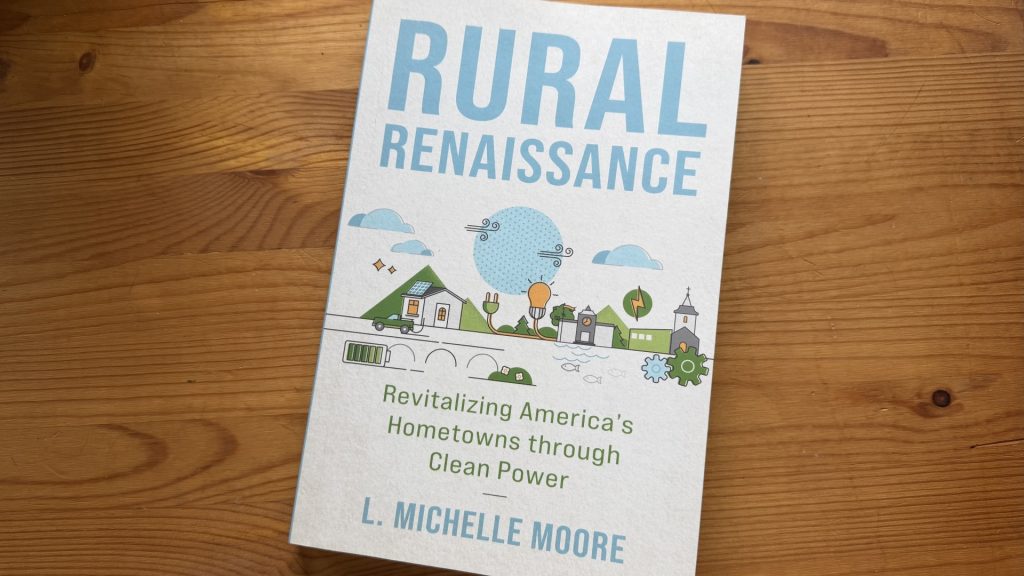
The Rural Renaissance Roadshow is coming up soon, organized by Michelle Moore of Groundswell. This year’s theme is At the Data Center Crossroads: Land, Energy, Water, and The Future of Rural Power, taking place 4-6 November 2026, at Decatur, Alabama. Read about it in our June preview for the APA Small Town & Rural Planning Division newsletter.
Related Reading on JCShepard.com
- The Rural Energy Revolution: How Data Centers and AI Are Driving Electricity Demand (October 2025): our original article one year ago.
- Rural Infrastructure 2026: Communications, Utilities & Energy: the opening of the June 2026 series.
- The Full Energy Picture in 2026: the U.S. energy mix, siting standards, battery storage, and decommissioning.
- Less Is More: Conservation, Efficiency, and Electrification in Rural Communities: efficiency, REAP, Elective Pay, and EV charging for local governments.
I am currently between regular positions. Need help with infrastructure planning or updating your development code for data centers and large-load energy production/use? Drop me a line.