

When most people talk about a successful community, they talk about more people, more jobs, more tax revenue. Yet, as I asked the Inland Northwest Partners last summer, Is that success? Or are those simple, easy-to-measure indicators of success?
When we ask real people what they mean by “successful”, they quickly get down to what they care about in their own hometowns. Author Wallace Stegner wrote that “a place is nothing in itself; it only has meaning in terms of human perception, use, and response… Natural beauty is nothing until it comes to the eye of the beholder. ”
That is a good reminder for local leadership. A place is not successful because it contains assets on paper. It is successful when those assets matter in people’s lives — when they are used, valued, experienced, remembered, and handed on.
A people-centered approach does not reject data. It simply insists that data serve what we value rather than replace it.
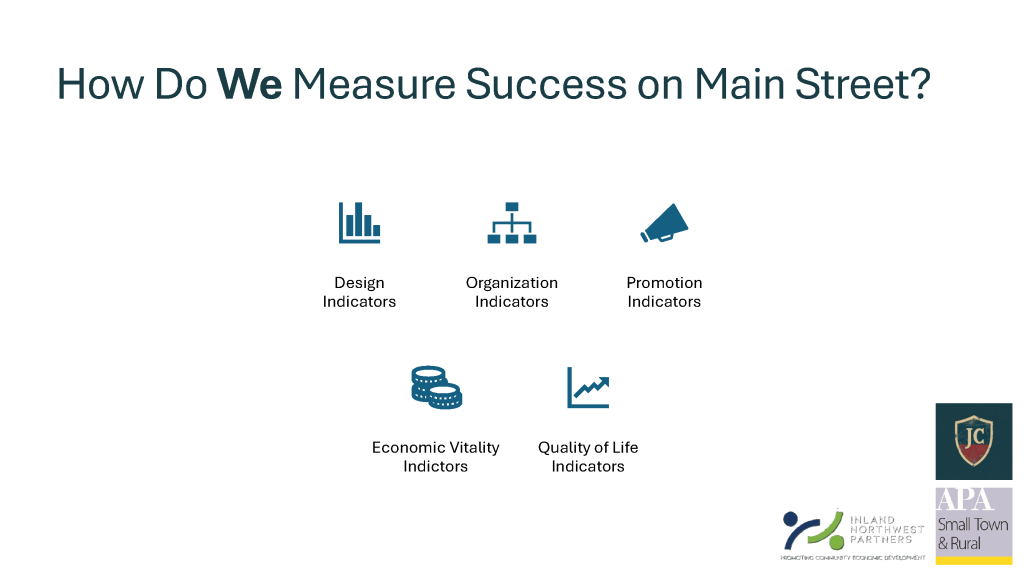
How Should We Measure Success Instead?
I like to look at broader measurement frameworks for indicators of success, many of which are more about quality than quantity. Some examples of better community indicators might be:
- Design Indicators: Is the physical environment improving in visible, usable, durable ways?
- Organization Indicators: How is your local civic capacity?
- Promotion Indicators: What is the story we tell about ourselves?
- Economic Vitality Indicators: What barriers can we remove from local adaptability, reuse, and entrepreneurship?
- Quality of Life Indicators: Can we broaden the usual framework into making your hometown more workable, more healthy, more connected, more equitable?
These are not the usual economic development or land use planning measures. For Quality of Life, for instance, how does your community do on the AARP Livability Indicators? My current home county brings home an overall livability score of 49, just shy of the median value. We could do better.
These measures are not necessarily good or bad on their own. What they do is give us ideas to adapt those categories beyond the easy statistics, and to think about better indicators for measuring success that can actually guide us towards where real people want to go.
I delivered the keynote at the Inland Northwest Partner’s summer conference on campus at Eastern Washington University in Cheney in July. We had a great discussion on practical strategies for building a better Main Street. Inland Northwest Partners has posted presentations from sessions on their website: https://inwp.org/events/speaker-presentations/ .
.