

A Perfect Storm for Rural Electricity
This article kicks off JCShepard.com’s October energy series, exploring how the accelerating energy transition is reshaping rural communities across North America.
Across the world we are using and producing more energy of all sorts. There is also a major shift unfolding beneath the surface of that energy trend: how artificial intelligence and data center growth are driving unprecedented electricity demand—not just in tech hubs like Silicon Valley, but in small towns, agricultural regions, and electric co-op territories across the country.
The American countryside is on the cusp of a rural energy revolution. Driven by the explosive rise of digital infrastructure, electricity demand is surging at rates not seen in decades. For local planners, elected officials, and rural development advocates, this shift presents both historic opportunities and urgent planning challenges.
By 2035, U.S. data center electricity demand is projected to more than double, from 35 gigawatts in 2024 to 78 gigawatts—equivalent to the power needed for millions of homes. AI data centers alone consume 10 to 30 times more energy than traditional facilities, and their rapid expansion means rural electric utilities must prepare for a future where digital infrastructure and clean energy collide.
Yet, this isn’t just a story about keeping the lights on. It’s about economic resilience, grid innovation, and the future of rural America.
Energy Production Rising in Response to Demand
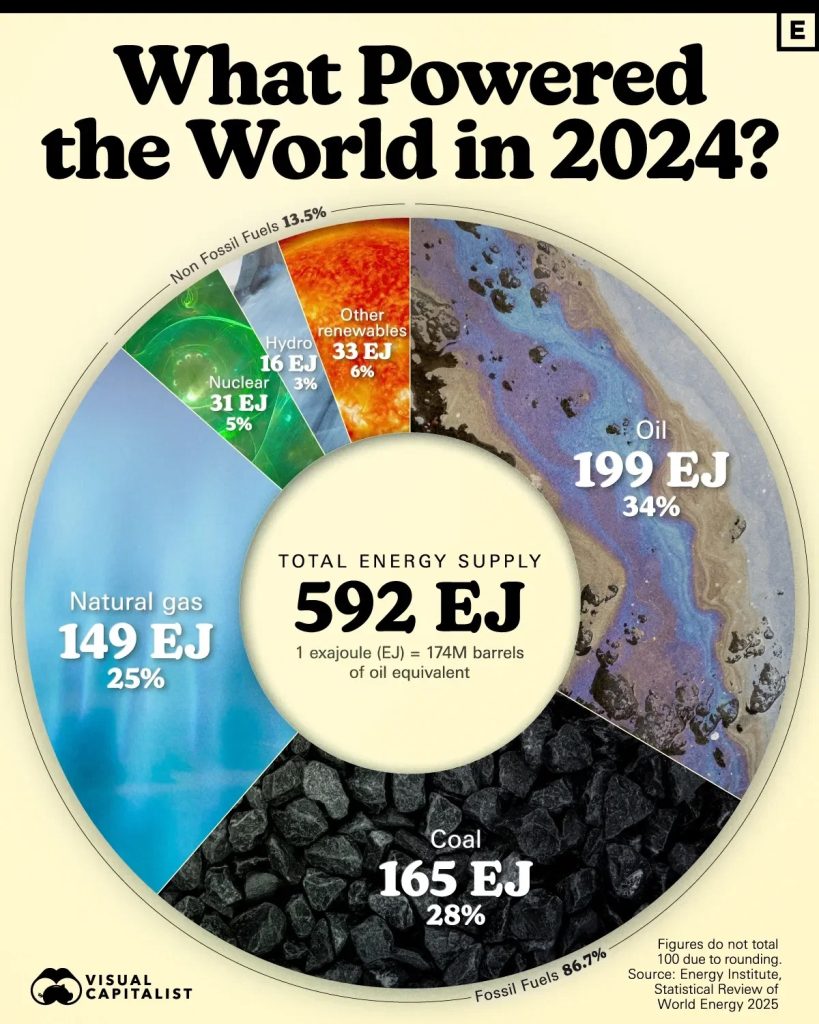
Global energy production in 2024 reached a record high as demand continued to grow, also at an all-time high of 592 exajoules (EJ), with fossil fuels remaining dominant. That said, renewables and nuclear energy are expanding their share. Over the last decade, there have been significant shifts by mode, and current projections suggest major changes leading up to 2050 for both total energy production and demand, particularly electricity.
Around the world, fossil fuels remain dominant, supplying 86.7% of global energy production in 2024, according to data from the Energy Institute. The share of energy produced from fossil fuels, though, has been declining gradually as clean energy grows. Regarding electricity specifically, the Ember Global Electricity Review reported data from 215 different countries. “Renewables generated a record 30% of global electricity in 2023, driven by growth in solar and wind.” Solar generation was up 23% and wind generation up 10% in 2023, compared to a slight increase of 0.8% in fossil fuel-based electric generation. Coal’s share was buoyed by growth in developing economies, but its long-term growth is more modest than renewables. Nuclear energy’s share has remained relatively stable globally, though some countries, like France and Japan, recently increased production by bringing reactors online.
Energy production is following demand. McKinsey projects global energy demand will grow between 11% and 18% by 2050, driven mainly by emerging economies (ASEAN, India, Middle East). Developed economies will see flatter growth. By 2050, renewables and nuclear could provide between 65%–80% of global electricity generation, depending on climate and policy scenarios. Global electricity demand is expected to rise by one-third to three-quarters by 2050, with most new capacity coming from renewables and nuclear. Renewables could meet the bulk of new demand: battery storage, solar, and wind will dominate growth in emerging markets. Production is expected to double 2024 levels by 2050.

North American Energy Production and Demand
The North American energy industry encompasses a vast, interconnected network across the United States, Canada, and Mexico, representing over 30% of global energy demand. The region has evolved one of the world’s most significant energy producing and consuming regions, marked by substantial integration, technological innovation, and ongoing transformation toward cleaner energy sources.
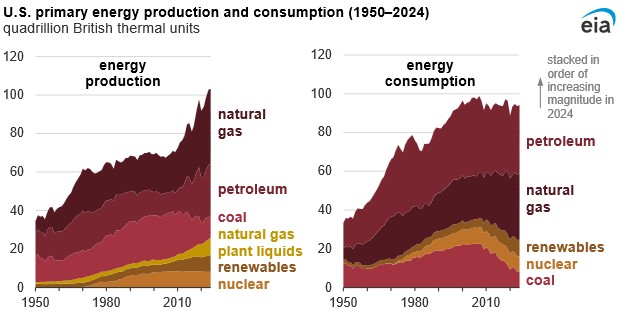
The US produced 103.6 Quadrillion BTU of power in 2024. A BTU, or British thermal unit, is the amount of heat required to raise the temperature of one pound of water by one degree Fahrenheit—one exajoule or EJ is just under 1 quadrillion BTUs. According to the US Energy Information Administration (EIA):
- 86.5 Quadrillion BTU (83.5%) were produced from fossil fuels,
- 8.2 Quadrillion BTU (7.9%) by nuclear electric power, and
- 8.9 Quadrillion BTU (8.6%) from renewable energy sources.
- Total energy production in 2024 was approximately 22.2% higher than a decade earlier in 2014.
In 2024, Canada produced approximately 23.7 million terajoules (TJ) of primary energy, a record high for the country. In BTUs, this equates to roughly 22.5 quadrillion BTU, given that 1 TJ equals almost one million BTU. The breakdown of Canada’s primary energy production by source (based on the most recent available EIA and Government of Canada data) is as follows:
For electricity generation, Canada’s mix in 2024 is cleaner than the global average:
- Around 79% of electricity was from low-carbon sources (hydroelectric 55%, nuclear 14%, wind and solar ~8.5%).
- Fossil fuels accounted for about 21% of electricity generation.
Canada has a significantly greener electricity grid than the U.S., with a far higher proportion generated by hydroelectric power and nuclear, and less reliance on fossil fuels overall. Total primary energy production, however, remains dominated by oil and gas, reflecting Canada’s major export industries
In 2024, Mexico’s total primary energy production was approximately 6.15 quadrillion BTU, slightly up from 2022’s 5.91 quadrillion BTU. The country’s energy mix remains heavily reliant on fossil fuels, with the following estimated shares for electricity generation:
- Fossil fuels: About 75-76% of electricity (with natural gas at around 59%, coal at 8%, and oil at 5%).
- Low-carbon sources (including hydro, nuclear, solar, and wind): About 24-25%. Hydropower supplies around 8%, solar and wind together about 13-14% (solar being the largest clean source at 8%), and nuclear about 3%.
- Mexico’s government had set a target of 35% electricity generation from clean sources by 2024, but was short by about 10%.
Unlike Canada, Mexico’s clean energy share is considerably lower, and natural gas plays an outsized role in both electricity and total energy supply. Primary energy production has seen slow growth, and the country’s electricity sector emissions have continued to rise due to reliance on imported U.S. natural gas and limited recent growth in clean energy.
A Significant Transformation
Our energy system experienced significant transformation in the 20th century, marked by booming oil and natural gas production, followed by wider adoption of renewable energy, and shifting patterns of energy use.
For the US, the EIA projects, through 2050, domestic crude oil production will decrease by about -0.7%, and coal will contract by -3.8%. New Mexico has bypassed North Dakota (the Bakken) as the fastest growing source of crude oil, and also is among the fastest growing sources of natural gas along with the rest of the Permian Basin. In the east, Pennsylvania’s natural gas is growing rapidly, as is Ohio and West Virginia. Yet nation-wide, natural gas and hydroelectric are both projected to grow by less than 1% each. Alternative energy production is projected to grow over the long term, by about 6.7%.
Projections for Canada suggest continued growth in clean electricity, gradual decline or plateau in fossil fuel use (especially coal), and notable expansion in wind and solar generation. By 2030, Canada aims for about 72–75% renewable electricity, with hydro and wind making up the largest shares. By 2050, projections indicate the national grid could reach more than 95% non-emitting sources, dominated by hydro (46%), wind (29%), and nuclear (14%). Solar is expected to contribute 5%. Oil production is projected to rise modestly by about 16.5% by 2030, mainly via expansions of existing projects rather than major new developments. Oil production is projected to rise modestly by about 16.5% by 2030. Natural gas production will remain relatively stable or decline slowly. Wind is projected to grow rapidly, potentially reaching 29% of the electricity mix by 2050, while solar could expand to around 5%. Biomass and geothermal remain minor contributors.
By 2030, Mexico is targeting 45% of its electricity generation from clean energy sources—including wind, solar, hydro, nuclear, and efficient cogeneration—with projections showing rapid growth particularly in wind and solar, which together could supply 26–32% of generation, and a steady contribution from hydro at around 14–16%. Fossil fuels, especially natural gas, are expected to decline from today’s majority status to around 40–50% of the mix, with coal and oil dropping to under 10% combined. By 2050, if policy goals are met and clean energy investments continue, renewables could contribute up to 70–80% of electricity production, transforming the system away from its historical reliance on hydrocarbons.
Electricity Production and Consumption
Much of our fossil fuels are consumed producing electricity. Across the US, net generation of electricity from coal and petroleum has been declining substantially year on year. Natural gas production exceeds coal production by about three times, as of the latest figures from EIA. Nuclear outproduces coal, and utility-scale renewables from all sources including hydroelectric are closing in on coal. All sectors of the US economy consumed about 3,874,253 million kilowatt-hours (kWh) in 2023:
- Residential consumers used 1,450,025 million kWh
- Commercial consumers used 1,408,109 million kWh,
- Industrial consumers used 1,009,256 million kWh,
- Transportation consumers used 6,864 million kWh
The Data Center Boom: Why Rural America?
The AI and Cloud Computing Surge
AI’s energy appetite:
Artificial intelligence is reshaping industries—from healthcare to logistics—but behind every AI breakthrough lies a massive energy cost. Training a single large-scale AI model, such as those used in language processing or image recognition, can consume as much electricity as 100 U.S. homes in a year. And that’s just the training phase. Once deployed, AI models continue to require substantial power for inference, processing, and storage—often operating 24/7 in high-density computing environments. As Bloomberg recently reported:
“The power needs of the massive [data center] complexes are rapidly driving up electricity bills–piling onto the rising prices for food, housing and other essentials already straining consumers. That’s starting to have economic and political reverberations across the country as utilities and local officials wrestle over how to divvy up the costs. Yet those same facilities are a linchpin of US leadership in the global AI race.”
As AI adoption accelerates across sectors, the demand for scalable, energy-intensive data infrastructure has exploded. Traditional tech hubs are reaching the limits of their capacity: land is expensive, local grids are strained, and community resistance to large-scale energy consumers is growing. That’s why data center developers are increasingly turning to rural America—where land is abundant, power costs may be lower, and there’s greater potential to connect with renewable energy sources like wind, solar, and hydropower.
Regional hotspots:
Northern Virginia’s “Data Center Alley”, the nation’s largest concentration centered on the big pipes of the Internet feeding Washington, DC, suburban sprawl is giving way to server farms. The fastest growth in new data centers is happening in the U.S. Southwest, Mountain West, and South, as well as parts of Asia-Pacific and Europe. Out west, a 950% increase in data center capacity is projected in the deserts of Las Vegas and Reno, Nevada; a 700% growth rate is expected around Salt Lake City, and 550% growth in Phoenix. None of these dry states are known for an abundance of water.
Meanwhile, rural counties in central Texas and the Midwest are leveraging their open space, proximity to transmission corridors, and proactive local leadership to attract billions in digital infrastructure investment. For example, the 13,000 square foot Hamilton Technologies Data Center in Aurora, Nebraska, near Grand Island, offers managed and unmanaged colocation services, operates with 24/7 monitoring, redundant power, and high-security biometric access. It is designed with reinforced concrete below-ground structure, redundant cooling, and backup power systems, making it a secure and technologically advanced data center.
The Polaris Forge 2 project near Fargo, North Dakota, has been proposed by Applied Digital. This $3 billion AI data center would be located on a 900-acre site at Harwood, a small town on I-29. The facility is planned to have a power capacity of 280 megawatts, designed for artificial intelligence computing. The project is expected to create around 200 full-time jobs once completed and could reach full operational capacity in early 2027. It is Applied Digital’s third data center campus in North Dakota, following the success of its Polaris Forge 1 campus in Ellendale. The project has sparked debate in the local community, with aspects like water and power consumption, environmental impact, and zoning changes being points of concern. As Minnesota Public Radio reported, Duncan McAlister from West Fargo stated the facility’s energy needs could strain the electrical grid, raising utility bills. “These [data centers] are going to use a lot of power,” McAlister said. “They’re going to drain our grid. They’re going to require new infrastructure, and all of that is going to raise prices, possibly permanently.” However, the project also promises significant economic benefits, including tax revenues that support local services and opportunities for economic growth.
Many rural regions offer competitive tax incentives, energy rate discounts, and streamlined permitting to court hyperscale data center developers. For some rural communities, this is a once-in-a-generation chance to transform their economies. For others, it’s a high-stakes gamble that hinges on careful planning, conservation of water resources, and long-term grid stability.

The Rural Grid: Stretched Thin
The US power grid is a vast, interconnected system divided into three primary regions—the Eastern, Western, and Texas (ERCOT) Interconnections—which operate mostly independently to deliver electricity from thousands of power plants to consumers through networks of high-voltage transmission and local distribution lines; although considered the largest machine in the world, the US grid is highly fragmented, overseen by various organizations and regulators, and faces challenges from aging infrastructure and the need for modernization to improve reliability and adapt to growing renewable energy sources.
Here in Nebraska, the electric transmission system is operated within the Southwest Power Pool (SPP) Regional Transmission Organization, which manages the bulk electric grid and wholesale power market in the central US. All major transmission facilities and electricity load in Nebraska fall within the boundaries of the Eastern Interconnection.
Aging infrastructure:
Many rural electric cooperatives and municipal utilities are working with infrastructure that dates back to the mid-20th century—designed for a time when electricity flowed in one direction, demand was relatively stable, and most loads were residential or agricultural. Today, that same infrastructure is expected to handle increasingly complex demands: EV chargers, distributed solar, energy storage, and now, potentially, industrial-scale data centers.
But rural utilities often lack the capital reserves or access to financing that larger investor-owned utilities enjoy. Distribution systems may rely on old poles, undersized transformers, and manual switches, making them vulnerable to overload, equipment failure, and extended outages—especially during peak demand or extreme weather events. And unlike urban systems, rural grids must stretch across vast distances to serve relatively few customers, which means higher per-user maintenance costs and longer restoration times when things go wrong.
Energy burden:
Affordability remains a major concern. Rural households spend an average of 4.4% of their income on energy, compared to 3.3% nationally—and for lower-income families, that burden can reach 9% or more. Electricity prices across the US have risen more than twice as fast as inflation over the past year. A recent poll by Heatmap News found 26% of American registered voters say rising electricity prices are having “a lot” of impact on their budgets. An additional 31% say rising prices are having “a decent amount” of impact, while only 30% say only “a little bit”.
These are not marginal figures; they represent real trade-offs between heating a home and affording groceries, healthcare, or transportation. Without intervention, added grid costs from large-scale users—or deferred upgrades—could make rural energy even less affordable.
The risk of being left behind:
While data centers and digital infrastructure promise economic growth, they also risk widening the rural-urban energy gap. If rural grids can’t meet new demand, communities may lose out on investment opportunities—or worse, become last-mile zones of instability, with higher rates and less reliable service than their urban counterparts.
To avoid this, rural leaders and utilities must treat grid modernization not as a luxury, but as a strategic necessity. Upgrading systems, planning for flexible loads, and aligning with state and federal funding programs are now essential steps toward keeping pace with the evolving energy economy.
As Hunter Traynor with the Nebraska Chamber of Commerce and Industry recently wrote, “Without new generation, transmission and grid capacity, we can’t fully realize that vision. And without deep community support for energy projects — including renewable energy facilities — the generation we need may never be built.”

The Opportunity: Rural Energy as an Economic Engine
Energy spurs improving agricultural productivity, expanding small and medium enterprises, and starting up new industries, all of which foster job creation and community stability. Access to affordable, reliable power allows farmers and local businesses to modernize operations, process goods onsite, and reach broader markets, amplifying the rural economy’s value chain and resilience. Furthermore, investment in renewable energy infrastructure generates construction and maintenance jobs while providing new revenue streams for landowners, thus diversifying income sources and strengthening local tax bases.
Attracting Investment
Data centers as anchors:
When a data center breaks ground in a rural county, it’s rarely a standalone investment. These facilities often serve as anchor tenants in a broader ecosystem of digital and energy infrastructure. Their presence can spark a chain reaction of economic development, from high-paying technical jobs—in IT, operations, and facilities management—to indirect employment in construction, maintenance, logistics, and even local education and workforce training programs.
In some regions, data centers have also attracted ancillary industries, such as cybersecurity firms, fiber-optic suppliers, backup power system vendors, and even advanced manufacturing. For communities long reliant on agriculture or declining industrial bases, this represents not just new revenue—but economic diversification.
Renewable energy synergy:
What makes this moment unique is the convergence of digital and clean energy priorities. Data center developers are increasingly under pressure from investors, customers, and regulators to reduce their carbon footprint—and rural regions with strong wind, solar, hydro, or geothermal potential are perfectly positioned to help them do just that.
Some rural counties are already leveraging this trend to their advantage, working with utilities and developers to create co-located renewable energy projects that serve both community needs and data center loads. In doing so, they create a virtuous cycle: energy demand justifies new renewables, which in turn lower emissions and attract more responsible investment.
Smart rural leaders recognize that this isn’t just about securing a single facility—it’s about positioning their community as a hub in the evolving energy economy, where digital infrastructure and clean power go hand in hand.

Grid Modernization: A Chance to Leapfrog
Modernizing the US power grid faces several significant challenges, including the high costs of upgrading aging infrastructure that was largely built decades ago and is now struggling with increased electricity demand and the integration of variable renewable energy sources such as solar and wind. Regulatory fragmentation complicates coordination for large-scale improvements, while physical infrastructure expansion faces opposition due to environmental and land use concerns. Additionally, the grid must become more resilient to extreme weather exacerbated by climate change and address vulnerabilities to cyberattacks. To meet these challenges, investments in smart grid technologies, improved transmission networks, enhanced cybersecurity, and new policies for collaboration and funding are critical to ensuring a reliable, efficient, and flexible grid for the future.
Smart grids and storage:
For many rural utilities, modernizing the grid can feel like an overwhelming task—especially when budgets are tight and technical expertise is limited. But the current moment offers a rare chance not just to catch up, but to leap ahead.
New technologies like battery energy storage systems (BESS), smart meters, and automated grid controls allow even small utilities to improve reliability, reduce peak loads, and better integrate local renewable resources. These tools also help manage the volatile demand patterns that come with data centers and electric vehicles—both of which are arriving faster than expected in rural regions.
Rather than upgrading yesterday’s grid for yesterday’s needs, rural communities can invest in flexible, future-ready systems designed to handle distributed generation, two-way power flows, and digitally responsive demand. With the right planning, today’s rural grid can become tomorrow’s clean energy backbone.
Federal funding as a catalyst:
Key to this transformation is money. Through the Inflation Reduction Act (IRA), the Bipartisan Infrastructure Law (BIL), and DOE initiatives like the Grid Resilience and Innovation Partnerships (GRIP) and ERA program, funding has been available for rural grid upgrades, clean energy projects, and workforce development. While we know the current Administration has revoked most of the incentives in the IRA, as of August 2025, over $431 billion has been authorized under the BIL, with approximately 47% of total program funds obligated for specific projects, covering areas such as transportation, water systems, energy, broadband, and environmental remediation.
But access isn’t automatic. It takes local initiative, partnerships, and grant-readiness to compete for these dollars. Communities that proactively assess their grid, identify shovel-ready projects, and build relationships with utilities, developers, and regional energy offices will be in the best position to take advantage.
Modernizing the rural grid is no longer a distant goal—it’s a defining factor in regional competitiveness. Communities that lead the charge will not only reduce outages and lower emissions, but also attract the kind of clean tech investment that creates lasting economic value.

Case Study: Greene County, Iowa — Wind Power, Rural Renewal, and Tech Investment
Nestled in the rolling farmland of west-central Iowa, Greene County (population: ~8,500) offers a compelling example of how rural communities can harness wind energy not just for electricity—but for economic revitalization. While the county hasn’t (yet) hosted a hyperscale data center, its experience with renewable energy investment has positioned it as a quiet leader in the rural energy economy.
A Rural County at a Crossroads
Like many Midwestern farming communities, Greene County faced a familiar set of challenges in the early 2010s:
- Population decline and outmigration, especially among younger generations seeking opportunity elsewhere.
- Aging grid infrastructure, limiting reliability and making it harder to attract new business.
- Economic vulnerability tied to fluctuating commodity prices and limited industrial diversification.
County officials, farmers, and civic leaders began looking for ways to stabilize local revenues and modernize infrastructure—without losing the county’s agricultural identity.
The Rippey Wind Farm and Google’s $75 Million Investment
In 2012, a 50-megawatt wind project broke ground near the small town of Rippey, just south of Jefferson, the county seat. The Rippey Wind Farm, developed by RPM Access, featured 20 turbines, each capable of generating 2.5 MW. While the project wasn’t headline-grabbing on size alone, it became nationally significant when Google invested $75 million as part of its broader clean energy strategy.
The investment didn’t power a specific Google data center in Greene County—but it did send a powerful signal: tech giants see long-term value in rural renewable energy infrastructure. And for Greene County, that meant real, tangible benefits:
- Land lease payments to local farmers—often $5,000 to $10,000 per turbine per year—provided stable income that could support multigenerational farm operations.
- Property tax revenues from the wind project helped fund schools, road maintenance, and public services.
- New jobs emerged in construction, operations, and maintenance—creating opportunities for both skilled and entry-level workers.
We didn’t just get turbines—we got momentum. Suddenly we had people paying attention to what Greene County could do with clean energy.
— Local economic development official (paraphrased)
A Platform for Future Growth
While no data centers have yet broken ground in Greene County, Iowa’s broader reputation as a wind-powered tech hub is growing rapidly:
- Major tech firms (Google, Microsoft, Meta) have invested over $17 billion in Iowa-based digital infrastructure.
- Google alone plans to expand its cloud and AI facilities in Iowa with a $7 billion investment announced in 2025.
- These investments are driven by Iowa’s affordable, reliable wind power, favorable zoning, and abundant land.
By investing early in wind infrastructure, Greene County is now better positioned to attract future clean-tech and digital economy development—especially as demand for rural siting continues to grow.
Lessons from Greene County’s Experience
Greene County’s journey offers a blueprint for other rural communities navigating the clean energy transition:
| Strategy | Greene County Example | Key Takeaway |
|---|---|---|
| Start with strong local assets | Excellent wind resources and willing landowners | Leverage what you already have—especially land, location, and leadership |
| Welcome outside investment—but on your terms | Google’s equity stake helped de-risk the wind project | Tech capital can support local goals if benefits are clearly defined |
| Preserve agricultural integrity | Turbines co-exist with cropland and pasture | Dual-use land models protect farming heritage while supporting energy goals |
| Think regionally | Greene County benefits from Iowa’s broader wind-energy ecosystem | Proximity to infrastructure, markets, and peers matters |
| Plan for what comes next | Wind was just the beginning—next could be data, broadband, or battery storage | Energy projects are a stepping stone, not a finish line |
“We’re still a farm county. But we’re also a clean energy county now—and that gives us options we didn’t have before.”
— Local farmer & turbine leaseholder
Useful Resources:
- USDA Rural Energy for America Program (REAP)
- DOE Energy Improvements in Rural or Remote Areas (ERA)
- Greene County, Iowa Economic Development

Leading the Rural Energy Revolution: Three Steps for Local Action
The rural energy revolution isn’t something that’s coming someday—it’s happening now. But knowing where to begin can be overwhelming. For small towns and rural counties, the path forward starts with three practical, interconnected steps:
1. Assess Your Energy Readiness
Before communities can pursue big ideas like attracting data centers or launching renewable projects, they need a clear picture of where they stand.
- Audit your grid: Work with your local utility or cooperative to assess your current grid capacity, reliability, and constraints. Identify bottlenecks, aging infrastructure, and areas that could support higher loads or renewables.
- Map your assets: Inventory existing infrastructure—transmission lines, substations, broadband access, industrial parks—as well as underutilized land near those assets. These are potential anchors for future development.
- Engage stakeholders early: Farmers, business owners, educators, and residents all have a role to play in shaping a local energy strategy. Public workshops or energy planning charrettes can uncover opportunities—and prevent backlash.
- Review Zoning codes: What’s not listed in zoning regulations is generally prohibited. It’s better to establish clear standards before a project application comes along.
2. Pursue Strategic Partnerships
You don’t have to do it alone. Rural success stories in energy planning almost always involve collaboration across sectors and regions.
- Work with data center developers: Carefully coordinate infrastructure, including water along with power. Some projects negotiate community benefits agreements that include investments in schools, workforce training, or local clean energy. (Consult your attorney, some states do not allow these financial arrangements.)
- Coordinate with renewable energy developers: Explore co-location strategies where data centers and renewables (like solar or wind) are developed in tandem, improving both efficiency and public perception.
- Leverage regional and state alliances: Many energy projects require coordination across county lines. Partnering with regional councils of governments or energy development boards can increase capacity and competitiveness.
3. Tap Into Funding and Technical Assistance
Billions in federal funding have been available in the US—but they often go unclaimed by rural communities due to lack of staff or grant-writing capacity.
- USDA’s Rural Energy for America Program (REAP): Offers grants and loan guarantees for energy efficiency and renewable energy systems for farmers, ag processors, and small businesses.
- DOE’s Energy Improvements in Rural or Remote Areas (ERA) Program: Up to $1 billion in funding to support innovative energy projects that improve resilience and lower energy costs.
- Technical assistance programs: Organizations like NREL, National Association of Counties (NACo), and Rural Energy America offer no-cost support for project scoping, partner matching, and application assistance.
Rural Energy Readiness: 3 Key Steps for Local Leaders
| Step | What to Do | Why It Matters |
|---|---|---|
| 1. Assess Your Energy Readiness | • Audit local grid capacity and bottlenecks • Map infrastructure and land assets • Engage community stakeholders | Identifies constraints and opportunities early, builds local support, prevents misalignment |
| 2. Pursue Strategic Partnerships | • Negotiate community benefits with data center and energy developers • Explore co-location of renewables and digital infrastructure • Coordinate regionally | Maximizes local value, shares risk, strengthens project credibility |
| 3. Tap Into Funding & Support | • Apply for USDA REAP and DOE ERA programs • Use free technical assistance for planning and grant writing • Track upcoming federal/state energy funds | Unlocks resources many rural communities leave on the table |
By taking these three steps, rural leaders can position their communities not as passive recipients of external development—but as active architects of their own energy future.

Conclusion: Rural America’s Energy Moment
The convergence of AI, data centers, and renewable energy isn’t just reshaping the national electricity grid—it’s redrawing the map of opportunity for rural America.
For decades, rural communities have been told to adapt to change. But in this moment, they have a rare chance to lead it.
By aligning infrastructure upgrades with long-term planning, embracing clean energy as a local economic engine, and building partnerships that serve both people and place, rural leaders can move beyond short-term fixes and create lasting resilience.
This energy transformation won’t wait—and it won’t arrive with a single solution. But it will reward communities that act boldly, plan wisely, and keep their values at the center of decision-making.
The rural energy revolution is here. The question is no longer if it will happen—but how, where, and for whom.
Now is the time to ensure it happens with rural America, not just around it.
What’s your community’s energy story? Share your experiences or questions in the comments, or [contact us] to explore how your region can prepare for the rural energy revolution.

Read More: Planning the Rural Energy Revolution
Looking to dive deeper into the future of rural energy systems, data center impacts, and infrastructure planning? These curated resources offer valuable insights and actionable strategies:
Books
- Rural Renaissance: Revitalizing America’s Hometowns through Clean Power, by L. Michelle Moore
Even the smallest town and most remote rural area has the potential to generate their own power close to home. Our Featured Book for October 2025. - Power After Carbon: Building a Clean, Resilient Grid, by Peter Fox-Penner
A must-read on how to build a resilient, zero-carbon grid—and what that means for utilities, regulators, and communities. - Our Renewable Future: Laying the Path for One Hundred Percent Clean Energy, by Richard Heinberg & David Fridley
A practical and realistic guide to the opportunities and limits of renewable energy deployment. - The Grid: The Fraying Wires Between Americans and Our Energy Future, by Gretchen Bakke
A compelling look at the aging U.S. electric grid and why modernization is so complex—but necessary.
Websites & Tools
- National Renewable Energy Laboratory (NREL)
Technical research, modeling tools, and data on renewables, storage, and distributed energy systems. - Database of State Incentives for Renewables & Efficiency (DSIRE)
Comprehensive source for state and federal energy incentives, grants, and policies. - Rewiring America
Policy briefs and tools on electrification and grid transformation, including rural-specific reports. - U.S. Department of Energy – Office of Rural Energy
Funding opportunities and strategic planning resources tailored to rural utilities and communities. - Heatmap News
Climate news focused on decarbonization and impacts on economy, politics, and society
Reports & Policy Briefs
- “AI and the Grid: Electricity Demand in the Age of Intelligent Computing” – McKinsey & Co.
An in-depth analysis of how AI-driven infrastructure is reshaping energy markets. - “Rural Electric Cooperative Planning Toolkit” – Smart Electric Power Alliance (SEPA)
Guidance for co-ops navigating distributed energy, rate design, and stakeholder engagement. - “The Future of Electricity in Rural America” – Brookings Institution
A policy-focused look at equity, investment, and regional opportunity in the evolving energy economy.
What’s Next in the Rural Energy Series?
This is just the beginning. In our next post, we’ll turn our attention to the complex landscape of wind energy development in rural America.
From wildlife protection and zoning setbacks to the growing role of battery storage, wind projects are evolving fast—and rural communities are being asked to weigh economic opportunity against environmental impact and land use priorities.
Join us next Sunday as we explore how local governments, planners, and landowners can navigate these challenges—and help shape wind energy in a way that truly serves the community.
You Might Also Like
If you found this article on the rural energy revolution compelling, here are three related reads from JCShepard.com that dive deeper into planning, rural economies, and sustainable development:
- The New Rural Playbook: Planning Trends That Matter
Exploring emerging practices and techniques reshaping rural planning. - Planning with Purpose: Emerging Trends in Rural and Small Town Planning
A look at five core trends influencing how small towns plan and grow. - Thriving Together: Proven Strategies for Sustainable Rural Economies in 2025
Insights on how rural communities can build more resilient, diversified local economies.
Looking for more insights? These resources offer a starting point for anyone working to strengthen policy that works for rural communities—whether you’re a planner, council member, or community leader.
The Best Books for Rural Development and Planning in 2025
Check out the Community Guides on our Resources page.
(As an Amazon Associate, we may earn commissions from qualifying purchases. Check your local library or bookshop, too.)

1 Comment
Global solar and wind generation overtake coal for the first time
Solar and wind outpaced the growth of global electricity demand in the first half of 2025, vaulting renewables toward overtaking coal worldwide for the first time on record, according to analysis published Tuesday by the research outfit Ember. This year’s growth resulted in a small overall decline in both coal and gas-fired power generation, with India and China seeing the most notable reductions, despite the United States and Europe ratcheting up fossil fuel usage. “We are seeing the first signs of a crucial turning point,” Malgorzata Wiatros-Motyka, a senior electricity analyst at Ember, said in a statement. “Solar and wind are now growing fast enough to meet the world’s growing appetite for electricity. This marks the beginning of a shift where clean power is keeping pace with demand growth.”
That growth is projected to continue. Later on Tuesday morning, the International Energy Agency released its own report forecasting that renewable capacity will double over the next five years. Solar is predicted to make up 80% of that growth. But, factoring in the Trump administration’s policies, the forecast roughly cut in half previous projections for U.S. growth. Domestic opposition to renewables runs beyond the White House, too. Exclusive data gathered by Heatmap Pro and published in July showed that a fifth of U.S. counties now restrict development of renewables.
-Heatmap AM newsletter, 7 October 2025