

Diary of Orrin Brown, Buck Creek Post Office at mouth of Brier Creek, near Sylvania, Georgia.
Monday–Dec. 5th
We were on the road this morning at 7 AM and marched very buisy all day, we found the swamps blockaded today with fallen timber, we went into camp at about 5 PM.
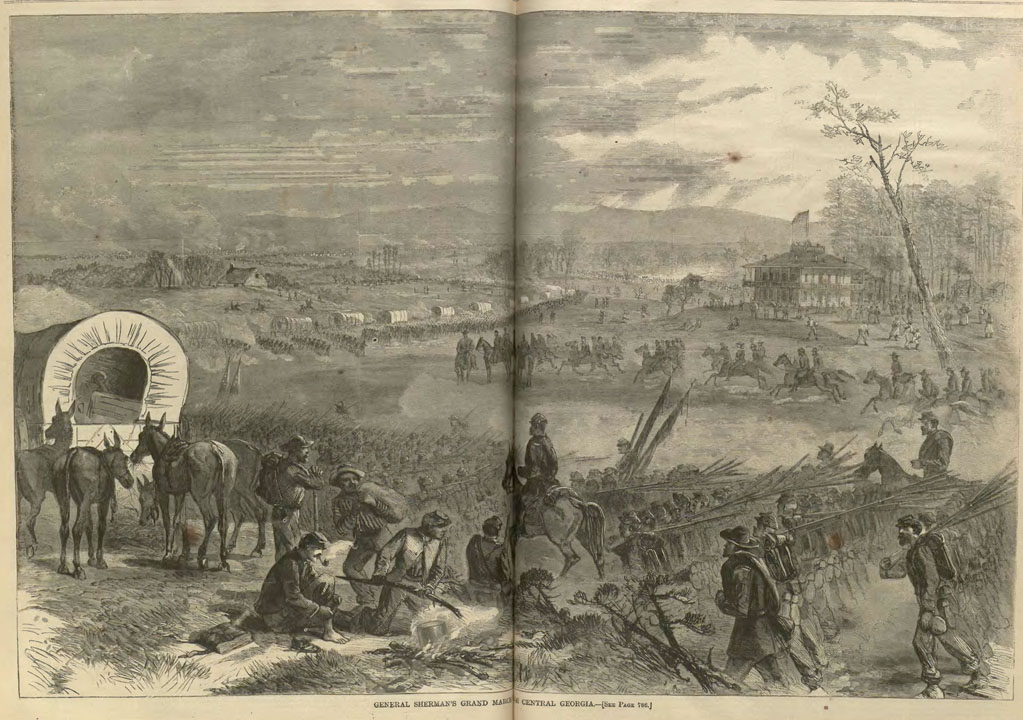
The Union column was now leaving fertile farm country, which had supplied ample forage, for more sandy, swampy lowlands where rice fields flourished. In the Official Records (Vol. 44, p.9), Gen. Sherman wrote:
As we approached Savannah the country became more marshy and difficult, and more obstructions were met in the way of felled trees, where the roads crossed the creek, swamps, or narrow causeways; but our pioneer companies were well organized, and removed these obstructions in an incredibly short time.
Rice production was widespread in coastal South Carolina and Georgia, where slaves with knowledge of African rice culture were valued by plantation owners. After the Civil War, rice production died out in the region, and by 1900, 75% of US rice production had shifted to Louisiana and Texas. According to the Ag Census of 2012, Arkansas leads US acreage with 1.28 million acres and more than twice the hundred-weight as California, the next highest producer. (Update 2025: Arkansas is still the top rice producing state with over 40% of the US crop.)
Read More:
- Fierce Patriot: The Tangled Lives of William Tecumseh Sherman by Robert L. O’Connell (Random House, 2014)
- Southern Storm: Sherman’s March to the Sea by Noah Andre Trudeau (Harper, 2008)
- Sherman’s March by Burke Davis (Random House, 1980)
- The Memoirs Of General William T. Sherman by W.T. Sherman (Library of America, 1990)
(As an Amazon Associate, we may earn commissions from qualifying purchases. Check your local library or bookshop, too.)
.