
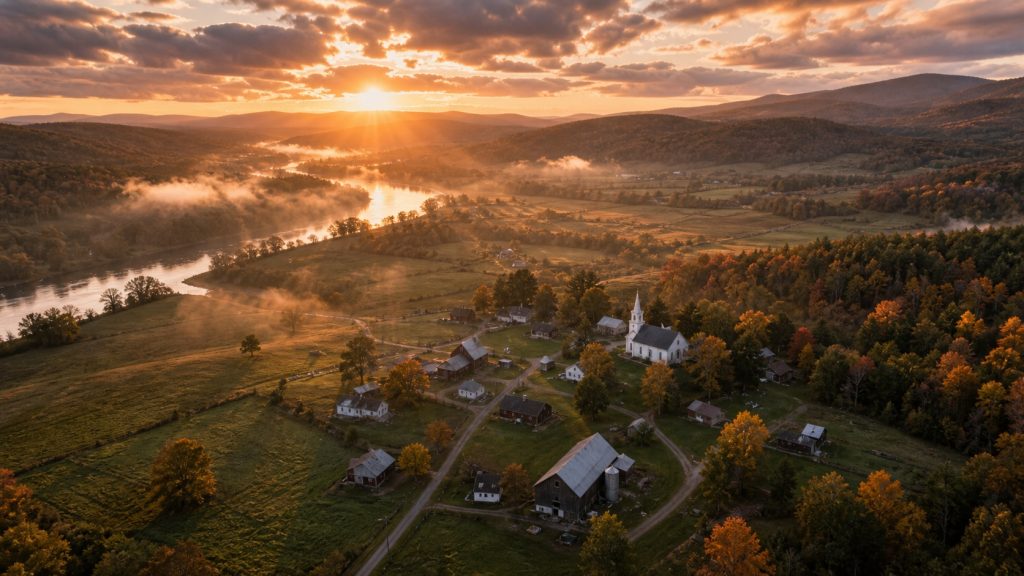
Across North America, restoration, rehabilitation, and remediation of open lands continues to gain momentum. From prairie towns to forested valleys, communities are rediscovering the power of natural systems—not only to repair degraded landscapes, but to strengthen local economies, cultural identity, and long-term resilience. Regenerative conservation is emerging as a practical framework for rural renewal, one that links ecological restoration with stewardship, planning, and place-based opportunity.
Our June 2025 series on Conservation and the Great Outdoors last summer wrapped up with “How to Catalyze Regenerative Conservation for Community Renewal,” the fourth installment. Since that original post, our conversation on JCShepard.com has grown to include stronger connections between comprehensive planning, natural resources, implementation, and the long work of helping small towns and rural communities bring their plans to life. The original article’s central ideas remain, but I wanted to revise the commentary in light of this broader body of work: regenerative conservation is not simply about restoring nature; it is about restoring the relationship between land, community, and local decision-making.
This matters because conservation can no longer sit on the margins of local planning. Rural communities are dealing with flood risks, drought, habitat fragmentation, infrastructure costs, changing land markets, and competing pressures on working lands. In that setting, conservation is not a side issue. It belongs in the comprehensive plan, the future land use map, the hazard mitigation strategy, the capital improvements discussion, and the community’s long-term economic vision.
This updated article explores how rural planners, landowners, and community leaders can help move that work forward. Drawing on conservation models, new technologies, and examples from the United States and Canada, it offers a practical way to think about rewilding and regeneration in service of community renewal. From nature-based solutions and ecosystem services to local leadership, youth stewardship, and regional partnerships, the larger point is simple: this is about more than saving nature. It is about building better places to live.

Reframing Conservation Around People and Place
From Preservation to Participation
Open lands conservation has evolved far beyond the traditional model of fencing off wilderness and leaving the rest of the landscape to fend for itself. Today, conservation is increasingly participatory, blending ecological restoration with local engagement, cultural stewardship, and regional planning. This shift—from isolated, top-down preservation toward inclusive, landscape-scale regenerative conservation—is changing how rural communities think about land, livelihoods, and resilience.
Regenerative conservation is a proactive approach to land management that goes beyond preserving ecosystems in their current condition. It works to restore and enhance ecological function, creating positive feedback loops where human actions contribute to the long-term health of the natural world. In practical terms, that means moving from a defensive posture—trying to lose less—to an active one that improves land, water, habitat, and local opportunity.
Landscape-scale conservation is central to this shift. Watersheds, wildlife corridors, floodplains, and climate systems do not stop at property lines. If planning remains fragmented, conservation efforts will remain fragmented too. But when communities think at the scale of landscapes, they can reconnect habitats, reduce flood and drought risk, support biodiversity, and strengthen the ecological foundations of long-term rural renewal.
Equally important is the rise of community-led conservation. Indigenous nations, farmers, ranchers, foresters, and local residents are increasingly recognized not just as stakeholders, but as stewards and decision-makers. Their lived experience, local memory, and long investment in the land make them essential to sustaining both ecological health and cultural continuity.
The policy environment has also helped encourage this shift. Governments, nonprofits, and conservation networks have increasingly supported collaborative efforts such as Regional Conservation Partnerships, Indigenous Guardians programs, and other place-based resilience initiatives. The larger lesson is worth underscoring: conservation works best when it aligns with community rather than standing apart from it.
Natural Systems as Planning Layers
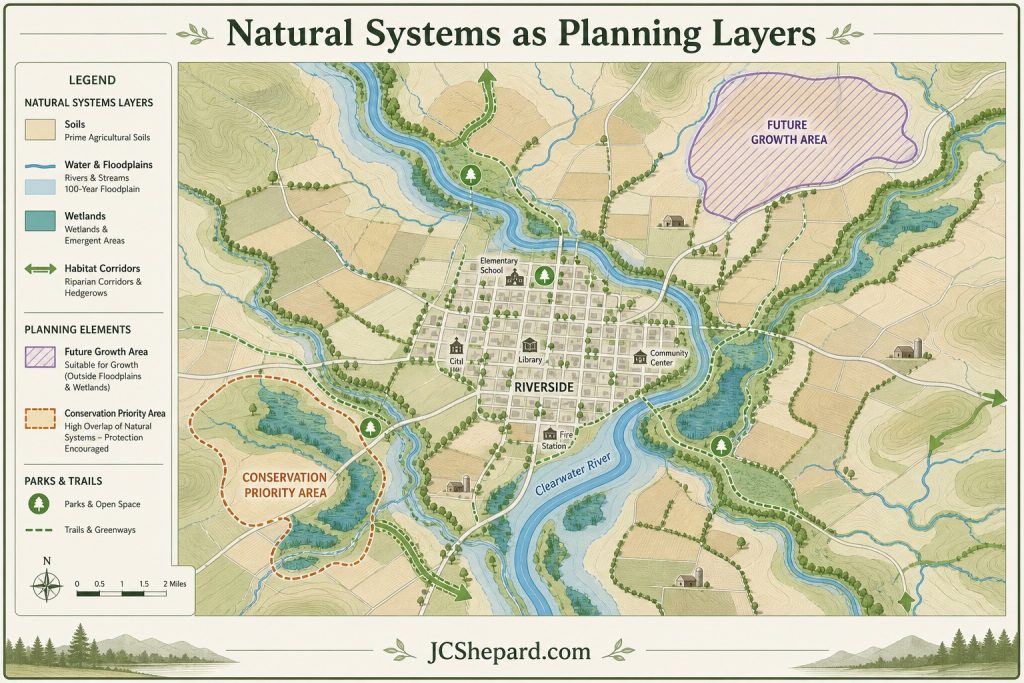
For planners, this is where regenerative conservation becomes especially useful. It encourages us to see natural systems not as decorative background, but as the organizing layers of the landscape.
Soils matter because they shape what land can support, where development will be costly, and where agriculture is strongest. Water matters because rivers, creeks, drainageways, floodplains, and recharge areas determine how safely and sustainably communities can grow. Wetlands matter because they store water, filter pollutants, support habitat, and provide natural buffers against storms and flooding. Habitat corridors matter because they connect fragmented landscapes into functioning ecological systems.
When those layers are mapped and taken seriously, the comprehensive plan becomes more than a document of aspirations. Land use, hazard mitigation, transportation, parks, and economic development all begin to reflect how the landscape actually works. Instead of asking only where growth can go, communities begin to ask where growth should go—and where conservation, restoration, or lower-impact uses make more sense in the long run.
That is the deeper shift behind regenerative conservation. It is not only about protecting wild places. It is about learning to plan with the land again.

Tools, Partnerships, and Planning Mechanics
Smart Stewardship
If the first part of our discussion is about changing the lens, this part is about using the right tools. Rural communities now have access to technologies that make conservation planning more precise, more strategic, and more grounded in evidence.
Remote sensing technologies—including satellites, drones, and LiDAR—can track changes in canopy cover, stream corridors, wetlands, and land use in near real time. Machine learning and AI can help analyze those large datasets, making it easier to identify restoration priorities, monitor ecological health, and understand change across wider landscapes. eDNA and bioacoustic monitoring expand the picture further by helping communities detect species presence and ecosystem change without relying solely on expensive or invasive fieldwork.
Digital twins and other modeling tools offer another layer of value. They allow planners and conservation partners to simulate how landscapes might respond to different development choices, infrastructure projects, restoration strategies, or climate pressures before major decisions are made. Used well, these tools support a stewardship model that is practical, proactive, and rooted in better information.
Still, technology works best when paired with local knowledge. A map may show drainage patterns, but farmers, hunters, and long-time residents often know where the water actually goes. Remote sensing may identify habitat patches, but local stewards often understand which places matter most and why. Regenerative conservation is strongest when modern tools and place-based knowledge reinforce one another.
Power in Partnership
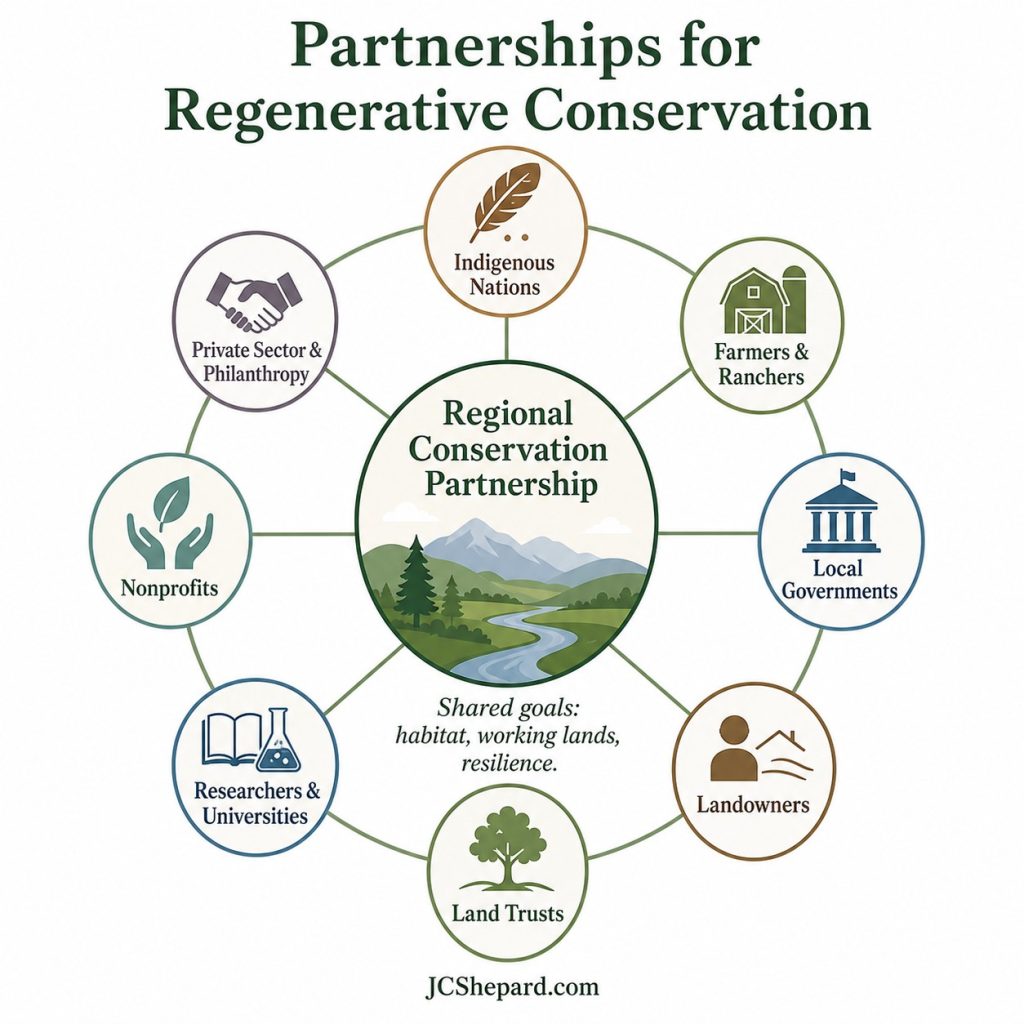
Conservation does not happen in isolation. It requires a shared vision and coordinated action across geographic, political, and cultural boundaries. That is why partnerships remain one of the central pillars of regenerative conservation.
Regional Conservation Partnerships bring together landowners, Indigenous nations, local governments, researchers, land trusts, and nonprofits around shared ecological and development goals. Public-private collaborations combine funding, technical expertise, and on-the-ground experience to restore wetlands, protect working lands, conserve habitat, and strengthen local resilience. Cross-border and cross-jurisdictional efforts matter as well, especially where watersheds, migratory species, or large habitat systems demand coordination across multiple boundaries.
For local planning, the lesson is straightforward. A comprehensive plan should not simply praise partnership in broad terms. It should identify likely partners, locate where collaboration matters most, and point toward the tools and programs that can turn conservation from aspiration into implementation.
Conservation in the Comprehensive Plan
One of the most important updates to this post is to state more clearly that regenerative conservation is a comprehensive planning issue. It belongs at the center of how rural communities think about growth, risk, land stewardship, and long-term prosperity.
In the natural resources chapter, regenerative conservation can serve as the organizing framework that connects soils, water, wetlands, forests, habitat corridors, and working lands. In the land use chapter, it can shape where new development is encouraged, where lower-intensity uses are more appropriate, and where conservation or restoration should guide future decisions. In hazard mitigation, it supports floodplain restoration, riparian buffers, wetland protection, and other nature-based solutions that reduce long-term public costs and vulnerabilities.
It also belongs in implementation. Conservation easements, land trusts, restoration projects, floodplain buyouts, and incentive programs should not be treated as side notes reserved for the environmental appendix. They are implementation tools every bit as real as roads, water lines, storm sewers, and capital projects. When communities map priority conservation areas, assign likely partners, and connect those areas to specific tools in the implementation matrix, conservation begins to function as policy rather than sentiment.
We’re going to go into more depth on this next month, in our upcoming series on Natural Resources in the Comprehensive Plan. tune in each weekend in July!
Valuing Nature in a More Complicated Rural Context
Our original 2025 article rightly emphasized ecosystem services, climate adaptation, and nature-based solutions. That still matters, but the case can be made in a more grounded way.
Rural communities today face overlapping pressures: flood resilience, habitat protection, farmland conservation, infrastructure costs, development pressure, and in some places land-use conflicts related to energy or growth. Regenerative conservation offers a way to navigate those pressures by focusing on the long-term functioning of the landscape. It helps communities ask not only what a site can be used for today, but what public value it provides over time.
Wetlands reduce flood damage and improve water quality. Grasslands and forests store carbon, support wildlife, and stabilize soils. Riparian buffers reduce erosion and protect streams. Green infrastructure can provide public benefits that gray infrastructure struggles to match over the long haul. Recognizing those values is not about reducing nature to a price tag. It is about acknowledging that healthy ecosystems are part of the infrastructure base rural communities rely on every day.

Stories of Renewal on the Ground
Empowering Communities
At the heart of regenerative conservation lies not just ecology, but community empowerment. Conservation tends to be more durable, more equitable, and more effective when local people help shape it.
That begins with recognizing local stewardship as a genuine form of expertise. Farmers, foresters, Indigenous guardians, youth leaders, and long-time residents often know their landscapes in ways that outside consultants do not. They understand where flooding repeatedly occurs, where wildlife moves, where soils fail, and which places matter most to community identity. Planning processes that make room for that knowledge are usually better grounded and more legitimate.
Inclusive governance matters too. When women, youth, Indigenous Peoples, and historically marginalized groups are part of conservation planning, the decisions tend to reflect a fuller picture of place and a broader understanding of stewardship. Participatory mapping, community visioning, and collaborative monitoring are not just good engagement practices. They are practical ways to make conservation more responsive to everyday life.
Capacity-building turns that participation into action. Programs in restoration, sustainable land management, and climate adaptation give communities the skills to lead projects themselves rather than waiting for outside institutions to do the work for them. In that way, regenerative conservation supports not only healthier landscapes, but also stronger civic capacity.
Youth in Conservation
Young people are not just the stewards of the future. They are already helping shape the present. Across rural regions, youth are participating in restoration, monitoring, land-based learning, and community stewardship in ways that reconnect them to place, purpose, and possibility.
Programs like the Student Land Stewards Initiative in Ontario, 4-H EcoLeaders in the United States, and Guardian Watchmen initiatives in British Columbia show how youth can engage directly in species restoration, habitat management, and ecological monitoring. These efforts connect science, stewardship, and local identity while also creating pathways into conservation, land management, and planning careers.
There is a practical planning lesson here as well. If a comprehensive plan calls for stronger natural-resource stewardship, youth should not be limited to attending a single public meeting or filling out a survey. Schools, youth groups, and service organizations can be involved in mapping, habitat restoration, stream monitoring, park planning, and stewardship activities that make conservation visible and real. Involving them early helps build the next generation of local leaders while making today’s work more rooted and more durable.
Heritage, Outdoor Economies, and Working Landscapes
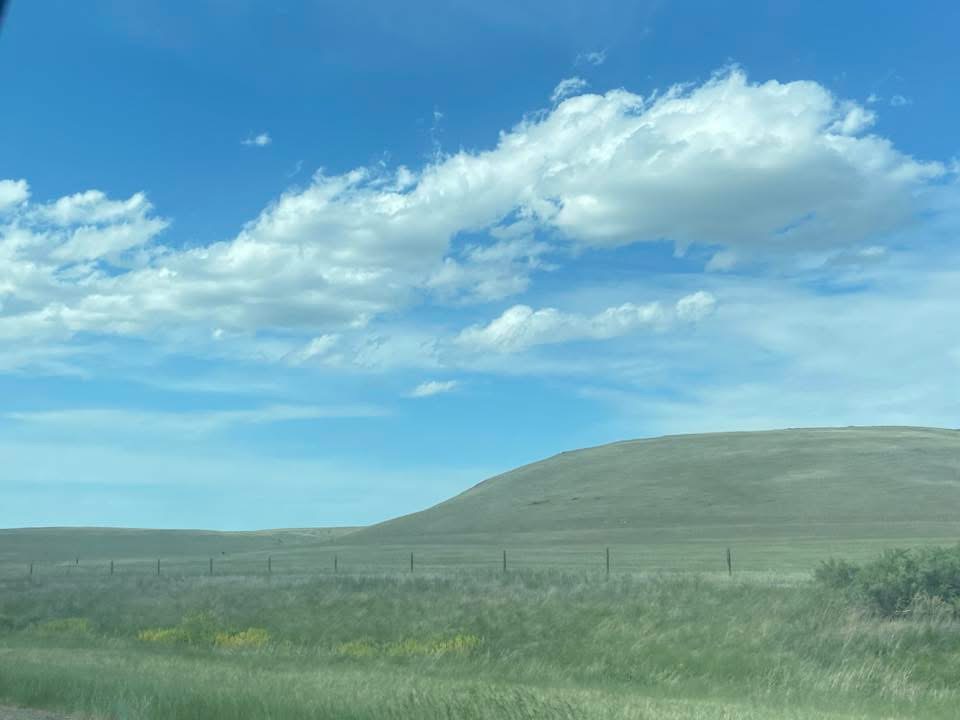
Another important revision is to connect regenerative conservation more directly to heritage and outdoor-economy themes. Rural landscapes are not just ecological systems. They are also cultural landscapes shaped by farms, forests, rivers, main streets, rail corridors, historic town patterns, and long local memory.
Regenerative conservation can strengthen those ties by treating heritage landscapes as assets rather than relics. A restored creek corridor, a working farm protected from fragmentation, or a greenway built along an old rail line can support ecological function while also reinforcing local identity. These are not separate goals. In many places, they are the same work viewed from two angles.
That matters for outdoor economies too. Trails, wildlife habitat, scenic river corridors, wetlands, and public access can support recreation, tourism, and small business activity. But the stronger point is not simply that conservation creates attractions. It is that healthy landscapes can support a more durable local economy without requiring communities to hollow out their character or overdevelop the very places that make them distinct.
In that sense, regenerative conservation fits comfortably within a “without selling out” approach to rural development. It offers a way to connect land stewardship, local history, and economic opportunity while keeping community identity intact.
Success in Action
The real test of any idea is whether it works on the ground. The case studies in the original article still help because they show how ecological restoration and community renewal can reinforce one another.
Floodplain easements and watershed restoration in the Midwest and Great Plains show how marginal farmland can be restored to wetlands and floodplains in ways that reduce risk, improve habitat, and provide landowners greater stability. Community-managed forests in India offer a transferable model of shared stewardship that links ecological regeneration to community governance and livelihoods. Regional Conservation Partnerships in Canada and the United States demonstrate how coordination across multiple stakeholders can secure land, restore habitat, and support long-term development goals. Nature-based infrastructure examples in places like Alberta and Vermont show that restored landscapes can often outperform gray systems while delivering co-benefits for biodiversity and public health. Indigenous-led conservation initiatives and eco-tourism models further illustrate how community benefit and environmental stewardship can strengthen one another.
Taken together, these examples underscore a central truth. Rural rewilding is not about abandoning human landscapes. It is about reshaping them so they become more resilient, more productive in the broadest sense, and more capable of carrying community life into the future.

Conclusion: From Wild Land to Living Landscape
Regenerative conservation is not about turning back time. It is about moving forward with intention—restoring the ecological systems that sustain rural life while renewing the social and economic systems that depend on them. Across North America and beyond, communities are showing that rewilding can be more than a conservation strategy. It can be a practical form of rural renewal.
The strongest lesson from this updated post is also the most practical one. Conservation belongs in the comprehensive plan, in the future land use map, in hazard mitigation, in implementation matrices, and in the daily decisions communities make about growth, infrastructure, and stewardship. It is not a decorative add-on. It is part of how rural places protect what matters and prepare for what is coming.
For rural planners, a few first steps stand out:
- Map the base layers: soils, floodplains, wetlands, forests, habitat corridors, and working lands.
- Identify priority conservation areas and match them with tools such as easements, partnerships, restoration projects, or incentive programs.
- Put conservation into implementation by naming projects, partners, and timelines in the comprehensive plan rather than leaving stewardship as a broad aspiration.
That is where regenerative conservation becomes real. Not just in visionary language, but in mapped priorities, civic partnerships, and practical choices that help communities live with the land more wisely.
Let’s not just conserve the past. Let’s reimagine the future—wild, rooted, and alive.

Resources on Rural Rewilding, Resilience, and Landscape Conservation
Community-Led Stewardship | Ecological Innovation | Nature-Based Planning
Rural by Design: Planning for Town and Country, 2nd Edition – Randall Arendt
A go-to reference for rural planners integrating conservation and community design.
Bringing Back the Beaver: The Story of One Mans Quest to Rewild Britains Waterways – Derek Gow
Part memoir, part practical guide, this book explores species reintroduction and wetland restoration
Wilding: The Return of Nature to a British Farm – Isabella Tree
A compelling narrative of rural rewilding through large-scale land transition, with takeaways for North American private landowners and land trusts.
Land Justice: Re-imagining Land, Food, and the Commons – Justine M. Williams & Eric Holt-Giménez
Explores the intersection of conservation, equity, and rural community empowerment
Great Growth That Works: Natural Capital Policy and Finance Mechanisms Around the World – Daly, Mantle, and Salzman
Inclusive green growth—the efficient use of natural resources. Inclusive green growth minimizes pollution and strengthens communities against natural disasters while reducing poverty.
Nature-Based Solutions & Resilience Planning
Climate Resilience: How We Keep Each Other Safe, Care for Our Communities, and Fight Back Against Climate Change – Alice C. Hill & Leonardo Martinez-Diaz
Includes chapters on green infrastructure, adaptive planning, and local empowerment.
Harnessing Biodiversity Tourism for Regenerative Conservation Management – Parinya Nakpathom, Kannapat Kankaew, Evgeniia Rotai, Krittipat Pitchayadejanant. (Expensive textbook, try interlibrary loan?)
Biodiversity tourism can promote regenerative conservation management by generating revenue and awareness through sustainable practices that protect and restore endangered ecosystems and support local communities.
Conservation Capital in the Americas: Exemplary Conservation Finance Initiatives – James N. Levitt, ed.
Conservation finance innovations are central to protecting ecosystems. Through case studies, this book shows environmentalists and policy makers how to find the financial, human, social, and natural capital to steward the earth’s resources for future generations
Online Tools & Reports
Building a Landscape Conservation Approach: The potential for Regional Conservation and Climate Partnerships in Canada
Working paper reviewing the growth of Regional Conservation Partnerships in the US and outcomes being achieved in Canada.
www.lincolninst.edu/publications/working-papers/building-landscape-conservation-approach
Center for Land Conservation / Centre pour la conservation des terres
Independent Canadian policy and program leadership institute to support and grow better, faster, and sustainable private land conservation in Canada.
www.centreforlandconservation.org/our-work/collaboration-partnerships
Center for Large Landscape Conservation
Technical resources and partnerships advancing cross-jurisdictional conservation and corridor planning.
landconservation.org
Conservation Finance Network
Resources and case studies on funding strategies for large-scale and community-led conservation.
conservationfinancenetwork.org
Conservation Planning for Ecosystem Services – Chan, Shaw, Cameron, Underwood, and Daily
Technical but accessible, this book links ecosystem service valuation to rural planning and land-use decisions.
Nature-Based Solutions Roadmap – U.S. Climate Resilience Toolkit
A practical guide to implementing NBS in local planning and infrastructure.
toolkit.climate.gov
Rewilding Network – Rewilding Europe
Though focused on Europe, this hub provides replicable tools, models, and case studies applicable in rural North America.
rewildingeurope.com
Rural Development Toolkit – Outdoor Recreation Roundtable
Outdoor-oriented development ideas, originating in a panel with speakers from Pennsylvania Wilds Center for Entrepreneurship, Eagle Market Streets Development Corp. of Old Fort, North Carolina, West Virginia University Outdoor Recreation Economic Development Collaborative, and Outdoor Recreation Council of Appalachia, Athens County, Ohio.
recreationroundtable.org/programs/rural-development
Young Stewards Network – Earth Force & Groundwork USA
Youth engagement in environmental justice, stewardship, and planning.
earthforce.org
Regenerative Conservation: Centering Preservation Philosophy Within Urban Planning Policy by Sean Gaouette, University of Notre Dame
This thesis has a different, urban, focus, but it’s getting included here at the end since it focuses on architectural preservation (part of our topic in May) with illustrations to regenerate the Arapahoe Square neighborhood in downtown Denver, Colorado. The thesis also was recognized with a Student Merit Award at the 2025 Congress for the New Urbanism Charter Awards in May.
PDF at nd.edu / Story at CNU.org.
Check out this resource: Small Town and Rural Community Guide to Conservation and the Great Outdoors (PDF). Let us know if you would like to see more Community Guides to share ideas and resources from jcshepard.com.
(As an Amazon Associate, we may earn commissions from qualifying purchases. Check your local library or local bookshop, too.)

1 Comment
Jessica Sellick noted how this week’s article aligns with her recent essay on Nature‑based Solutions (NbS) and a “nature‑positive rural economy” in the UK. Drawing on UK land use frameworks, farm policy, and new reporting standards, she makes a case for treating peatlands, wetlands, rivers, and farmland as “natural infrastructure” underpinning rural livelihoods and national resilience. Her emphasis on community‑led governance, fair benefit sharing, and blended finance to keep value in rural places strongly echoes the regenerative conservation and community renewal agenda I’ve outlined here.
You can read her full article, “How can Nature-based Solutions unlock new opportunities for rural areas?” at https://ruralwords.co.uk/how-can-nature-based-solutions-unlock-new-opportunities-for-rural-areas/.