

October’s Mainstreet Index Marks a Five‑Year Low
The heartbeat of rural America slowed this month. The latest Creighton University Rural Mainstreet Index (RMI) came in at 34.6 for October 2025—the weakest reading since May 2020, and the eighth straight month below the growth neutral mark. For those who watch the contours of the rural economy, especially in agricultural regions, that’s not just a dip; it’s a warning sign flashing red across farm country.
The RMI surveys bank CEOs across ten states dependent on agriculture and energy. It’s one of the better early indicators of how the rural economy feels before those numbers show up in USDA reports. This fall, the picture isn’t pretty.

Prices Down, Pressure Up
Creighton economist Ernie Goss told ProFarmer that low grain prices continue to drag on local economies. Corn and soybean producers are below breakeven. High input and financing costs aren’t helping. Farmland prices dropped again–37.0 on the index this month, down from 45.8 in September–marking 17 out of 18 months below neutral.
Farm loan delinquencies ticked up from 1.1 percent to 1.6 percent since June. Tractor and equipment sales barely budged; the sales index rose to 18.8 but stayed in contraction territory for a remarkable 26 months straight. Rural bankers report confidence at 32.7—essentially flat from last month’s gloomy expectations.
On Main Street, that means fewer upgrades at the co-op, stalled equipment orders, and another season of holding on tight.
Tariffs, Trade, and Tough Choices
Even as tariffs rattle markets, most rural bankers still back President Trump’s trade stance. Roughly 72% of surveyed bankers responded with the opinion the approach toward China was “about right.”
In 2024, the US exported 985 million bushels of soybeans to China—about half of all US soybean exports. By August 2025, that dropped to just 218 million bushels, with nearly no shipments during the summer harvest and sales down over 80% year-over-year due to tariffs and trade tensions. Other crops have been cut even more.
Economist Shawn Arita of North Dakota State University explained to NPR, the crop sector is being hit by a “triple whammy.” “You have high production costs. You have low crop prices. And then you also have the trade situation that exacerbates the condition,” Arita says.
Yet 85% of surveyed bankers also support the President’s proposal for a $10 billion farm aid package to offset negative cash flows, due in large part to the President’s tariffs. This reflects a paradox familiar in rural politics: support for policy hurting our own people and our own economies.
Nebraska’s story illustrates this split perfectly. Exports from the state are up nearly 50% for the year thanks to strong beef sales, yet shipments to China are down more than 90%. “A lot of farmers are below break even in terms of their income there on grain,” Goss told Nebraska Public Media. “Much better for the livestock producers, but nonetheless, was not as much as we’d like to see.”
Echoes of Past Crises
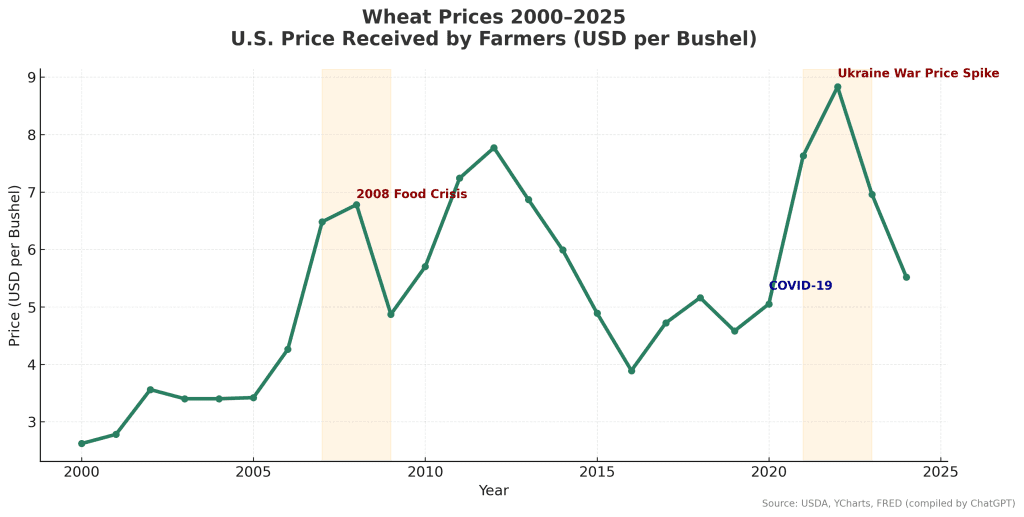
MarketMinute’s analysis dives deeper into the long view. Commodity prices have contracted nearly 50% from 2022 highs, although not yet down to earlier troughs. Federal Reserve surveys show 8 in 10 lenders report lower farm income, and 2/3 see reduced capital spending. NPR reports “The president of the American Farm Bureau Federation warned the White House last week that more than half of U.S. farms are losing money, threatening small towns and rural economies. Court records show farm bankruptcies in the 12 months ending in June were up 56% from the previous year. And that ominous trend has continued.”
It feels a bit like the 1980s farm crisis—only with expensive precision ag equipment and digital tools.
The pattern is familiar: as profits squeeze, farm consolidation accelerates. Bigger operations leverage technology and scale; smaller operations tighten their belts or bow out. In turn, those lost dollars ripple down Main Street—from the local hardware store, implement dealer, and coffee shop. The RMI is a statistical reflection of that everyday wear and tear.
Where We Go from Here
The rural economy has taken hits before. Every time, resilience has followed. Recovery, however, requires more than waiting for commodity markets to bounce back. The rural economy is more than agriculture, but it also can be very fragile when it comes to impacts of trade.
Rural resilience means diversifying local economies, investing in value-added production, and broadening markets beyond traditional exports of raw materials. For lenders and leaders alike, regional diversification and adaptation become the real measures of resilience.
We may be entering an era where foreign trade, economic aid, and policy support become less a structural necessity and more of a political necessity. Unfortunately, free trade worked so well for so long for so many. It’s worth asking if this cycle builds long-term capacity or just buys time.

The Takeaway
The Rural Mainstreet Index doesn’t measure hope, but it does measure momentum–and right now, momentum is moving in the wrong direction. I’ve usually found Ernie Goss’ work insightful for the region in Middle America where I do most of my work.
Yet the story of rural America is one of stubborn optimism. Communities built through decades of booms and busts know that adaptation is a skill, not a slogan. As the index reminds us, economic vitality in the heartland is never guaranteed–but neither is it gone.
With their roots deep in land and community, rural families and towns will find ways to weather this turn—and very likely to lead the next one.
Sources:
ProFarmer/FarmJournal (Tyne Morgan & Mike Walsten)
Nebraska Public Media (Brian Beach),
MarketMinute (Financial Content News Provider),
National Public Radio (Scott Horseley)
Looking for more insights on rural economy and planning? Explore our recommended resources on rural resilience and land-use strategy:
The Best Books for Rural Development and Planning in 2025
As an Amazon Associate, I earn from qualifying purchases.
.