

Clean energy is driving a quiet revolution in rural America—not just through wind farms and solar panels, but through a rediscovery of local power, community resilience, and land-based innovation. Is the future of rural America to be found in our past? Author L. Michelle Moore thinks there are lessons there, especially for small towns and rural areas.

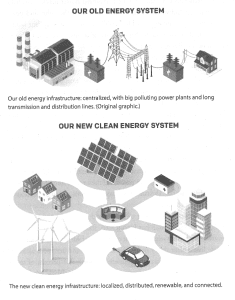
In her book, Rural Renaissance: Revitalizing America’s Hometowns through Clean Power (Island Press, 2022), Michelle starts with the roots of rural power. Originally, each home produced their own power. Then with electricity, we started centralizing power production in large generating facilities, many located in rural areas connected to urban areas by miles and miles of transmission lines.
Today, even the smallest town and most remote rural area has the potential to generate their own power close to home or industry. Combined with broadband, people have more choices and chances for self-sufficiency than ever before.
Moore sees our energy future in localization—back to the future when energy was produced where it was used. In contrast to industrialized power generation and transmission, “distributed clean energy technologies… bring our energy systems into alignment with local priorities and needs.”
Many of us are served by public power utilities, or rural electric cooperatives originating from the Rural Electrification Administration (REA). Most Small Town & Rural Planners should be familiar with the REA, formed at the height of the Great Depression, to bring electricity to areas not served by investor-owned, centralized utilities. REA was brought into the US Department of Agriculture, and became the Rural Utility Service. There are about 2,000 public power utilities and 922 rural electric cooperatives across the US today, and the author gives detailed information on how they function and are financed in the modern energy economy.
Keeping Power Local
Local power utilities are uniquely situated to understand local needs. Moore supports the idea of supporting public power and rural cooperatives to initiate smaller, community-scale renewable energy projects.
Local government agencies are also closest to the people, and play essential roles in energy policy, even in areas without public power or electric cooperatives. Moore writes, “municipal permitting and regulations (including planning, zoning, and building codes) shape our energy futures.”
Agrivoltaics is another example of adapting energy systems to local conditions. Several states are studying how ground-mounted solar arrays can be adapted to co-locate with active farming operations—either planting food crops under slightly elevated solar panels or allowing grazing by sheep or other animals. Solar farms can also be adapted for beekeeping.
While the author dismisses concerns with preserving prime farmland, in this reviewer’s experience many rural jurisdictions remain skeptical of (if not hostile to) wind and solar facilities taking land out of production.
Energy Efficiency
The “first fuel” is energy efficiency. Most planners are familiar with state and local weatherization and energy reduction programs. Moore tells us about initiatives demonstrating practical results in rural areas, such as Ouachita Electric Cooperative’s Home Energy Lending Program (HELP) Arkansas, helping households save money on their monthly bills.
Moore discusses solar energy generation more than wind energy, based on her experience, and targets portions of the book to people considering investments in solar projects. “Where you’re installing a solar project on ten acres near town or on a thousand acres of grazing land in the country,” she writes, “there are important land use questions to ask and answer at the local level.” Many municipal or county land use regulations are still silent on renewable energy generation facilities—wind or solar—as the technology (and Federal tax credits) have been changing rapidly. As we know, in most states when a specific use is not listed as allowed in zoning, it is implied (if not explicitly stated) to be prohibited.
Different types of regulations, as well as business cases, need to be provided for different types of renewable energy projects. Behind-the-meter generators, such as individual wind turbines or roof-top solar, provide power to an individual structure, Many states have “Net Metering” where excess power can be sold back to the utility provider at a set rate. It is also becoming more common to see small solar panels in a field powering irrigation equipment or wells where old windmills once spun (like the Small Town & Rural Planning logo).
Community solar projects enable multiple local households or businesses to share power from a single nearby source, often serving a single neighborhood, with capacity typically up to about 5 megawatts. Large utility-scale wind and solar projects can cover thousands of acres, selling power into the grid for use in far distant urban areas. Yet even these systems provide lease payments to landowners and in many states are required to pay taxes to local schools and units of government. Many wind and solar projects are now being “firmed” with battery energy storage systems (BESS), evening out a more firm energy flow into the grid.
Moore has provided both a deeply personal story and an informative, practical guide to local applications of renewable energy generation. The book was immediately useful to this small town and rural planner.
(This review appeared first in the Spring 2024 edition of Small Town & Rural Planning, the newsletter of the APA STaR Division.)
Read More about Clean Energy:
- Rural Renaissance: Revitalizing America’s Hometowns through Clean Power by L. Michelle Moore (Island Press, 2022)
- “Wired for Change: Rural America and the Energy Economy of Tomorrow,” our post starting off the October series on resilience, energy, and rural development.
Find out more about Michelle’s continued work in community power and the Rural Renaissance.
(As an Amazon Associate, we may earn commissions from qualifying purchases... one of these days.)