
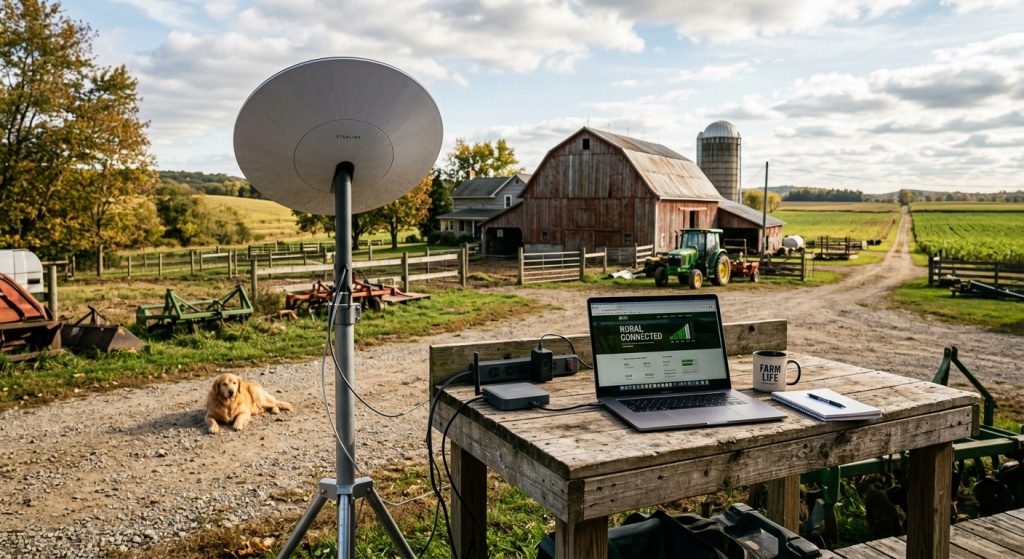
The US Federal Communications Commission (FCC) recently reported 96.9% of Americans have access to 100/20 Mbps fixed terrestrial broadband. I guess that puts me among the 3.1%, despite a 44% reduction in unserved populations in rural America over the last two years.
I was reminded of that report listening to Deb Brown and Becky McCray on Joe Barker’s Rural Strong Podcast on Labor Day. They were discussing the SaveYour.Town Survey of Rural Challenges. When Joe asked what they’ve seen change over the last 10 years of surveys, Becky responded with “broadband.” She related there were quite a few mentions of “awful broadband” or even limited dial-up access when they started the survey in 2015. Now over the last four years or so, the mentions have turned into “people bragging on their good broadband.”
That’s progress. Tho not out here on our farm.
Broadband availability has improved significantly, but availability is not the same as practical, affordable, high-quality service. Rural communities still face a compounded gap:
- High deployment costs: The few customers waiting for reliable service are spread across many road miles, making fiber builds difficult to finance without substantial public support.
- Service-quality gaps: A location may technically have service on the map but lack a reliable, scalable connection suitable for telework, online education, telehealth, precision agriculture, public safety, or a home-based business.
- Affordability and adoption gaps: Even where networks exist, households may not subscribe because of monthly cost, equipment, digital-skills barriers, or distrust based on previous poor service.
- Mapping and eligibility problems: Federal money depends heavily on the FCC National Broadband Map. Governments, residents, Tribal entities, and providers can challenge the map, but the process can be resource-intensive—especially for small local governments with limited technical capacity. The map says we can get service. The service providers said no.

BEAD and ReConnect
Federal efforts hit the brakes with the change in Federal administration in 2025. The Broadband Equity, Access, and Deployment (BEAD) program, administered by the National Telecommunications and Information Administration (NTIA), has become the largest federal broadband-infrastructure program. Then the Commerce Department changed the rules in the middle of the game, substantially restricting programmatic funding after states had already done years of mapping, challenge work, and preliminary grant design. In Nebraska, here, the immediate effect was to produce a much lower-cost initial award package—about $44.5 million of the state’s $405 million allocation—while leaving roughly $360 million awaiting NTIA direction and a new process for locations still considered unserved.
Last week, NTIA released a new Supplemental Deployment Policy Notice. It authorizes states and territories to use BEAD savings through a “location true-up” to address locations that were excluded, newly identified, or became newly eligible after the original final proposals. I won’t try to explain it here, but it sheds some light on this gray process. Benton Institute has posted info here if you are interested.
The other big Federal policy question is USDA’s ReConnect program, which has already awarded more than $5.8 billion and is reported to have supported broadband access for more than 570,000 households. But its future authorization and appropriations remain a policy question: rural broadband authorities and funding provisions have faced expiration and reauthorization pressures, and proposed FY 2027 funding approaches have varied. The Daily Yonder has reported on the slow slog for re-authorization in the new Farm Bill slogging through Congress. It’s worth keeping an eye on.
The good news is that rural broadband is no longer an afterthought in federal policy or in the public conversation. The bad news is that the last miles are always the hardest—and the people living at the ends of those roads cannot be treated as rounding errors in a national percentage. For rural America, broadband is no longer a luxury or a nice economic development amenity. It is basic civic infrastructure: as necessary to a working farm, a home business, a student, a clinic, or a volunteer fire department as a decent road and dependable electricity. The maps and federal programs may say progress is being made. But until a family can actually order reliable, affordable service as easily as rural electric service, the work is not finished.
Now go take the SaveYour.Town Survey of Rural Challenges.
Read More from JCShepard.com
Life has changed a bit over the last 15 years in the world of rural broadband.
- In 2011, I wrote about the Blandin Foundation’s broadband conference in “Doing Our Broadband Homework“
- In 2013, I did an update on the Blandin Foundation’s broadband programs in “Broadband Service, Training, Digital Inclusion, Innovation and Marketing Key to Rural Success“.
- Also in 2013, I participated in a bonus session at the APA National Planning Conference in Chicago, which I wrote about in “Broadband Planning And Big Data“.
- This June, I wrote a bit about broadband and other communications utilities in “Signal and Story: Communications Infrastructure in Rural America“.
.
